Captain Marcus Carter walked through the front doors of Riverside Precinct at 6:17 on a cold Monday morning carrying a worn brown leather case in his right hand. His navy command uniform was perfectly pressed, his polished badge caught the fluorescent light, and four gold stripes circled each sleeve near his wrists. Nothing about his appearance revealed that he had spent the previous fourteen hours moving through smoke, broken glass, and screaming families inside a condemned apartment building. Only his exhausted eyes showed that the night had followed him home.
The precinct expected Marcus to return as a hero. Television crews had already gathered across the street, the mayor’s communications office had drafted a public statement, and several officers stood near the front desk waiting to congratulate him. A newspaper website had published his photograph beneath a headline praising the “fearless captain who entered a collapsing building alone.” Marcus saw the headline on a computer monitor as he entered, but he did not slow down.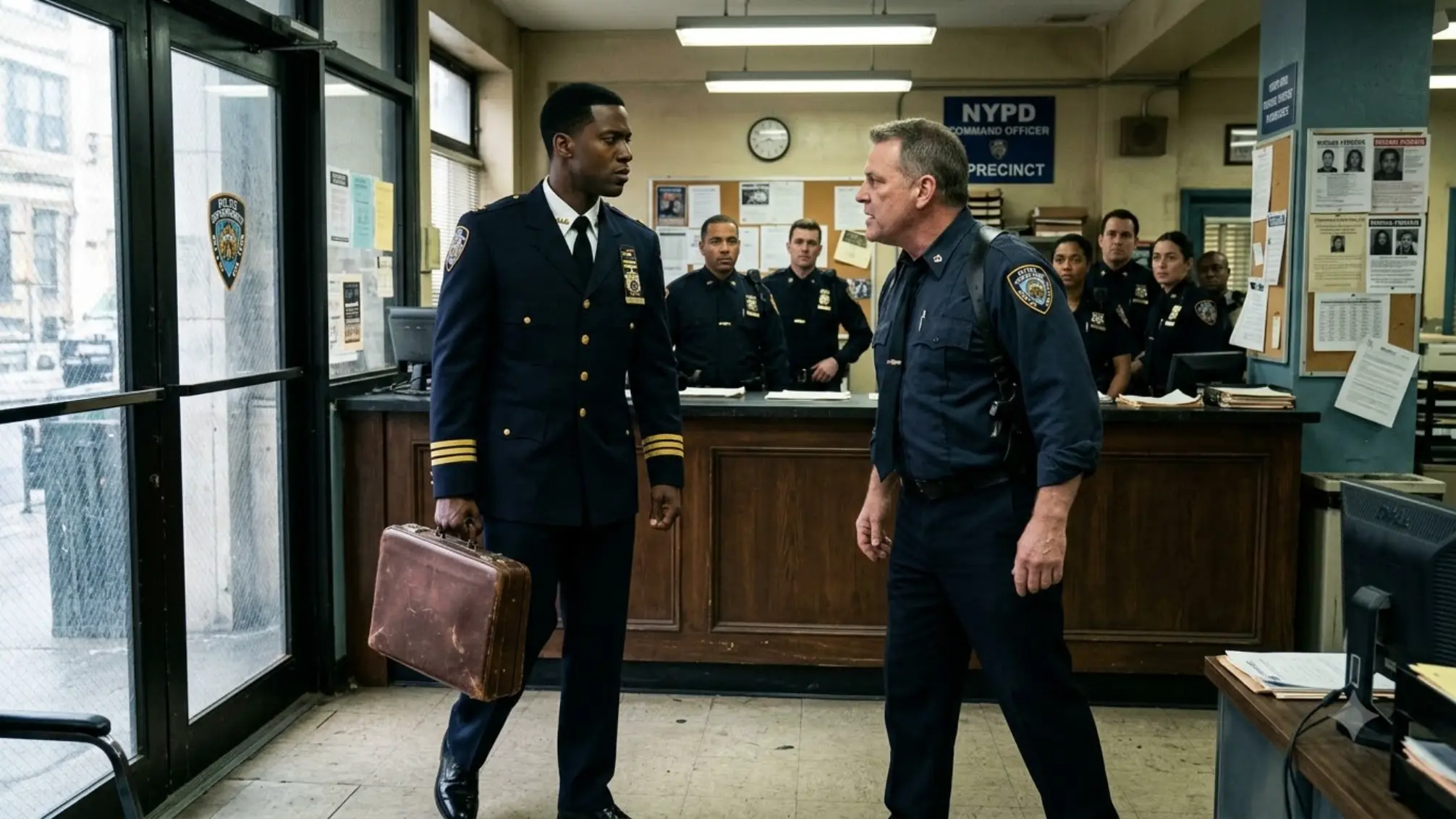
Senior Detective Raymond Voss stepped away from the front desk and blocked Marcus’s path. The fifty-three-year-old white American detective wore a rumpled white shirt, a loosened dark tie, and a shoulder holster beneath an unbuttoned jacket. He was broad, red-faced, and smiling with the confidence of a man who believed the building belonged to him. He patted Marcus’s shoulder as nearby officers watched.
Senior Detective Raymond Voss (smugly, squeezing Marcus’s shoulder): “You did good out there. Take the medal, smile for the cameras, and let this precinct enjoy one clean victory.”
Marcus looked at the hand resting on his uniform. “Move it.”
Voss’s smile disappeared.
Marcus set the leather case on the front counter. The sound was not loud, but every officer nearby stopped talking. Inside the case were six body-camera drives, three dispatch recordings, seventeen altered incident reports, and a handwritten list of officers who had been ordered away from trapped civilians while the building burned.
Senior Detective Raymond Voss (furiously, blocking his path): “You broke protocol, embarrassed this precinct, and came back expecting applause.”
Black Police Captain Marcus Carter (coldly, setting down the leather case): “I came back because your report erased the civilians your men abandoned.”
Senior Detective Raymond Voss (threateningly, stepping into his face): “Say that again, and I’ll strip that uniform off you myself.”
Black Police Captain Marcus Carter (fiercely, opening the case): “Touch me. Internal Affairs is outside, and every name in this file starts with yours.”
The front doors opened behind Marcus.
Deputy Inspector Lena Morales entered with four Internal Affairs investigators. Lena was a forty-seven-year-old Latina American officer with dark hair pulled into a tight bun, a charcoal overcoat, and the controlled expression of someone who had already read enough to know that the morning would end careers. Two investigators carried evidence cases, while another held a sealed warrant authorizing the seizure of precinct computers, radio logs, and body-camera archives. The final investigator closed the doors and stationed himself beside them.
Voss stepped backward.
Captain Marcus Carter had commanded Riverside Precinct for only eleven days. Before his appointment, he spent six years leading emergency-response operations across New York City, first as a lieutenant and later as deputy commander of a borough-wide rescue unit. He had a reputation for calm decisions, strict documentation, and an almost painful refusal to accept convenient explanations. Those qualities earned him respect from younger officers and resentment from men who had survived by controlling what reached the official record.
Riverside was supposed to be a temporary assignment. The precinct’s previous captain retired unexpectedly after several civilian complaints disappeared from the internal system. City leadership wanted Marcus to stabilize operations, review misconduct allegations, and prepare the command for an external accreditation inspection. Voss had served at Riverside for twenty-seven years and expected the captain’s position to become his.
Marcus’s arrival destroyed that expectation.
Voss greeted him politely during the first command meeting. He praised the precinct’s history, introduced influential detectives, and offered to explain which officers could be trusted. Marcus listened until Voss referred to civilian complaints as “political noise.” Then he opened a folder containing seventy-three unresolved reports and asked why some had remained inactive for more than two years.
The room became silent.
Voss claimed staffing shortages caused the delays. Marcus asked why complaints against junior officers received immediate review while cases involving senior detectives remained untouched. Voss replied that experience deserved discretion. Marcus answered that experience created greater responsibility, not greater immunity.
Their conflict became open on the fourth day.
A Black American store owner named Harold Bennett entered Riverside Precinct with security footage showing two officers searching his business without a warrant. The desk sergeant attempted to send him to another station, but Marcus overheard the conversation and reviewed the video personally. One officer was Voss’s nephew, Detective Andrew Voss.
Marcus placed Andrew on administrative duty pending investigation.
Raymond Voss entered the captain’s office without knocking.
Senior Detective Raymond Voss (angrily, closing the door behind him): “You suspended a good detective over a shopkeeper’s complaint.”
Black Police Captain Marcus Carter (firmly, turning the monitor toward him): “Your nephew searched a locked office without consent and removed cash from a drawer.”
Senior Detective Raymond Voss (defensively, pointing at the screen): “He believed drug proceeds were inside.”
Black Police Captain Marcus Carter (coldly, folding his hands): “Belief is not a warrant, and the cash never reached evidence.”
Voss stared at him for several seconds. “Riverside protects its own.”
Marcus answered quietly. “That sentence is why I’m here.”
The hostility spread through the precinct. Some officers stopped speaking whenever Marcus entered a room. Others began bringing him records privately, often after dark. A young white American patrol officer named Daniel Price delivered copies of dispatch logs showing senior detectives repeatedly removing themselves from dangerous calls while junior officers handled them alone.
A Black American records clerk named Denise Walker showed Marcus how complaint files had been reassigned to inactive case numbers. A white American dispatcher named Chloe Martin provided audio in which Voss ordered units to delay responses in neighborhoods considered “high trouble and low value.” Each person feared retaliation, but each had witnessed enough to understand that silence had become participation.
Marcus created an encrypted evidence archive outside the precinct network.
He did not trust the local server.
The decision proved critical on the night of the Harbor Street fire.
At 3:08 on Sunday afternoon, a tenant called emergency services to report smoke inside the basement of a five-story apartment building at 412 Harbor Street. The property housed sixty-eight residents, including elderly tenants, families with children, and several people using mobility equipment. City inspectors had cited the landlord repeatedly for blocked exits, illegal electrical work, and disabled alarms.
The first fire units arrived within six minutes. Riverside patrol officers followed to control traffic, evacuate nearby buildings, and assist residents leaving the structure. Marcus was off duty at his apartment when a command notification appeared on his phone, identifying Harbor Street as a possible mass-casualty event.
He drove directly to the scene.
Smoke covered the upper windows when he arrived. Residents stood barefoot in the street, shouting names and pointing toward apartments where relatives remained trapped. Firefighters fought flames in the basement while officers attempted to establish a safe perimeter.
Marcus found Voss beside a command vehicle.
The senior detective was speaking with property owner Grant Mallory, a wealthy white American developer whose company had donated heavily to police charities. Mallory wore an expensive coat and appeared more concerned about cameras than residents. He insisted the building had been empty except for unauthorized tenants.
Marcus looked toward the crowded sidewalk. “Those people live there.”
Mallory shook his head. “Most were supposed to leave after the city order.”
A woman ran toward Marcus, screaming that her husband was trapped on the fourth floor. Another tenant said three children remained inside Apartment 4C. Marcus asked the fire commander whether crews knew.
The commander checked his board.
The names had not been added.
Marcus ordered officers to create a complete resident list and relay every missing person to fire command. Voss stepped in front of him.
Senior Detective Raymond Voss (sharply, grabbing Marcus’s arm): “Stay in your lane. Fire has the building.”
Black Police Captain Marcus Carter (furiously, pulling free): “Our lane is every civilian standing here begging not to be erased.”
Senior Detective Raymond Voss (low, glancing toward Mallory): “The property was condemned. Anyone still inside accepted the risk.”
Black Police Captain Marcus Carter (coldly, stepping closer): “Say that into your body camera.”
Voss’s camera was off.
Marcus noticed.
He ordered all Riverside officers to activate theirs immediately. Several complied. Four senior detectives claimed battery failures.
At 3:31, a partial collapse blocked the main stairwell. Firefighters withdrew from one interior section while engineers assessed the structure. Panic spread among the families outside. Marcus moved through the crowd collecting names, apartment numbers, medical needs, and possible locations.
That was when eleven-year-old Noah Kim grabbed his sleeve.
The Asian American boy was crying so hard he could barely speak. His grandmother used a wheelchair and remained inside Apartment 3A. Noah’s father had returned to help her and had not come out.
Marcus knelt until they were eye level.
Black Police Captain Marcus Carter (gently, gripping the boy’s shoulders): “Look at me. Tell me the apartment again.”
Noah Kim (terrified, pointing toward the smoke): “Three-A. My dad went back, and nobody will listen.”
Black Police Captain Marcus Carter (steadily, holding his gaze): “I hear you. Stay with this officer. I’m bringing their names to the people going inside.”
Marcus wrote both names on his own glove when the command sheet became soaked.
At 3:39, dispatch received a call from inside Apartment 4C. A frightened girl whispered that she and her younger brothers were trapped in a bathroom. Chloe Martin relayed the call over the radio.
Voss ordered her to clear the channel.
Chloe repeated that children were inside.
Voss responded, “Fire command has enough noise. Mark it unconfirmed.”
Marcus heard the exchange through his shoulder radio.
He demanded the address and apartment number again. Chloe gave it to him despite Voss shouting in the background. Marcus brought the location to the fire commander, who immediately redirected a ladder team toward the rear windows.
The children were rescued eight minutes later.
The television footage later showed firefighters carrying them down the ladder. Reporters called it a dramatic rescue, but none knew their location had nearly been removed from the radio record.
At 3:54, the fire commander reported that conditions near Apartment 3A were briefly accessible from an adjoining building. A rescue team needed someone familiar with the interior layout to guide them through a connecting service corridor.
Marcus had reviewed the building plans during a previous emergency inspection.
He volunteered.
Voss ordered him to remain outside.
Marcus ignored him.
Inside, heat pressed through the walls and smoke reduced visibility to several feet. Marcus followed two firefighters through the adjoining building, across a narrow maintenance passage, and into the third-floor hallway. They found Noah’s father unconscious near the kitchen and his grandmother trapped beside the wheelchair after fallen plaster blocked the doorway.
Marcus and one firefighter moved the debris while the second treated Noah’s father. The ceiling groaned above them. Fire command ordered immediate withdrawal.
Marcus refused to leave the grandmother.
He lifted her from the wheelchair and carried her through the corridor while the firefighters dragged Noah’s father on a rescue tarp. They reached the adjoining building seconds before part of the hallway ceiling collapsed.
Outside, Noah ran toward them.
Marcus placed the grandmother onto a stretcher and knelt beside the boy. Noah wrapped both arms around his neck. Cameras recorded the embrace, though Marcus did not know they were there.
The public saw courage.
Marcus saw how close the family came to disappearing from the official response.
The fire killed two residents and injured nineteen. Both deaths occurred in a rear apartment with an illegally sealed window. Investigators later found that the landlord had covered several exits to prevent tenants from using a fire escape during a rent dispute.
Grant Mallory attempted to leave the scene before questioning.
Marcus ordered officers to stop him.
Voss countermanded the instruction.
Mallory drove away.
At 7:20, while rescue operations continued, Voss gathered senior officers inside a mobile command vehicle. He instructed them to describe the building as largely vacant, the remaining tenants as trespassers, and the police response as immediate and complete.
Officer Daniel Price secretly activated his phone recorder.
Voss told them not to include the delayed apartment calls or the order to mark missing children unconfirmed. He said the department could not afford a scandal before the accreditation review. Then he promised that Mallory’s attorneys would handle the rest.
Marcus entered before the meeting ended.
Everyone stopped speaking.
He looked at the blank incident template projected on the vehicle’s monitor.
Black Police Captain Marcus Carter (coldly, removing his smoke-stained gloves): “Write the children’s names.”
Senior Detective Raymond Voss (dismissively, closing the file): “The rescue is already documented.”
Black Police Captain Marcus Carter (angrily, stepping toward the screen): “Write who tried to remove their call.”
Senior Detective Raymond Voss (threateningly, lowering his voice): “You’re exhausted. Go home before you say something that ends your command.”
Marcus placed the glove bearing Noah’s family names onto the table. “My command ends before their truth does.”
He spent the next nine hours collecting evidence.
Chloe provided the complete dispatch audio. Daniel gave him the command-vehicle recording. Firefighters shared helmet-camera footage showing civilians had been present and actively calling for help. Denise downloaded drafts of the altered police reports before Voss’s people replaced them.
Marcus placed everything inside the worn leather case.
He also contacted Deputy Inspector Lena Morales at Internal Affairs.
Lena initially believed the case involved a disputed emergency response. Then she listened to Voss order dispatch to mark trapped children unconfirmed. She heard him describe poor tenants as “a liability problem Mallory would solve.” She read the edited reports removing eleven civilian names.
By sunrise, she had enough for a warrant.
Marcus returned to Riverside Precinct at 6:17.
Now Voss stood before Internal Affairs while officers watched investigators disconnect computers and seal evidence cabinets. The morning applause never happened. The reporters outside still waited for a hero, unaware that the true confrontation had moved inside.
Lena opened the leather case.
She placed each item on the counter one at a time.
Six body-camera drives.
Three dispatch recordings.
Seventeen altered reports.
A copy of the unauthorized search involving Voss’s nephew.
Financial records connecting Mallory’s companies to a police charity controlled by Voss.
The final document was a list of officers willing to testify.
Voss looked around the room.
Several officers lowered their eyes.
Others looked directly at him for the first time.
Officer Daniel Price stepped forward.
Voss’s expression hardened.
Senior Detective Raymond Voss (furiously, pointing at Daniel): “You recorded a private command meeting?”
Officer Daniel Price (nervously but firmly, removing his badge from his belt): “I recorded you ordering us to lie about trapped families.”
Senior Detective Raymond Voss (threateningly, moving toward him): “You just destroyed your career.”
Black Police Captain Marcus Carter (coldly, stepping between them): “No. He finally started one worth keeping.”
Two investigators restrained Voss before he reached Daniel.
Andrew Voss attempted to leave through a rear hallway. Another Internal Affairs team stopped him near the evidence room carrying a box of cash and two hard drives. The money matched serial numbers from Harold Bennett’s store.
By eight o’clock, Riverside Precinct had been placed under emergency external command.
Voss was suspended and escorted from the building. Six officers lost system access. Three supervisors surrendered department phones. Grant Mallory was arrested at his Manhattan office after fire investigators found falsified inspection certificates and payments to city employees.
The investigation widened over the following months.
Auditors discovered Voss had protected Mallory’s properties in exchange for donations, private security contracts, and payments routed through a police charity. Complaints involving unsafe buildings were delayed or closed. Tenants who protested received aggressive enforcement visits, while Mallory’s attorneys used police reports to portray them as criminals or trespassers.
The Harbor Street fire was not the first disaster created by that arrangement.
It was the first one Marcus refused to let them rewrite.
At Voss’s disciplinary hearing, his attorney argued that emergency decisions made under pressure should not be judged by people sitting safely in offices. Marcus agreed with the principle but rejected the excuse.
“Pressure explains mistakes,” he testified. “It does not explain changing records after the smoke clears.”
Voss was later convicted of obstruction, evidence tampering, conspiracy, and corruption charges. Andrew Voss pleaded guilty to theft and unlawful search. Mallory faced manslaughter, fraud, bribery, and building-safety violations.
Several officers who cooperated received discipline but remained employed. Marcus supported that decision only when their testimony revealed the full structure of the corruption. He did not believe fear erased responsibility, but he understood reform required witnesses willing to break silence.
Riverside Precinct changed slowly.
Every emergency call involving a trapped civilian required direct confirmation before closure. Dispatch recordings could no longer be edited locally. Body-camera failures during critical incidents triggered automatic independent review.
Civilian complaints entered a system visible to outside monitors.
Denise Walker became records supervisor.
Chloe Martin received a commendation for refusing to erase the children’s call.
Daniel Price remained a patrol officer, but Marcus assigned him to help train recruits in emergency documentation and ethical intervention.
The ceremony honoring Marcus took place six months after the fire.
He accepted no medal for entering Harbor Street. Instead, he asked the department to recognize the firefighters, dispatcher, officers, residents, and children whose information forced the rescue system to respond.
Noah Kim attended with his father and grandmother.
After the ceremony, the boy approached Marcus carrying the smoke-stained glove that had held his family’s names. Investigators had returned it after the trial.
Noah Kim (emotionally, offering him the glove): “My grandma says you should keep this.”
Black Police Captain Marcus Carter (gently, kneeling before him): “Your family survived because you refused to stop asking for help.”
Noah Kim (softly, holding back tears): “You were the first person who listened.”
Black Police Captain Marcus Carter (deeply moved, closing the boy’s fingers around the glove): “Then keep it. Let it remind you that your voice brought them home.”
Later that evening, Marcus returned to the quiet precinct lobby.
The leather case rested inside a glass evidence display near the training room. A small plaque explained that official records existed to preserve truth, not protect reputations.
A rookie officer found Marcus staring at it.
“Captain, how did you keep going that night?”
Marcus looked around the station. Officers worked behind the counter, answered calls, reviewed reports, and prepared for another shift. Each carried private fears that no uniform could completely hide.
He thought of Noah waiting outside the burning building.
He thought of the children in Apartment 4C.
He thought of his own teenage daughter, who had texted him six times during the fire and received no answer until sunrise.
Black Police Captain Marcus Carter (quietly, touching his badge): “It isn’t this that keeps us standing.”
The rookie waited.
Marcus looked toward the front doors, where families often arrived hoping officers would bring someone safely home.
Black Police Captain Marcus Carter (emotionally, holding the rookie’s gaze): “It’s knowing someone is still waiting for us to come back with the truth.”
The rookie nodded.
Marcus picked up his coat and walked toward the doors.
The city would remember him as the captain who entered a burning building. Riverside remembered something more dangerous.
He returned to his own precinct carrying proof.
And when the senior detective demanded silence, Marcus opened the leather case and made every badge in the room choose what it truly represented.