At 8:57 on Monday morning, Staff Sergeant Brin Solace entered Courtroom Three at Quantico without looking toward the gallery. The room was already crowded with senior officers, legal advisers, clerks, investigators, and observers who had somehow heard that the tribunal concerning Solace’s service record had become the most uncomfortable proceeding on the installation. She wore an olive service uniform with almost nothing on it that explained the rumors surrounding her career, and her dark-brown hair was pulled into a severe low bun that revealed a pale, controlled face. Brin walked toward the defense table, sat down, folded her hands, and waited.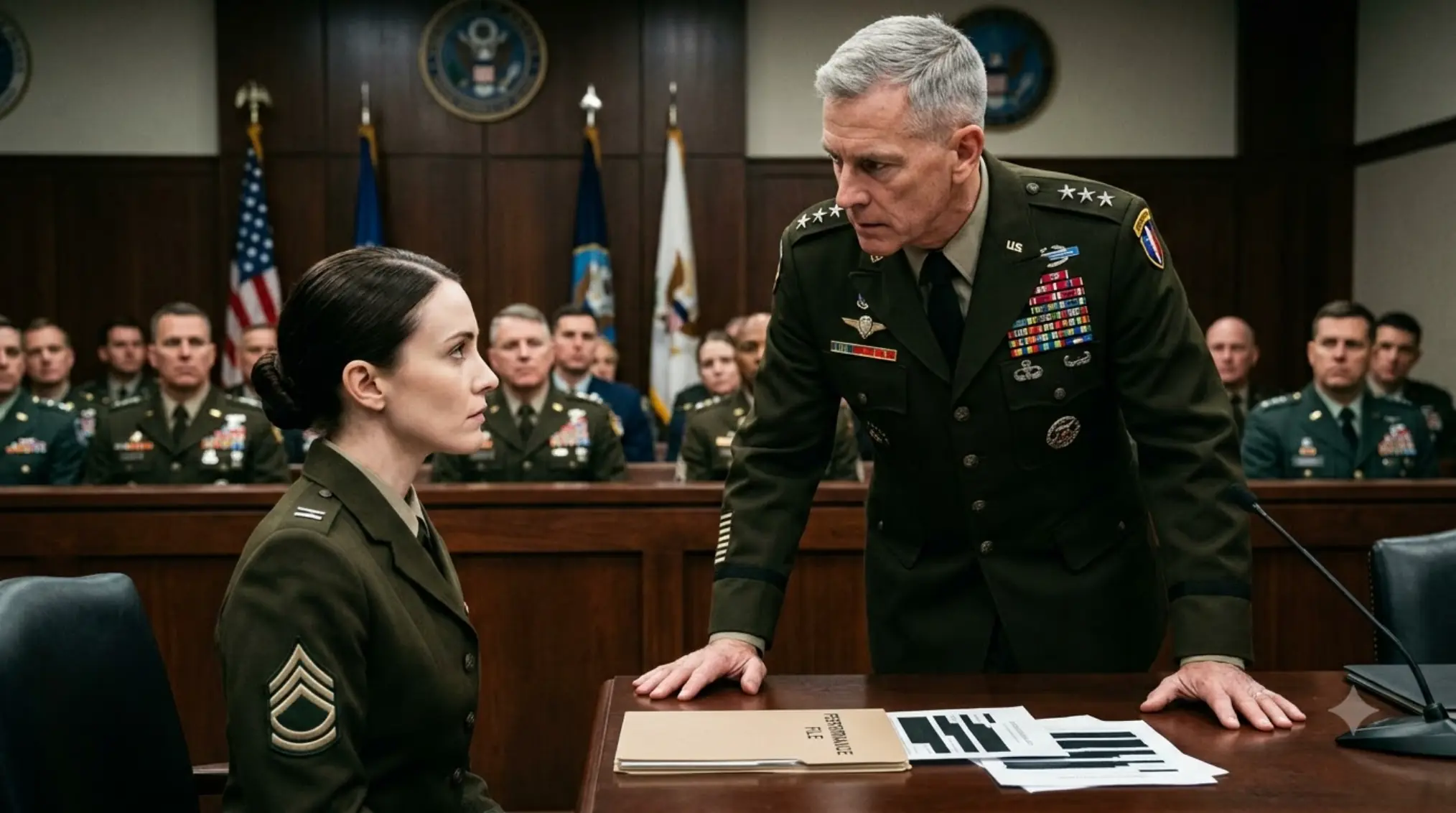
Across the chamber, Lieutenant General Merrick Caldwell watched her as though she were a stain somebody had forgotten to remove. He was sixty-two, tall and lean, with steel-gray hair cut perfectly above his ears and cold blue eyes that never seemed to rest on a person without measuring them. His dark olive ceremonial uniform carried enough ribbons and badges to fill the left side of his chest, while silver stars sat sharply against both shoulders. Caldwell had spent forty years building a reputation for discipline, control, and an almost obsessive contempt for officers who could not justify every line of their record.
Brin’s record was the opposite of neat. It contained promotions without supporting narratives, commendations whose citations had been replaced by thick black redactions, travel orders listing locations that officially did not correspond with any known assignment, and deployment periods where entire months simply disappeared from ordinary personnel systems. More troubling to the tribunal, several awards appeared to reference operations that no member of the review panel could locate in accessible archives. To the officers examining her file, it looked either extraordinary or fraudulent. Caldwell had already decided which one he preferred.
The tribunal had technically begun because Brin was under review for advancement into a highly selective senior operations billet. The promotion board had flagged inconsistencies, which triggered an administrative investigation, which in turn produced more inconsistencies rather than answers. Each attempt to verify her record reached another compartment, another denied request, another document stamped with authorities none of the reviewing officers expected to encounter. Eventually someone decided the safest response was to place Brin in front of a formal panel and demand that she explain herself.
She had spent the first two hours refusing to do so beyond what her orders permitted. When asked about a three-month absence from her official unit roster in 2018, she answered that she had been assigned elsewhere under written authority. When asked where, she said the assignment remained restricted. When asked who authorized it, she gave the name of an office rather than an individual. Every answer was calm, precise, and infuriatingly incomplete.
Caldwell paced across the courtroom as though she were personally insulting him. “You understand how this looks, Staff Sergeant?” he asked. Brin kept her eyes forward and answered that she understood how the file looked to people without access to the underlying records. The distinction produced several raised eyebrows behind the panel. Caldwell heard arrogance where Brin had intended only accuracy.
He lifted one of the files from the table and let it fall again. “You have a commendation here with no action report.” Brin replied that the action report existed. Caldwell asked where it was, and Brin answered that he would need to request it through the authority listed on the cover sheet. He smiled without humor and told her that three requests had already been rejected.
“That is not the same as the report not existing,” Brin said. Caldwell stopped walking. Several officers in the gallery shifted because they knew his patience had been thinning since the hearing began. He stared at Brin for a long moment and then asked whether she enjoyed making the tribunal chase ghosts.
Brin answered, “No, sir.” Caldwell leaned closer and asked why every attempt to confirm her record led to another locked door. Brin said because some doors had been locked for a reason. The silence that followed was the first moment that morning when even the court reporter seemed hesitant to move.
Caldwell walked back toward the panel and picked up another document. It contained a recommendation describing Brin as “exceptionally effective under isolated conditions,” but nearly every sentence explaining those conditions had been redacted. He read the visible words aloud with exaggerated skepticism, then asked whether “isolated conditions” meant she had been working alone. Brin answered that sometimes it did.
A colonel seated behind Caldwell smirked. Another officer whispered something to the man beside him. Brin heard both reactions and gave neither of them anything in return. She had learned years earlier that ridicule was often an invitation to defend pride instead of facts.
Caldwell flipped another page. “No team roster. No operational summary. No casualty report.” Brin said nothing. He looked toward her and added, “Yet somehow we are expected to accept that you earned decorations the rest of this panel cannot verify.”
Brin finally looked at him. “I didn’t ask the panel to accept anything without verification, sir.” Caldwell’s jaw tightened. “I asked the panel to obtain the correct records.”
The senior legal officer presiding over the proceeding, Colonel Miriam Shaw, intervened before Caldwell answered. She reminded both of them that the tribunal was fact-finding, not adversarial theater. Caldwell nodded, but his expression said he had heard only the first half of the sentence. Brin lowered her eyes again.
Then Caldwell changed tactics. Instead of attacking the documents, he began attacking the person sitting behind them. He asked whether Brin believed her career deserved special protection, whether secrecy made her superior to ordinary personnel rules, and whether she expected senior officers to approve advancement based on a collection of blacked-out pages. Each question arrived harder than the last.
Brin answered no to all three. When Caldwell asked what exactly she expected, she said she expected the tribunal to determine whether the underlying records confirmed what appeared in her file. Caldwell laughed quietly. “And if we never receive those records?”
“Then you should not promote me.”
That answer surprised him. It also irritated him because it removed the accusation he had prepared about ambition. Brin was not demanding advancement. She was asking the system to either verify her record properly or deny her based on facts rather than suspicion.
Caldwell walked toward her table. “You’re remarkably calm for someone whose career is being dismantled in public.” Brin did not respond. He leaned one hand against the edge of the table and asked whether she had rehearsed the expression she was wearing.
“No, sir.”
“Nothing embarrasses you?”
Brin glanced toward the observers. “Plenty of things do.”
“Apparently not being exposed.”
Brin’s eyes returned to him.
“Exposed for what?”
Caldwell smiled because he had finally gotten a question from her. “That is what we’re trying to determine.” Brin nodded once and said, “Then determine it.”
The gallery reacted with a low murmur. Caldwell straightened. Colonel Shaw warned the room to remain silent, but the damage was done.
For the next forty minutes, Caldwell dissected Brin’s performance evaluations. He found every vague phrase and treated it as suspicious. “Exceptional judgment in restricted environments.” “Demonstrated uncommon resilience.” “Performed beyond expected capacity under denied conditions.” To Brin, the language was familiar bureaucratic camouflage; to Caldwell, it sounded like a career built by people inventing mythology.
Then he reached an evaluation from seven years earlier. The signature line had been declassified even though the rest remained heavily redacted. Caldwell stared at it longer than he had stared at the others.
M. Caldwell.
Brin noticed.
He did not comment.
Instead, he placed the page beneath another file.
Colonel Shaw noticed that too.
“General,” she said, “was that document signed by you?”
Caldwell looked toward her.
“It appears so.”
“Do you remember Staff Sergeant Solace?”
“No.”
Brin’s expression did not change.
Shaw asked, “Do you remember the assignment?”
Caldwell studied the blacked-out report. “Not from this.”
Brin looked down at the table.
He remembered.
She knew he remembered because of the way his left hand had tightened against the paper.
But she said nothing.
The hearing recessed shortly before noon. Brin was escorted to a small conference room where her assigned counsel, Major Daniel Price, immediately shut the door and asked if Caldwell had been part of her restricted chain of command. Brin looked toward the ceiling camera before answering.
“Not exactly.”
Daniel sighed. “That is the most Brin Solace answer possible.”
She almost smiled.
He sat opposite her. “He signed one of your evaluations.”
“Yes.”
“Did he know what you were doing?”
Brin hesitated.
“He knew enough.”
“Enough to verify you?”
“Yes.”
“Then why is he acting like he’s never seen your name?”
Brin folded her hands. “That is what worries me.”
Daniel stared.
Brin had been uneasy from the moment she learned Caldwell would personally participate in the tribunal. She had assumed he might challenge her record aggressively, but she had not expected him to deny remembering a mission he had personally reviewed. There were only two possibilities: he genuinely had forgotten, or he had a reason to pretend.
Daniel lowered his voice. “Can you name the operation?”
“Not here.”
“Can you tell the panel?”
“If they ask the correct question under the correct authority.”
“They’ve been asking you questions for four hours.”
“Not that one.”
Daniel leaned back. “What question?”
Brin looked directly at him.
“How many?”
The tribunal reconvened at 1:16. The atmosphere had changed because word had spread that Caldwell’s signature appeared somewhere in Brin’s supposedly unverifiable file. Several additional officers had entered the gallery. One man in civilian clothing sat near the rear with a sealed black portfolio across his knees.
Brin noticed him immediately.
She recognized Dr. Elias Vance, though she had not seen him in five years.
He did not acknowledge her.
That was enough.
Caldwell resumed questioning as though nothing unusual had happened. He asked Brin about a period when she was allegedly attached to an intelligence-support element in Eastern Europe. She confirmed the attachment but refused to discuss operational activities. He pressed for details until Colonel Shaw reminded him that the tribunal did not have blanket authority to compel classified operational disclosure.
Caldwell turned toward Brin with open irritation. “Everything with you hides behind classification.” Brin said classification had not been her decision. “Convenient,” he replied.
“No, sir.”
“No?”
“It usually made my life considerably more difficult.”
A few officers smiled.
Caldwell did not.
He stepped from behind the panel table and moved toward Brin again. “Let’s remove the paperwork.” She watched him approach. “Let’s remove the black lines, the secret offices, the mysterious recommendations, all of it.”
He stopped directly before her.
“Let’s ask something simple.”
Colonel Shaw looked uneasy.
Brin knew what was coming before he opened his mouth.
Caldwell leaned closer.
“What’s your kill count?”
The courtroom changed.
Two officers behind him laughed softly.
Someone else exhaled through his nose.
Daniel Price immediately looked toward Colonel Shaw, but Brin gave him a nearly invisible shake of the head.
She understood the trap.
If she objected, Caldwell would say she was avoiding the question.
If she answered with a high number, he could accuse her of embellishment.
If she answered low, he could use it to diminish the mysterious operational language surrounding her record.
The question was not designed to discover anything.
It was designed to embarrass her.
Brin looked at Caldwell.
He smiled.
“What’s wrong, Sergeant?”
She remained silent.
“Surely someone with all these secret commendations can answer one number.”
The laughter returned.
Brin heard it.
She heard a pen click somewhere behind her.
A chair creak.
The faint hum of the ventilation system.
Then she lifted her head fully.
For the first time all day, she looked directly into Caldwell’s eyes.
“Seventy-three.”
The laughter vanished.
Caldwell’s smile remained for perhaps half a second.
Then it disappeared.
Colonel Shaw stopped writing.
An officer seated in the gallery whispered, “What?”
Caldwell blinked.
“Excuse me?”
Brin’s voice remained perfectly level.
“Seventy-three confirmed.”
The courtroom stayed silent.
Caldwell stared at her as though deciding whether she had made the number absurdly large on purpose.
“Seventy-three confirmed kills?”
“Yes, sir.”
“You expect this tribunal to believe that?”
“No, sir.”
That answer caught him again.
Brin continued.
“I expect records to verify it.”
Caldwell’s face tightened.
“What records?”
Brin waited.
Daniel could almost feel the room leaning forward.
She spoke two words.
“Operation Nightglass.”
Caldwell froze.
Dr. Elias Vance lifted his head in the rear row.