The Gulfstream G650 sat on the private ramp at Teterboro Airport like a seventy-million-dollar promise. Its white fuselage reflected the bright New Jersey morning, while ground crews moved beneath the wings checking tires, fuel quantities, baggage compartments, and departure paperwork for the five-hour flight to Aspen. Inside the cockpit, every display glowed cleanly, the overhead panel was alive with neatly arranged switches, and Captain Mark Harrison stood between the two pilot seats studying the flight package with the confidence of a man who believed the cockpit belonged to him long before the passengers arrived. He had more than twenty thousand flight hours, decades of private aviation experience, and a reputation for delivering wealthy clients exactly where they wanted to go without delay.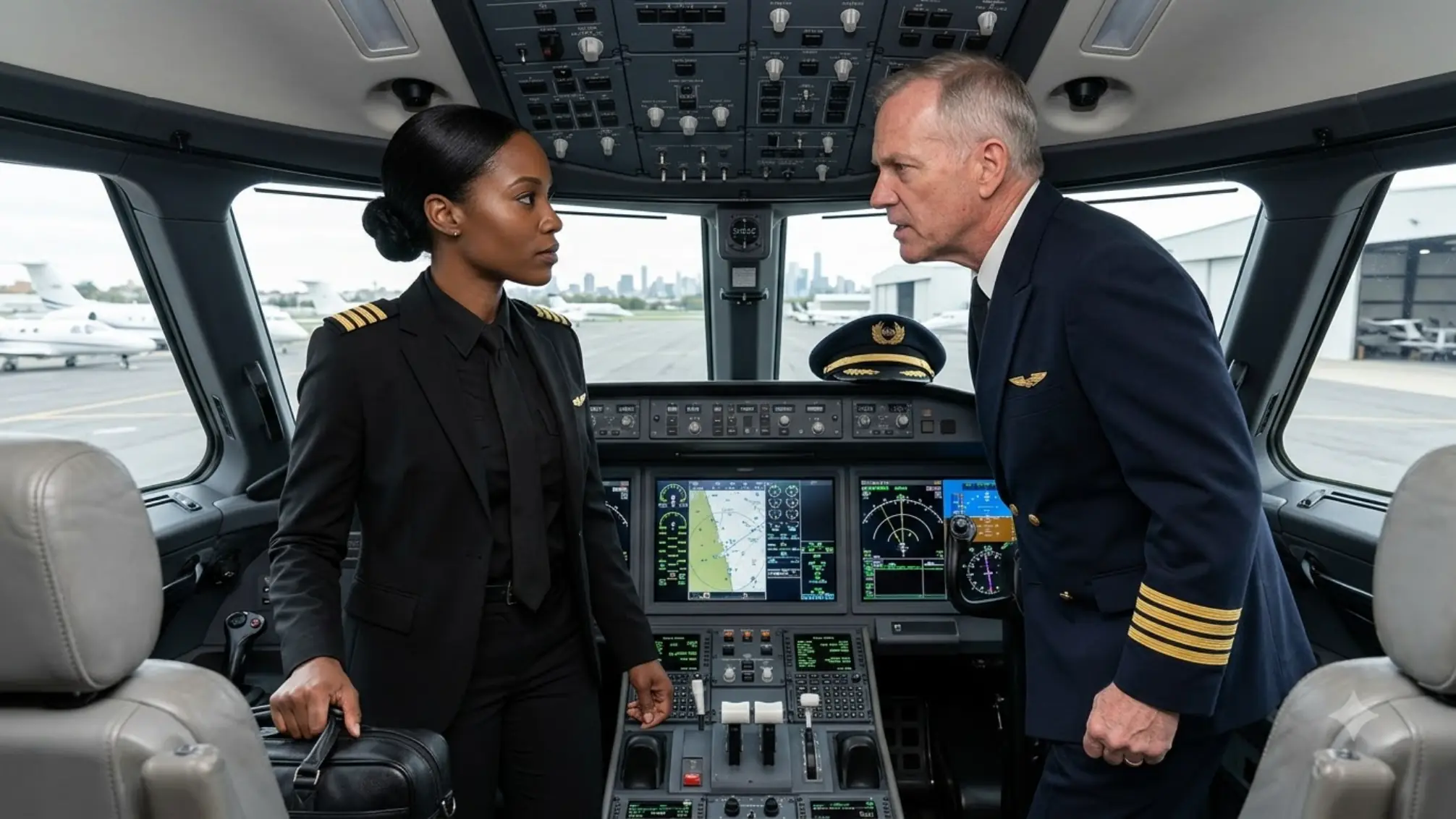
At fifty-eight, Mark was considered one of Summit Executive Air’s most valuable captains. Silver hair, perfect posture, immaculate navy jacket, and four gold stripes made him look like the kind of pilot passengers trusted before hearing him speak. He had flown celebrities, corporate executives, international investors, and people wealthy enough to purchase the aircraft beneath them without noticing the transaction on their monthly statements. Mark liked that world because everyone understood hierarchy.
Captain.
First officer.
Cabin crew.
Ground staff.
Passengers.
Everyone had a place.
And Mark had spent years convincing himself that maintaining those places was the same thing as maintaining standards.
He looked at the crew roster again.
First Officer E. Reed.
The name meant nothing to him.
He hated flying with unfamiliar first officers on high-profile trips. Arthur Thompson, a billionaire technology manufacturer, was scheduled to arrive with his wife in twenty-five minutes. Thompson expected professionalism, silence, and flawless execution.
Mark intended to give him exactly that.
Then someone entered the cockpit.
Mark looked up.
For half a second, he said nothing.
Evelyn Reed stood just beyond the cockpit doorway.
She was thirty-four, tall and poised, with deep-brown skin, striking elegant features, intelligent dark eyes, and sleek black hair pulled into a precise low bun. Instead of Summit’s standard white-shirt uniform, she wore a sophisticated black pilot uniform approved for executive evaluation flights: fitted black blazer, black shirt, narrow black tie, tailored trousers, polished shoes, and gold first-officer stripes.
A black flight bag rested beside her leg.
Evelyn met Mark’s stare.
“Captain Harrison?”
His eyes moved toward her epaulets.
“Yes.”
“Evelyn Reed.”
Mark looked at the roster.
Then at her.
“You’re my first officer?”
“Yes.”
Something in his expression changed so quickly that Evelyn almost admired the lack of discipline.
He did not ask how many hours she had.
Did not ask about her Gulfstream qualifications.
Did not review her training record.
Instead, he looked at her as though the scheduling department had played a joke.
“I wasn’t informed they were sending someone new.”
Evelyn placed her flight bag beside the right seat.
“I’m not new.”
“To this aircraft?”
“No.”
“To Summit?”
She looked toward him.
“Does that affect today’s flight?”
Mark’s jaw tightened.
He disliked questions that forced him to explain assumptions.
He lifted the flight package.
“I need a first officer familiar with high-level executive operations.”
“I am.”
“How many G650 hours?”
“More than enough.”
“That isn’t a number.”
“Two thousand four hundred.”
Mark paused.
That was substantially more than he expected.
“Total time?”
“Eight thousand six hundred.”
Another pause.
Evelyn watched him.
He looked down at her paperwork.
Then back up.
The numbers had removed one easy excuse.
They had not removed the decision already forming in his head.
Mark walked toward the right seat and examined the bag.
“Where were you previously?”
“Several operators.”
“Which ones?”
“Captain, my employment history is in the crew file.”
His expression hardened.
“I’m asking you.”
“And I’m answering that the company already verified my qualifications.”
The air between them changed.
Mark folded the paperwork.
“I don’t like attitude in my cockpit.”
Evelyn’s gaze remained steady.
“I haven’t shown you any.”
“You’re challenging the captain before we’ve even started engines.”
“No.”
She took one step closer.
“I’m asking why you’re conducting an interrogation that wasn’t part of the briefing.”
Mark stared at her.
Outside, a fuel truck rolled slowly past the windshield.
The cockpit became strangely quiet.
Finally, Mark said, “I’ve checked your papers, First Officer Reed, and I’m not satisfied.”
Evelyn’s expression did not change.
“With what?”
“My comfort level.”
“That isn’t a qualification.”
“It is when I’m captain.”
Evelyn let the silence sit.
Mark continued.
“I will not compromise the safety of this aircraft or my passengers.”
Her eyes sharpened.
“What exactly about me creates a safety concern?”
He immediately looked irritated.
“You’re making this personal.”
“You made it personal when you questioned whether I belong here without identifying one deficiency.”
Mark lowered the flight package.
“I refuse to fly with you.”
There it was.
Direct.
Unmistakable.
Evelyn stared at him.
Mark expected anger.
Instead she became calmer.
“Say that again.”
His mouth tightened.
“I said I am not operating this aircraft with you in the right seat.”
Evelyn looked toward the cockpit voice recorder controls, then toward the open cockpit door where flight attendant Melissa Grant had quietly stopped after hearing raised voices.
Mark noticed her too.
“Melissa, give us a minute.”
She hesitated.
Evelyn spoke.
“No. She can stay.”
Mark turned sharply.
“You don’t decide who stays in my cockpit.”
Evelyn looked directly at him.
“Then stop pretending this is about safety and say what you really mean.”
His face reddened.
“What I mean is I have standards.”
“So do I.”
Mark pointed toward the cabin.
“I don’t care who pushed your file through. Take your bag and get off my aircraft before I remove you myself.”
Melissa went pale.
Evelyn looked at the pointing hand.
Then at Mark.
She reached into her flight bag.
He gave a bitter laugh.
“What now? Another certificate?”
Evelyn removed a black folder.
“Something like that.”
She opened it.
Aircraft registration.
Ownership structure.
Insurance authorization.
Board authorization.
Mark’s eyes moved across the first page.
His expression changed slowly.
The aircraft was registered through Reed Aeronautics Holdings LLC.
Majority beneficial owner:
Evelyn Reed.
Mark stopped breathing normally.
Evelyn turned another page.
Summit Executive Air itself was partially controlled through Reed Capital Aviation Partners after a quiet acquisition completed six months earlier.
Mark looked up.
“What is this?”
“The aircraft registration.”
“I can see that.”
“Then read the name.”
His face drained.
“You own this jet?”
Evelyn closed the folder.
“Yes.”
Mark stared.
Then something else occurred to him.
“Reed Capital.”
“Yes.”
“You’re that Evelyn Reed?”
She tilted her head.
“Which one were you hoping I was?”
Melissa looked away to hide a reaction.
Mark took a step backward.
Suddenly, the cockpit that had belonged to him five minutes earlier seemed much smaller.
“Why didn’t you tell me?”
Evelyn’s voice remained level.
“Would you have treated me differently?”
Mark opened his mouth.
Nothing came.
“That’s exactly why.”
He looked toward the cabin.
“Ms. Reed, this has clearly been a misunderstanding.”
“No.”
Evelyn placed the folder on the center console.
“You understood perfectly.”
“I was making a safety judgment.”
“Based on what?”
He hesitated.
“My experience.”
“That isn’t an answer.”
“I didn’t recognize you.”
She nodded.
“You keep saying things that make this worse.”
Mark looked increasingly desperate.
“Look, if I had known the aircraft owner was coming aboard—”
Evelyn interrupted.
“If you had known I had power over you.”
Silence.
Melissa remained completely still near the doorway.
Mark lowered his voice.
“This conversation shouldn’t happen in front of crew.”
Evelyn looked toward Melissa.
“Why?”
He stared.
“Because it’s inappropriate.”
“No.”
She took one step closer.
“What’s inappropriate is believing respect should depend on whether the person standing in front of you can damage your career.”
Mark’s face hardened again.
Pride had not disappeared.
Only confidence.
“I have twenty thousand hours.”
“I know.”
“My record is spotless.”
“We’ll discuss that.”
Something in her tone made him freeze.
“What does that mean?”
Evelyn picked up her phone.
“It means today was not random.”
The cockpit became silent again.
Mark looked toward Melissa.
Then back at Evelyn.
She dialed.
“Rebecca? I need you at aircraft N900SA now.”
She listened.
“Yes.”
Another pause.
“And bring the Harrison file.”
Mark’s face changed.
“What file?”
Evelyn ended the call.
“The one you apparently assumed nobody would ever read.”
Twelve minutes later, the passengers had been informed of a departure delay.
Arthur Thompson did not complain.
That surprised Mark.
What frightened him more was that Thompson’s assistant simply answered, “Ms. Reed can take whatever time she needs.”
Mark now understood everyone except him seemed to know who Evelyn was.
Two black SUVs stopped near the aircraft.
Three people approached.
Rebecca Sloan, Summit’s general counsel.
David Chen, independent director of flight safety.
And Luis Barrett, an external investigator hired by Reed Capital.
Mark stood beside the jet stairs.
His jacket remained perfect.
His face did not.
Rebecca opened a folder.
“Captain Harrison, effective immediately, you are removed from flight duty pending investigation.”
Mark stared at Evelyn.
“Because I didn’t recognize her?”
Evelyn shook her head.
“No.”
She looked toward David.
“Start with the Denver event.”
Mark went still.
Melissa’s face changed.
David opened another document.
“Tail number N772SE. March seventeenth. Junior mechanic reported recurring hydraulic pressure variance during preflight servicing.”
Mark’s eyes shifted.
“The aircraft was cleared.”
David continued.
“The mechanic recommended secondary inspection.”
“We were within operational limits.”
“Did you call him inexperienced?”
Mark said nothing.
David looked at the report.
“Did you tell him he was trying to impress management by creating unnecessary delays?”
Mark’s jaw tightened.
“The issue never became critical.”
Evelyn stepped closer.
“That’s not the standard.”
Mark looked toward her.
“You’re not a maintenance engineer.”
“No.”
She nodded toward David.
“That’s why I brought one.”
David continued.
“The same aircraft showed a related pressure warning nine days later.”
Mark’s voice sharpened.
“And landed safely.”
Evelyn looked at him.
“There it is again.”
“What?”
“You keep defining good judgment by whether the worst outcome happened.”
Mark stared.
“That’s not safety.”
He folded his arms.
“You’re twisting things.”
Rebecca opened another file.
“Seven complaints involving crew conduct.”
Mark’s expression changed.
“Those were personality conflicts.”
“Three complaints involving first officers.”
“Junior pilots.”
“Two involved women.”
Mark looked toward Evelyn.
She did not react.
Rebecca continued.
“One stated you questioned her competency repeatedly despite identical qualifications to the male pilot she replaced.”
“That is subjective.”
“Another alleged you removed a Black contract pilot before an executive flight because you were ‘not comfortable with the presentation.’”
Mark’s face tightened.
“That is taken completely out of context.”
Evelyn spoke softly.
“Was he qualified?”
Mark looked at her.
“Was he?”
“Yes.”
“Then explain the context.”
Mark stopped.
Evelyn waited.
Nothing came.
Melissa finally stepped forward.
“I filed one too.”
Mark turned.
“What?”
She swallowed.
“Last year.”
His expression hardened.
“About what?”
“You told scheduling not to assign me to your flights after I reported the Denver argument.”
Mark stared at her.
“That wasn’t retaliation.”
“Then what was it?”
“You were difficult.”
Melissa’s eyes filled with anger.
“I asked you to listen to a maintenance warning.”
Mark looked toward everyone watching.
Ground crew had gathered at a distance.
Not close enough to interfere.
Close enough to hear.
He lowered his voice.
“This has turned into a public spectacle.”
Evelyn’s expression remained controlled.
“No.”
She looked toward the aircraft.
“It became public the moment a captain used his authority where everyone beneath him could see it.”
Mark pointed at her.
“You came here trying to trap me.”
“No.”
She shook her head.
“I came here to observe you.”
“That’s the same thing.”
“Only if you planned to behave badly.”
Mark said nothing.
The investigation lasted six weeks.
Evelyn removed herself from the final disciplinary panel because she refused to let Mark claim his outcome had been decided in the cockpit.
Independent investigators reviewed flight logs, crew scheduling, maintenance escalations, internal messages, passenger feedback, and training records covering five years.
The results reached far beyond one captain.
Mark Harrison had been protected because wealthy passengers liked him.
He remembered names.
Knew restaurants.
Managed difficult schedules.
Delivered smooth flights.
Senior management repeatedly interpreted that client satisfaction as proof of leadership.
It was not.
Several junior pilots described Mark as technically excellent but openly dismissive whenever someone questioned his judgment.
Mechanics described him as impatient with delays.
Cabin crew described an environment where complaining about senior captains could quietly reduce desirable assignments.
None of those problems had seemed large enough alone.
Together they described culture.
Evelyn reviewed the findings inside Reed Capital’s New York office.
David Chen sat across from her.
“He’s technically one of their best.”
“I know.”
“He hasn’t failed a check ride in twenty years.”
“I know.”
“He has loyal clients.”
“I know.”
David leaned back.
“So what do you want?”
Evelyn closed the report.
“I want people to stop asking whether skill cancels character.”
David nodded slowly.
“Termination?”
“Your decision.”
“You own the company.”
“I own shares.”
She looked toward him.
“You’re the independent safety director.”
David smiled faintly.
“You built that wall deliberately.”
“Yes.”
“Why?”
“Because power shouldn’t investigate itself.”
The final panel terminated Mark Harrison’s employment for repeated leadership failures, retaliation concerns, improper crew conduct, and disregard of escalation procedures.
His pilot certificates remained his.
His experience remained his.
Summit Executive Air simply decided he would no longer exercise command under its name.
Mark appealed.
The decision stood.
Three months later, Evelyn received a letter from him.
Not through lawyers.
Personal.
She almost threw it away.
Then she read it.
Mark did not ask for reinstatement.
He admitted something surprising.
He had spent his entire career believing captains earned the right to stop explaining themselves.
He wrote that the cockpit confrontation forced him to realize the opposite was true.
The more authority he gained, the greater his obligation should have become to explain decisions clearly enough for others to challenge them.
One paragraph stayed with Evelyn.
I kept saying I didn’t know who you were. I understand now that this was the confession, not the defense.
She read that sentence twice.
Then placed the letter inside the investigation file.
Mark’s career did not disappear.
After additional training and nearly a year away from command, he eventually found work teaching simulator procedures at a smaller aviation training organization.
He never returned to Summit.
Evelyn did not oppose his second chance.
Accountability did not require permanent destruction.
It required consequences strong enough that the lesson could not be ignored.
Summit changed too.
Evelyn ordered independent safety escalation for all maintenance concerns.
Flight operations could no longer erase a technical review because a wealthy client disliked delays.
First officers gained explicit authority to request anonymous cockpit-culture reviews.
Retaliatory scheduling became a terminable offense.
Most importantly, captains were evaluated on leadership rather than only flight performance.
Some senior pilots hated the changes.
One resigned.
Evelyn accepted the resignation.
Others adjusted.
A year after the confrontation, Evelyn returned to Teterboro.
Same airport.
Same aircraft.
Same cockpit.
But this time, she wore the black pilot uniform because she intended to fly.
Her assigned captain was Rachel Morgan, a forty-six-year-old pilot with nearly fifteen thousand hours and a reputation for asking first officers more questions than they expected.
Rachel entered the cockpit carrying coffee.
“Reed?”
Evelyn smiled.
“That’s me.”
Rachel looked toward the right seat.
“You flying or owning today?”
“Hopefully flying.”
“Good.”
Rachel handed her a coffee.
“Owners make terrible copilots.”
Evelyn laughed.
They began the preflight.
No performance.
No ceremony.
Just two pilots reviewing weather, fuel, routing, alternate airports, and aircraft status.
A young mechanic entered halfway through.
“Captain Morgan?”
Rachel turned immediately.
“Yes?”
“I want another look at the left hydraulic servicing indication.”
Departure was twenty minutes away.
Passengers were already in the lounge.
Rachel did not sigh.
Did not check her watch.
Did not ask whether the mechanic was sure enough to delay wealthy clients.
She stood.
“How long do you need?”
“Maybe fifteen minutes.”
“Take twenty.”
The mechanic nodded.
“Thank you.”
He left.
Evelyn looked toward Rachel.
“What?”
Rachel smiled.
“You’re staring.”
Evelyn shook her head.
“Just remembering something.”
Twenty-three minutes later, maintenance cleared the aircraft.
The flight departed safely.
As the Gulfstream climbed above New Jersey, sunlight filled the cockpit.
Rachel handled the radios.
Evelyn looked toward the horizon.
A year earlier, she had stood almost exactly where she stood now while a senior captain told her he refused to share the cockpit with her.
The easy version of the story was that Evelyn humiliated him by revealing she owned the aircraft.
That was the version people online loved.
Power reversal.
Arrogant pilot.
Secret billionaire owner.
Instant consequence.
But Evelyn never considered that the important part.
Owning the aircraft had not made her qualified.
Her training did.
Owning the company had not created her dignity.
She already possessed it.
And Mark’s mistake was not that he insulted a woman powerful enough to fire him.
It was that he believed power was what determined whether someone deserved respect.
Rachel looked toward her.
“You have the controls.”
Evelyn placed both hands correctly.
“My controls.”
Outside, the Gulfstream continued climbing into clear sky.
Below them, Teterboro disappeared beneath layers of distance.
Evelyn smiled slightly.
For the first time since the original confrontation, the cockpit felt exactly the way it should.
Not hers.
Not Rachel’s.
Not the captain’s private kingdom.
A shared professional space where skill could be questioned, evidence could outrank ego, and the person with fewer stripes could still say something important enough to stop the flight.
That was the culture Evelyn wanted.
And it mattered far more than owning the seventy-million-dollar machine carrying them through the sky.