The training room was silent before anyone spoke.
Not the comfortable kind of silence.
The kind that appeared when everyone inside knew something important was about to happen.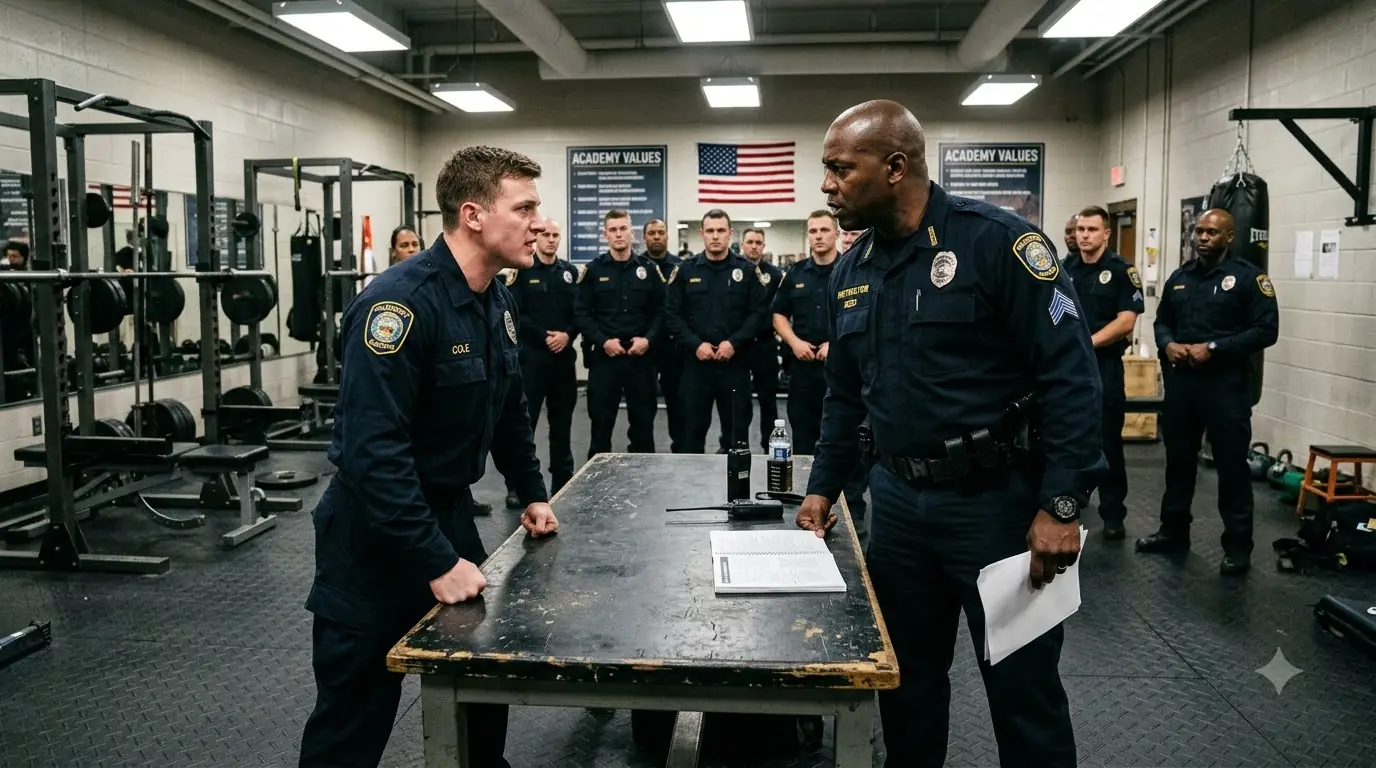
The academy gym inside the Franklin County Law Enforcement Training Center was usually filled with noise.
Footsteps hitting the mats.
Instructors calling commands.
Officers practicing communication drills.
Equipment moving across the floor.
But that morning, every person inside the room was watching two officers standing across from each other.
One was young.
Confident.
Still early in his career.
The other had spent decades learning what happened when confidence became something more dangerous.
His name was Marcus Reed.
For twenty-four years, Marcus had trained officers across the country.
He had worked patrol.
Supervised teams.
Investigated difficult cases.
And eventually became one of the academy’s most respected instructors.
People described him with the same words.
Direct.
Demanding.
Fair.
Marcus was not the type of instructor who tried to make officers afraid of mistakes.
He wanted them to understand mistakes.
Because he believed something simple.
A person who never questioned themselves was more dangerous than someone who admitted they needed improvement.
That belief had shaped his entire career.
And that was why he was standing across from Officer Ethan Cole that morning.
Ethan was twenty-nine years old.
A young officer with three years of field experience.
He was intelligent.
Hardworking.
Physically capable.
His evaluations were strong.
His supervisors considered him promising.
But Marcus noticed something others had not.
Ethan trusted his instincts.
That was not automatically a problem.
Good officers needed instincts.
They needed awareness.
They needed confidence.
The problem was what happened after the instinct appeared.
Some people treated instinct as a starting point.
Others treated it as the answer.
Marcus had seen the difference many times.
The best officers asked:
“What else do I need to know?”
The worst ones asked:
“How do I prove I was right?”
That morning’s exercise was supposed to be simple.
A communication and decision-making drill.
No real suspects.
No real emergency.
Just a scenario designed to test judgment under pressure.
A table sat in the center of the training room.
Several documents were placed on top.
A group of officers stood around the area observing.
Marcus looked at Ethan.
“You ready?”
Ethan nodded.
“Yes, sir.”
Marcus walked slowly around the table.
“You know what this exercise is about?”
“Decision-making.”
Marcus nodded.
“Partly.”
Ethan waited.
“Then what else?”
“Control.”
Marcus looked at him.
“Explain.”
Ethan answered confidently.
“Maintaining control of the situation.”
Several younger officers nodded.
It sounded correct.
Marcus smiled slightly.
“That answer is why we’re doing this.”
Ethan frowned.
“What do you mean?”
Marcus placed a hand on the training documents.
“Too many people think leadership means controlling everything around them.”
He looked around the room.
“But real leadership begins with controlling yourself.”
Ethan remained quiet.
Marcus continued.
“Today is not about proving you are strong.”
“It is about proving you can think when someone challenges you.”
Ethan nodded.
“Understood.”
The exercise began.
Marcus stepped into character.
He became a difficult partner.
A frustrated officer.
Someone questioning Ethan’s decisions.
The goal was to see how Ethan responded.
At first, Ethan performed well.
He listened.
He answered.
He stayed calm.
The observers watched carefully.
Then Marcus changed the situation.
“You made the wrong call.”
Ethan responded immediately.
“I followed procedure.”
Marcus stepped closer.
“That’s not what I asked.”
Ethan looked at him.
“I said I followed procedure.”
The room became quieter.
Marcus noticed.
The tone had changed.
Not dramatically.
But enough.
Marcus continued.
“And what if the procedure was incomplete?”
Ethan crossed his arms.
“Then I would adjust.”
Marcus nodded.
“Would you?”
“Yes.”
“Would you admit you were wrong?”
Ethan paused.
The pause was small.
But Marcus saw it.
That was the moment.
Not anger.
Not disrespect.
A hesitation.
The moment when pride entered the conversation.
Marcus stepped closer.
“Officer Cole.”
“Yes?”
“Answer honestly.”
Ethan looked at him.
“If someone challenges your decision, what is your first thought?”
Ethan answered:
“That they may not understand the situation.”
Marcus nodded.
“Good.”
A pause.
“What is your second thought?”
Ethan said nothing.
The other officers watched.
Marcus waited.
Finally Ethan answered.
“That I may need to explain.”
Marcus looked at him.
“Better.”
Then he stepped closer.
“What if the person is right?”
The room went completely silent.
Ethan looked uncomfortable.
Because that was the real question.
Not whether he could explain.
Whether he could reconsider.
“I would evaluate the information.”
Marcus nodded.
“Would you?”
Ethan’s expression changed.
He knew the question was not theoretical anymore.
Marcus walked around the table.
“Young officers often think the hardest part of this job is making decisions.”
He stopped.
“It is not.”
“The hardest part is changing your decision when new information appears.”
Ethan looked down briefly.
Marcus noticed.
The lesson was reaching him.
But Marcus was not finished.
“Let’s try something different.”
He placed the documents on the table.
“These reports contain conflicting information.”
Ethan looked at them.
“You have two possible explanations.”
Marcus pointed.
“One supports your first assumption.”
“And one challenges it.”
Ethan nodded.
Marcus asked:
“Which one do you choose?”
Ethan answered:
“The one supported by evidence.”
“Good.”
“Not the one that makes me feel correct.”
Marcus smiled.
“Exactly.”
The room relaxed slightly.
Then Marcus changed direction.
“What happens when someone refuses to agree with you?”
Ethan answered:
“I explain.”
“What if they still disagree?”
“I stay professional.”
“What if they challenge your authority?”
Ethan hesitated.
“I maintain control.”
Marcus immediately responded.
“There it is.”
Ethan looked confused.
“What?”
“That phrase.”
Marcus stepped closer.
“Maintain control.”
He pointed toward the room.
“Everyone says it.”
“Everyone believes it.”
“But many people misunderstand it.”
Ethan waited.
Marcus placed both hands on the table.
“Control is not making everyone obey you.”
“Control is making sure you do not lose yourself when someone does not.”
The sentence stayed in the room.
Several officers looked at each other.
Because they knew it was true.
Marcus had seen careers damaged by moments that lasted only seconds.
A conversation becoming an argument.
An argument becoming a confrontation.
A confrontation becoming something nobody could undo.
And often, the beginning was simple.
Someone felt challenged.
Someone felt disrespected.
Someone decided they needed to prove authority.
Marcus stepped back.
“Ethan.”
“Yes?”
“What is the difference between confidence and ego?”