In the sun-scorched hills beyond Fort Bowie in Arizona Territory, a widowed settler named Clara Dillard lived a quiet and precarious life.
She had already lost more than most people could survive, her husband to a stray shot during a skirmish, her sense of safety to the violence that haunted the frontier, and her faith in the world to a grief that would not loosen its grip.
Every sunrise found her alone beside a little cabin that once held two voices, two sets of footsteps, and two dreams. Now it held only her, the desert wind, and the memories she could not bury.
One sweltering afternoon, as dust moved like pale smoke across the dry ground, Clara found a wounded Apache man crumpled outside her cabin.
He lay half hidden near a rock outcropping behind the house, his breathing shallow, his shirt torn, his body weakened by heat and pain.
When his dark eyes opened and locked on hers, fear passed between them like a blade. Yet in that terrible moment, Clara made a choice that would change both their lives forever.
She decided to save him.
Clara Dillard was no stranger to hardship. Five years earlier, she had arrived in the Arizona Territory with her husband, Thomas, both of them still young enough to believe that courage could make a home anywhere.
They had come from New Orleans after reading newspaper promises about land, cattle, and opportunity, promises written by men who had never slept under a desert sky with rattlesnakes near the doorstep and thirst always waiting beyond the well.
The West had been described as a place where a determined family could build a future, but nobody had warned them how much the land would demand before giving anything back.
From the first month, the desert tested them. Blistering heat cracked the soil, monsoon rains turned trails into rivers, and insects swarmed the small vegetable patch Clara tried to keep alive.
Rattlesnakes found their way into the shade beneath the porch, and coyotes cried at night from the ridges beyond the cabin. Still, she and Thomas had endured because they had each other, and in those early years, that was enough.
Together, they built a modest cabin with their own hands. Thomas raised a corral for a handful of horses, and Clara planted corn and beans in a patch of soil that seemed determined to reject anything tender.
Their harvests were never abundant, but they were enough to keep them going. Their furniture was plain, their supplies were often low, and every coin had to be stretched until it nearly broke, but they had shared laughter in that cabin and whispered hopes by the fire.
Then fate struck without warning.
One dawn, a violent skirmish erupted between a U.S. Cavalry patrol and an Apache raiding party less than a mile from the Dillard homestead. Clara had barely understood what was happening when the first shots cracked across the valley. Thomas had gone outside to check the horses, thinking only to secure the corral before panic scattered the animals into the hills. By midday, he was dead, struck by a single stray shot that no one could trace and no one took responsibility for.
The cavalry never found out who fired it. Some soldiers said the shot had likely come from an Apache rifle; others admitted it might have come from their own side during the confusion. None of those explanations brought Thomas back. Clara buried him on a low hill overlooking the land they had tried to tame, and when the last handful of earth covered him, something inside her went quiet.
For weeks after his death, she moved through the days like a ghost. Neighbors came with flour, beans, and solemn faces, offering sympathy that felt too small for the hole inside her. Fort Bowie sent a patrol to check on her, but the soldiers brought no answers and no comfort. They looked at Thomas’s grave, tipped their hats, and rode away.
Nothing was well.
Clara was alone, a widow in an unforgiving territory, trying to maintain the fragile life she and Thomas had built. Many people advised her to leave, to return east if she had any family left, or to sell the homestead for whatever little it could bring. But Clara refused. If she abandoned the cabin, the field, and the grave on the hill, it felt as if Thomas’s death would become nothing more than another forgotten tragedy swallowed by the frontier.
So she stayed.
Six months after Thomas’s burial, Clara’s life changed again.
The day began with ordinary routines. She tended the small vegetable patch behind the cabin, checked the corral fence for breaks, and made sure the water barrel was full before the sun reached its highest cruelty. By noon, the heat pressed down so heavily that even the lizards seemed to vanish beneath stones. Clara was returning from the well with a bucket of water when she saw the figure lying near the brush.
At first, she thought it was a dead animal. Then she saw the shape of a man’s arm, the dark braid against the dust, and the faint rise and fall of his chest. Her breath caught. The bucket shook in her hand, water spilling over her skirt.
She took a cautious step closer.
The man was Apache. That much was clear from his braided hair, the beaded necklace at his throat, and the markings on his arm. He lay on his back, eyes closed, lips cracked from thirst. A dark stain spread from a tear in his shirt along his side, soaking into the sand beneath him.
Clara’s first instinct was to run.
She imagined herself bolting back to the cabin, locking the door, and taking up Thomas’s old rifle. She had heard stories of Apache raids, of burned wagons, stolen horses, and families who disappeared on lonely trails. Every settler in the territory carried such stories like a second shadow. Fear told her to leave the man where he lay.
But another voice rose beneath the fear.
Had Thomas not died in the same senseless violence that made enemies of strangers? Had he not been reduced to a body in the dust because men on both sides had already decided who deserved mercy and who did not? Clara thought of her husband’s hands, rough from work yet gentle when he touched her face. She thought of the way he had once stopped a neighbor from beating a captured Apache boy, saying, “Fear doesn’t give a man the right to forget another man is human.”
Her throat tightened.
If she walked away and let the wounded man die, Clara knew some part of Thomas’s goodness would die with him.
She set the bucket down and knelt beside the stranger.
Her hands trembled as she pressed two fingers to his neck. A faint pulse beat beneath her touch, fast and weak but real. He was alive. Clara stood and ran to the cabin, grabbing blankets, linen strips, a basin, and a small bottle of whiskey she kept for cleaning wounds.
When she returned, the man had not moved. She knelt again, carefully pulling open the torn cloth at his side. The wound was ugly, but the bullet had not lodged deep. It seemed to have torn across his side rather than through him, leaving a long gash that still leaked blood.
Clara poured water over the wound.
The man hissed, eyes snapping open.
For one terrible second, they stared at each other. Fear flashed in his eyes, sharp and instinctive. Clara felt her own fear answer it. He was too weak to rise, but his hand twitched toward the knife at his belt.
“Don’t,” Clara said, though she had no idea if he understood. “I’m trying to help you.”
His hand stopped.
She worked quickly, cleaning the wound as best she could. The smell of blood and dust filled the hot air around them, but Clara forced herself not to look away. Sweat rolled down her temples and into her collar. She bound his side tightly with torn linen, then pressed the cloth in place until the bleeding slowed.
It took nearly an hour to get him inside.
He was heavier than he looked, all lean muscle and stubborn pride. Clara wedged herself under his arm and helped him stagger across the yard one slow step at a time. Twice, he nearly collapsed. Twice, she tightened her grip and pulled him onward.
Inside the cabin, she laid him on a blanket near the hearth, where the shade was deepest and the floor stayed cooler. She brought a pillow, more water, and a cup of thin broth she had been saving for supper. The room felt too small with him in it. Every creak of the boards seemed louder.
This man was no friend. He was no ordinary traveler. He belonged to the people many settlers feared most, and Clara knew that if the wrong person found him in her cabin, she could lose everything.
For three days, the man drifted in and out of consciousness. Clara tended to him, washing his wound, changing bandages, and feeding him broth when he seemed alert enough to swallow. At night, she slept in a chair with Thomas’s rifle beside her. Every time she closed her eyes, she imagined the man rising in the dark and turning on her.
Yet every morning, he remained where she had left him. Weak, feverish, and silent.
On the fourth afternoon, while Clara rinsed a cloth in a basin, he spoke.
“You save me.”
The words were rough, heavily accented, but clear enough to stop her hands in the water.
She turned slowly.
His eyes were open and fixed on her, dark and steady despite the fever’s lingering hold on him. His voice had been weak, but there was no confusion in it. He knew where he was. He knew what she had done.
“I just…” Clara swallowed. “I couldn’t leave you there.”
He watched her as if measuring every word.
“I am Nantan,” he said slowly.
Clara nodded. “My name is Clara.”
Silence settled again, but it was different now. Not safe, exactly, but no longer empty. There were names between them. Names made it harder to imagine someone as only an enemy.
After a long moment, Nantan lifted a trembling finger toward the bandage on his side.
“Your hands,” he said. “Good medicine.”
Clara gave a small, uneasy smile. “I did what I could. I’m no doctor, but I hope it helped.”
He dipped his head in a faint gesture of gratitude.
By the end of the week, Nantan was strong enough to sit upright on his own. He could drink without help and eat small portions of beans and cornmeal. His fever had faded, though he still moved carefully, one hand often braced against the bandage at his side. Clara found herself watching him constantly, not out of curiosity alone, but from the knowledge that his recovery created new dangers.
What would happen when he could stand?
Would he leave without a word and disappear into the desert? Would he return with others? Would he tell his people that a lone widow lived here with no husband, no neighbors nearby, and no horses left in the corral?
The answer came closer than she expected.
Early one morning, three cavalrymen from Fort Bowie rode up to her cabin, their uniforms dusty but unmistakable in the glare of the rising sun. Clara’s pulse lurched when she saw them. Nantan was inside, propped against the wall near the hearth, still too weak to flee.
A tall officer tipped his hat as he approached.
“Morning, ma’am. Lieutenant Granger at your service. We’re scouting for signs of Apache raiders. There’s been trouble reported down the pass. Mind if we look around?”
Clara’s mouth went dry.
“Of course, Lieutenant,” she managed. “But you’ll see there’s little enough here.”
Granger dismounted and scanned the property. His two companions did the same. The empty corral, the struggling crops, the patched roof, the worn bucket by the well. Clara prayed they would not ask to go inside.
“Mind if I trouble you for a bit of water?” Granger asked politely. “It’s already a scorcher.”
“Certainly,” Clara said.
She led them to the well, heart pounding so hard she thought they must hear it. She dipped the bucket and handed it to Granger, who drank deeply before passing it to the others. Clara clutched her shawl, trying to keep her hands still.
If they entered the cabin, they would find Nantan. If they found him, they might drag him away immediately. Worse, they might decide she was aiding the enemy.
Granger wiped his mouth. “Your husband around?”
Clara forced herself not to flinch.
“No,” she said. “My husband passed on half a year ago. He’s buried on the hill over there.”
The lieutenant’s face softened. “My condolences, ma’am.”
“Thank you.”
“We’ll leave you be, then,” he said. “But keep your guard up. Folks have gone missing. If you see any sign of raiders, come to Fort Bowie. General Crook is stepping up patrols.”
Clara nodded. “I will. Thank you, Lieutenant.”
Her relief nearly made her knees buckle as the soldiers mounted and rode away in a swirl of dust.
She rushed inside.
Nantan’s eyes were wide with alarm, sweat beading along his forehead. He had heard everything.
“That was the cavalry,” Clara said, though it was obvious. “They’re looking for your people. I don’t know what will happen if they find you here.”
“They kill me,” Nantan said plainly.
The starkness of the words sent a chill through her. Clara thought again of Thomas, of a man gone because both sides had learned to pull triggers faster than they asked questions. She had reasons to hate Apache raiders as a group. But she could not hate the wounded man in her cabin, the man who had said her hands were good medicine.
“What did you do?” she asked softly.
Nantan looked toward the window. For a while, she thought he would not answer.
“I fought soldiers,” he said at last. “I fought men who came to take land, horses, food. I did not kill your husband.”
The words struck her in the chest.
“I know,” she whispered.
But knowing did not make the world simpler.
Over the next weeks, Clara struggled with herself. Part of her wanted Nantan gone so she would not have to carry the danger of his presence. Another part of her knew that sending him into the desert while he was still weak might be the same as killing him. She had chosen to save his life, and that choice had consequences.
Nantan healed slowly. He began helping with small chores, insisting on fetching water from the well even when the bucket made him pale. Clara tried to stop him at first, but his pride bristled under her concern. He needed to feel useful. He needed to be more than a patient on her floor.
In the evenings, they spoke in careful fragments. His English was limited but better than she first thought, and Clara learned to listen between words. He told her he had fought beside Apache men resisting the spread of settlers and soldiers across lands his people had known for generations. He spoke of broken promises, of rations that never came, of families forced from places where their ancestors were buried.
Clara did not know what to say to that.
She spoke, in turn, of Louisiana, of Thomas, of the hopes that had brought them west. She told Nantan that Thomas had been killed in a skirmish no one intended to touch their home, and that grief had made her afraid of everyone. Nantan listened without interruption. When she finished, he simply nodded.
“Many dead,” he said. “On both sides.”
“Yes,” Clara whispered. “Too many.”
Despite everything between them, a fragile bond began to form. It was not friendship at first. It was something quieter and more practical, born from daily survival. She needed help repairing fences, carrying water, watching the horizon. He needed shelter, food, and time to heal.
One blistering afternoon, Clara was tending the corn patch when Nantan came outside and stood beside her. He shaded his eyes from the sun and looked out toward the long ridges beyond her land. Clara straightened, wiping sweat from her brow.
“You should leave,” he said.
She turned sharply. “Leave?”
“Your home is danger.”
“My home is here,” she said.
Nantan shook his head. “Soldiers come. My people come. White men come. Danger on all sides.”
A flash of anger rose in her. “I can’t just walk away from everything Thomas and I built. Besides, where would I go?”
“East,” Nantan said. “Family.”
“My family is gone,” Clara replied, looking away. “There is no one else.”
Nantan studied her for a long moment.
“Then prepare for trouble,” he said.
The words sat heavy between them.
After a pause, he added, “I stay. Help.”
Clara should have felt relief. Instead, dread washed through her. His staying meant more risk, more questions, more danger if anyone discovered him. Yet the thought of him vanishing alone into the desert troubled her more than she wanted to admit.
“We’ll prepare,” she said finally. “If trouble comes, we’ll face it together.”
Trouble came sooner than expected.
On a moonless night, Clara woke to the smell of smoke. She scrambled out of bed, heart racing, and rushed to the window. The corral fence was burning, flames licking upward into the black sky.
She grabbed Thomas’s rifle and ran outside. Nantan was already there, half dressed, scanning the darkness beyond the fire. Figures moved near the edge of the light, quick and low. Clara could not tell if they were raiders, rustlers, or local men hiding behind the night.
A shot cracked.
Splinters jumped from the cabin doorframe.
Clara ducked behind the water barrel, raised the rifle, and fired toward the flash. She had no idea if she hit anything, but the figures scattered into the dark. The sound of running feet faded across the hard ground.
For the next half hour, she and Nantan fought the fire with buckets of water and dirt. By the time the flames died, half the corral fence was gone. Clara sank to the ground, chest heaving, rifle still clenched in both hands.
“Apaches?” she asked quietly.
Nantan crouched near the ashes, studying footprints in the dust.
“No,” he said. “White men.”
He touched the deep mark of a boot heel near the fence post.
“They wanted you afraid.”
Clara felt cold despite the heat still rising from the scorched wood.
“Why?” she whispered, but deep down she knew.
Someone had heard rumors. Someone had seen something. Someone suspected she was harboring an Apache and decided to take matters into his own hands.
Nantan looked toward the dark hills.
“They know I am here.”
Two days later, Clara rode into the nearest town because she had no choice. She was nearly out of flour, entirely out of salt, and the linen she used for bandages was nearly gone. A neighbor had loaned her an old mule months earlier, and she guided it carefully along the rocky trail with dread sitting in her stomach like a stone.
The settlement was little more than a mercantile, a saloon, a blacksmith shed, and a few weather-worn houses leaning under the sun. When Clara stepped into the mercantile, conversations quieted. A handful of rugged men looked up from sacks of feed and coils of rope.
The shopkeeper, Reuben Simms, greeted her with a tight smile.
“Haven’t seen you in a while, Mrs. Dillard. How are you holding up out there?”
“Managing,” Clara replied. “I need flour, salt, and bandages.”
Simms rubbed his chin. “Bandages?”
Clara forced herself not to show fear. “Cut my hand on splintered wood. Takes a while to heal out here.”
Behind her, someone cleared his throat.
“Folks say they’ve spotted an Apache near your place, Mrs. Dillard.”
Clara turned.
The speaker was Bert Kelly, a broad rancher with hard eyes and a harder voice. He was known for having no patience for anything Apache, and he had never been shy about saying so. His boots were dusty, his hat low, his hand resting near his belt.
“That true?” Kelly asked.
Clara met his stare. “I’ve seen no such thing.”
It was a clean lie.
Kelly’s eyes narrowed, but he said nothing.
Simms quietly packed the items she requested. Clara paid with nearly the last coins she had. The whole store seemed to hold its breath as she gathered her supplies.
Outside, she loaded the saddlebags with hands that wanted to shake. She resisted the urge to look back, though she felt eyes burning into her. On her way out of town, she passed the saloon porch, where several men had gathered with Lieutenant Granger. Their voices hushed when they saw her.
Clara kept her head high and rode on.
The rumors were spreading faster than the desert wind.
The tension snapped three nights later.
Bert Kelly arrived at Clara’s homestead under cover of darkness with six armed men behind him. This time, there was no subtlety. They rode up carrying torches and rifles, their horses snorting clouds of dust in the dark.
Clara and Nantan were inside, eating a sparse supper of beans. The thunder of hooves made them both rise at once. Clara grabbed the rifle. Nantan moved toward the wall, tense and alert.
“Mrs. Dillard!” Kelly bellowed from outside. “We know you’re in there, and we know you’ve got an Apache with you.”
Clara’s hands shook around the rifle.
“Go out the back,” she whispered to Nantan. “Hide.”
He shook his head sharply. “No. They burn this place if we do nothing.”
She swallowed. He was right. Kelly had not come to ask questions.
“What do we do?” she whispered.
Nantan’s jaw set. “We talk.”
With trembling resolve, Clara opened the door a crack, the rifle angled outward. Torchlight painted the men’s faces in restless orange.
“What do you want?” she called.
Kelly scoffed. “We want the savage you’re hiding. Don’t deny it. Folks saw you treating an Apache’s wounds. You betrayed your own people.”
Clara’s fear flared into anger.
“You don’t know what you’re talking about. This is my land and my home. You have no right to come here armed.”
“We have every right to protect ourselves from raids,” Kelly snapped. “If you won’t hand him over, we’ll do what’s necessary.”
Clara lifted the rifle until the muzzle pointed at Kelly’s chest.
“If you set foot on my property with violent intent,” she said, “I’ll shoot.”
Kelly’s men shifted uneasily, but Kelly held his ground.
“You can’t stand against all of us, ma’am. Think carefully.”
At that moment, the door opened wider, and Nantan stepped out beside Clara with his hands at his sides.
A murmur ran through the men.
Several raised their rifles.
Clara’s heart pounded so hard she thought she might collapse, but she stood by Nantan’s side.
“He’s done nothing to you,” she said. “And if you harm him, you’ll have to kill me too.”
Kelly laughed darkly. “A savage and a traitor. Maybe we should.”
Before anyone moved, hoofbeats thundered from the trail.
“Hold it right there!” Lieutenant Granger shouted.
He rode into the yard with two cavalrymen behind him. Dismounting swiftly, he stepped between Kelly’s men and the porch, his face hard with authority.
“Bert Kelly, you are not authorized to conduct a lynching in this territory.”
Kelly spat into the dirt. “We don’t need your permission to protect ourselves. You soldiers aren’t doing your job.”
“The army will handle this according to military law,” Granger said. “If the Apache is wanted, we’ll bring him in. Now back off, all of you.”
Kelly’s face twisted with rage, but he saw the cavalrymen’s rifles and thought better of it.
“Fine,” he muttered. “But this ain’t over.”
He signaled his men, and they rode away, torches bobbing in the darkness.
Granger approached the porch and removed his hat. His expression was grim.
“Mrs. Dillard, I hope you understand how dangerous this is. Harboring an Apache suspected of raiding could cost you dearly.”
“He was wounded,” Clara said. “I gave him aid. That’s all.”
“I have orders to detain any Apache found in the area,” Granger replied. “But I also won’t allow a mob to murder a man on your porch. My men and I will remain here tonight to ensure no one returns. Tomorrow, we ride to Fort Bowie. The general will decide what to do with him.”
A cold knot formed in Clara’s stomach.
The cavalry would take Nantan. There might be a hearing if they bothered with one. Knowing the brutal realities of the frontier, she feared the outcome was already written.
Late that night, while the cavalrymen stood guard outside, Clara paced her cabin. Nantan sat at the small kitchen table, calm in a way that frightened her.
“I will face them,” he said quietly.
“They’ll kill you,” Clara replied. “To them, you’re an enemy.”
Nantan looked at her. “Is your law always so cruel?”
Clara sank into a chair across from him and covered her face with her hands.
“We have courts and trials, but out here justice is… complicated. People are afraid. Fear makes them cruel.”
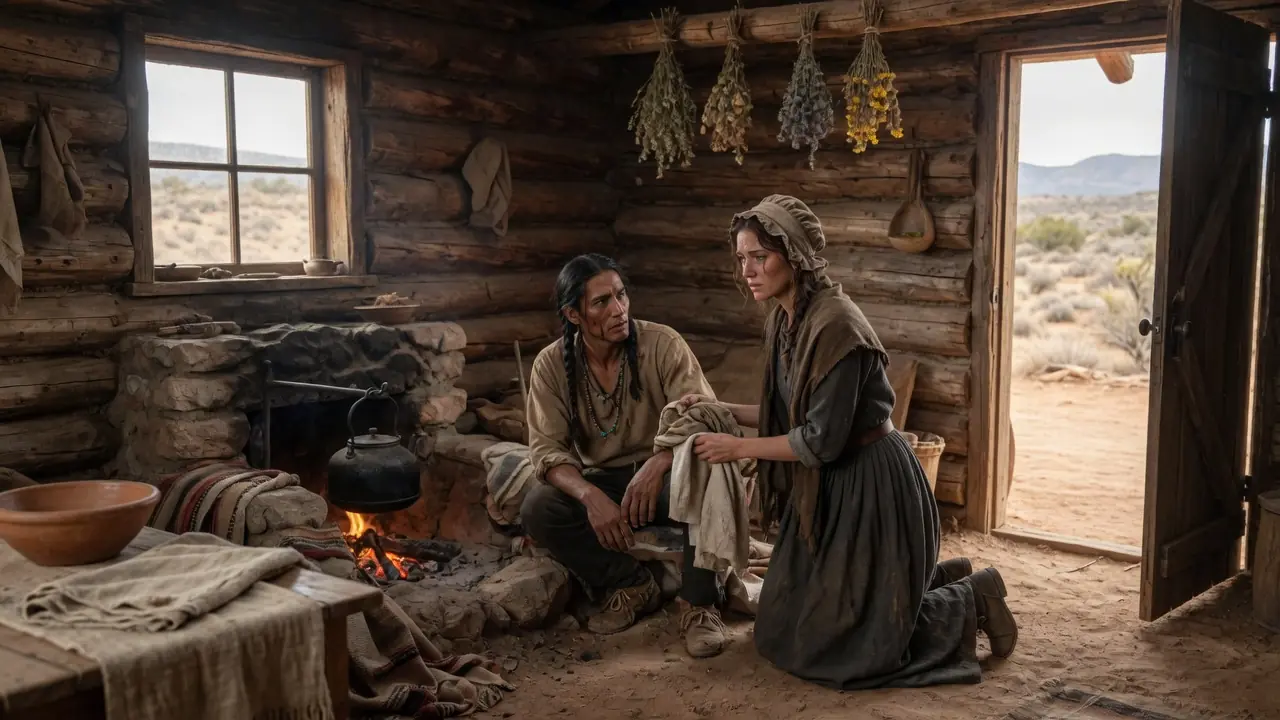
“You are afraid,” Nantan said. “But not cruel.”
“I am afraid,” Clara admitted. “But I am more afraid of what this land is turning people into.”
They sat in silence, the lantern flickering between them.
Then a desperate idea entered Clara’s mind.
It was absurd. Reckless. Possibly the only thing left.
“If you were my husband,” she said slowly, “they could not accuse me of simply harboring an enemy. You would have certain rights. I would have certain rights. They couldn’t separate us so easily, not without a formal hearing.”
Nantan stared at her.
“Your husband?”
Clara’s cheeks burned. “In some places, the cavalry might still ignore it. But legally, if we are married, it forces the matter into another kind of proceeding. It buys time. It makes them answer questions.”
Nantan was silent for a long time.
“Among my people,” he said finally, “marriage is sacred. Not a thing done for convenience.”
“Among mine too,” Clara whispered. “I know how this sounds. But these are not ordinary circumstances. I don’t want to see you hanged or imprisoned because people are afraid of the color of your skin and the language you speak.”
Nantan looked at her steadily.
“You would share your life with an Apache warrior?”
Clara gave a small, sad smile.
“I would rather share my name than watch you die.”
Something softened in his eyes.
After a moment, he placed his hand over hers.
“Your spirit is strong, Clara Dillard. If this is our path, I will walk it with you.”
Tears burned in her eyes, but she blinked them back.
“Then tomorrow,” she said, “we tell them we are married.”
Morning came too quickly.
Clara could barely swallow breakfast. Outside, Lieutenant Granger and his men prepared to escort them to Fort Bowie. Nantan stood beside her, stoic and calm, though Clara could see the tension in his shoulders.
When Granger called them outside, Clara stepped forward.
“Lieutenant, I have something to say.”
He raised an eyebrow. “Go ahead.”
Clara took Nantan’s hand. The gesture felt strange, dangerous, and unexpectedly comforting.
“This man is my husband,” she said.
A stunned silence followed.
One soldier snickered, then stopped when Granger shot him a glare.
“Your husband?” Granger repeated. “Since when?”
“We had a private ceremony several weeks ago, after I saved his life,” Clara said. “He was injured and vulnerable. We found common ground in grief and struggle. We chose to marry under his tradition.”
Granger’s eyes narrowed. “Tribal tradition is not recognized by territorial law, Mrs. Dillard.”
Nantan’s voice was quiet but firm. “We married before my ancestors and before her God. It is done.”
Clara squeezed his hand. “You cannot drag my husband away without due process.”
Granger took a deep breath. “This is highly irregular. The general may not recognize such a union. But you’re right about one thing. If there is any claim of marriage, I have to present the matter before command before any sentence is passed.”
He shook his head.
“All right. You both come with me. We’ll see what General Crook has to say.”
Fort Bowie loomed in the desert like a stern warning, all wood, dust, discipline, and suspicion. Soldiers moved across the grounds with practiced urgency. Wagons rolled near the supply buildings. Horses stamped in the heat.
Clara had been there once before, after Thomas’s death. The memory made her heart ache.
They were led into a dim administrative room where General George Crook waited behind a sturdy wooden desk. Clara knew him by reputation: stern, intelligent, and not easily swayed. His eyes moved from Granger to Clara, then to Nantan.
Lieutenant Granger saluted.
“General, this is Mrs. Dillard and the Apache man we detained. She claims he is her husband.”
Crook’s eyebrow rose.
“Is that so?”
Clara forced herself to speak clearly. “Yes, sir. We married under tribal tradition. We wish to remain together peacefully. Nantan is no threat to anyone.”
Crook’s mouth tightened. “Scouts reported raids in this region. Men killed, livestock taken. We have reason to suspect your husband may have been involved.”
Nantan squared his shoulders. “I have fought for my people. I did not raid these settlements. I killed no women, no children. These men who accuse me, do they have proof?”
Crook studied him.
“That is what we intend to find out.”
He folded his hands.
“Now, as for this marriage, territorial law requires recognized ceremony, license, or witness. You have none. From where I sit, Mrs. Dillard, you are either lying to protect him or you have entered an unsanctioned union that may not hold in court.”
Clara’s cheeks burned, but she did not look away.
“There are no easy papers out where I live, General. We did what we could. Before God, we are husband and wife.”
Crook leaned back. “Be that as it may, I have a territory to keep from burning. Lieutenant, place this man in detention. Arrange a hearing for tomorrow. Mrs. Dillard will remain here as well.”
Protests rose in Clara’s throat, but she swallowed them.
At least there would be a hearing. At least they had bought time.
Nantan was escorted away by two armed guards, his expression unreadable. Clara watched him go, her heart twisting inside her chest.
That night, confined to a small guest room under the watchful eye of a female caretaker, Clara could not sleep. She paced the narrow room, replaying every possibility. If the hearing found Nantan guilty of raiding, he could be executed, imprisoned, or sent away to some distant place where she would never see him again.
A soft knock startled her.
She opened the door to find a young cavalry corporal standing there, hat in hand. He glanced over his shoulder before stepping inside and lowering his voice.
“I’m Corporal Reyes,” he whispered. “I’m risking my neck coming here, ma’am, but I heard about what you did.”
Clara frowned. “Why would you risk anything for me?”
“My mother was Mescalero Apache,” he said. “My father was Mexican. I enlisted because I needed work and wanted a better life. But sometimes I see how the army treats the tribes, and it doesn’t sit right with me.”
Clara studied his earnest face.
“What can you do to help Nantan?”
Reyes took a breath. “There’s a clerk who handles records. I can check if Nantan was ever officially identified in a raid. If there’s no record, that helps. I can also speak with scouts who tracked the raiding parties. If none of them place him there, General Crook may have to admit there is no evidence.”
Hope stirred, fragile but real.
“That could save him,” Clara said.
“I’ll do what I can,” Reyes replied. “The hearing is tomorrow afternoon. Keep your head up, ma’am. And pray.”
He slipped away as quietly as he had come.
The next day, the hearing took place in the fort’s small assembly room. Officers gathered behind a long table with General Crook presiding. Clara sat to the side, flanked by two sentries. Nantan stood before the officers with his hands bound, his face calm, though Clara could see the tension in his jaw.
A scout testified first. He described raids in the region, stolen horses, and signs of Apache movement. But when pressed, he admitted he had never personally seen Nantan at any attack. Another soldier spoke of reports that an Apache had been living at Clara’s homestead, but he too could not connect Nantan to any specific violence.
Clara’s anxiety climbed with every word.
Finally, Crook looked toward her.
“Mrs. Dillard, step forward.”
Clara rose, her pulse pounding in her ears.
“Nantan came to my homestead badly wounded,” she said. “I found him near death. Out of mercy, I helped him. He stayed because he was too weak to leave. He has not harmed me. He has stolen nothing from me. Instead, he helped me tend my farm when he was strong enough.”
One officer leaned forward. “You claim you married him, but you have no documents or witnesses. Is that correct?”
“Yes,” Clara said. “That is correct. In the desert, we do not always have the luxury of formal papers. But we pledged ourselves to each other. I ask that you not punish an innocent man simply because he is Apache.”
Crook tapped a pencil on the table.
“His innocence is yet to be proven. But we need hard evidence to convict him.”
He turned to the scout.
“Any further proof?”
The scout shook his head. “No, sir.”
Corporal Reyes raised his hand from the back of the room.
Crook gave him a curt nod.
Reyes stepped forward. “General, I spoke with several trackers. None recognized Nantan as part of the raiding parties they followed. There is no official record tying him to specific attacks.”
Crook’s sharp gaze fixed on him.
“No official record?”
“No, sir.”
Crook turned to Nantan.
“What do you say for yourself?”
Nantan lifted his chin.
“I fought soldiers when they came for my people,” he said. “But I did not raid these settlements. I was shot fleeing a patrol that struck my band. I was left behind wounded. Clara found me.”
Crook leaned back.
For a long moment, no one spoke.
“Very well,” the general said at last. “Without direct evidence, I cannot in good conscience condemn this man to death or imprisonment. However, this so-called marriage remains questionable under territorial law. Still, Mrs. Dillard insists upon it, and I won’t stand in the way for now.”
Relief washed over Clara so strongly she nearly swayed.
Crook pointed at Nantan.
“If you commit violence or flee to join hostile bands, you will be treated as a criminal. Do you understand?”
“I understand,” Nantan said.
“Mrs. Dillard, you will be watched. Any further accusations may lead to a more severe intervention.”
“I understand,” Clara replied.
The hearing closed.
When the guards removed Nantan’s bindings, Clara rushed to his side.
“We did it,” she whispered.
He looked at her, relief softening his face.
“For now,” he said.
They remained at Fort Bowie for several days while paperwork was arranged. Soldiers whispered and stared, but no one challenged them openly after Crook’s ruling. Clara and Nantan were given small quarters near the edge of the fort, guarded but not imprisoned. Their forced marital status hung awkwardly between them.
One evening, they sat outside on a low bench, watching the sun sink behind distant mountains.
“I never intended to marry again,” Clara said quietly. “My heart still aches for Thomas.”
Nantan looked toward the horizon.
“My wife died years ago,” he said. “Sickness took her. I had not thought to marry again either.”
Clara turned to him, her expression softening.
“I’m sorry.”
“We do what we must to survive,” Nantan said. “But survival alone is not enough. We must live with honor.”
The words settled deeply inside her.
Their marriage had begun as a desperate shield against death, but Clara found herself increasingly aware of the man beside her. His grief. His pride. His quiet patience. His willingness to face soldiers, settlers, and even his own people rather than abandon what he believed was right.
When permission finally came for them to leave Fort Bowie, Clara felt both relief and fear. General Crook’s decision was simple: Nantan could remain free so long as he kept to Clara’s homestead and did not engage in hostilities. Clara was warned that any further accusations would bring consequences.
They rode back to the homestead with guarded hearts.
The cabin stood intact, though one window had been broken. The corral fence still bore black scars from the fire. Clara unlocked the door with trembling hands, uncertain if she was returning home or stepping deeper into danger.
Over the next weeks, word spread that Clara Dillard had returned with an Apache husband. Bert Kelly and his men simmered with resentment, but after a warning from the cavalry, they did not stage another assault. Instead, they muttered in town and stared when Clara passed. Hatred did not vanish simply because a general ordered it to behave.
Yet not everyone turned away.
An old rancher named Walter Peterson visited one afternoon with a small sack of coffee. Clara served him at the kitchen table while Nantan sat quietly beside her.
“I won’t say I understand all this,” Peterson said, eyeing Nantan warily. “But I know you, Clara. You’ve always been honest. If you say this man is no threat, maybe he ain’t.”
Nantan dipped his head politely.
The conversation was stiff, but Clara understood its importance. A small acceptance had begun. Not love, not trust, but a crack in the wall.
Just as life settled into a fragile rhythm, new trouble came.
News reached them from Fort Bowie that fresh raids had occurred near the border. This time, scouts spoke of a band led by a feared Apache warrior named Lozan, known for his ruthlessness against settlers. Panic spread through the region. Families fled isolated ranches, and cavalry patrols stretched themselves thin trying to guard too many roads at once.
Clara and Nantan argued late into the night.
“If these raids continue,” Clara said, pacing the cabin, “Kelly and men like him will use it as an excuse to come for us again.”
Nantan’s expression was grim. “Lozan is from my people. But he is cruel. He does not seek peace. He believes fear is the only weapon left.”
“Then we need to protect ourselves.”
“We must prove we are not his allies,” Nantan said. “Perhaps warn the cavalry.”
Clara gave a bitter laugh. “Warn the same cavalry that nearly imprisoned you?”
“Crook listened once,” Nantan replied. “Maybe he will listen again.”
Time ran short.
Late one afternoon, Corporal Reyes arrived at the homestead, dusty from hard riding. His horse was lathered, his face tight with urgency.
“Lozan plans to strike a ranch not far from here,” he said. “Possibly tonight. The cavalry is spread too thin. If we can’t slow him down, people will die.”
Nantan stood.
“I will go to him.”
Clara’s eyes widened. “He’ll kill you for siding with me.”
Reyes looked uneasy. “It’s dangerous. But if Nantan knows him, maybe he can dissuade him, or at least buy time.”
Nantan met Clara’s gaze.
“If I do nothing, many die. We must try.”
He gathered his knife and bow. Clara watched with dread building in her chest. She wanted to beg him to stay, to let someone else risk everything, but she saw the resolve in his eyes. This was not only about settlers. It was about his people too.
“Please,” she whispered. “Come back to me.”
Nantan stepped close and kissed her forehead, a gesture so gentle it nearly broke her.
“I will try,” he said.
He left under cover of darkness, moving toward a rocky plateau where Lozan’s men were rumored to gather. The desert seemed endless beneath the stars. Nantan traveled lightly, following old paths and reading signs in the sand. Near midnight, he spotted movement along the ridge.
He called out in Apache.
Warriors emerged from the darkness, arrows drawn. Lozan stepped into view last, tall and lean, a scar cutting across his cheek. His eyes narrowed with contempt when he recognized Nantan.
“You return to us after lying with a white woman,” Lozan said. “Have you come to betray us or beg forgiveness?”
Nantan stood still.
“I have come to ask you not to spill more blood. The army is strong. More killing will bring more soldiers, and they will strike families who have done nothing.”
Lozan laughed harshly.
“So you sold your soul to them. You tie yourself to one of their women and now lecture me about caution.”
“I have not forgotten who I am,” Nantan said. “But I have seen enough death.”
“There is no other way,” Lozan snapped. “They build farms on our land. They raise fences where our fathers rode. We starve while they grow fat. We burn them out, or they bury us.”
A tense silence fell.
Nantan understood the fury in Lozan’s men. Many had lost families. Many had been driven from places they loved. But he also knew where this path led. More raids. More soldiers. More graves.
“If you strike that ranch,” Nantan said, “the cavalry will hunt not only you, but every Apache they can find. Even children. Even the old. You will bring destruction upon all of us.”
Lozan’s lip curled.
“Then let destruction come. I will not be caged.”
He signaled his warriors to move.
Nantan knew words had failed.
He drew his bow and aimed at Lozan.
“Then I will stop you.”
The warriors froze.
Lozan grinned like a wolf.
“You would raise a weapon against your own people for a white woman?”
“For innocent lives,” Nantan said. “Apache and settler alike.”
Lozan lunged, knife flashing in the moonlight.
Nantan released the arrow. It grazed Lozan’s arm, drawing a snarl of pain. In the next heartbeat, the plateau erupted into movement. Nantan ducked, turned, and fought in the dark, not to slaughter his own people, but to survive long enough to stop one man.
Steel flashed. Feet scraped stone. Breath came hard.
Lozan came at him again, wild with rage. Nantan stepped aside and struck once, fast and final.
Lozan staggered, shock crossing his face.
His warriors froze.
Nantan stood over him, breathing hard, his arm bleeding from a shallow cut.
“No more,” Nantan said. “Take him. Go home. Enough blood.”
For a moment, no one moved.
Then one by one, Lozan’s men lowered their weapons. Two lifted their fallen leader. Without another word, they disappeared into the night.
Nantan stood alone beneath the stars, shaken by what he had done. He had killed one of his own people to prevent greater slaughter. The wind moved over the plateau like a mourning song.
Dawn broke as he returned to the homestead.
Clara had not slept. She ran from the cabin the moment she saw him. His forearm was bleeding, his face gray with exhaustion, but he was alive. She reached him before he could speak and nearly collapsed against him.
“You came back,” she whispered.
“I told you I would try.”
She brought him to the porch and cleaned the wound with shaking hands.
“Lozan is dead,” he said quietly. “His men scattered.”
Clara looked up and saw the torment in his eyes.
“I’m sorry,” she said.
“I did what I had to do,” Nantan replied. “To save lives. But the cost…”
Clara wrapped her arms around him.
For the first time, he let himself lean into her.
Word of Lozan’s death spread quickly. The planned raid never happened, and for a time, violence in the area lessened. Some settlers viewed Nantan with cautious gratitude. Others still resented him and muttered that an Apache could not be trusted, no matter whom he saved. But the loudest voices lost some of their certainty.
Even Bert Kelly kept his distance.
Life did not become easy, but it became possible.
Clara and Nantan repaired the homestead, rebuilt the corral fence, and worked the land side by side. Their harvest was modest, but every ear of corn and every bean plant represented a victory over heat, drought, and suspicion. Cavalry patrols still passed occasionally, but they no longer stopped to interrogate them.
Slowly, their desperate marriage became something else.
They still slept apart at first, Clara in the bed and Nantan near the hearth. But the distance between them changed. They spoke more freely, laughed sometimes, and shared silence without fear. Clara taught him to read simple English using an old Bible, and Nantan taught her how to track small animals, find edible desert plants, and read changes in the wind.
At dusk, they often walked together beyond the cabin. Clara told him more about Thomas, and Nantan spoke of the wife he had lost years earlier. They did not pretend their pasts had vanished. Instead, they learned to carry them together.
One evening, as a desert sunset painted the sky in pink and orange, Clara and Nantan sat on the porch with their hands loosely entwined.
“I used to dream of having children out here,” Clara said softly. “Thomas and I wanted a big family.”
Nantan’s grip tightened slightly.
“Would you want children now?”
Clara hesitated. Their marriage had begun under threat. The future remained uncertain. The world beyond their porch still held suspicion, hatred, and danger.
“I don’t know,” she admitted. “I’m still scared. What about you?”
Nantan looked toward the horizon.
“Children are the hope of a people,” he said. “But this land… is it safe for them?”
Clara exhaled slowly.
“I don’t know. But maybe we can help make it safer. A little at a time.”
She rested her head on his shoulder, and he did not pull away.
Love, fragile and uncertain, had taken root in the cracks of hardship.
As summer stretched toward harvest, the desert nights grew cooler. Clara and Nantan worked side by side, coaxing life from stubborn soil. Townspeople still watched them carefully, but some offered nods when Clara came for supplies. Walter Peterson brought coffee again, then seed corn, then a worn plow blade he said he no longer needed.
Corporal Reyes visited occasionally with news from Fort Bowie. General Crook was pursuing new talks with several Apache leaders, though peace remained fragile and uncertain. The territory was still scarred by violence, and no one believed one marriage could heal what years of war had broken. But small things mattered.
A saved life mattered.
A stopped raid mattered.
A cabin where two former enemies shared bread mattered.
One evening, after the chores were done, Nantan presented Clara with a small leather pouch. Inside lay a slender turquoise stone, polished smooth by time and water. The color was deep and clear, like a piece of sky captured in earth.
“My mother gave this to me when I was a child,” he said. “It was meant to protect and guide. Now I give it to you.”
Clara’s eyes filled with tears.
She closed her hand around the stone and pressed it to her heart.
“Thank you,” she whispered.
Nantan touched her cheek with the gentleness of a man who had known both war and loss, yet still found room for tenderness.
“You saved my life,” he said. “But more than that, you called me human when others called me enemy.”
Clara looked at him through tears.
“And you gave me a reason to stop living only beside a grave.”
They stood together in the golden wash of sunset, two souls from different worlds joined first by mercy, then by survival, then by something deeper than either had expected. Around them, the desert stretched wide and unforgiving, but no longer empty. The cabin still bore scars from fire and fear, but it also held laughter now. It held two cups on the table, two shadows by the hearth, two lives moving forward together.
Clara Dillard had once believed compassion was a fragile thing in a violent world. Nantan had once believed peace was a dream crushed beneath boots and rifles. But together, they learned that kindness could survive even in the harshest soil if someone was brave enough to plant it.
Their marriage defied the expectations of a world scarred by fear. It had no fine church, no grand celebration, no easy blessing from society. It was born in danger and tested by suspicion, yet it became real through daily courage.
In saving each other, Clara and Nantan uncovered a fragile hope.
A hope that respect could cross the widest divide.
A hope that mercy could outlive hatred.
A hope that even on the blood-stained frontier, two wounded people could build a home where fear did not have the final word.