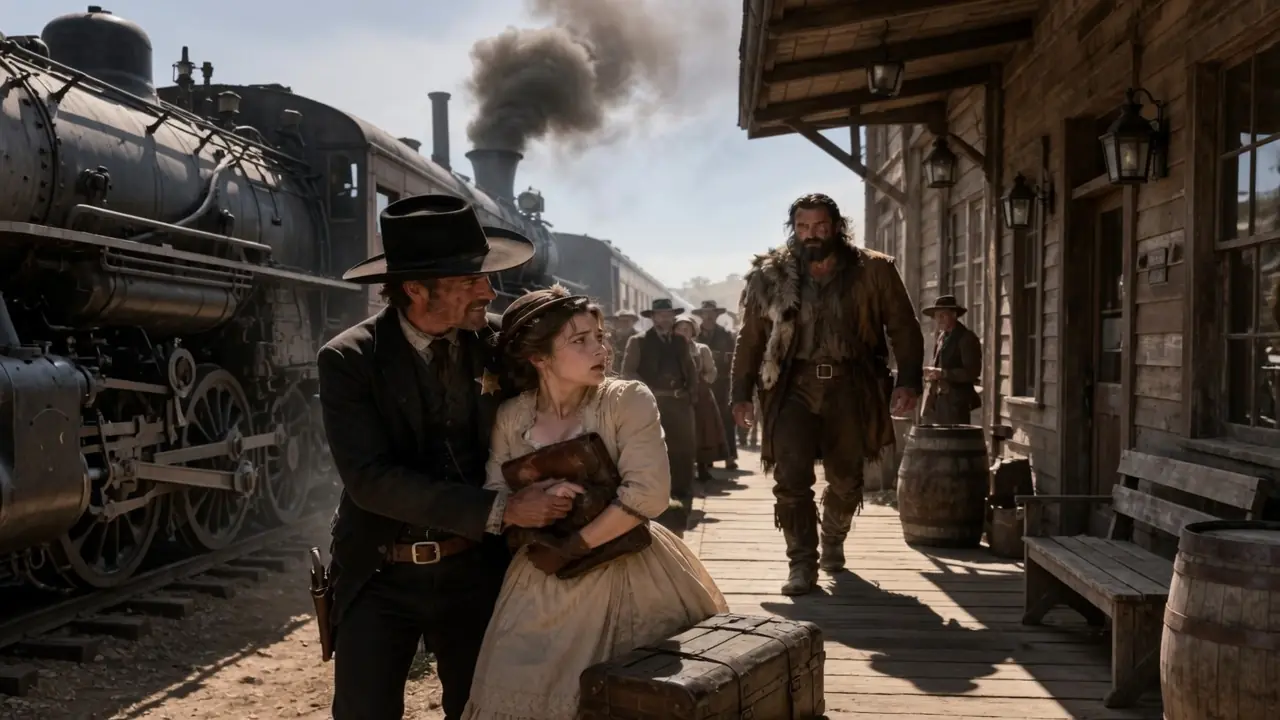
Cora Harrison arrived in Bitter Creek one day late, and the whole town seemed ready to punish her for it. The train hissed behind her like an angry animal, spilling smoke across the platform while passengers hurried away from the heat, the dust, and the hard stares waiting on the boardwalk. She stood beside her trunk with soot on her hem, a leather satchel clutched against her ribs, and a marriage contract hidden beneath her bodice. Elias Reed had promised her a home in Wyoming, but the only thing waiting for her was a crooked sheriff with tobacco in his cheek and cruelty in his smile.
“You looking for Elias Reed?” Sheriff Amos Vail asked, leaning against the depot post as if he had been waiting all morning for this pleasure. Cora lifted her chin, though her throat had tightened the moment she saw the empty platform. “I am his fiancée,” she said. “My train was delayed by a rock slide, but we were to be married today.” Amos spat into the dust near her skirt and said, “Day late, little bird. We hanged him yesterday at dawn.”
The words struck her so hard she forgot how to breathe. The street, the depot, the horses, and the staring townspeople all seemed to blur around her. At the far end of Bitter Creek, a new gallows stood beneath the sun, its rope turning slowly in the wind as if the town had not finished showing off its work. Cora’s hand tightened around the satchel until the leather creaked.
“No,” she whispered. Amos smiled wider. “Yes. Card cheat, claim jumper, thief, and dead fool.” His eyes dropped to her trunk. “Folks say he hid stolen gold before we gave him the rope, and if you were meant to marry him, maybe he sent you the map.” Cora stepped backward, but his hand shot out and caught her arm.
Pain flashed beneath his fingers, and Cora’s satchel nearly slipped from her grasp. “I have nothing,” she said, forcing the words through fear. The depot clerk bent lower over his ledger, pretending not to see. Women on the boardwalk looked away, and men in doorways watched with the blank interest of people deciding silence was safer than decency. Amos tugged her toward the trunk and said, “Then you won’t mind us looking.”
A shadow moved beside the blacksmith’s wall. A man stepped from the alley, broad as a doorway and dressed in worn buckskin, with a wolf pelt hanging over one shoulder and a black hat shading eyes pale as winter creek ice. His beard was dark, his face marked by sun and a scar near the cheekbone, and the crowd shifted before he even spoke. “Let her go, Amos,” the mountain man said.
Gideon did not look at her first. He looked at the sheriff, then at the gallows, then at the faces along the boardwalk. “This town already killed one man on a lie,” he said. “It will not tear apart a woman on the same one.” Amos rubbed his wrist, hatred crawling over his face. “She belongs to the investigation.” Gideon bent, lifted Cora’s trunk onto his shoulder as if it weighed no more than a blanket, and said, “She belongs nowhere you can reach.”
Cora should have refused to follow a stranger, but staying meant Amos, the trunk, and the crowd. She walked after Gideon because the road behind him looked dangerous, yet the street behind her looked worse. He moved toward the edge of town with long, steady strides, carrying her trunk past the saloon, past the mercantile, past the gallows that had ended the life she had crossed the country to meet. Only when they reached the shade of a feed shed did he stop.
“You knew Elias,” Cora said, her voice trembling. Gideon lowered her trunk to the ground and finally looked at her properly. “He was my friend.” The answer was short, but grief sat inside it like a buried nail. “Then why did you let them hang him?” she asked, and the question came out sharper than she meant.
Gideon’s jaw tightened, but he did not punish her for the pain behind it. “I was three days north trapping when Amos arrested him,” he said. “By the time word reached me, they had already built the gallows.” Cora looked toward town, her eyes burning. “They said he stole gold.” Gideon’s face hardened. “Elias never had the stolen gold.”
The sentence moved through Cora like cold water. She pressed one hand over the place where the marriage contract lay hidden. Elias had written to her for six months, every letter careful, gentle, and almost too humble. He had never promised riches, only a home with a stove that worked, a garden patch, and a man willing to build a life without lies. “Then why would they kill him?” she asked.
Gideon looked back toward Bitter Creek. “Because the real thieves needed a dead man to carry their guilt.” He reached into his coat and pulled out a small tin matchbox. Inside was a folded scrap of paper, stained at the edges. “Elias left this with the livery boy the night before they took him.” Cora opened it with shaking fingers and saw only one line: If she comes, Croft must know she carries my name.
“My name?” Cora whispered. Gideon’s eyes dropped to her satchel. “Not your birth name. His.” Cora remembered the contract, the signature, the seal from Boston, and Elias’s last letter telling her to keep every paper safe no matter what anyone said. “He sent me the marriage contract,” she said. “Nothing more.” Gideon’s gaze sharpened. “Then that paper is more than it seems.”
They left town before Amos could gather men brave enough to follow. Gideon led her along a dry creek road toward a cabin tucked between cottonwoods and a low ridge of stone. The cabin was rough but clean, with a split-rail fence, a woodpile, and smoke curling from a crooked chimney. It was not the home Elias had promised her, but it was the first place since leaving the train where Cora felt no one was watching her like prey.
Inside, Gideon gave her water, bread, and a chair near the hearth. Cora sat stiffly, unable to eat, her mind still circling Elias’s death like a bird trapped in rafters. After a while, she drew the marriage contract from inside her dress and laid it on the table. Her fingers trembled as she smoothed it open, seeing Elias Reed’s name written in the same careful hand that had filled his letters.
Gideon leaned over the paper without touching it. “May I?” he asked. The question surprised her because every other man that day had tried to take without asking. She nodded. Gideon lifted the contract and held it near the window light, then turned it slightly. For a moment, nothing happened.
Then faint marks appeared beneath the ink. Lines, numbers, and initials were hidden in the paper, not written over it but pressed into the fibers by a second sheet that must have rested above it when Elias wrote. Gideon’s eyes narrowed. “Ledger marks,” he said. “Elias must have copied them without ink.” Cora leaned closer and saw names: Vail, Hollis, Vane.
“Amos Vail?” she asked. Gideon nodded once. “Sheriff Amos Vail, Judge Silas Hollis, and banker Thaddeus Vane.” He tapped the faint numbers. “Amounts paid. Dates. Shares.” Cora looked at the paper again, horror growing inside her. “They stole the gold.”
Gideon’s expression grew colder. “Mine payroll gold, forty thousand dollars worth, stolen from a stagecoach outside Crow Pass.” He lowered the contract carefully. “They blamed Elias because he found the first proof and tried to tell the judge.” Cora understood before Gideon said the rest. “But the judge was part of it.” Gideon nodded. “So Elias became the thief before he could name the thieves.”
That night, Cora slept little. She lay beneath a spare blanket in the small back room, listening to the wind move along the cabin walls and to Gideon’s quiet steps outside as he kept watch. She had imagined her first night in Wyoming would be as a wife in Elias Reed’s house, nervous and hopeful beside a man whose letters had made her believe life could still turn kind. Instead, Elias was in a pine box, and his murderers were searching for the evidence hidden inside her future.
At dawn, Gideon took her to Elias’s grave. It lay on a low hill behind the old church, marked only by a plain wooden cross with his name burned into it. Cora knelt in the dry grass and placed one hand on the soil, but no tears came at first. The grief was too new and too strange, a sorrow for a man she had loved through letters but never touched.
“I am sorry I was late,” she whispered. Gideon stood several feet away, hat in his hands, giving her the dignity of silence. Cora closed her eyes and finally wept, not loudly, but with the quiet devastation of someone mourning both a man and a life that would never begin. When she stood, her face had changed. The frightened woman from the depot had not vanished, but something harder now stood beside her.
“What do we do?” she asked. Gideon looked toward town. “We get proof they cannot burn, bury, or laugh away.” Cora held the contract against her chest. “Is this not enough?” “Not in Bitter Creek,” Gideon said. “Judge Hollis will call it meaningless. Amos will call you a liar. Vane will call it forgery.” His eyes hardened. “We need the gold.”
Cora stared at him. “You know where it is?” Gideon looked toward the mountains, where the ridges rose blue and distant under the morning sun. “I know where Elias believed it was hidden.” He took out another scrap from his pocket, one marked with symbols Cora did not understand. “He wrote me once about an abandoned icehouse near the burned mill.” Cora looked at the map, then toward Bitter Creek. “Then let us go before they find us.”
They rode north by noon, Cora on a gentle mare Gideon said belonged to his sister before fever took her. The trail climbed through sagebrush, stone, and wind-bent pines until Bitter Creek disappeared behind them. Gideon said little, but when the path grew steep, he slowed without making her feel weak. Cora noticed that about him: he protected without turning protection into ownership.
Near sunset, they reached the burned mill. Charred beams leaned over the dry creek bed, and half the roof had collapsed into blackened timbers. A stone icehouse sat farther back beneath a tangle of brush, its wooden door warped but still standing. Gideon dismounted first, listening, then signaled Cora to remain back.
He pushed the door open and found darkness, dust, and the smell of old rot. Cora followed with a lantern, her breath tight as the light crossed the stone floor. In the far corner, beneath a cracked slab, Gideon found fresh scrape marks. Together they shifted the stone just enough to reveal a tin strongbox wrapped in oilcloth.
Cora’s heart pounded as Gideon broke the rusted hasp. Inside lay gold bars stamped with the Crow Pass Mining Company mark, along with a second ledger. This one was written in ink. Names, dates, payments, signatures, and distribution amounts filled every page. Elias had found the thieves’ true record and hidden it where they had not thought to look.
A sound outside made Gideon turn. Horses. Men. Voices moving through the brush. “Amos,” Gideon said, already closing the box. Cora grabbed the ledger and shoved it inside her satchel. Gideon lifted the strongbox, but it was heavy enough to slow even him. “Leave the gold,” Cora whispered. “Take the truth.”
Gideon looked at her, and for the first time, admiration burned through the hardness in his eyes. He took the ledger from the box and kicked the gold back beneath the slab. Then he took Cora’s hand and pulled her through a narrow rear opening where stones had fallen loose. They escaped into the trees as Amos and two deputies broke through the icehouse door.
The ride back became a race beneath a darkening sky. Gideon led them through a creek wash, across low ridges, and down a cattle trail so narrow Cora had to trust the mare more than her own fear. Behind them, gunshots cracked once, then twice, but the distance and the wind swallowed the danger before it reached them. Gideon kept one hand close to his rifle, but he did not turn unless necessary.
By dawn, they reached Bitter Creek with the ledger hidden beneath Cora’s saddle blanket. Instead of going to the sheriff or the judge, Gideon rode straight to the telegraph office. The operator, a nervous man named Mr. Bell, tried to close the window when he saw them. Cora placed one hand on the counter and said, “Send this to the territorial marshal in Cheyenne.”
Mr. Bell looked past her toward the street. “Sheriff won’t like that.” Gideon stepped inside behind Cora, filling the doorway. “Sheriff has liked too much for too long.” The operator swallowed, took the message, and began tapping. Cora dictated every name from the ledger, every payment, every gold mark, and every word with her back straight and her hands steady.
Amos arrived before the final line was sent. He kicked open the telegraph office door, revolver at his side, face red with fury. “Step away from that wire,” he ordered. Cora turned slowly, the ledger open in her hands. “No.” The simple word stunned the room more than shouting would have.
Amos pointed at her. “You are under arrest for conspiracy with Elias Reed.” Gideon moved one step forward, but Cora lifted her hand to stop him. “No, Sheriff,” she said, her voice clear enough to carry into the street where people had begun gathering. “Elias Reed was murdered because he found the names in this book.” She raised the ledger. “Your name is the first.”
The townspeople pressed closer to the windows. Judge Hollis appeared on the boardwalk, coat half-buttoned, banker Vane behind him with his face already losing color. Amos reached for the ledger, but Gideon caught his wrist again. This time, the sheriff did not only gasp. He dropped his revolver.
“Marshal’s on the wire,” Mr. Bell whispered. “Says hold all parties. Federal men are already in Laramie.” Judge Hollis turned to leave, but the livery owner stepped into his path. Banker Vane tried to slip through the crowd, but two miners grabbed his arms. Bitter Creek, which had watched a woman be grabbed in silence the day before, finally discovered the weight of its own shame.
Cora walked into the street with the ledger pressed against her chest. “You all watched Elias die,” she said, her voice trembling now but not breaking. “Maybe some of you believed he was guilty. Maybe some of you were afraid.” Her eyes moved over the faces in windows, doorways, and dust. “But yesterday you watched Sheriff Vail put hands on me because silence had already taught him he could.”
No one answered. That was answer enough. Gideon stood beside her, not in front this time, and Cora understood the difference. He was not shielding her from being seen. He was standing with her while she made sure they saw.
By afternoon, the territorial marshal arrived with two armed deputies. Amos cursed until they bound his hands. Judge Hollis tried to claim procedural authority, but the marshal took the ledger, the contract, the telegram copy, and three witness statements before ordering his arrest. Banker Vane fainted on the boardwalk, which would have been funny if the gallows had not still stood at the end of the street.
Elias Reed was cleared three days later in the only way a dead man can be cleared. The marshal ordered the charges struck from the territorial record and allowed Cora to place a new marker on his grave. She chose one carved from pale stone. It read: Elias Reed, an honest man wronged by cowards.
Cora stood before it with Gideon beside her. “I wish I had known him,” she said. Gideon looked at the grave. “He wanted a life more than a fortune. That made him rare out here.” Cora folded her hands. “He gave me a contract, and I thought it was a promise of marriage.” Gideon’s voice softened. “It was. It was also his last way of keeping you alive.”
Cora had nowhere to go when justice was done. Her rented room in Boston was gone, her money nearly spent, and the marriage that brought her west had become a grave and a name cleared too late. Bitter Creek suddenly treated her with kindness, but public kindness after public cowardice tasted bitter. Women brought pies. Men tipped hats. None of them met her eyes for long.
Gideon did not ask her to stay. He only offered work at his cabin until she decided. “There’s a garden that needs hands,” he said. “A roof that needs mending. Chickens that need more sense than they were born with.” Cora looked at him with the first real smile he had seen from her. “Do chickens pay wages?” “Poorly,” he said. “But I do.”
Weeks passed. Cora learned the mountain road, the names of Gideon’s horses, the sound of the creek after rain, and the shape of quiet that did not feel lonely. She helped keep books for traders, wrote letters for settlers who could not write, and eventually opened a small desk in the corner of the mercantile to help women read contracts before signing them. “A signature can save you,” she told them. “Or trap you. Know the difference.”
Gideon watched her become less afraid of taking up space. She no longer clutched the satchel as if the world might snatch it away. Her voice grew steadier, her chin lifted more often, and the town learned that Cora Harrison was not a widow, not exactly, and not a bride, not anymore. She was something Bitter Creek did not know how to name: a woman who had arrived as prey and stayed as proof.
One evening near the end of summer, Gideon found her by the cabin fence, looking toward the ridge where the sun fell red behind the pines. “You thinking of leaving?” he asked. Cora did not answer at once. Then she said, “I was thinking I crossed two thousand miles to belong to a man I never met.” Gideon’s face tightened, but he remained silent.
Cora turned toward him. “Now I think I would rather belong to myself first.” Gideon nodded, and something like pride softened his hard features. “That sounds right.” She studied him for a moment. “And after that?” Gideon looked at her, his pale eyes steady. “After that, if you choose someone, let it be because his door opens and not because the world closed every other one.”
Cora’s eyes filled, but she smiled. “Your door opened when the world was still trying to rob me.” Gideon stepped closer, slowly enough to let her choose the distance. “It will stay open,” he said. “Whether you walk through it or past it.” That was the first time Cora understood he loved her, because he did not make his love another trap.
A year later, the gallows at the end of Bitter Creek was torn down. Cora watched from the boardwalk as men pulled the beams apart and children carried away scraps for firewood. The town had changed, not perfectly, but enough to know shame when it passed the place where Elias died. Gideon stood beside her, his hand near hers, waiting without taking.
Cora reached for him first. His fingers closed around hers, warm and careful. “Elias brought me here,” she said quietly. Gideon looked toward the mountains. “No,” he said. “A lie brought you here. Elias made sure the truth found you.” Cora squeezed his hand. “And you waited.”
Gideon looked down at her with the same steady gaze he had given her at the depot, but this time there was no grief hiding behind it. “You were a day late for one promise,” he said. “Right on time for another.” Cora leaned against his arm as the last gallows beam hit the dust. Behind them, the train whistled through Bitter Creek, no longer carrying a warning, but a sound like departure, arrival, and the long road finally bending toward home.