The roast had been in the oven since seven that morning.
By noon, Eleanor Hayes’s small kitchen smelled of rosemary, garlic, and the recipe her husband had perfected during their forty-three years of marriage. She had peeled potatoes by hand, glazed carrots with honey, baked two pies, and ironed the floral blouse Diane once said made her look “presentable.” At sixty-eight, Eleanor’s back no longer tolerated eight hours of standing, but she ignored the ache because Sunday dinner was the one family tradition she still believed belonged to her.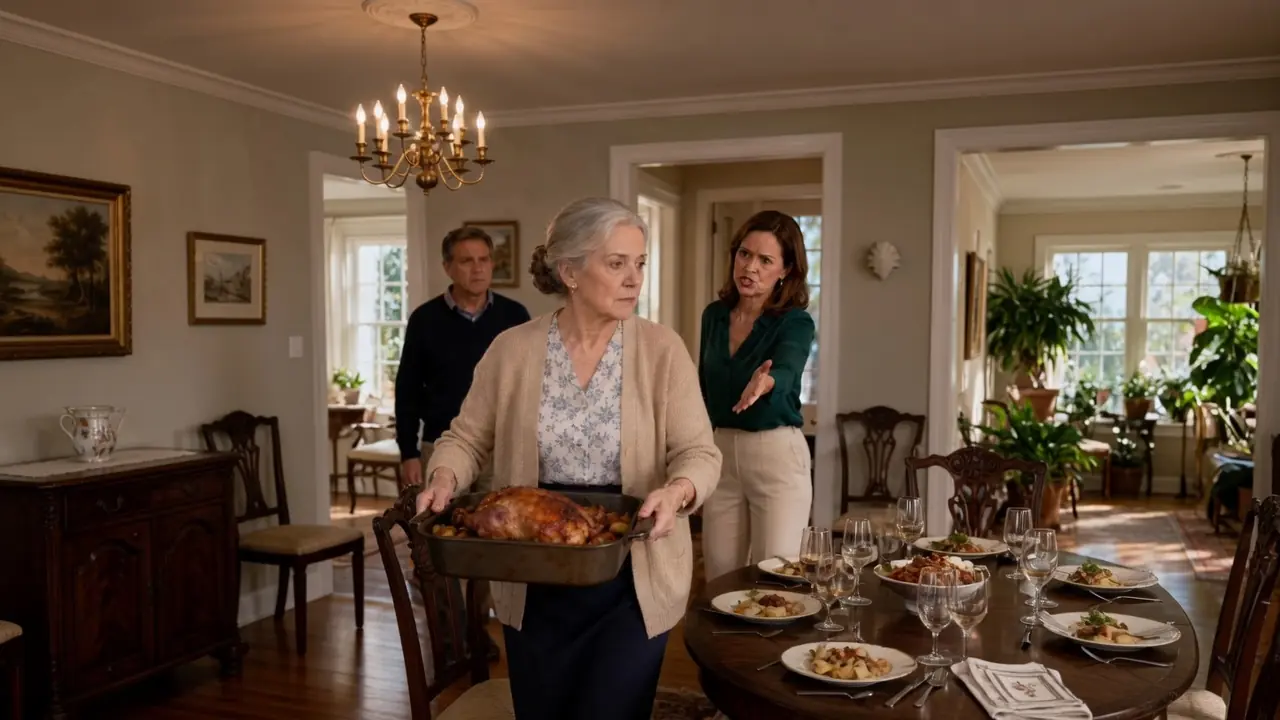
Diane had insisted that the gathering take place at her house.
“It’s easier for everyone,” she had said. “You get confused when too many people move around your kitchen.”
Eleanor had not been confused.
She simply disliked people opening drawers without asking and leaving dirty glasses on polished furniture. But Diane repeated the word often enough—confused—that Eleanor gradually stopped correcting her. She packed every dish into insulated containers, placed the heavy roasting pan in the back of her car, and drove forty minutes to the large suburban home her daughter shared with her husband, Paul.
Diane opened the door without hugging her.
“You’re late.”
“It’s twelve fifteen.”
“I asked you to arrive before noon.”
“The roast needed another few minutes.”
Diane sighed and stepped aside. “Just take everything into the kitchen. Guests will be here soon.”
Paul appeared from the dining room, gave Eleanor an apologetic smile, and lifted the pie carrier from her hands. He had always been polite, though politeness was often the furthest he ventured when Diane became cruel.
“That smells wonderful,” he said.
“Mom makes the same thing every time,” Diane replied. “People only pretend to be surprised.”
Eleanor carried the roast inside.
By one o’clock, the dining room was filled with relatives, neighbors, and two couples from Diane’s church committee. Crystal glasses reflected the chandelier while everyone praised the beautiful table. Diane accepted each compliment as if she had spent the morning cooking instead of arranging flowers and changing clothes three times.
“This must have taken you all day,” one guest said.
Diane smiled. “Family gatherings are a lot of work.”
Eleanor stood near the doorway holding a bowl of potatoes.
No one corrected her daughter.
Her granddaughter Sophie noticed, but Sophie was twenty-one and still learning which family truths were considered dangerous. She caught Eleanor’s eye from across the room and offered a small, uncomfortable smile.
Eleanor placed the potatoes on the table.
“Mom, not there,” Diane said. “They’ll block the centerpiece.”
Eleanor moved them.
“Not beside the wine either.”
She moved them again.
Diane finally took the bowl from her hands. “I’ll handle it.”
The room remained cheerful.
People discussed vacations, property prices, and Paul’s recent promotion. Eleanor returned to the kitchen and checked the gravy. Through the doorway, she watched Diane take the head seat that had once belonged to Eleanor’s husband, George.
George had been gone six years.
During the first year after his death, Diane called every day. She came to appointments, organized bills, and brought groceries Eleanor did not request. Her attention felt loving at first, like a daughter protecting a grieving mother.
Then protection became permission.
Diane began opening Eleanor’s mail before handing it to her. She insisted on attending every bank meeting and answering questions directed at Eleanor. When Eleanor tried to purchase a new car, Diane told the salesman her mother needed time because “large decisions overwhelm her now.”
Eleanor had been embarrassed, but she allowed it.
Grief had made ordinary tasks feel heavier, and Diane’s confidence provided temporary relief. By the time Eleanor felt capable again, her daughter had become comfortable controlling everything.
“Mom,” Diane called from the dining room. “We’re ready.”
Eleanor carried in the roast.
For the first time that afternoon, the room fell silent.
The browned meat rested among roasted potatoes, onions, and carrots, its surface shining beneath the chandelier. Several guests praised it immediately. Paul stood to help, but Diane waved him back into his seat.
“Mom can manage.”
Eleanor set the pan on the serving stand.
She waited for Diane to indicate where she should sit.
There were twelve chairs around the table.
Eleven were occupied.
The last chair held Diane’s handbag.
Eleanor looked toward her daughter.
Diane smiled with the perfect expression she reserved for neighbors, church friends, and anyone whose opinion mattered more than her mother’s feelings.
“Mom,” she said sweetly, loud enough for the entire room to hear, “eat in the kitchen after everyone else.”
A few people lowered their eyes.
One woman adjusted her napkin.
Paul opened his mouth but said nothing.
Eleanor thought she might have misunderstood.
“What?”
“It’ll be easier if you stay in the kitchen,” Diane continued. “You’re always getting up to serve things anyway, and there isn’t enough room.”
“There was enough room when you invited me.”
Diane’s smile tightened. “Please don’t make this awkward.”
Eleanor looked around the table.
Her brother Robert stared at his plate. Paul studied his wineglass. Sophie looked furious but uncertain. Every person there had eaten food Eleanor purchased, prepared, transported, and arranged.
Not one invited her to sit.
Tears burned behind her eyes.
“I’m your mother, Diane,” Eleanor said softly. “I spent all day cooking because I wanted to feel welcome.”
Diane leaned closer, lowering her voice without lowering it enough.
“Stop embarrassing me and do as you’re told.”
Something inside Eleanor became very still.
She had expected pain to arrive as anger, shouting, or humiliation. Instead, it arrived as clarity. She looked at the woman her daughter had become and understood that no amount of patience would transform contempt back into love.
Eleanor wrapped two dish towels around her hands.
Then she lifted the roasting pan.
Diane’s smile disappeared. “What are you doing?”
“Taking my dinner home.”
“You can’t remove the main course.”
“I brought it.”
“Everyone is seated.”
“They can eat what you prepared.”
A nervous laugh came from one of the guests, but nobody joined it.
Diane stood. “Put that down.”
Eleanor’s arms trembled beneath the weight, yet her voice remained calm.
“No.”
She carried the roast toward the front door.
Behind her, Diane hissed, “If you walk out now, everyone will see how unstable you’ve become.”
Eleanor paused.
For years, that word had stopped her.
Unstable. Forgetful. Emotional. Confused.
Diane used each one like a small locked door, and Eleanor had obediently remained behind all of them. This time, she continued walking.
No one followed her outside.
The front door closed with a quiet click.
Eleanor drove home with the roast secured beside her and tears sliding silently down her face. She cried for the empty chair, for George, and for every insult she had translated into concern because admitting the truth seemed worse.
At home, she placed one setting at the kitchen table.
She used the faded blue-flowered china Diane wanted her to throw away because it looked old-fashioned. She carved two slices of roast, poured tea, and sat beneath the window overlooking George’s garden.
No one criticized how slowly she moved.
No one asked why she had forgotten the serving spoon.
No one made her wait until everyone else finished.
For the first time in years, Eleanor ate an entire meal in peace.
Halfway through, her phone began vibrating.
Diane called seven times.
Paul called once.
Robert sent a message asking whether she had arrived home safely, followed by another asking whether she could return the roast because “people were hungry.”
Eleanor turned off the phone.
The silence that followed did not feel lonely.
It felt like a room finally becoming hers again.
The next morning, Eleanor entered the small study where George once handled household paperwork. Diane had reorganized it two years earlier, placing documents into labeled folders and insisting Eleanor should stop worrying about complicated details.
A blue folder sat beside the printer.
Diane must have left it during her last visit.
Eleanor nearly ignored it.
Then she remembered the empty chair.
She opened the folder.
The first document was a form granting Diane authority to manage utility accounts. Another requested online access to Eleanor’s investments. A third was an unfinished durable power of attorney naming Diane as Eleanor’s sole financial agent.
Several forms contained spaces where Eleanor’s signature would eventually go.
One already carried a signature that looked almost like hers.
Eleanor examined it closely.
The shape of the E was wrong.
Her hands began to tremble.
She checked her bank accounts immediately. Every dollar remained where it belonged. George’s investments had not been moved, and the house was still legally hers.
Relief arrived first.
Then anger.
Diane had not stolen the money yet.
She had been preparing to make Eleanor believe she no longer had the right to control it.
The folder included notes from a legal consultation. Diane had written that her mother showed “increasing forgetfulness,” “emotional instability,” and “difficulty understanding finances.” She had listed minor incidents as evidence: Eleanor misplacing keys, repeating a story at Christmas, and missing one doctor’s appointment after the clinic changed the time.
Ordinary mistakes had been assembled into a case.
Eleanor called her bank.
She removed Diane as an authorized contact, changed every password, and required in-person identification for large transactions. Then she contacted the utility companies and discovered Diane had redirected several statements to her own email address.
By noon, Eleanor had reversed each change.
At one, she called attorney Margaret Lawson, an old friend of George’s who specialized in elder law.
Margaret listened without interruption.
“Do you believe Diane has used your signature without permission?”
“Yes.”
“Do you have the original document?”
“It’s in front of me.”
“Do not confront her yet. Photograph everything and bring the folder to my office.”
Eleanor hesitated. “She’ll say I’m confused.”
“Then we will document that you are not.”
That afternoon, Margaret arranged for an independent physician to evaluate Eleanor’s decision-making capacity. Eleanor completed memory tests, financial questions, and problem-solving exercises.
The doctor found no cognitive impairment.
Margaret then prepared revocations of every previous authorization, a new power of attorney naming Sophie and a licensed fiduciary, and an updated estate plan.
“Do you want to remove Diane entirely?” Margaret asked.
Eleanor looked out the office window.
Diane was still her daughter.
Love did not disappear simply because trust had.
“No,” Eleanor said. “But I don’t want her rewarded for controlling me.”
They changed the inheritance.
Diane would receive a modest fixed amount rather than control of the estate. The house and most savings would enter a trust benefiting Eleanor during her lifetime, then support Sophie’s education and a local organization helping older adults resist financial coercion.
Paul would receive nothing.
Eleanor also signed instructions preventing Diane from making medical, residential, or financial decisions on her behalf.
When the last document was notarized, Eleanor expected guilt.
Instead, she felt taller.
Her phone had accumulated thirty-two messages.
Mom, answer me.
You humiliated me in my own house.
People are asking questions.
You are making reckless decisions.
Call me before you damage this family any further.
Eleanor did not respond.
Sophie arrived shortly after sunset.
She stood on the porch holding the pie Eleanor had left at Diane’s house.
“I thought this belonged to you,” she said.
Eleanor invited her inside.
They ate pie at the kitchen table while Sophie stared at her hands.
“I should have said something yesterday.”
“You were frightened.”
“I’m an adult.”
“So am I, and I stayed silent for years.”
Sophie’s eyes filled with tears. “Mom talks to everyone like that when nobody important is watching.”
“I know.”
“She tells people you can’t manage alone.”
“I know that too.”
Sophie looked up. “Is it true?”
“No.”
A long silence passed.
Then Sophie said one word.
“Good.”
Eleanor almost laughed.
“Good?”
“Good that you left. Good that you took the roast. Good that she finally learned you won’t keep serving everyone while they treat you like you don’t belong.”
That one word removed the last excuse Eleanor had made for Diane.
She showed Sophie the folder.
Her granddaughter’s face changed as she read.
“She signed your name.”
“It appears so.”
“Are you calling the police?”
“Not yet.”
“Why not?”
“Because I want the truth documented before your mother turns it into another story about my confusion.”
Sophie reached across the table.
“I’ll tell the truth.”
The pounding began at eight the next morning.
Diane did not wait for Eleanor to invite her inside. The moment the door opened, she pushed past and entered the living room.
She wore an emerald blouse, cream trousers, and the furious expression of someone whose authority had been questioned publicly.
“What have you done?”
Eleanor closed the door.
“Good morning, Diane.”
“The bank called me. They said I no longer have access to anything.”
“That is correct.”
“You changed the utility accounts.”
“Yes.”
“You canceled the power of attorney appointment.”
“I never requested one.”
Diane pointed toward her. “This is exactly what I warned everyone about. You make emotional decisions and then forget why safeguards were necessary.”
Eleanor walked toward the table where copies of the documents had been arranged.
“I remember perfectly.”
“Someone is manipulating you.”
“No.”
“Was it Sophie? She has always been jealous of our relationship.”
Eleanor almost admired how quickly Diane redirected blame.
“My granddaughter did not make these decisions.”
“Then who did?”
“I did.”
Diane laughed sharply. “You cannot manage this alone.”
“I already have.”
“You don’t understand the consequences.”
“I understand that you redirected my statements, collected forms giving yourself control, and signed my name without permission.”
Diane’s face changed.
Only briefly.
Then anger returned.
“I was helping you.”
“You were preparing to take over.”
“You asked me to handle paperwork after Dad died.”
“I asked for temporary help.”
“And I gave up years of my life keeping you organized.”
“You opened my mail.”
“Because you forgot bills.”
“I missed one bill after George died.”
“You nearly bought the wrong insurance.”
“I chose a plan you disliked.”
“You see?” Diane snapped. “You cannot separate facts from emotion.”
Eleanor’s hands trembled, but she did not lower her eyes.
Diane stepped closer.
“If you keep this up, I’ll have you evaluated. I’ll tell everyone you’re no longer competent to live alone. Do you really want strangers deciding whether you belong in a care facility?”
The threat would once have broken her.
Now it confirmed everything.
Eleanor raised her phone.
The conversation was being recorded.
Diane noticed the screen.
“You’re recording me?”
“Yes.”
“You have no right.”
“I have every right inside my home.”
Diane reached for the phone, but Eleanor stepped back.
Then the older woman’s fear became fury.
“You don’t get to manage me anymore,” Eleanor said. “When I left with that meal, I took back the life you stole from me too.”
Diane stared at her.
For the first time in years, she had no immediate response.
Then her expression twisted.
“If you continue this, I’ll make sure everyone knows you are the one destroying this family.”
A knock sounded behind them.
Eleanor opened the door.
Margaret Lawson stood on the porch holding a leather case. Beside her was Dr. Henry Patel, the physician who had completed Eleanor’s capacity evaluation.
Diane’s face drained of color.
Margaret entered calmly.
“Good morning, Diane. I represent your mother.”
“This is unnecessary.”
“The recorded threat suggests otherwise.”
“I was concerned.”
“Concern does not include forged signatures.”
Diane looked at Eleanor. “You showed her private family documents?”
“They were my documents.”
Margaret placed several papers on the table.
“These revoke every authorization you previously held. Mrs. Hayes has also completed an independent capacity assessment confirming that she fully understands her finances, property, medical choices, and estate plan.”
Diane glanced toward the doctor.
“You evaluated her after she was upset.”
“I evaluated her across two appointments,” Dr. Patel replied. “She demonstrates no impairment affecting independent decisions.”
Diane turned back to Eleanor.
“What did you change?”
“My life.”
“The will?”
Eleanor heard the fear beneath the question.
So that was where Diane’s concern finally led.
“Yes.”
“You changed Dad’s will?”
“It became my estate when he died.”
“He intended the house to stay in the family.”
“It will.”
“I am your daughter.”
“And Sophie is my granddaughter.”
Diane understood.
“You’re giving everything to her?”
“No. I created a trust. It will support me first. After my death, part will help Sophie, and part will fund services for older people whose families try to take control of their lives.”
Diane’s face hardened.
“You’re giving family money to strangers?”
“I’m protecting people who may not have someone willing to believe them.”
“You are punishing me over one dinner.”
Eleanor shook her head.
“The dinner did not create the problem. It showed me the problem clearly enough that I could no longer pretend.”
Diane began crying.
The tears looked real, but Eleanor no longer mistook emotion for innocence.
“I took care of you after Dad died.”
“You did.”
“I put my own life aside.”
“And I thanked you.”
“I deserve something.”
“You deserved my love. You had it. You did not deserve ownership of me.”
Diane covered her face.
For one painful moment, Eleanor saw the child who used to run into her arms after school. Love pulled at her, asking her to soften the consequences.
Then Diane lowered her hands.
“If you sign this, I will tell the entire family Sophie manipulated you for money.”
Eleanor’s grief disappeared beneath certainty.
“The documents are already signed.”
Diane looked toward Margaret.
“You let her do this?”
“I advised a competent adult,” Margaret replied.
Diane stormed out.
The front door slammed hard enough to shake the framed photographs on the wall.
Eleanor stood perfectly still until the car disappeared.
Then she sat down and cried.
Margaret remained nearby without speaking. Dr. Patel quietly left. Sophie arrived twenty minutes later after Eleanor called, and together they sat at the kitchen table.
“I thought taking control back would feel like winning,” Eleanor whispered.
Sophie held her hand.
“It can hurt and still be right.”
The story Diane told the family spread quickly.
She said Eleanor had become paranoid. She claimed Sophie and Margaret had pressured an emotionally vulnerable widow. Several relatives believed her immediately because accepting Diane’s story required less courage than questioning years of behavior they had witnessed.
Robert called Eleanor.
“You should reconsider before this becomes permanent.”
“Did you hear what Diane said at dinner?”
“She was stressed.”
“Did you hear her order me to eat in the kitchen?”
“It was crowded.”
“There was a handbag on the empty chair.”
Robert went silent.
“You could have moved it,” Eleanor said.
“I didn’t want to interfere.”
“That is what everyone says after choosing silence.”
She ended the call.
Not everyone sided with Diane.
Two guests from the dinner contacted Eleanor privately. One apologized for remaining seated. Another admitted Diane had told everyone before Eleanor arrived that her mother could no longer be trusted with money.
Paul visited alone.
He stood on the porch looking exhausted.
“I should have stopped her,” he said.
“Yes.”
“I told myself it was between you.”
“It became everyone’s business when she humiliated me in front of them.”
Paul nodded. “She has been planning to sell your house.”
Eleanor gripped the doorframe.
“She said you would eventually move into assisted living, and the sale would help us pay off our mortgage. She told me you had agreed.”
“I did not.”
“I know that now.”
He handed her copies of emails between Diane and a real-estate agent. The messages discussed preparing Eleanor’s house for an “easy family transfer” once power of attorney was secured.
Eleanor gave the evidence to Margaret.
The forged signature and planned property transfer were reported to the appropriate authorities. Because Diane had not successfully taken ownership or removed funds, the legal consequences remained limited, but the investigation created a formal record Eleanor could use if future threats continued.
Diane received a written demand to stop representing herself as Eleanor’s agent.
She did not contact her mother for three months.
During that time, Eleanor reclaimed parts of her life she had surrendered quietly. She chose her own insurance plan, bought a used blue sedan without seeking permission, and joined a community gardening group.
She invited Sophie to dinner but refused to let her help with every task.
“I can carry the bowl,” Eleanor insisted.
“I know,” Sophie replied. “I was only opening the door.”
Eleanor smiled.
That distinction mattered.
At Thanksgiving, Eleanor hosted dinner in her own home.
Robert came early and moved chairs without being asked. Paul arrived alone, carrying flowers. Several relatives apologized awkwardly while avoiding the deeper subject.
Diane did not come.
Eleanor left one chair empty anyway.
Not because she expected her daughter, but because grief deserved acknowledgment even when the person being mourned was still alive.
After dinner, headlights appeared outside.
Diane stood on the porch.
She looked thinner and less polished than before. For once, she carried nothing—no folders, no advice, no list of corrections.
Eleanor opened the door but did not invite her inside immediately.
“I came to apologize,” Diane said.
“For the dinner?”
“For much more.”
Eleanor waited.
Diane admitted she had become frightened after George died. Her parents had always seemed financially secure, while her own family carried debt. Helping Eleanor gave her a sense of control, and control slowly became entitlement.
“I told myself the house would eventually be mine,” Diane said. “Then I started treating your life like something I was already managing.”
“You forged my signature.”
“Yes.”
“You threatened to take my home.”
“Yes.”
“You made me believe I could not trust my own mind.”
Diane began crying.
“I don’t expect you to forgive me tonight.”
“That is the first reasonable thing you’ve said.”
Diane nodded.
“I started counseling.”
“That is good.”
“Can I come in?”
Eleanor looked toward the empty chair.
“Not yet.”
Pain crossed Diane’s face, but she accepted the answer.
Eleanor stepped onto the porch and closed the door behind her. They sat together on the front steps, separated by several inches and years of damage.
It was not reconciliation.
It was a beginning with boundaries.
Months later, Diane began rebuilding contact slowly. She called before visiting. She stopped asking about bank balances. When Eleanor said no, Diane practiced accepting the answer without explaining why it was wrong.
Trust returned in small pieces, never completely.
The estate documents remained unchanged.
Diane once asked whether Eleanor would reconsider.
“No,” Eleanor said.
Her daughter looked disappointed but nodded.
For the first time, consequences remained even after an apology.
A year after the dinner, Eleanor prepared the same Sunday roast. This time, she cooked only because she wanted to.
Sophie set the table using the blue-flowered china. Paul brought potatoes, Robert made dessert, and Diane arrived carrying a salad.
When everyone sat down, Diane remained standing.
She lifted Eleanor’s chair away from the wall and placed it at the head of the table.
“This is yours,” she said.
Eleanor looked at her daughter for a long moment.
Then she sat.
The meal did not erase what had happened. No perfect apology could return the years Eleanor spent doubting herself.
But as she carved the roast, nobody hurried her.
Nobody corrected the size of the slices.
Nobody asked her to disappear into the kitchen.
The silence surrounding her was not the silence of people ignoring humiliation.
It was the silence of a family finally waiting for Eleanor to speak.
She looked around the table.
“I spent years believing peace meant doing whatever kept everyone else comfortable,” she said. “It doesn’t.”
Diane lowered her eyes.
“Peace means knowing my life still belongs to me.”
Eleanor served herself first.