The afternoon my daughter-in-law told me I was not family, she said it with a smile in my own backyard.
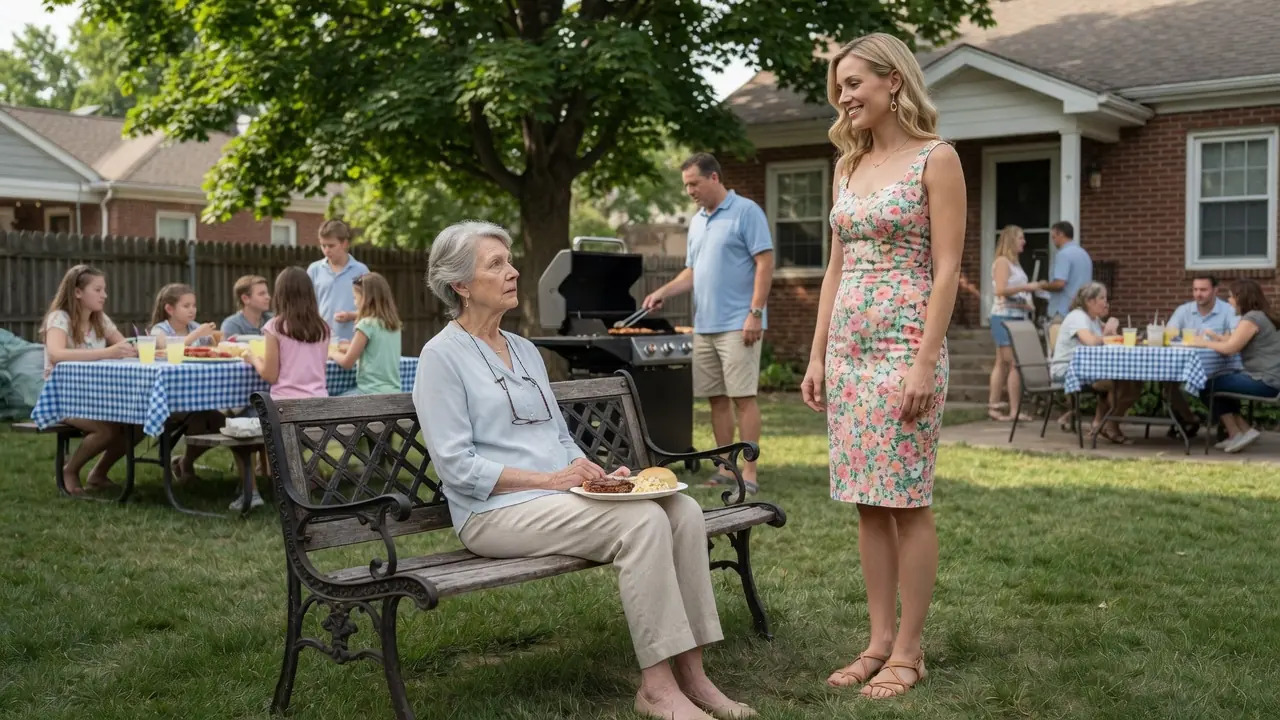
The sun was bright over Denver, the barbecue grill was smoking near the patio, and five children were running across the lawn with sticky fingers and paper cups of lemonade.
I was sitting on the garden bench with an untouched plate in my lap, listening to the laughter around me and trying to pretend it still belonged to me.
Then Chloe Patterson stood in front of me, lifted her chin, and calmly announced that I would not be invited to her and Julian’s anniversary dinner.
“It’s family only this year,” she said.
She said it so smoothly that at first I thought I had heard her wrong.
My name is Eleanor Patterson, and I was sixty-five years old when I finally learned that silence is not always kindness. Sometimes silence becomes the carpet other people wipe their feet on before walking into your life and taking whatever they want.
I owned the duplex where my son Julian and his wife Chloe lived upstairs.
I lived on the ground floor beneath them.
For five years, I had paid the property tax, water, electricity, heating, garbage collection, internet, groceries, repairs, lawn service, and every little household expense they somehow never noticed until it stopped being free.
They called it family.
I called it helping.
But by the end, Chloe had begun treating my help like rent she was owed for tolerating my existence.
The backyard had once been my favorite part of the house. My late husband, David, planted the old maple tree near the back fence, and every spring he would sit under it with coffee and say the yard had more patience than people.
After he passed, I kept the garden trimmed because it made the silence feel less empty.
The roses along the fence were mine.
The tomato beds were mine.
The garden bench beneath the maple tree was the last thing David ever built for me before his hands grew too weak from illness.
But after Julian and Chloe moved in, the yard slowly became theirs.
At first, I did not mind.
They had children, friends, birthday parties, summer cookouts, and a noisy young life I thought would make the house feel alive again. After losing David, I was too grateful for noise to question who was making it.
Chloe bought expensive outdoor furniture and placed it across my ground-floor patio without asking.
A sectional couch blocked the garden path.
A glass-top table sat where David and I used to drink morning coffee.
She filled my storage shed with pool toys, folding tables, seasonal decorations, outdoor cushions, Halloween props, and party supplies for events I was rarely consulted about but often expected to clean after.
I told myself families share space.
I told myself a widow should be grateful to have her son nearby.
I told myself Chloe was young, busy, overwhelmed, and maybe a little careless.
Not cruel.
Then careless became entitled.
Entitled became dismissive.
Dismissive became the kind of public disrespect that makes every guest stare at the grass because no one wants to admit what they just witnessed.
That Saturday barbecue was supposed to be simple.
Chloe had invited her parents, Diane and Robert Whitman, her two sisters, a cousin from Aurora, three neighbors, and enough children to make the lawn feel like a schoolyard.
I had made the potato salad.
I had bought the hamburger patties, hot dogs, buns, fruit, ice, and paper plates.
I had refilled the lemonade twice and brought out extra napkins when Chloe’s sister knocked over a tray near the patio.
Chloe accepted it all with the cheerful efficiency of a woman receiving service she believed was owed to her.
She wore a white sundress, gold sandals, and a smile that grew brighter whenever other people watched her. She moved from guest to guest holding a glass of sparkling water, acting as if she had personally created the sun, the yard, and the food.
Julian stood near the grill pretending to be useful.
He flipped burgers he had not bought with charcoal I had picked up that morning.
He was thirty-nine years old, my only child, and in small private moments, he could still be gentle. He called me when he needed advice about work, remembered David’s birthday every year, and sometimes brought me coffee without being asked.
But Julian was weak when peace required a spine.
Chloe had learned that if she raised her voice or acted wounded, Julian would fold himself smaller until the disagreement passed.
I had watched it happen for years.
Worse, I had watched him let it happen to me.
I asked about the anniversary dinner because Chloe had been talking about it all afternoon.
She mentioned the steakhouse downtown, the private room, the wine list, and how excited her mother was to “finally get everyone together.”
Naturally, I thought I was included.
I had attended every anniversary dinner for the first four years.
I had paid for two of them.
I had watched their children overnight for another, so Chloe and Julian could stay at a hotel and “reconnect.”
“What time is the dinner next Friday?” I asked gently.
Chloe turned toward me as if I had stepped out of place.
The conversation around the patio thinned. It did not stop completely, but it softened enough that I knew people were listening.
She smiled with all her teeth and no warmth.
“Oh, Eleanor,” she said. “The anniversary dinner is family only this year. It would be better if you didn’t come.”
For a second, I thought I had misunderstood.
The children were still laughing near the fence. A paper plate slid off the picnic table. Someone’s soda can tipped over in the grass.
Life kept moving while my heart stood perfectly still.
I looked at Julian, waiting for him to correct her.
He looked down at the grill.
“Family only?” I repeated.
Chloe gave a small sigh, the kind people use when they want to make your hurt look unreasonable.
“It’s just more intimate that way,” she said. “My parents, my sisters, a few close relatives, Julian and me. We don’t want it to become a big obligation.”
A big obligation.
That was what I had become.
Not the mother who raised Julian alone after his father died.
Not the woman who kept a roof over their heads for five years.
Not the grandmother who picked up sick children from school, paid for dance shoes, bought groceries, and cooked Sunday dinners.
An obligation.
Her mother, Diane, stood near the patio with a glass of wine in her hand and looked away.
Her father suddenly became fascinated by the bowl of chips.
That was when I understood the dinner was not small at all.
I was the only person being removed.
I set my plate on the bench beside me.
My appetite had vanished, but my voice did not shake.
“I see,” I said.
Julian finally looked at me.
“Mom, please don’t make this awkward.”
I looked at my son then.
Really looked at him.
He was not defending me.
He was not even privately asking his wife to be kinder.
He was asking me to make his discomfort easier.
In that moment, something inside me cooled.
“No, Julian,” I said quietly. “I think you’ve both made things very clear.”
Chloe smiled as if she had won.
She turned back to her guests and raised her voice about dessert, because people like Chloe believe changing the subject is the same as erasing what happened.
I stayed on the bench for another ten minutes.
Nobody said anything.
That silence hurt almost as much as Chloe’s words.
Then my granddaughter Lily came running over with red punch on her chin and asked if I wanted to see her cartwheel.
I smiled for her.
Of course I smiled for her.
Children should not have to carry adult cruelty before they understand what it is.
I clapped when she wobbled sideways across the grass.
Her brother Noah shouted that he could do better, then fell before he even started. Everyone laughed.
For one brief second, I felt the old ache again, the one that told me to keep quiet for the children.
Then I looked at Chloe, laughing with her sisters near my patio furniture, and I knew silence had already cost me too much.
That evening, after everyone left, I washed the serving bowls.
I wiped down the counters.
I put leftover food into containers, separated the trash, emptied the cooler, and carried sticky paper cups from the yard to the garbage bin.
Chloe did not help.
Julian carried one trash bag outside and then went upstairs with the expression of a man who wanted credit for surviving tension he had helped create.
I stood alone in my kitchen after that, listening to their footsteps above me.
The children were laughing upstairs.
Chloe’s voice floated through the floor, light and satisfied.
I made myself tea, sat in my armchair, and opened my tablet.
The photo appeared at 8:17 p.m.
It had been posted by Diane, Chloe’s mother.
The picture showed a long table at the best steakhouse in downtown Denver, filled with Chloe’s parents, her sisters, her cousins, Julian, Chloe, and several smiling relatives I had seen in my backyard only hours earlier.
Chloe sat in the center with a glass raised high.
Julian sat beside her, smiling fully.
Not awkwardly.
Not apologetically.
Fully.
The caption read: Only family tonight. So blessed to have all my favorites together.
Only family.
I stared at those two words for a long time.
My tea cooled beside me.
The house was quiet except for footsteps overhead and the faint hum of my refrigerator, the one stocked with food I had purchased for people who could not make room for me at a dinner table.
I did not cry.
Grief had made me familiar with tears, and this was not grief.
This was clarity.
Sharp and clean as cold water.
I pressed like on the photo.
Then I typed one sentence.
Then from now on, the family should also be the ones paying the family’s bills.
I hit send.
Then I set the tablet down and finished my tea.
Five minutes later, my phone began buzzing.
First Julian.
Then Chloe.
Then Julian again.
Then Chloe twice more.
I watched the screen light up and go dark, light up and go dark, while I walked to my filing cabinet.
In the bottom drawer, behind old insurance papers and David’s military discharge documents, was the thick household expense folder I had been preparing for weeks.
That was the part they never understood.
My decision did not begin with the Facebook photo.
The photo only gave the truth a stage.
I had been watching.
I had been calculating.
I had been documenting.
For five years, I had absorbed their expenses quietly.
At first, it was little things.
Julian and Chloe moved in after their rent increased, saying it would be temporary. Six months, maybe a year, just until they got ahead.
They had two children then and one income, because Chloe had decided to stay home “until things stabilized.”
I understood.
I loved my son.
I loved my grandchildren.
So I told them they could take the upstairs unit rent-free for a while.
A while became five years.
During that time, Chloe went back to work part-time, then full-time. Julian got promoted twice. They bought newer phones, a second car, Chloe’s designer bags, weekend trips, and the outdoor furniture now taking up my patio.
But rent?
Never.
Utilities?
Somehow always mine.
Groceries?
Family groceries, they called them.
Repairs?
Well, I owned the house, so they assumed those were my responsibility too.
My bank statements told a clearer story than their excuses.
Over the last year alone, I had paid more than eighteen thousand dollars in household costs directly connected to the upstairs unit.
Electricity during winter months when Chloe kept their heat at seventy-four.
Water bills inflated by endless laundry, long showers, kiddie pools, and outdoor sprinklers.
Internet service because Chloe needed strong Wi-Fi for work.
Trash removal after parties.
Repairs to appliances they used.
Groceries that disappeared from the basement fridge without a single thank you.
I had not planned to cut them off in anger.
I had planned to have a calm conversation at the end of the month.
But Chloe had stood in my backyard and called me not family.
So I decided to accept her definition.
I heard footsteps pounding down the stairs.
Hurried.
Uneven.
Then Julian knocked on my door as if the house were on fire.
I took my time placing the folder on the dining table before opening the door.
My son stood there breathless, his face flushed with panic.
“Mom,” he said, “what is with that comment? Chloe’s whole family saw it. She is humiliated. Delete it right now.”
I leaned against the doorframe.
“No.”
He blinked.
“No?”
“No, Julian. I am not deleting it.”
“This is our anniversary night.”
“No,” I said. “This was your family-only anniversary night. I was very careful to respect the distinction.”
His mouth opened, then closed.
He looked behind him toward the stairs, probably hoping Chloe would not come down yet.
“Mom, please. You’re making everything worse.”
I turned and picked up the top sheet from the folder.
“Starting the first of next month, the electricity and water for the upstairs unit will be in your names. I have already revoked the automatic payments from my account.”
Julian stared at the paper like it had become dangerous.
“What?”
“The heating bill will be transferred too,” I continued. “I’m also separating the shared utility meter. The technician is scheduled for Monday.”
“Why would you do this now?”
I smiled a little.
Not warmly.
Calmly.
“Because I realized I am not family. And if I am not family, I should not be carrying the family’s burdens.”
That was when Chloe appeared behind him.
She came down the stairs in her dinner dress, beautiful, furious, and embarrassed in exactly that order. Her heels hit the floor like punctuation.
“This is blackmail, Eleanor.”
“No, Chloe,” I said. “Blackmail is a threat. This is adult life.”
Her face tightened.
“You are punishing us because you were not invited to one dinner.”
“I am adjusting my expenses to match my status in your life.”
Julian rubbed his forehead.
“Mom, we haven’t budgeted for this.”
“You lived here rent-free for five years,” I said. “You had time.”
Chloe pointed toward my tablet on the chair.
“You embarrassed my mother online.”
I looked straight at her.
“Your mother posted that only family mattered while sitting beside my son at a table I was banned from. I simply agreed with her.”
For the first time that night, Chloe had no quick reply.
She looked at Julian, expecting him to fight for her, but he looked pale.
Maybe he had never seen the numbers before.
Maybe he had, and guilt was finally becoming heavier than obedience.
I walked to the dining table and opened the folder.
“Here,” I said. “Since everyone is awake, we might as well be honest.”
Julian did not move.
Chloe folded her arms.
“I am not looking at your little papers.”
“That is fine,” I said. “The bank has already looked at them. So has the utility company. So has the contractor scheduled for the meters.”
Julian stepped forward slowly.
“What is all this?”
“Records.”
He picked up the first page.
His face changed as he read.
Electricity.
Water.
Heating.
Internet.
Insurance increase.
Plumbing repairs.
Washer maintenance.
Grocery averages.
Yard care.
Property tax.
Household supplies.
Beside each category was the yearly amount I had paid.
At the bottom was a total.
Julian swallowed.
Chloe leaned over his shoulder, then snatched the page from his hand.
“This is ridiculous,” she said. “You were helping us.”
“Yes,” I replied. “I was.”
“You offered.”
“For a temporary period.”
“You never said it had to end.”
“I never imagined I would need to explain that five years of free housing was not a lifetime contract.”
Her cheeks flushed.
“We have children.”
“I know. I helped raise them.”
Chloe’s eyes narrowed.
“If you cut us off like this, you are hurting your grandchildren.”
That was her strongest weapon.
She knew it.
I knew it.
Julian knew it too, because he looked at me quickly, ashamed before I even answered.
“No,” I said quietly. “You are their parents. You are responsible for providing for them. I will always love Noah and Lily, but I will no longer let you use them as a shield for your entitlement.”
Chloe stepped back as if I had slapped the air between us.
Julian whispered, “Mom.”
I held up one hand.
“No. Not tonight. You both made it clear I am not family when it comes to celebration, respect, and inclusion. So from this point forward, I will not be family when it comes to your bills.”
Chloe’s voice sharpened.
“You are going to regret this.”
I looked at her evening dress.
Then at my son’s tired, silent face.
“No, Chloe. I think regret is finally moving upstairs.”
The next morning, the duplex was silent.
Usually, I heard Chloe moving around above me, drawers opening, heels clicking, commands traveling through the ceiling as if sound obeyed her.
That morning, nothing.
I made coffee, fried one egg, and ate breakfast at my kitchen table with the household folder open beside me.
For the first time in years, breakfast tasted peaceful.
At noon, the utility technician arrived.
His name was Pete, and he was polite, professional, and blessedly uninterested in family drama. I led him to the basement where the meters and panels were located.
He had just opened his toolbox when the basement door flew open.
Chloe stood at the top of the stairs in a robe.
“What is going on?”
“The upstairs unit is getting its own meter,” I said without turning around. “From now on, you pay for what you use.”
She came down fast, gripping the railing.
“You cannot do this without warning.”
“I warned you yesterday.”
“You warned us in a Facebook comment.”
“No,” I said. “I announced the end of my silence in a Facebook comment. The paperwork was already in motion.”
Her eyes flicked toward Pete.
He wisely continued working as if he had been born deaf to domestic disputes.
Chloe lowered her voice.
“Do you have any idea how cruel this is?”
I turned to her then.
“Cruel is excluding a widow from her son’s anniversary dinner while living upstairs in her house for free. A utility bill is not cruelty. It is arithmetic.”
She stared at me with pure disbelief.
Chloe had mistaken my generosity for dependence.
She believed I paid because I needed them close.
Because I feared an empty house.
Because widows were supposed to be grateful for noise, even when the noise carried disrespect.
She did not understand that I had been lonelier beneath their footsteps than I had ever been alone.
The meter work took most of the afternoon.
Chloe stayed upstairs.
Julian came down once and asked Pete a few practical questions in a small, strained voice.
I almost felt sorry for him.
Almost.
But then I remembered him smiling in that steakhouse photo, sitting under the words only family while I sat alone downstairs.
Sympathy cooled quickly after that.
On Monday, I reclaimed the backyard.
Chloe had arranged her expensive outdoor furniture across my patio, blocking the maple tree and the garden bench David had built for me.
I hired two college students from the neighborhood to move every piece carefully to Julian and Chloe’s upstairs deck.
Nothing was damaged.
Nothing was thrown away.
And nothing remained where it did not belong.
Then I went to the garden center.
I bought two Adirondack chairs, a small teak table, three pots of lavender, and a wooden privacy screen.
By five o’clock, my patio looked like mine again.
I sat under the maple tree with a glass of white wine and a book, feeling the evening air move through the leaves.
The garden had room to breathe.
So did I.
Chloe came home at 5:40.
I heard her stop before I looked up.
“Where is my furniture?” she demanded.
“On your deck.”
“We always grill down here.”
“You still can,” I said, turning a page. “On your deck. You’ll have more privacy for family-only gatherings.”
Her face reddened.
“You are being petty.”
“No,” I said. “Petty would have been putting it on the curb. I put it where it belongs.”
Her mouth opened.
Closed.
Opened again.
Then she turned and stormed upstairs.
I took another sip of wine.
It tasted better than apology.
The laundry room came next.
I owned a high-end washer and dryer in the basement, bought after David died because bending over the old machines hurt my back.
Chloe had treated them like public property for years.
She left wet clothes sitting inside.
She spilled detergent across the shelf.
She piled unfolded laundry on my folding table until I moved it because I needed the space.
She washed small loads whenever she felt like it, using hot water, extra rinse cycles, and specialty detergent she did not buy.
I once believed doing small things for family was love.
Now I understood love without respect becomes labor.
On Wednesday morning, I found Chloe’s blouses, Julian’s gym clothes, and the children’s soccer uniforms scattered across the folding table.
I said nothing.
I took a heavy-duty plug lock from my toolbox and secured the washer cord.
Then I put the key in my pocket and went upstairs to make lunch.
That evening, Julian knocked softly.
He looked tired before he even spoke.
“Mom, did you lock the washer?”
“Yes.”
“Chloe has a meeting tomorrow. Her suit is in there.”
“There is a laundromat three blocks away.”
He looked like a child being told no for the first time.
“Can’t you just unlock it tonight?”
“No.”
“Mom, come on.”
I folded my hands in front of me.
“Julian, this is not an emergency. It is inconvenience. You are old enough to know the difference.”
Chloe stepped out from behind him, her face red.
“You are trying to kick us out.”
“I am taking care of my property.”
“This is insane.”
“No,” I said. “Insane was pretending independence meant using everything I own while treating me like an inconvenience.”
She took a step forward.
“Those are your grandchildren’s clothes too.”
“And you are their mother,” I replied. “The laundromat has machines large enough for all of it.”
Chloe looked at Julian.
“Say something.”
Julian opened his mouth.
Then he looked at me.
For a second, I thought he might finally defend something true.
Instead, he whispered, “Let’s just go, Chloe.”
It was not courage.
But it was no longer complete surrender either.
Saturday brought groceries.
For years, I had done the big grocery run for all of us. I filled the basement fridge with steaks, fruit, vegetables, bottled drinks, snacks for the children, Chloe’s preferred sparkling water, and Julian’s favorite smoked turkey.
They never asked how much it cost.
They simply opened the fridge and helped themselves.
That morning, I bought salmon, asparagus, fruit, tea, and a small bottle of wine for myself.
When I came home, I emptied the basement fridge.
I wiped it clean, unplugged it, and left the door propped open.
It looked peaceful and useless.
Exactly how I wanted it.
At 6:20, Chloe knocked on my door.
Actually, she tried the handle first, because she had never learned to knock in a house she did not own.
I had started locking my door.
When I opened it, she looked offended.
“The basement fridge is empty.”
“Yes.”
“Where is the food for the weekend?”
“In the store, I imagine.”
She gasped.
“We have nothing upstairs.”
“That sounds like something you should have checked before dinner.”
“You could have told us.”
“I did tell you,” I said. “Family bills, family groceries, family utilities. All returned to the family that counted.”
She stared at me as if I had become a stranger.
Maybe I had.
Or maybe she was only now meeting the woman who had been behind the kindness all along.
Sunday used to be my cooking day.
Julian loved roast chicken, baked pasta, garlic potatoes, and the kind of family meals that made a house smell loved.
Chloe often invited her parents or friends without asking me, then acted surprised when I looked tired after cooking for ten people.
That Sunday, I did not put on an apron.
I showered, wore my favorite blue dress, added lipstick, and drove to a quiet bistro by the lake.
I ordered lunch, a glass of champagne, and dessert because no one was there to tell me it was too much.
Afterward, I walked along the water, watching sunlight shimmer against the surface.
For the first time in years, my Sunday belonged to me.
When I got home around five, Julian was sitting on the bottom porch step.
“Mom, where were you?” he asked.
“At lunch.”
“Chloe’s parents came over.”
“How nice.”
“We thought you were cooking.”
“Why?”
He blinked.
“Because it’s Sunday.”
I smiled gently.
“Sunday still happened, Julian. It simply did not happen for you in my kitchen.”
He lowered his head.
“It was awkward.”
“I imagine it was.”
“Her mother kept asking where you were.”
“You could have told her I was enjoying my free time instead of cooking for people who exclude me from milestones.”
He looked exhausted.
“Chloe says this house feels hostile now.”
“No,” I said. “It feels honest now. That can be uncomfortable at first.”
Two days later, Julian came downstairs with apartment listings, budget notes, and the face of a man discovering math very late in life.
I made tea and let him sit at the dining table.
He spread the papers out slowly.
Rent in Denver was high.
Utilities were worse.
Groceries looked different when they were no longer appearing magically in the basement fridge.
He rubbed his eyes with both hands.
“Mom,” he said quietly, “can’t we go back to how it was?”
“No.”
He flinched.
I softened my voice, but not the answer.
“Julian, this is not only about one dinner photo. You lived here for free, let your wife treat me like an obligation, and expected me to keep paying because I loved you.”
“I know,” he whispered.
I watched him struggle with the words.
Then he finally said them.
“I was a coward.”
“Yes,” I said.
Not cruelly.
Truthfully.
His eyes filled.
“I wanted peace.”
“You cannot buy peace by letting someone else be disrespected.”
He looked down at the numbers.
“I didn’t think about how much you were paying.”
“That is part of the problem.”
“I thought you wanted to help.”
“I did.”
He looked up.
“Then what changed?”
I held his gaze.
“I realized helping you was teaching you to take me for granted.”
That landed harder than I expected.
Julian’s face tightened with shame.
I slid a printed lease form across the table.
“If you stay upstairs, we sign a formal lease. Fair rent, separate utilities, separate groceries, shared-space rules, washer use by schedule, and respectful boundaries.”
He looked at the papers.
“If that does not work for Chloe,” I continued, “you are both free to move.”
He swallowed.
“She will never agree.”
“Then she can choose differently.”
The storm came upstairs that night.
Chloe’s voice rose and fell.
Doors slammed.
Furniture shifted.
At one point, I heard her say, “Your mother is trying to control us.”
Then I heard Julian answer, low but clear.
“No. She stopped paying for us.”
The silence after that was long.
I sat in my living room with tea and soft music playing.
I did not go upstairs.
Adults were finally meeting the consequences of adult choices.
The next morning, I placed ten moving boxes in the hallway.
Then I knocked on their door.
Chloe opened it in a robe, eyes red, jaw tight.
“What do you want?”
“I brought boxes,” I said. “Julian mentioned my terms were unacceptable. I wanted to make moving easier.”
She stared at me.
“You would throw your own son out?”
“Julian is welcome here under respectful terms. If he chooses to leave with you, that is his decision.”
“You are heartless.”
“No,” I said. “I am finished being useful without being valued.”
For once, Chloe stepped back.
Her usual weapons had failed.
Guilt.
Outrage.
Embarrassment.
Public pressure.
Wounded pride.
I had walked off her chessboard, and she did not know how to move pieces on a board I no longer stood on.
That afternoon, Diane came over.
Chloe’s mother.
She arrived wearing cream linen pants and a carefully concerned expression, carrying a bakery box as if pastries could sweeten the conversation.
I let her in because I was curious.
She sat at my table, looked around my kitchen, and said, “Eleanor, this has gone far enough.”
I poured tea.
“For whom?”
She blinked.
“For the family.”
I smiled faintly.
“There is that word again.”
Diane sighed.
“Chloe should not have said what she said. I admit that. But you know how she is.”
“Yes,” I said. “I do.”
“She speaks before thinking.”
“No. She thinks very carefully before speaking. That is why it lands where she aims.”
Diane’s lips pressed together.
“She feels attacked.”
“She excluded me publicly while benefiting privately. Now she feels consequences. That is not the same as being attacked.”
Diane folded her hands.
“Julian is your son.”
“Yes.”
“And the children are your grandchildren.”
“Yes.”
“Then surely you do not want them struggling.”
I leaned back.
“Diane, your daughter and son-in-law have lived rent-free for five years. If they are struggling now, it is not because I stopped helping. It is because they wasted the help.”
Her face flushed.
“That is unfair.”
“No,” I said. “It is a bank statement.”
I placed a copy of the yearly expense summary in front of her.
She did not want to look.
But she did.
Her expression changed as the numbers reached her.
The bakery box sat untouched between us.
After a long silence, she said, “I didn’t realize it was that much.”
“No one ever does when someone else is paying.”
Diane left quietly.
She did not apologize.
But she did take the expense sheet with her.
That night, Chloe did not come downstairs.
The next week was colder inside the duplex than the Denver air outside.
Not because the heater failed.
Because politeness had ended before honesty had fully replaced it.
Julian transferred the upstairs internet account into his name.
Chloe complained that the speed package I had been paying for was too expensive.
They lowered it.
Then complained that streaming lagged.
I said nothing.
Their first independent grocery order arrived on Thursday.
I heard Chloe gasp upstairs when the total came through.
The children came down Saturday morning, asking if I had pancakes.
I did.
Of course I did.
But I made only enough for the three of us.
No extra trays.
No upstairs delivery.
No plate covered in foil for Chloe because she liked to sleep late.
No second pot of coffee for Julian.
No family buffet.
Just me, Noah, and Lily at my kitchen table.
Lily asked, “Grandma, why doesn’t Mommy come eat pancakes anymore?”
I buttered her toast gently.
“Because grown-ups are learning how to take care of their own kitchens.”
Noah frowned.
“Does that mean we can still eat here?”
I smiled.
“You are always welcome at my table when you come with kindness.”
He nodded solemnly.
Children understand more than adults think.
They also accept simple rules better than adults do.
Two weeks later, a small moving truck pulled into the driveway.
Chloe could not bring herself to pay rent to her mother-in-law.
She and Julian had found a two-bedroom apartment across town. It was smaller, less convenient, and completely theirs, which apparently was less attractive than free comfort under my roof.
Julian carried boxes quietly.
He looked more ashamed than angry.
Chloe supervised with sunglasses on, though the day was cloudy. She did not speak to me except to ask where I had put one of her patio cushions.
“On your deck,” I said.
She turned away.
Noah and Lily were confused.
Children always are when adults call disruption “necessary.”
I hugged them both and told them my door was open for visits, sleepovers, pancakes, homework, and garden days.
Lily cried.
Noah tried not to.
Julian watched from beside the truck, and I saw guilt move through him like weather.
When the upstairs unit was empty, he came down and handed me the keys.
“I’m sorry, Mom,” he said.
His voice broke on the last word.
“For all of it.”
I took the keys.
Then I hugged him because he was my son, and love does not disappear just because respect was late.
But the hug was not a surrender.
It was a doorway.
“I love you, Julian,” I said. “But I will never again pay to be treated like a ghost in my own home.”
He nodded.
“I know.”
Chloe waited in the car, staring straight ahead.
She did not wave.
I did not need her to.
After they drove away, the house was quiet.
Not abandoned quiet.
Not lonely quiet.
Peaceful quiet.
The kind that lets you hear yourself breathe without someone else’s entitlement pressing against the walls.
I went upstairs to the empty unit and opened the windows.
The rooms smelled like floor cleaner, cardboard, and new possibility.
I walked through each room slowly.
The living room.
The kitchen.
The small bedroom where Noah had once taped dinosaur drawings to the closet door.
The larger bedroom where Chloe had kept too many shoes and too little gratitude.
I did not feel triumph.
I felt space.
There is a difference.
I decided I would repaint.
Repair the deck.
Replace the scratched cabinet handles.
Maybe rent the unit to someone respectful.
A retired couple.
A travel nurse.
A quiet teacher.
Someone who understood that a house is not a resource to drain, but a place to honor.
The rent would pay for travel.
Maybe Italy.
Maybe the south of France.
Places David and I once talked about seeing but never reached because life, work, illness, and family needs always came first.
That evening, I sat in my Adirondack chair under the maple tree with tea instead of wine.
The garden looked different without Chloe’s furniture crowding it.
The maple leaves moved lightly in the Denver breeze.
For a moment, I imagined David sitting beside me, smiling because I had finally remembered the house was mine.
I opened my tablet and looked once more at the anniversary photo.
It no longer hurt the same way.
It felt like evidence from another life.
The last scene before a woman stopped shrinking herself to fit into a family that wanted her money but not her presence.
Three months later, Julian came for Sunday breakfast.
Alone at first.
Then the next week, he brought Noah and Lily.
He knocked properly.
That mattered more than he knew.
He brought groceries too.
Eggs.
Milk.
Orange juice.
A bag of flour.
He set them on the counter and said, “I thought I should contribute.”
I looked at him for a long second.
Then I smiled.
“That would be welcome.”
We cooked together.
Not perfectly.
He burned the first batch of pancakes.
Noah laughed so hard he spilled juice.
Lily asked if Grandpa David ever burned pancakes, and I told her the truth.
“Only when he tried to flip them too high.”
Julian smiled at that.
A real smile.
The kind that remembered who he had been before comfort made him careless.
Chloe did not come for several weeks.
When she finally did, it was only to pick up the children after breakfast. She stood at the door, stiff and pale, and said hello with the strained effort of someone swallowing pride.
I said hello back.
No more.
No less.
She looked past me into the kitchen, where Julian was washing dishes without being asked.
Something in her face changed.
Perhaps surprise.
Perhaps irritation.
Perhaps the first unpleasant realization that I had not damaged my son by setting boundaries.
I had helped him grow up.
A year after the family-only dinner, Julian invited me to his and Chloe’s anniversary meal.
This time, he called me himself.
Not Chloe.
Not a group text.
Not an afterthought.
“Mom,” he said, “we would like you to come. And I want to say clearly, you are family. You always were. I should have said that sooner.”
I sat quietly with the phone in my hand.
The old part of me, the part trained to accept crumbs of respect as if they were feasts, almost said yes immediately.
But the woman under the maple tree knew better.
“Thank you,” I said. “I appreciate the invitation. I will think about it.”
He paused.
“Of course.”
That answer told me he had learned something.
The dinner was at a modest Italian restaurant, not the expensive steakhouse downtown.
When I arrived, Julian stood and pulled out my chair.
Chloe did not glow at the center of the table this time.
She sat quietly, hands folded, and looked at me with discomfort she could not decorate into charm.
Before anyone ordered, she cleared her throat.
“Eleanor,” she said, “I was wrong last year.”
The table went silent.
Her mother Diane looked down.
Julian watched his wife carefully.
Chloe continued.
“I said something cruel. I benefited from your generosity and then acted as if you were outside the family. I am sorry.”
It was not a perfect apology.
It was not warm.
It did not erase five years.
But it was direct.
I accepted it with a nod.
“Thank you, Chloe.”
Nothing more.
Forgiveness is not the same as returning the keys.
That night, when the bill came, Julian picked it up.
He did not look at me.
He did not hesitate.
He paid.
And I let him.
On the drive home, I passed my own house and saw the upstairs lights glowing softly. My new tenant, a pediatric nurse named Marisol, had moved in two months earlier.
She paid rent on time.
She kept flowers on the deck.
She asked before using the backyard and always brought me tamales when her mother visited.
The house felt balanced now.
Alive without being invaded.
Full without being consumed.
I parked in the driveway, walked through my garden, and touched the maple tree as I passed.
The bark was rough beneath my palm.
David’s tree.
My tree.
My yard.
My home.
I did not plot revenge.
I did not scream.
I did not beg.
I simply stopped paying the price of being excluded.
Chloe said the dinner was family only.
So I let family pay the family bills.
And in doing so, I took back the keys to my home, my peace, and my own story.