Dr. Maya Bennett was forty-seven seconds from the parking-garage elevator when her phone vibrated against the pocket of her royal-blue scrub pants. She was moving quickly already, one hand wrapped around a stainless-steel coffee tumbler she had forgotten to drink from and the other holding a slim tablet filled with morning staffing reports. The screen lit with a red notification from St. Catherine Medical Center’s internal emergency system, the kind of alert that bypassed silent mode and reached only a small group of senior clinical leaders.
PICU RAPID ESCALATION. PEDIATRIC TRANSFER ETA 6 MIN. RESPIRATORY FAILURE. EQUIPMENT/STaffing ISSUE. CNO REQUESTED.
Maya stopped only long enough to read it twice.
Then she started moving faster.
She had been scheduled to spend the morning in budget meetings, which meant she wore the same practical blue scrubs she often chose whenever administrative work might pull her back onto clinical floors. She had learned years earlier that expensive suits became ridiculous during genuine emergencies. Scrubs did not care whether someone controlled a hospital budget or changed bed linens. They simply allowed movement.
Maya was thirty-eight, slim but athletic, with warm olive skin, dark-brown eyes, and long black hair tied into a low ponytail at the base of her neck. She wore almost no jewelry beyond a thin wedding band and a smartwatch that constantly reminded her she did not sleep enough. Her hospital badge was clipped at her waist beneath the hem of her scrub jacket, mostly hidden unless someone looked carefully.
Few visitors recognized her.
That was normally useful.
Maya had been Chief Nursing Officer of St. Catherine for fourteen months, becoming the youngest person ever to hold the position in the hospital’s seventy-eight-year history. Her responsibilities covered nearly 2,300 nurses, nursing assistants, patient-care technicians, clinical educators, staffing coordinators, and several operational teams whose names sounded boring until something went wrong. She spent more time analyzing infection rates and staffing ratios than standing beside patients now, but she still maintained her nursing license and routinely walked floors without announcing herself.
She hated leaders who knew their hospitals only through dashboards.
The parking garage sat beneath the eastern tower, directly below the emergency department and pediatric wing. The row nearest the elevator contained six wheelchair-accessible spaces with striped access aisles wide enough for ramps, mobility devices, and emergency transfers. Maya had helped approve new signage there only three months earlier after a visitor complained that vehicles repeatedly blocked the painted pathways.
She reached the final turn.
Then stopped.
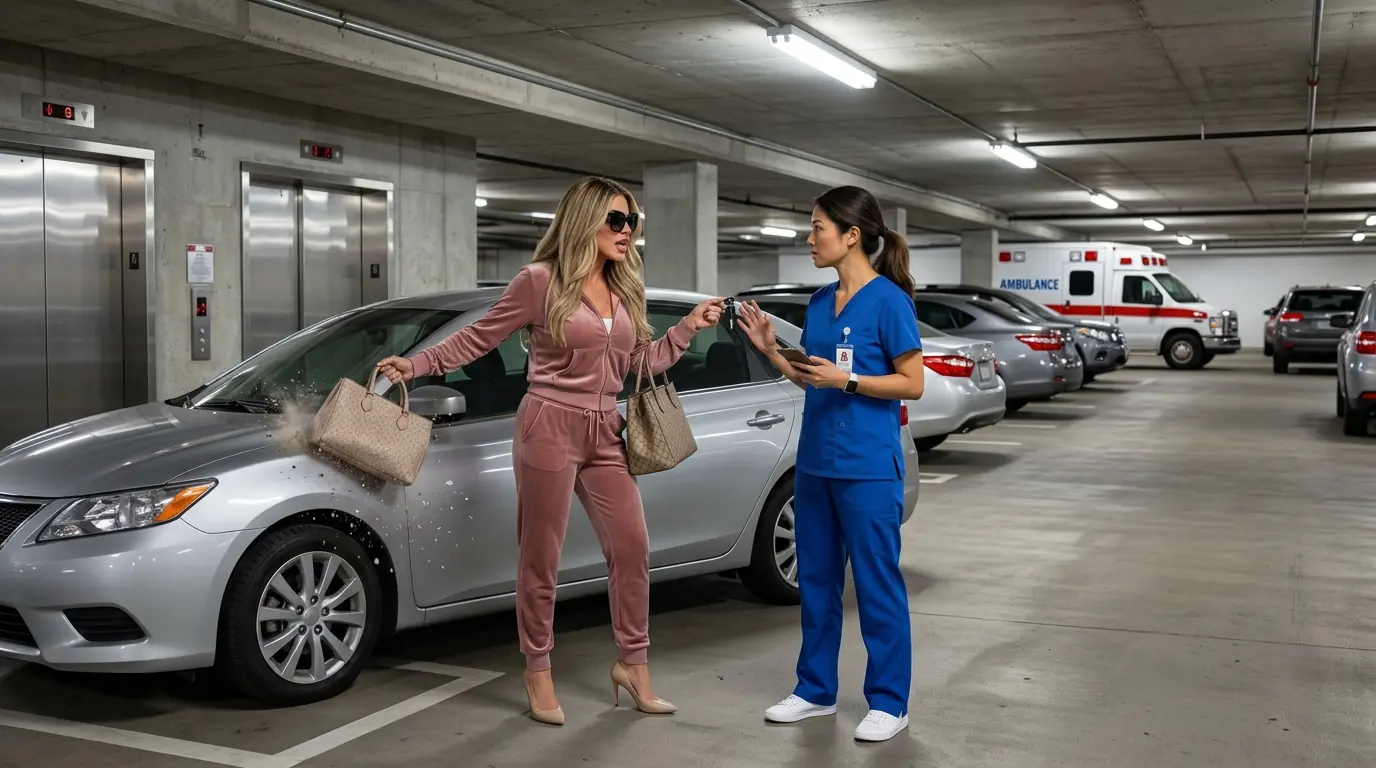
A silver luxury sedan had been parked diagonally across one accessible space and most of the striped access aisle beside it. The front wheel crossed the blue boundary line. The rear quarter nearly touched the concrete column. Whoever had parked it had treated the markings like decoration.
Beside the car stood a woman in a dusty-pink velour tracksuit.
Vanessa Cole.
Maya did not know her name yet.
She noticed the sunglasses first.
Huge.
Black.
Designed more for a resort than an underground garage.
Vanessa was forty-seven, blonde, carefully styled, and wore expensive beige heels that clicked sharply against the concrete. A large patterned tote hung from one forearm while she searched through it with increasing irritation.
Maya looked at the car.
Then the sign.
Then Vanessa.
“Excuse me.”
Vanessa kept searching.
Maya stepped closer.
“Ma’am?”
Vanessa finally looked up.
“Yes?”
“That vehicle is blocking the accessible access aisle.”
Vanessa glanced toward the sedan.
Then back.
“I’ll be five minutes.”
Maya checked her phone.
The emergency alert updated.
ETA 4 MIN.
She kept her voice controlled.
“You need to move it now.”
Vanessa’s eyebrows lifted.
It was not the request that offended her.
It was the assumption that Maya expected compliance.
“I said I’m going inside for five minutes.”
“The access aisle needs to stay clear even for five minutes.”
Vanessa sighed.
“I’m not in anybody’s way.”
Maya pointed toward the painted stripes.
“That section is specifically designed so wheelchair users can exit vehicles and deploy ramps.”
“There are other spaces.”
“That doesn’t make this one optional.”
Vanessa put her sunglasses back over her eyes.
“You work here?”
“Yes.”
“Then go to work.”
Maya stared.
“I’m trying to.”
She gestured toward the elevator.
“Move your car.”
Vanessa’s mouth tightened.
“I parked where I want.”
She held up her keys.
“You can walk around.”
Maya felt the first spark of anger.
Not because Vanessa was rude.
Hospital leadership exposed her to more sophisticated forms of rudeness every day.
Because the access aisle existed for people who could not simply “walk around.”
Maya had spent nine years as a bedside nurse before moving into administration. She remembered patients struggling with wheelchairs, oxygen tanks, walkers, prosthetics, and exhaustion that made a thirty-foot detour feel like half a mile. Accessibility was not abstract to her. It was whether someone could enter a building without being forced to negotiate another person’s convenience.
Her phone vibrated again.
PICU CALLING.
Maya answered.
“This is Bennett.”
A nurse spoke rapidly.
“We have the Warren child four minutes out. Severe respiratory distress following transfer from Franklin County. Transport team reports sats unstable despite support. We have one high-flow unit tied up in isolation and Respiratory says backup system is still in Biomed. Charge nurse is trying to pull another from adult step-down.”
Maya’s expression changed.
“Who’s on PICU?”
“Dr. Levin, Dr. Shah, two respiratory therapists, three nurses. One nurse called out this morning.”
“Float?”
“None immediately credentialed for pediatric critical care.”
“I’m coming.”
“We need authority to pull equipment from surgical recovery if Biomed doesn’t release backup.”
“You have it. I’ll call operations from the elevator.”
Maya ended the call.
Vanessa was watching.
For half a second Maya thought the medical urgency might finally make the situation obvious.
Instead Vanessa said:
“If you’re late, that’s not my problem.”
Maya stared.
“Move the car.”
Vanessa crossed her arms.
“You people always act like everything is an emergency.”
Maya’s face became still.
“You people?”
“Nurses.”
Vanessa waved dismissively.
“Doctors, nurses, whatever. Everybody in hospitals acts like the world stops because your shift started.”
Maya looked toward the elevator again.
She had a decision.
She could walk around.
Physically, yes.
It would take perhaps twenty additional seconds.
She could let security handle the vehicle later.
That was probably the rational response.
Then she noticed something else.
A minivan was turning slowly into the row.
A wheelchair-accessible minivan.
Its side ramp markings were visible.
The driver slowed near the accessible spaces.
Saw Vanessa’s sedan blocking the only wide access aisle beside an empty spot.
Paused.
Then continued farther down the garage.
Maya watched it disappear.
That changed the equation.
The blocked access had already affected someone.
“Ma’am.”
Her voice became firmer.
“You are preventing another disabled visitor from using this area.”
Vanessa turned and saw the minivan moving away.
“There are spaces downstairs.”
Maya felt something cold settle inside her.
“Move the car.”
Vanessa stepped closer.
“No.”
The answer seemed to surprise even Vanessa.
But once spoken, pride took control.
She lifted her keys between two fingers.
“You do not order me around.”
Maya looked directly at her.
“I’m not trying to control you.”
“I’m telling you what the posted sign already says.”
“This space is reserved.”
“The striped section must remain clear.”
Vanessa laughed.
“You’re really enjoying this, aren’t you?”
“What?”
“Power trip.”
Maya nearly looked behind herself.
Vanessa continued.
“I deal with people like you all the time.”
“You get a uniform and suddenly you think everybody owes you obedience.”
Maya looked down at her scrubs.
“I’m wearing pajamas with pockets.”
That escaped before she could stop it.
Vanessa stared.
Maya almost smiled.
Wrong moment.
Vanessa stepped closer.
“There.”
“That attitude.”
Maya exhaled.
“I have a critically ill child arriving upstairs.”
“I need to get to the elevator.”
“You need to move your car.”
Vanessa’s expression changed slightly.
Not concern.
Suspicion.
“You’re lying.”
Maya blinked.
“What?”
“Now suddenly there’s a dying child because you want my parking space?”
Maya stared.
The sentence was so absurd she could not immediately answer.
Vanessa mistook silence for victory.
“Exactly.”
She placed her tote on the hood of the sedan.
“You’re a nurse.”
“Stop acting important.”
Maya’s phone vibrated.
Another alert.
PATIENT ARRIVED.
She began moving.
“Fine.”
Vanessa smiled.
Then stepped directly into Maya’s path.
Maya stopped.
“Move.”
“You’re going to apologize.”
“For what?”
“For speaking to me like I’m some criminal.”
Maya looked toward the sedan.
“You are illegally parked.”
“That doesn’t make me a criminal.”
“I didn’t call you one.”
“You implied it.”
“No.”
“You just want to win.”
Maya’s patience ended.
“I do not care about winning an argument in a parking garage.”
“There is a seven-year-old child upstairs who cannot breathe properly.”
“I am being requested in the pediatric critical-care unit.”
“Move your car and move out of my way.”
Vanessa stared.
Somewhere behind them, a door opened.
Footsteps approached quickly.
Maya saw movement beyond Vanessa’s shoulder.
Two hospital administrators.
Thomas Grant, Chief Operating Officer.
And Rebecca Sloan, Director of Emergency Operations.
They were coming almost at a jog from the secondary elevator corridor.
A hospital security supervisor, James Holloway, followed them.
Thomas carried a red emergency folder.
Rebecca had her phone pressed to one ear.
“Dr. Bennett!”
Vanessa turned.
Thomas walked directly past her.
“Maya, we have a problem upstairs.”
“I know.”
Rebecca ended her call.
“Biomed says backup respiratory unit won’t clear inspection for another twenty minutes.”
“Pull the surgical recovery unit.”
“I authorized it by phone.”
Thomas nodded.
“Already moving.”
He handed Maya the folder.
“Pediatric transport arrived two minutes early.”
“Dr. Levin wants executive approval to hold a second respiratory therapist past shift because the next team is delayed.”
“Approved.”
Maya turned toward James.
The security supervisor had stopped beside Vanessa’s car.
He looked at the accessible sign.
Then the vehicle.
Then Vanessa.
His expression hardened.
“Is this yours?”
Vanessa looked between everyone.
She had stopped speaking.
Thomas finally noticed the confrontation.
“What’s happening?”
Maya pointed briefly toward the vehicle.
“Blocked accessible aisle.”
“I asked her to move.”
“She refused.”
Thomas’s expression changed instantly.
Vanessa removed her sunglasses.
“Wait.”
James took out his phone.
He began photographing the license plate.
Vanessa stepped toward him.
“What are you doing?”
“Documenting the violation.”
“You can’t photograph my car.”
“We can document vehicles parked on hospital property.”
“I was only here for five minutes.”
James looked at the sedan.
“You’re in a reserved accessible space and across the striped access zone.”
Vanessa pointed toward Maya.
“She started this.”
Maya stared.
James remained professional.
“Ma’am, I need your keys.”