The first man laughed before the auctioneer finished saying the price.
Ruth Callahan heard him from somewhere behind her left shoulder.
A short bark of amusement.
Then another man joined him.
By the time Donnie Greer brought his wooden block down and shouted, “Sold! One hundred ninety-eight dollars for the lot,” half the cattle buyers leaning against the steel rail were smiling.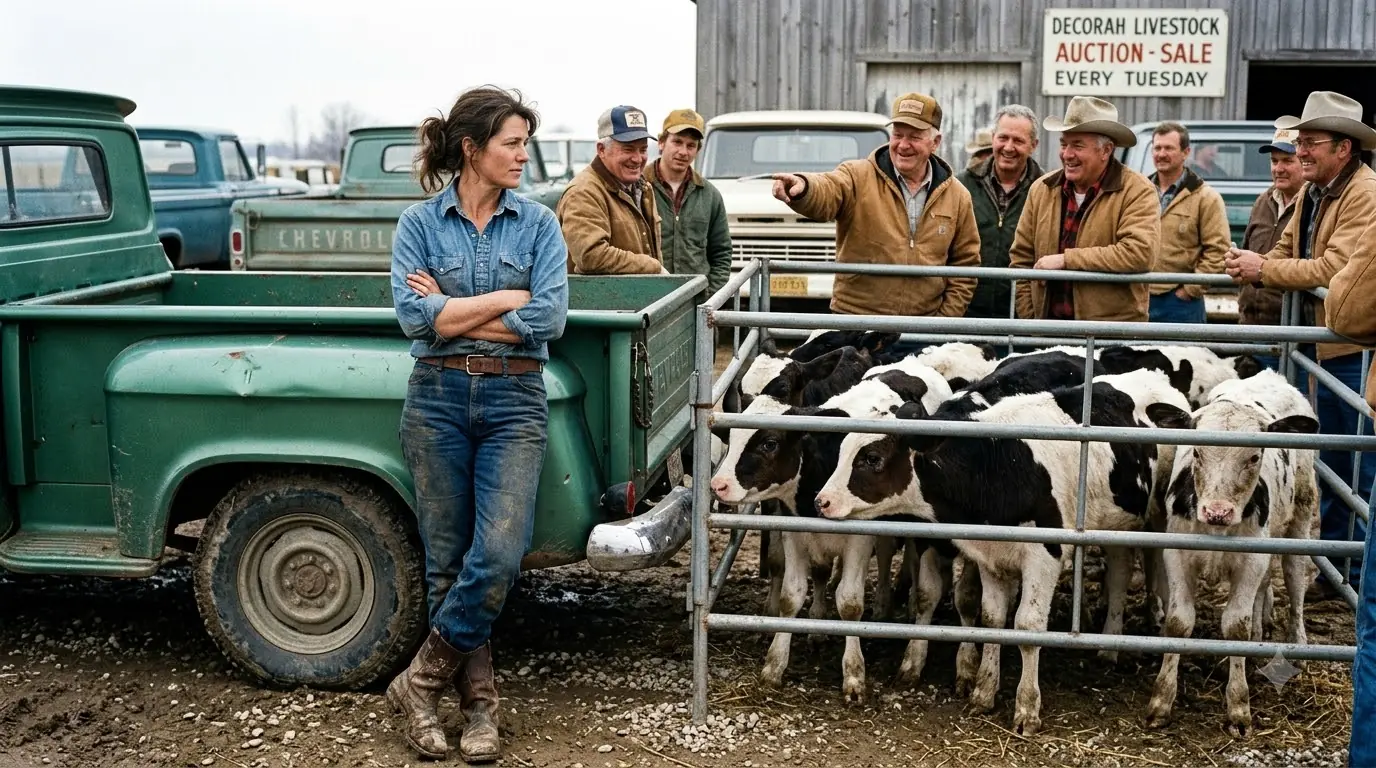
Not kindly.
Ruth remained where she was.
Arms folded.
Shoulder against the rear corner of her old Chevrolet pickup.
Mud had dried in pale streaks along her jeans from chores that morning. Her faded denim shirt was rolled to the elbows. Brown hair, already coming loose from the knot at the back of her head, moved in the cold March wind blowing through the open side of the sale barn.
Eleven Holstein bull calves crowded in Pen Twelve.
Crowded was generous.
Some stood.
Some leaned.
One lay curled in filthy straw with its nose against another calf's hind leg.
The smallest animal had a yellow ear tag marked 73.
He seemed more bone than calf.
The buyer who had laughed first stepped closer.
His name was Clifford Hayes.
Everyone called him Cliff.
Forty-eight years old.
Cattle dealer.
Broad chest.
Tan cowboy hat.
A belly that had grown steadily since his twenties.
He bought calves across northeastern Iowa and southern Minnesota, moved them between farms, and could estimate weight from fifty feet away with irritating accuracy.
He pointed at Pen Twelve.
“Two hundred dollars for that wreck?”
Ruth looked at him.
“Hundred ninety-eight.”
That made several men laugh harder.
Cliff grinned.
“Thank God you saved the two bucks.”
Ruth said nothing.
He walked to the rail and looked at the calves.
One coughed.
Another lifted its tail and passed watery manure.
Cliff made a face.
“Scours.”
“I can see.”
“Two of them at least.”
“Three.”
His grin weakened slightly.
“You counted?”
“Yes.”
He looked at her.
Then at the calves again.
One tried to stand.
Its back legs trembled.
The animal dropped to its knees.
Cliff pointed.
“That one won't make Thursday.”
Ruth looked at the ear.
Number 73.
She remembered it.
Cliff continued.
“You just bought eleven ways to lose money before April.”
Ruth uncrossed her arms.
On the bed of her pickup sat a red metal nursing bottle.
Old.
Dented.
Paint worn almost to bare steel around the handle.
Her father had used it for years.
Thomas Callahan could judge a calf's thirst from the way it moved its tongue.
He could tell early pneumonia by watching an animal breathe from across the pen.
He believed farmers who waited until livestock looked obviously sick had usually waited too long.
Ruth picked up the bottle.
Cliff laughed again.
“Planning to feed that whole cemetery with one bottle?”
She looked at him.
“I didn't buy them because they're healthy.”
“No?”
“No.”
“I bought them because I know why they're weak.”
The men behind him quieted slightly.
Cliff leaned against the pickup.
“And what's that great mystery?”
Ruth looked toward the pen.
“Mostly people.”
He frowned.
“What?”
She walked toward the gate.
“Bad milk schedule.”
“Cold pens.”
“Dirty buckets.”
“Not enough water once they started scouring.”
She looked back.
“Calves don't always die because they're worthless.”
Cliff shook his head.
“Lady, a bad calf is a bad calf.”
Ruth opened the latch.
“No.”
She stepped inside.
“Sometimes a bad calf is a decent calf that had a bad week.”
Cliff laughed.
“Put that on a sign.”
She ignored him.
Number 73 had raised his head.
Ruth crouched.
She pinched the loose skin along his neck.
It remained tented too long before falling.
Dehydrated.
She touched his mouth.
Cool.
Not good.
She pressed two fingers against his gums.
Sticky.
Worse.
Then she tried the suck reflex.
Weak.
But present.
That mattered.
Behind her, Cliff called:
“Don't get attached.”
Ruth did not turn.
“You selling advice now?”
“I'll give you that free.”
“I already bought enough today.”
He laughed.
Ruth looked at Number 73 again.
Small eyes.
Tired.
Still watching her.
She whispered:
“You better not embarrass me.”
The calf blinked.
That was all.
By noon, Ruth had loaded the eleven calves into a borrowed stock trailer.
The auction yard manager tried to convince her to take fewer.
“You can default on part of the lot if the office approves.”
“No.”
“Ruth.”
“No.”
“You've got three that need treatment today.”
“I know.”
He lowered his voice.
“You have a vet coming?”
“If I need one.”
“That sounds expensive.”
“Everything is expensive.”
He looked at the trailer.
Then at her.
“What are you trying to prove?”
Ruth tightened the gate chain.
“Nothing.”
He did not believe her.
Most people did not.
People liked simple motives.
Pride.
Revenge.
Stubbornness.
The truth was less dramatic.
Ruth was trying to keep the Callahan farm alive.
The farm sat eight miles outside Decorah.
Eighty-six acres.
Thirty-two workable.
The rest pasture, creek, timber, and rolling ground her father used to say God had designed without consulting machinery manufacturers.
Thomas Callahan died eleven months earlier.
Cancer.
Pancreatic.
Fast enough that Ruth still occasionally expected to hear his boots on the kitchen floor at five in the morning.
He had left the farm to Ruth and her younger brother Eddie.
Eddie lived in Cedar Rapids and repaired commercial refrigeration.
He wanted Ruth to sell.
Not because he hated the farm.
Because he loved his sister.
That distinction caused almost all their arguments.
“You're thirty-four,” he told her two months after the funeral.
“You've spent fifteen years helping Dad keep that place alive.”
“So?”
“So maybe you get to live now.”
Ruth had looked through the kitchen window.
Past the barn.
Past the windbreak.
Past the field her mother planted sweet corn in before she died.
“This is living.”
Eddie had sighed.
“No.”
“It is surviving.”
Ruth did not answer.
He was not entirely wrong.
Thomas had left debt.
Not catastrophic.
Enough.
A tractor note.
Property taxes.
Feed account.
A small hospital balance.
The farm could survive another year if nothing went wrong.
Something always went wrong.
Corn prices shifted.
Fuel climbed.
A heifer broke through fencing.
The old water heater failed.
A storm damaged the machine shed roof.
Ruth needed a new source of income.
Beef cows required capital she did not have.
Hogs required buildings she could not afford.
Dairy was impossible alone.
Then, during January, she found one of Thomas's old notebooks.
Brown cover.
Grease stain.
Pages filled with numbers.
Her father wrote everything down.
Feed weights.
Calving dates.
Temperatures.
Milk prices.
Treatment outcomes.
In the middle of the notebook, Ruth found a set of calculations from 1959.
Poor dairy bulls bought cheap. Raise to feeders.
Thomas had experimented with buying unwanted bull calves from nearby dairies.
Not many.
Two.
Four.
Six.
He wrote costs beside each one.
Milk.
Grain.
Hay.
Medicine.
Death loss.
Sale weight.
Some years profitable.
Some barely.
But one note caught Ruth.
Profit is bought at purchase. Health is built after.
She read it three times.
Then began researching what dairy bull calves were bringing.
Not good ones.
Bad ones.
The weak.
The undersized.
The ones nobody wanted to spend milk on.
She visited auctions without buying.
Watched.
Asked almost no questions.
Learned which dealers dumped problem calves in groups.
She noticed something.
The men who were best at buying healthy calves did not necessarily want to nurse weak ones.
Time.
Labor.
Risk.
An eighteen-dollar calf could consume more attention than a hundred-dollar calf.
Experienced cattlemen were not stupid.
They were optimizing for something different.
Ruth had time.
What she lacked was money.
So she designed a system around labor instead of capital.
She repaired three small pens behind the machine shed.
Dry.
Deep straw.
No drafts.
She cleaned every bucket with boiling water and bleach.
She arranged to buy skim milk from a dairy two miles away at a low price because the farmer otherwise fed it to hogs.
She sourced cracked corn and oat screenings from the local mill.
She stored electrolyte ingredients based on an old formula the county vet once gave Thomas.
Salt.
Baking soda.
Potassium chloride when available.
Sugar.
Water.
Nothing magical.
Just consistency.
And observation.
By March, Ruth had approximately $360 available for livestock.
She planned to buy six calves.
Then Pen Twelve appeared.
Eleven.
All poor.
Average auction value maybe eighteen dollars.
Ruth calculated quickly.
If four died, seven survived.