At seventy-three thousand dollars, the dealer turned and looked at Paula Reinhardt as though he expected her to finally understand what she was bidding on.
Behind the auctioneer stood a tractor with no cab roof, blackened pillars, and a steering column distorted by heat. The right side of the hood was blistered, and the exposed operator platform looked less like a place to work than the remains of something someone had escaped.
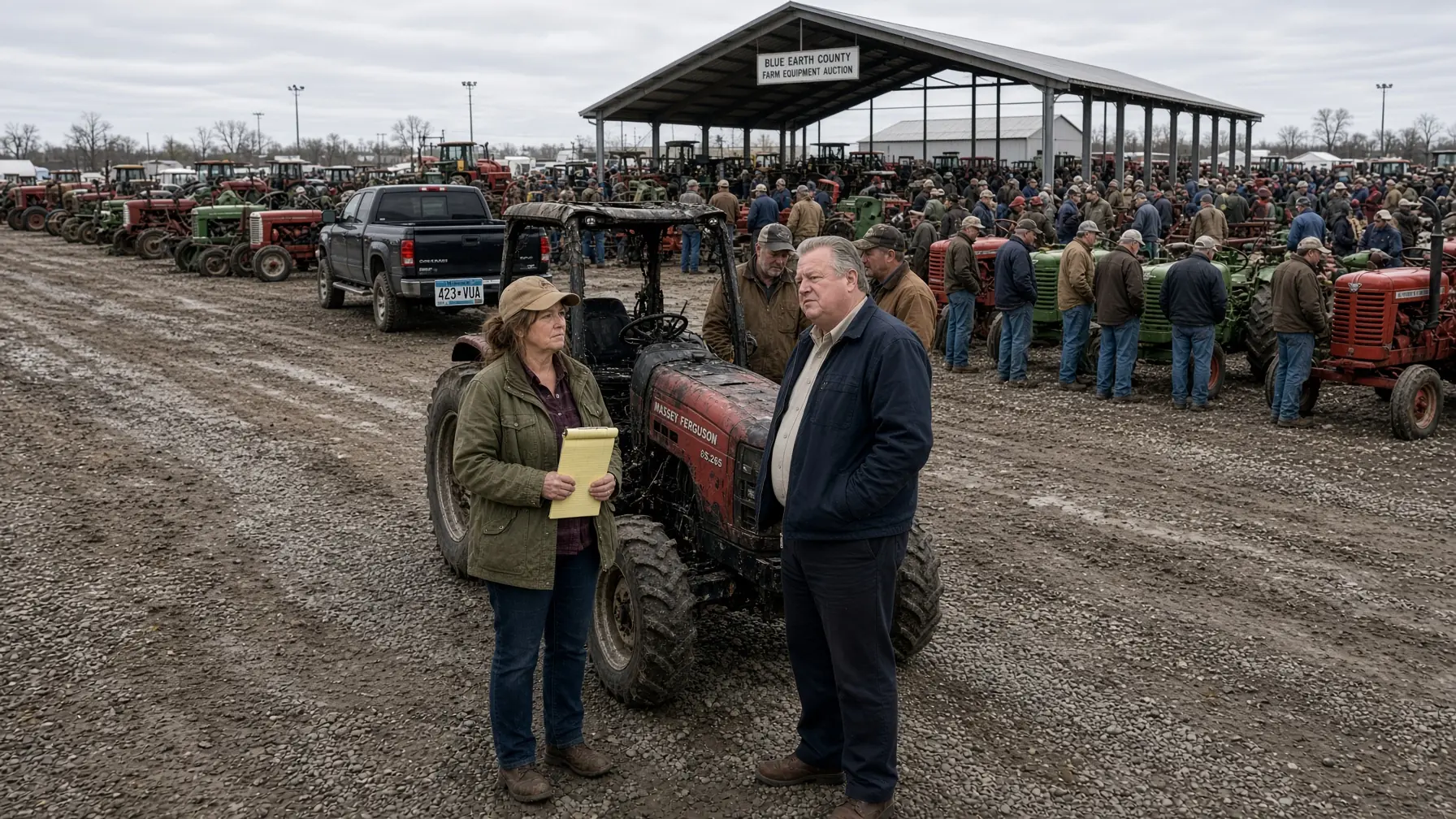
Paula raised her hand.
“Seventy-five,” she said.
The dealer stared at her for another moment. His parts manager leaned close and murmured something she could not hear.
Paula kept her eyes on the auctioneer.
She had not come to prove anything to the men beside the fence. She had come with a folded legal pad, an inspection report, and a number she would not exceed, no matter how many people decided she was making a mistake.
The auctioneer waited.
Across the yard, the dealer lowered his hand.
“Sold.”
Paula wrote seventy-five thousand dollars on the pad.
Only then did she allow herself to look at the tractor.
The auction had been moving quickly all morning, forty-three lots in three hours. By the time the burned Massey Ferguson 8S.265 reached the front of the line, the crowd had thinned, the serious buyers were loading trailers in the east lot, and the cold late-October wind had driven most remaining hands into coat pockets.
From thirty feet away, the tractor looked finished.
Paula had moved to fifteen.
She was fifty-five years old and had spent twenty-six years building a nine-hundred-acre corn and hay operation in Blue Earth County, Minnesota. Nothing about those years had encouraged her to confuse a low purchase price with a good decision.
There were inexpensive machines she could not afford to own.
There were expensive machines that paid for themselves.
Knowing the difference had kept her farm growing when growth would otherwise have been impossible.
She had started with two hundred eighty rented acres and a used Massey Ferguson 6180 bought for twenty-eight thousand dollars at a private sale. For eleven years, that tractor had worked beside her through seasons when every repair competed with seed, fuel, rent, and the need to leave a little money untouched.
By the time she sold it, it owed her nothing.
Her operation had expanded in pieces: forty acres when the lease made sense, sixty when the equipment could handle them, a parcel purchased after enough years of records persuaded the bank to stop treating her plans as possibilities and start treating them as evidence.
She had declined more opportunities than she had accepted.
Some people remembered the acres she acquired. Paula remembered the offers she walked away from, the machines she did not buy, and the mornings when refusing a tempting deal had been the only sensible thing she accomplished.
Now she needed additional tractor capacity.
The farm had reached the point where adequate equipment was beginning to cost her time. A machine could still start every morning and remain wrong for the work she needed done.
She had been watching the market for months.
Clean tractors in the range she wanted carried prices that demanded careful thought. She could finance one, but the payments would follow her through good seasons and bad ones, and she had no interest in signing away flexibility merely to park a newer machine in the shed.
Then she saw the auction listing.
Fire-damaged Massey Ferguson 8S.265.
Inspection documentation available.
She read the description once, then went back to the photographs.
The pictures were ugly.
One showed the burned roof structure. Another showed the console area, where the fire had started. A third showed the engine compartment, its exterior scorched on a diagonal that suggested how the flames had traveled.
Paula enlarged that image.
The damage looked severe, but it also looked concentrated.
She did not decide that meant anything yet.
On Thursday, she drove forty minutes to the auction company’s office and asked for the inspection packet in person. The employee behind the counter offered to email it.
“I know,” Paula said. “I’m here now.”
She took the packet to her truck and sat in the parking lot reading while cold air crept around the door seals.
The assessor’s report was more specific than the listing.
The fire had originated in the cab electrical harness. An aftermarket GPS mount had been installed incorrectly, bridging circuits in a way the manufacturer’s wiring diagram prohibited.
That detail mattered.
An unexplained fire could leave an unexplained risk. This report identified a cause.
She read on.
The cab structure, ventilation equipment, display screens, upper controls, and affected wiring were destroyed. The report did not soften that language.
Below the operator area, however, the findings changed.
The Dyna-VT transmission had been inspected and documented as functional. The hydraulic system had been pressure-tested, with no evidence of contamination or internal damage. The engine had approximately twenty-two hundred hours, a regular service history, and no reported thermal damage beyond the scorching visible on the exterior panels.
Paula turned back to the photographs.
She compared them with the description, then read the summary again.
The mechanical components were considered above average for the recorded hours. The fire damage was severe in appearance but contained in scope.
She underlined that sentence.
Then she sat back.
A report was not a guarantee.
It was information, and information became useful only when someone understood what it did and did not establish.