Noah Carter had counted the money three times because eleven dollars somehow felt more impressive when arranged neatly instead of lying in a wrinkled pile inside an old cookie tin.
There were seven one-dollar bills, eight quarters, six dimes, and enough nickels to make Eli complain that their customers were trying to ruin his arms. The brothers had been outside for forty-three minutes, and in that time they had sold eleven bottles of water, received three dollars in extra donations, and learned that grown adults became unexpectedly generous when children placed the words SCHOOL FUNDRAISER underneath a price sign.
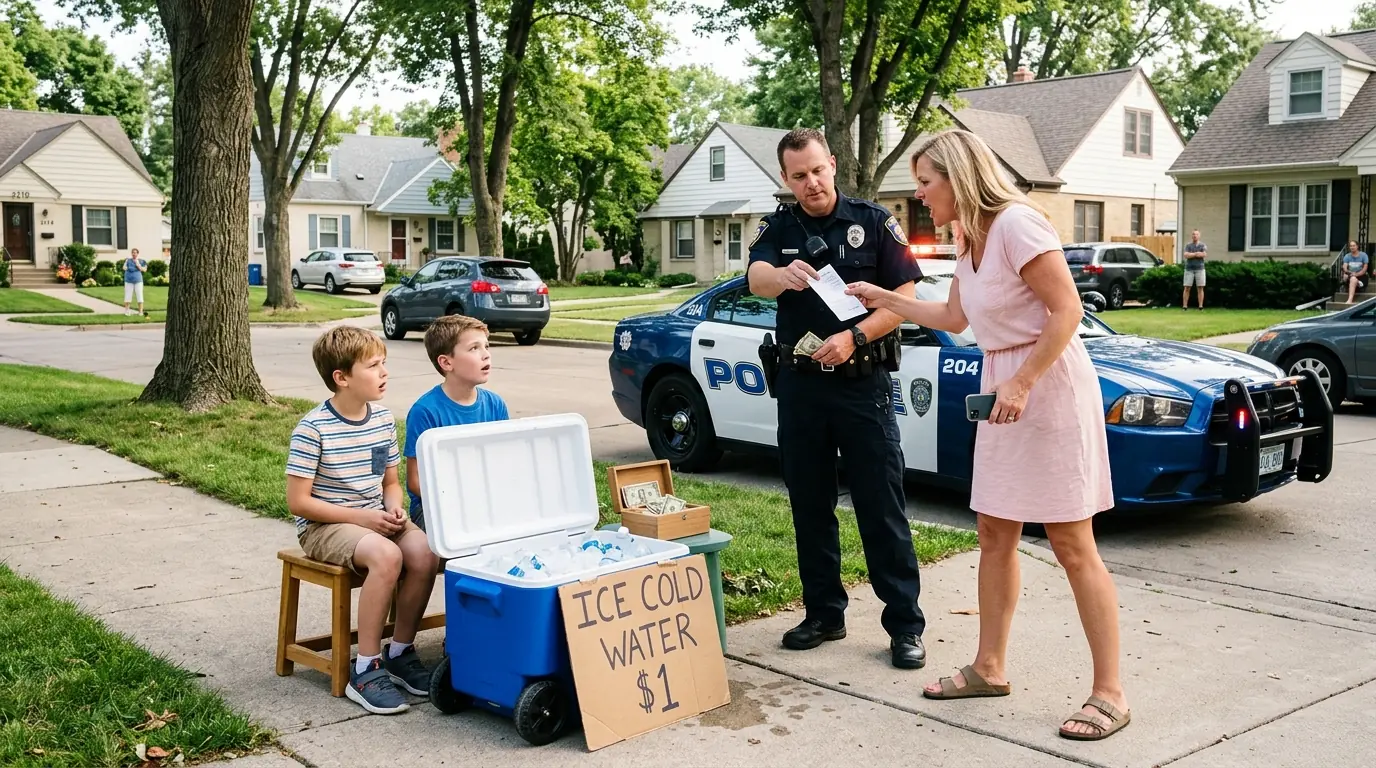
Eli leaned over the blue cooler.
“How much now?”
“Fourteen sixty.”
“That’s not bad.”
“It’s forty-three minutes.”
“I know.”
Eli grinned.
“At this rate we’ll be rich by dinner.”
Noah looked at him.
“We need four hundred eighty dollars.”
Eli’s smile disappeared.
“Oh.”
The boys were sitting beside the sidewalk in front of their family home on Briarwood Lane, a quiet suburban street outside Raleigh, North Carolina. Their neighborhood, Pine Hollow Estates, looked like the sort of place real-estate advertisements described using phrases such as family-friendly, tree-lined, and minutes from everything.
Two-story houses sat behind trimmed lawns.
Mailboxes matched.
Tall pines rose above the rooftops.
Children rode bicycles between driveways while parents waved from porches.
It was nearly ninety degrees before noon.
Perfect weather for selling cold water.
Noah was thirteen, lanky, brown-haired, and old enough to believe eleven-year-old Eli created unnecessary complications simply by existing. Eli was shorter, louder, and had already consumed two bottles from their own inventory despite Noah repeatedly explaining that drinking merchandise reduced profit.
Their mother, Rachel Carter, had approved the stand under three conditions.
Stay on their property.
Do not step into the road.
Come inside immediately if any adult made them uncomfortable.
The boys agreed.
Rachel helped them fill the cooler with ice before leaving for her nursing shift at Wake County Medical Center.
Their father, Mark, was repairing a broken fence gate in the backyard and checked on them every twenty minutes.
The fundraiser had started because of something far less dramatic than anyone watching them would have guessed.
Their middle school science club had qualified for the North Carolina Young Innovators Challenge, an event Noah had spent six months preparing for. His team designed a small solar-powered irrigation system intended to help community gardens use less water during hot months.
Then a burst pipe damaged the school storage room.
Several sensors, batteries, tools, and one laptop were ruined.
Insurance would eventually cover part of the loss.
Eventually did not help a competition scheduled three weeks away.
Their science teacher, Ms. Elena Ramirez, asked families whether they could help organize a fundraiser.
Noah volunteered before consulting anyone.
That evening Rachel asked:
“What exactly did you volunteer us for?”
Noah smiled nervously.
“Community spirit?”
Mark laughed from the kitchen.
“You’re doomed.”
Rachel eventually approved.
Bake sales were already being planned.
One parent organized an online donation page.
Noah decided to sell water because temperatures were approaching one hundred degrees and the neighborhood walking trail passed directly by their house.
Eli joined because Noah promised him ten percent of whatever the brothers personally raised could be used to buy snacks for the science club.
Technically, the club had not approved that arrangement.
Noah intended to deal with the ethical implications later.
Their sign was made from a cardboard shipping box.
ICE COLD WATER $1
Underneath, in smaller writing:
HELP PINE HOLLOW MIDDLE SCIENCE CLUB
Eli added a badly drawn rocket.
Noah told him the project was about irrigation.
Eli answered:
“Rockets make people donate.”
Unfortunately, he appeared correct.
Their first customer was Mrs. Lawson, a retired teacher who lived three houses down.
She bought one bottle.
Paid five dollars.
“No change.”
Noah smiled.
“Thank you.”
Mrs. Lawson looked at the sign.
“Science club?”
“Yes, ma’am.”
“What are you building?”
Noah started explaining the irrigation system.
Twenty seconds later Eli interrupted.
“He can talk about this for an hour.”
Mrs. Lawson laughed.
“I believe you.”
Then came a jogger.
Two bottles.
A landscaping crew purchased six.
One driver stopped and handed them ten dollars without taking anything.
By eleven thirty, the boys had raised twenty-nine dollars.
Eli was beginning to believe capitalism had finally discovered him.
Then Marianne Whitmore appeared.
Noah noticed her before she crossed the street.
Everyone in Pine Hollow knew Marianne.
Not because she held any official position.
She simply behaved as if forgetting her existed constituted disrespect.
Marianne was forty-eight, blonde, always carefully dressed, and lived in a large brick house at the corner of Briarwood and Oakridge. On that Saturday she wore a light-pink casual summer dress, white sandals, oversized sunglasses, and a small beige handbag.
She stopped across the street.
Looked at the boys.
Looked at the cooler.
Then at their sign.
Her mouth tightened.
Noah immediately sensed trouble.
Eli whispered:
“Don’t say anything weird.”
Noah stared at him.
“You’re telling me?”
Marianne crossed the street.
She stopped directly in front of the stand.
No greeting.
No smile.
“What is this?”
Noah looked at the sign.
“Water.”
Marianne removed her sunglasses.
“I can see that.”
Neither boy spoke.
She pointed.
“Why are you selling things on the sidewalk?”
Noah answered:
“We’re raising money for school.”
“This is a residential neighborhood.”
“Yes, ma’am.”
“You cannot operate a business here.”
“It’s not really a business.”
“You are exchanging goods for money.”
Noah looked toward Eli.
Then back.
“It’s a school fundraiser.”
“That does not matter.”
Eli said:
“It kind of does.”
Noah closed his eyes.
Marianne looked toward him.
“Excuse me?”
Eli lowered his voice.
“Nothing.”
Marianne pointed toward the cooler.
“Pack it up.”
Noah stared.
“Our mom said we could do this.”
“I don’t care what your mother said.”
That sentence changed Noah’s expression.
He tried remaining polite.
“We’re in our own driveway.”
“You’re attracting cars.”
One vehicle had stopped during the previous ten minutes.
It belonged to Mrs. Lawson.
Noah said:
“Nobody’s blocking anything.”
Marianne took out her phone.
“You children think rules don’t apply because adults are afraid to correct you.”
Eli whispered:
“She talks like Principal Graves.”
Noah kicked his shoe lightly.
Marianne heard.
“You think this is funny?”
“No, ma’am.”
“Yes, you do.”
Noah’s patience began thinning.
“What do you want us to do?”
“I already told you.”
“Close this.”
“No.”
Eli looked toward Noah.
That was the first time either boy had openly refused.
Marianne appeared genuinely surprised.
“No?”
Noah shook his head.
“My parents said we can sell water here.”
“The school knows.”
“We aren’t bothering anyone.”
“So no.”
Marianne stepped closer.
“You do not tell me no.”
Noah almost laughed because the statement made no sense.
Instead he asked:
“Why?”
Her expression sharpened.
“Because adults know better than children.”
Eli looked toward the cooler.
“Not always.”
Noah kicked him again.
Harder.
“Ow.”
Marianne raised her phone.
“I’m documenting this.”
Noah stared.
“Why?”
“Because when your parents claim you were innocent little angels, I want evidence.”
That was the moment Noah remembered his mother’s third rule.
Come inside if an adult makes you uncomfortable.
He stood.
“Eli.”
“What?”
“We’re going to get Dad.”
Marianne moved one step toward the cooler.
“You are not walking away from me.”
Noah froze.
Something about those words frightened him more than the yelling.
He held up one hand.
“We’re going inside.”
“You’re staying right here until this is resolved.”
Eli looked nervous now.
Noah pulled his phone from his pocket.
Seven missed notifications from the science-club group chat.
He ignored them and texted his father.
Can you come out front? Lady yelling at us.
Marianne saw the phone.
“Put that away.”
“No.”
“I’m speaking to you.”
“I’m calling my dad.”
She laughed.
“Good.”
“Bring him out.”
Noah stared.
“I just did.”
That should have been the end.
A parent arriving.
Adults talking.
Problem solved.
Instead Marianne looked toward the sign again.
Then said:
“I’m calling the police.”
Both boys thought they misheard.
Eli spoke first.
“For water?”
Marianne turned.
“For operating an illegal roadside business and creating a traffic hazard.”
Noah looked up and down the completely empty street.
“You’re joking.”
Marianne dialed.
“No.”
Eli whispered:
“She’s actually doing it.”
Noah felt his stomach tighten.
Police changed things.
Even when nobody had done anything wrong.
Especially when adults sounded certain.
He knew enough from television and stories to understand that officers arriving meant the situation no longer belonged entirely to the boys.
Mark Carter opened the front door.
“What’s happening?”
Noah immediately felt better.
His father was forty-three, six feet tall, wearing an old green T-shirt and work jeans streaked with fence paint.
Marianne turned toward him.
“Are these your children?”
Mark stared.
“Yes.”
“They are operating an illegal business.”
He looked toward the cooler.
Then the sign.
Then his sons.
Then Marianne.
“You mean the water stand?”
“Yes.”
Mark waited.