Naomi Bennett arrived at Aurelian House shortly after ten on a bright Tuesday morning, carrying nothing except a small leather portfolio and the brown handbag her mother had given her fifteen years earlier. She wore a cream pantsuit, low heels, and a simple gold watch that did not advertise its price. No driver waited outside, no assistant walked beside her, and no photographer followed her through the revolving doors. That was exactly how she wanted to enter.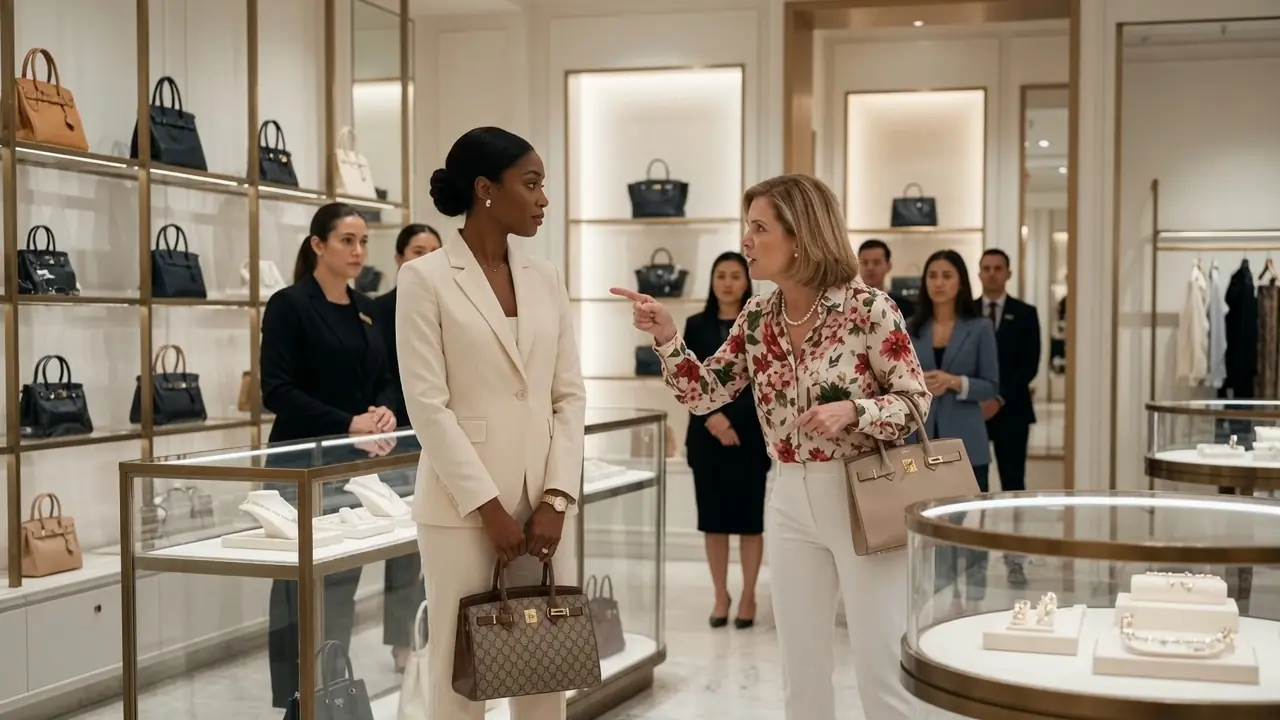
Only six hours earlier, Naomi had signed the final documents transferring ownership of Aurelian House and its twelve luxury boutiques to Bennett Rowan Holdings. The acquisition had taken nine months of negotiations, three failed financing structures, and more late-night meetings than she cared to remember. The chain had once been one of the most respected names in American luxury retail, but declining sales and repeated customer complaints had left it vulnerable. Naomi believed the brand could be saved, but only if she understood what had been destroying it.
The previous owner had encouraged her to begin with financial reports, inventory reviews, and executive interviews. Naomi had agreed publicly, then made a different plan privately. Before anyone announced that a Black woman from Baltimore now owned the company, she wanted to visit the flagship boutique as an ordinary customer. She wanted to see how employees behaved when they believed nobody powerful was watching.
Aurelian House occupied three floors of a limestone building on Madison Avenue. Inside, cream-colored walls surrounded glass display cases filled with handbags, watches, scarves, and jewelry arranged beneath soft white lighting. The marble floor was polished so perfectly that customers could see faint reflections of themselves beneath their shoes. Sales associates in black suits stood near each department with the disciplined stillness of museum guards.
Naomi paused near the entrance and looked across the showroom. She noticed a sales associate greeting an older white couple before they had taken three steps inside. Another employee offered sparkling water to a young man wearing an expensive watch. Yet nobody approached Naomi, even after she stood beside the central handbag display for nearly a minute.
She did not take the silence personally. Instead, she recorded it mentally.
The first handbag she examined was part of the Marcelline collection, one of Aurelian House’s most profitable lines. Naomi lifted it carefully by the handle and inspected the stitching along the side seam. The leather was excellent, but the metal clasp felt slightly loose. She turned the bag over and noticed that the serial tag had been placed unevenly beneath the lining.
These were small problems, but luxury survived on details. Naomi had spent years building her investment company by noticing weaknesses that other executives dismissed as unimportant. A loose clasp could become a returned purchase, a returned purchase could become a disappointed customer, and enough disappointment could become a dying brand. She opened her portfolio and wrote a brief note.
Across the room, Karen Whitmore stopped speaking to the sales associate helping her choose a silk scarf. Karen was fifty-eight, elegantly dressed in white trousers, a floral blouse, and pearls that rested perfectly against her neck. She had visited the boutique for nearly twenty years and considered herself more than a customer. Employees knew her preferences, stored her payment information, and sent new merchandise to her apartment before it reached the sales floor.
Karen had also become accustomed to deciding who belonged inside Aurelian House. She complained whenever tourists touched too many products, whenever children spoke too loudly, and whenever customers arrived wearing clothing she considered inappropriate. Previous managers had tolerated her behavior because she spent more than two hundred thousand dollars there each year. Her money had slowly taught her that every opinion she expressed would be treated as a rule.
She watched Naomi lift a second handbag from the display. Naomi checked its zipper, studied the interior lining, and compared the stitching with the first bag. To anyone willing to observe carefully, she looked like a knowledgeable buyer or quality inspector. Karen saw only a Black woman standing alone with expensive merchandise.
“Has anyone been assisting her?” Karen asked.
The sales associate beside her, Lily Chen, followed Karen’s gaze. “Not that I know of.”
“Then why is she touching everything?”
Lily hesitated. “Customers are allowed to examine the display pieces.”
Karen’s expression tightened. “Customers, yes.”
Lily understood the meaning but pretended not to. She had worked at Aurelian House for eleven months and needed the health insurance the job provided for her young son. She had already seen Karen humiliate a delivery driver and accuse a Latina teenager of damaging a scarf she had barely touched. Each time, management had apologized to Karen instead of the person she insulted.
Naomi placed the second handbag down and moved toward a limited-edition brown satchel displayed inside a glass case. She recognized the design immediately because it had been one of the reasons she pursued the acquisition. Her mother had owned an inexpensive imitation of the original Aurelian satchel and carried it to church, parent meetings, and two jobs. Naomi had promised herself that one day she would buy her mother the real version.
Her mother had died three years before Naomi could keep that promise.
The new limited edition was beautiful, but Naomi wanted to inspect it before approving the planned national relaunch. She asked Lily whether she could see the bag more closely. Lily smiled politely, unlocked the case, and placed the satchel on a velvet pad.
“Take your time,” Lily said.
“Thank you,” Naomi replied. “Do customers often ask about this design?”
“Older customers remember the original,” Lily explained. “Younger customers like the shape, but some think the hardware feels dated.”
Naomi nodded, impressed by the honest answer. “What would you change?”
Lily glanced toward the manager’s office before speaking. “A lighter clasp, maybe. And a longer shoulder strap.”
Naomi smiled. “That is exactly what I was thinking.”
Karen had moved closer without either woman noticing. She saw Naomi holding the satchel while Lily stood beside the open case. In Karen’s mind, the situation confirmed every suspicion she had created. She did not ask Lily whether Naomi was being assisted.
Instead, she stepped forward and pointed directly at the bag.
“I’ve been watching you for several minutes,” Karen said sharply. “Put that handbag down immediately.”
The volume of her voice silenced nearby conversations. Naomi looked up slowly but did not release the handle. Lily’s face became tense.
“Excuse me?” Naomi asked.
“You heard me,” Karen replied. “You have been moving from case to case, touching merchandise, and writing things down while no one properly supervises you.”
Naomi looked at the notebook inside her open portfolio. “I am inspecting the merchandise.”
Karen gave a short, contemptuous laugh. “Women like you do not inspect luxury stores. You steal from them.”
A man near the watch counter turned around. Two customers beside the jewelry display stared openly. Lily stepped between Karen and the glass case, but Karen raised one hand to silence her.
“This customer asked to see the handbag,” Lily said. “I unlocked the case for her.”
Karen ignored her. “You should close the case and check her bag before she leaves.”
Naomi’s expression remained controlled, though anger moved beneath her calm voice. “You are not an employee here.”
“I am one of this store’s most important clients.”
“That still does not give you authority over me.”
Karen’s eyes narrowed. She was accustomed to employees lowering their voices when she announced how much money she spent. Naomi’s refusal to be impressed felt like an insult. She turned toward the front entrance and raised her arm.
“Security!”
A uniformed guard named Anthony Miles approached from beside the doors. Anthony was a thirty-nine-year-old Black man who had worked private security for more than a decade. He had witnessed the beginning of the confrontation and already understood that Naomi had done nothing wrong. Unfortunately, he also knew Karen’s complaints had caused two previous guards to lose their assignments.
“What seems to be the problem?” Anthony asked.
Karen pointed toward Naomi. “She has been handling expensive handbags without supervision, taking notes, and preparing to walk away with that one.”
Lily spoke immediately. “That is not true. I gave her the bag.”
Karen turned on her. “You are inexperienced, and she took advantage of you.”
Naomi placed the satchel carefully on the velvet pad. “The security cameras will show that I requested assistance, your employee opened the case, and I remained beside her the entire time.”
Anthony nodded. “That is also what I observed.”
Karen stared at him as though his answer were an act of betrayal. “Then perhaps this store needs security capable of recognizing suspicious behavior.”
Anthony kept his hands calmly in front of him. “Suspicious behavior requires more than a customer looking at merchandise.”
“She is carrying an old handbag while touching one that costs eighteen thousand dollars.”
Naomi looked down at the brown bag hanging from her arm. The leather had faded along the edges, but it remained carefully maintained. Her mother had bought it for Naomi when she received her first promotion, saving for months to afford it. Karen saw something cheap; Naomi saw the last gift her mother had chosen for her.
“My handbag has nothing to do with the one on the counter,” Naomi said.
“It tells me whether you can afford what you are touching.”
“And what exactly does my skin tell you?”
The question changed the atmosphere in the room. Karen’s mouth tightened as several customers lifted their phones. She looked around, suddenly aware that the attention she had demanded was no longer working in her favor.
“I never mentioned your skin,” she said.
“You did not need to.”
The boutique manager, Gregory Hale, emerged from his office after hearing the raised voices. Gregory was forty-seven, with carefully styled gray hair and a navy suit tailored to make him appear thinner. He recognized Karen immediately and hurried toward her with concern. He did not ask Naomi what had happened.
“Mrs. Whitmore, are you all right?”
“I will be when this woman is searched.”
Gregory turned toward Naomi. His eyes moved over her cream suit, simple watch, and old handbag. Like Karen, he measured status through visible signals. Unlike Karen, he had been trained to hide the judgment behind polished language.
“Madam, perhaps we can continue this conversation privately.”
“There is no reason for a private conversation,” Naomi said. “I have not done anything.”
Gregory lowered his voice. “A valued customer has expressed concern.”
“Then investigate the concern instead of treating it as evidence.”
Karen stepped beside him. “Gregory, I watched her moving between displays for several minutes. She is clearly planning something.”
Naomi opened her portfolio and removed a folded set of documents. “You are right about that.”
Karen smiled with satisfaction, apparently believing Naomi had just confessed. Gregory reached toward the papers, but Naomi held them away from him. She looked first at Lily, then Anthony, then the customers gathered around them.
“I came here with a plan,” Naomi continued. “I intended to observe this store before deciding which changes were necessary.”
Gregory’s expression shifted slightly. “Are you from corporate?”
“In a manner of speaking.”
Karen rolled her eyes. “Now she is pretending to be an executive.”
Naomi removed a second document bearing the seal of Bennett Rowan Holdings and the signatures of Aurelian House’s former owners. The closing certificate confirmed that the acquisition had become legally effective at 6:00 that morning. Beneath it was a temporary management order naming Naomi Bennett as owner and executive chairwoman of the entire retail group.
She placed the documents on the glass counter.
“My name is Naomi Bennett,” she said. “As of this morning, Bennett Rowan Holdings owns Aurelian House, all twelve boutiques, the distribution center, and every design license connected to this brand.”
Nobody spoke.
Gregory stared at the signature page, then reached for his phone. Karen’s confident expression disappeared so quickly that it seemed to fall from her face. Lily looked from Naomi to the documents, trying to understand whether the quiet customer she had assisted now controlled the company that issued her paycheck.
Karen recovered first. “That cannot be true.”
Naomi removed her phone and called Daniel Rowan, the company’s general counsel. She placed the call on speaker. Daniel confirmed the acquisition, Naomi’s authority, and the executive announcement scheduled for noon.
Gregory looked as though the floor had shifted beneath him.
“Ms. Bennett,” he began, “we were not informed that you would be visiting.”
“That was intentional.”
“I assure you this is not how we normally treat customers.”
Lily lowered her eyes. Anthony remained silent. Both understood that Gregory’s statement was false.
Naomi looked toward the security cameras mounted above the showroom. “Then the footage and complaint records should support your assurance.”
Karen stepped closer and forced an uncertain smile. “Ms. Bennett, this has clearly been a misunderstanding. I care deeply about this store and was only trying to protect your merchandise.”
“No,” Naomi replied. “You were protecting your belief that someone who looked like me could not belong here.”
“I am not prejudiced.”
“You accused me of theft without seeing me conceal anything, leave any display, or refuse assistance.”
Karen glanced at the phones recording her. “I reacted strongly because luxury retailers face enormous losses.”
“You reacted strongly because you assumed I was powerless.”
Gregory attempted to intervene. “Perhaps we should move to my office and resolve this discreetly.”
Naomi turned toward him. “Why discreetly? Mrs. Whitmore chose to accuse me in front of the entire showroom.”
Karen’s cheeks flushed. “Are you trying to humiliate me?”
“I am asking you to stand in the same public space where you tried to humiliate me.”
The answer drew a quiet murmur of approval from one of the customers. Karen looked toward Gregory as though expecting him to defend her. For years he had done exactly that, but now his loyalty had become less certain.
“I spend more money here than almost anyone,” Karen said.
Naomi nodded. “And that money taught you the staff would tolerate whatever you did.”
“You cannot treat a loyal customer this way.”
“Loyalty to a store does not mean ownership of the people inside it.”
Karen grabbed the handle of her own designer handbag. “Then I will take my business elsewhere.”
“That is your choice.”
She hesitated, apparently waiting for Naomi to beg her to reconsider. When no one did, Karen turned toward the door. Anthony stepped aside but did not open it for her.
Before leaving, Karen looked back at Naomi. “This brand will collapse if you drive away its best clients.”
Naomi’s voice remained even. “A business that survives by allowing wealthy customers to abuse others deserves to be rebuilt.”
Karen left beneath the gaze of the entire boutique.
The room remained quiet after the doors closed. Gregory began apologizing, but Naomi stopped him. She did not want rehearsed regret delivered only after her authority became known.
“Close the store for one hour,” she said. “Customers who made purchases may complete them, but no one else enters until I speak with the staff.”
Gregory hesitated. “Closing during business hours could cost us thousands.”
“Then consider it the price of understanding what happened here.”
Anthony secured the entrance while Lily assisted the remaining customers. Several people quietly thanked Naomi before leaving, and one woman provided her contact information as a witness. Another customer admitted that she had seen Karen mistreat employees on previous visits but had never spoken up.
When the doors were locked, Naomi gathered the staff near the central display. Twelve employees formed a loose circle around her, uncertain whether they were about to lose their jobs. Naomi did not raise her voice.
“I did not come here hoping to catch someone,” she said. “I came because this location has lost thirty-two percent of its repeat customers in four years, and the financial reports do not explain why.”
No one responded.
Naomi looked toward Lily. “How many times has Mrs. Whitmore accused another customer or employee of not belonging here?”
Lily swallowed. “At least six times since I started.”
“Were those incidents reported?”
“Yes.”
“To whom?”
Lily looked toward Gregory.
Gregory straightened his jacket. “The complaints were addressed internally.”
Naomi asked for the records. Gregory claimed some had been resolved verbally and therefore had no written documentation. Anthony then revealed that security incident reports existed for four confrontations, including one involving a Black teenager Karen accused of stealing a bracelet later found inside the display case.
Naomi requested every report before the end of the day.
The review lasted three weeks. Investigators found that Gregory had repeatedly protected wealthy customers while discouraging employees from documenting discriminatory behavior. Sales associates had been instructed to follow customers who wore inexpensive clothing, spoke with certain accents, or entered without visible luxury items. Black and Latino shoppers were offered assistance less frequently but watched by security more often.
Anthony had complained twice about the profiling system. Both complaints had been forwarded to Gregory and marked resolved without investigation. Lily had reported Karen’s treatment of the teenage customer, but Gregory warned that continued conflict with major clients could affect her commission schedule. Employees had learned that silence protected their jobs.
Naomi did not fire the entire team. She believed accountability required separating those who created the system from those trapped inside it. Gregory was dismissed for suppressing complaints, retaliating against employees, and enforcing discriminatory practices. Two regional executives who had ignored declining customer-trust scores were also removed.
Anthony was promoted to director of customer safety for the chain. His new responsibility was not to make luxury customers comfortable, but to ensure every person entering a store was treated according to evidence rather than appearance. Lily joined a product-feedback committee after Naomi remembered her suggestion about the satchel strap.
The boutique introduced clear standards for suspected theft. Employees needed observable behavior, not clothing, race, age, accent, or account history, before contacting security. Every escalation required written documentation and independent review.
Naomi also ended the unwritten hierarchy that allowed high-spending customers to command employees. Private appointments continued, but no client could demand that another shopper be followed, searched, or removed. Staff were given the authority to end service when a customer threatened or humiliated them.
Karen received a formal notice banning her from every Aurelian House location for one year. The letter explained that the ban resulted from harassment, false accusations, and interference with staff. It also stated that any future return would require a written acknowledgment of the conduct.
Karen’s attorney threatened legal action. Daniel Rowan responded with security footage, witness statements, and copies of earlier incidents involving her. No lawsuit was filed.
Six months later, Aurelian House relaunched the Marcelline satchel with lighter hardware and a longer strap. Naomi named the updated design the Evelyn, after her mother. The first bag produced was placed in a glass display at the Manhattan boutique beside a photograph of Evelyn Bennett carrying her old imitation satchel to Naomi’s college graduation.
The original brown handbag Naomi had carried during the confrontation appeared beside it.
A small plaque explained that value was not always visible in leather, logos, or price tags. It said that the old bag had been purchased by a mother who saved for months so her daughter could walk into her first executive job feeling prepared. Customers often stopped to read the message before examining the new collection.
Sales at the flagship boutique increased during the following year, but the more meaningful change appeared in customer surveys. People who had once avoided the store began returning because they felt free to browse without proving they could afford to be there. Employees reported fewer confrontations and greater confidence in management.
One afternoon, nearly fourteen months after the incident, Karen returned.
Her ban had expired, but she stood outside the entrance for several minutes before walking in. She carried no attorney and wore no expression of authority. Anthony recognized her immediately.
“I would like to speak with Ms. Bennett,” Karen said.
Naomi happened to be upstairs reviewing renovation plans. She agreed to meet Karen near the same handbag display where the confrontation had begun. Karen looked at the Evelyn satchel and then at the old brown bag behind glass.
“I came to apologize,” she said.
Naomi waited.
Karen admitted that her first apology had been motivated by fear. She had been embarrassed that the woman she accused possessed more authority than she did. Only later, after watching the security video privately, had she understood how little evidence she required before deciding Naomi was a criminal.
“I thought I was protecting the store,” Karen said.
“You were protecting a place where your assumptions had never been challenged.”
Karen nodded. “That is true.”
Naomi did not offer immediate forgiveness, nor did she demand public humiliation. She told Karen that regret mattered only when it changed future behavior. Then she asked what Karen would have done if Naomi had actually been an ordinary shopper.
Karen looked toward the floor. “I probably would have forgotten her.”
“That is the woman you owe the apology to.”
Karen’s eyes filled with shame because she finally understood. The lesson was never that she had chosen the wrong Black woman to accuse. The lesson was that there should have been no powerless version of Naomi whom she was permitted to degrade.
Before leaving, Karen purchased nothing. She asked whether she might return another day and shop under the same rules as everyone else. Naomi told her the door was open as long as her respect entered with her.
Years later, employees still told the story of the morning the new owner entered without an entourage. Some remembered the ownership papers, Karen’s stunned face, and the moment Gregory realized his authority had ended. Naomi remembered something quieter.
She remembered Lily unlocking the glass case without asking whether Naomi could afford the handbag. She remembered Anthony refusing to treat suspicion as proof, even when defending her placed his job at risk. Those choices had been made before either of them knew who she was.
That was why Naomi trusted them.
Power had revealed the truth, but it had not created it. The people who respected Naomi only after learning she owned the store had simply become afraid of consequences. The people who treated her with dignity while believing she was an ordinary shopper had shown the character on which the new Aurelian House would be built.