At 9:08 on Monday morning, Marcus Cole stood in the lobby of Oakwood Heights and counted how many employees looked nervous when Margaret Van Der Kamp stepped out of the elevator.
Four.
The doorman.
The concierge.
The assistant manager.
And the maintenance technician carrying a toolbox near the mailroom.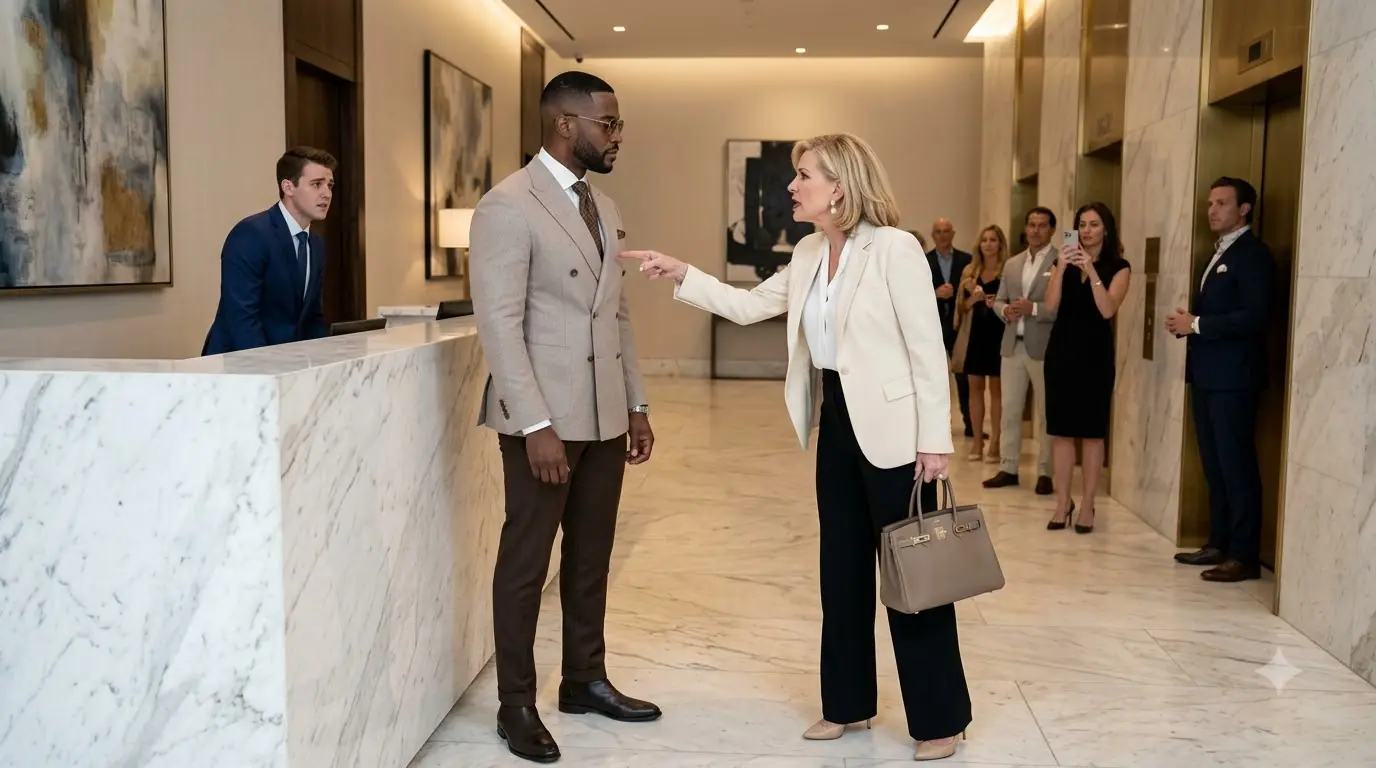
Marcus noticed because he had spent most of his adult life learning to watch the people who stopped talking when someone important entered a room.
Fear rarely announced itself.
It adjusted posture.
Lowered eyes.
Shortened sentences.
Made people suddenly remember tasks on the other side of the building.
Oakwood Heights was built to make fear look impossible.
Everything about the lobby communicated control.
White Italian marble.
Brass trim polished until it reflected shoes.
Floor-to-ceiling glass facing East Seventy-Third Street.
White orchids arranged in enormous black ceramic bowls.
A curved reception desk made from a single slab of veined stone.
Soft amber wall lights.
Fresh flowers replaced three times a week.
Two elevator banks.
Private residential lounge.
Uniformed staff.
Twenty-four-hour concierge.
A discreet scent system that released cedar and bergamot through hidden vents.
The building contained forty-seven residences.
The least expensive rented for approximately eleven thousand dollars per month.
The penthouse lease exceeded forty.
Marcus knew every number.
His company owned the building.
Not personally in the simple sense.
Oakwood Heights belonged to CUH Residential Fund IV, a real-estate vehicle controlled by Cole Urban Holdings, the company Marcus founded seventeen years earlier.
But if somebody wanted the short version, the one newspapers used, it was accurate enough.
Marcus Cole owned Oakwood Heights.
He did not usually visit dressed like this.
That morning he wore a perfectly tailored light-taupe double-breasted blazer, white shirt, patterned brown silk tie, dark chocolate trousers, dark Chelsea boots, silver watch, and tinted glasses.
Nothing flashy.
Nothing accidental either.
He looked expensive.
Margaret Van Der Kamp saw him and apparently saw something else.
She crossed the lobby toward him with irritation already forming across her face.
Fifty-seven.
Blonde hair styled to appear effortless.
Cream blazer.
White blouse.
Black wide-leg trousers.
Pearl earrings.
Taupe handbag.
Marcus knew who she was before she opened her mouth.
Unit 28B.
Three-bedroom corner residence.
Monthly rent: $12,450.
Resident for six years.
One dog listed on lease.
Two adult children not occupying unit.
Widowed.
No current balance due.
Multiple service complaints.
That last category was why Marcus was standing there.
Three weeks earlier, a former concierge named Luis Ortega had sent a letter directly to corporate headquarters.
Not a legal complaint.
Not a demand.
A resignation letter.
Luis had worked at Oakwood Heights for nine years.
His final paragraph said:
I enjoyed serving most residents, but I became tired of being told that certain tenants are “too valuable to upset.” If the building's rules only apply downward, then they are not rules. They are instructions for employees.
Marcus read it twice.
Then requested employee complaint data for the property.
The records bothered him.
Not because Oakwood Heights had more resident complaints than comparable buildings.
Luxury residential properties always produced friction.
Noise.
Packages.
Elevators.
Parking.
Pets.
Staff.
Visitors.
Renovations.
The problem was distribution.
A small group of residents appeared repeatedly.
Margaret Van Der Kamp appeared most.
Fourteen documented complaints involving employees over three years.
Nine closed as “resolved informally.”
Three labeled “resident misunderstanding.”
One withdrawn.
One with no final disposition.
Marcus asked property management for details.
The answer came polished.
Mrs. Van Der Kamp is demanding but loyal.
Long-term tenant.
Strong payment history.
Active resident association participant.
Maintains high community standards.
Marcus hated the last phrase.
Community standards could mean flowers in the lobby.
Or permission to bully the person changing the flowers.
He scheduled a visit.
Only three people knew he was coming.
His chief legal officer.
Head of residential operations.
And Sammy Reed, the twenty-eight-year-old assistant manager at Oakwood Heights.
Sammy had been instructed not to announce Marcus.
No special reception.
No staff lineup.
No executive elevator.
Marcus wanted ordinary Monday morning.
He got Margaret instead.
“Excuse me.”
Marcus turned.
She was already close.
“Yes?”
Margaret looked him over.
Shoes.
Trousers.
Hands.
Face.
Then toward the reception desk.
“You, the delivery guy.”
Marcus said nothing.
“Stop standing around and do whatever you came here to do.”
Behind the desk, Sammy stiffened.
“Mrs. Van Der Kamp, he’s actually—”
Margaret slapped one palm against the marble.
Not violently.
Sharply enough that Sammy stopped.
“Do not interrupt me when I'm speaking.”
The concierge beside Sammy looked down.
Marcus watched him.
Name badge:
Andre Lewis.
Andre had worked there three years.
Marcus returned his attention to Margaret.
She continued.
“I pay thousands every month to live here. I should not have to wait while workers block the lobby.”
Marcus looked behind himself.
Nothing.
He stood several feet from the desk.
No doorway blocked.
No elevator.
No path.
“I'm not blocking anything.”
Margaret's eyebrows rose.
“That isn't the point.”
“What is?”
Her expression sharpened.
The question itself offended her.
“The point is that you clearly have business here, so complete it.”
“I am completing it.”
“What are you doing?”
“Waiting for paperwork.”
She laughed.
“For what?”
Marcus looked toward Sammy.
“Management.”
Margaret followed his gaze.
Then looked back.
“Landscaping?”
“No.”
“Construction?”
“No.”
“Then what?”
“Building business.”
Her mouth tightened.
“That's not an answer.”
“It wasn't meant to be one.”
A resident near the elevators turned.
Older man.
Newspaper under one arm.
Marcus recognized him from the rent roll.
Dr. Harvey Gold, unit 19C.
Margaret noticed the audience too.
Her voice became louder.
“You don't belong standing around in here.”
Marcus breathed once.
Slowly.
His grandfather used to tell him:
Never borrow somebody else's lack of control.
Marcus had been twelve the first time he heard it.
Back then he thought it meant do not fight.
As an adult, he understood it differently.
Control was leverage.
Losing it transferred leverage to whoever provoked you.
Marcus looked at Margaret.
“I belong exactly where I am.”
Her eyes narrowed.
“If you refuse to leave, I will call security.”
“That is your choice.”
She looked toward Sammy.
“Where is security?”
Sammy stepped from behind the desk.
“Mrs. Van Der Kamp, please. I can explain.”
“I don't need an explanation from you.”
Sammy flushed.
Marcus noticed that too.
She continued.
“I asked a simple question. Why is this man standing in the residential lobby?”
Sammy looked at Marcus.
Marcus gave no signal.
Sammy understood.
He said:
“He has an appointment with management.”
Margaret laughed.
“For what?”
Sammy hesitated.
Marcus answered.
“Documents.”
Margaret turned back.
“What documents?”
“Mine.”
“You're being deliberately difficult.”
“No.”
“Yes.”
She stepped closer.
Her perfume reached him.
Expensive.
Floral.
Sharp.
“You think because you're dressed up you can stand in here and intimidate people?”
Marcus looked down at his own suit.
“Dressed up?”
“Don't play games.”
He almost smiled.
Across the lobby, the maintenance technician had stopped pretending to organize tools.
Two residents near the mailroom watched openly.
One woman raised a phone.
Margaret saw none of them.
Or perhaps she saw them and liked the stage.
“You're making residents uncomfortable.”
Marcus asked:
“Which residents?”
“Me.”
“Then say that.”
She stared.
He continued.
“Don't turn your discomfort into a building-wide emergency.”
Her face reddened.