“People who belong here don't wander around looking suspicious.”
Karen Whitmore spoke loudly enough for the neighbors behind the hedges to hear. She stood beside Officer Daniel Hayes with her chin lifted, one arm extended toward the woman on the sidewalk as if she had delivered the police an obvious criminal. Across from her, Nia Carter stood perfectly still. A small remote lay hidden in the leather handbag at her hip, and behind her rose the high black gates of one of Willow Crest Estates' largest homes.
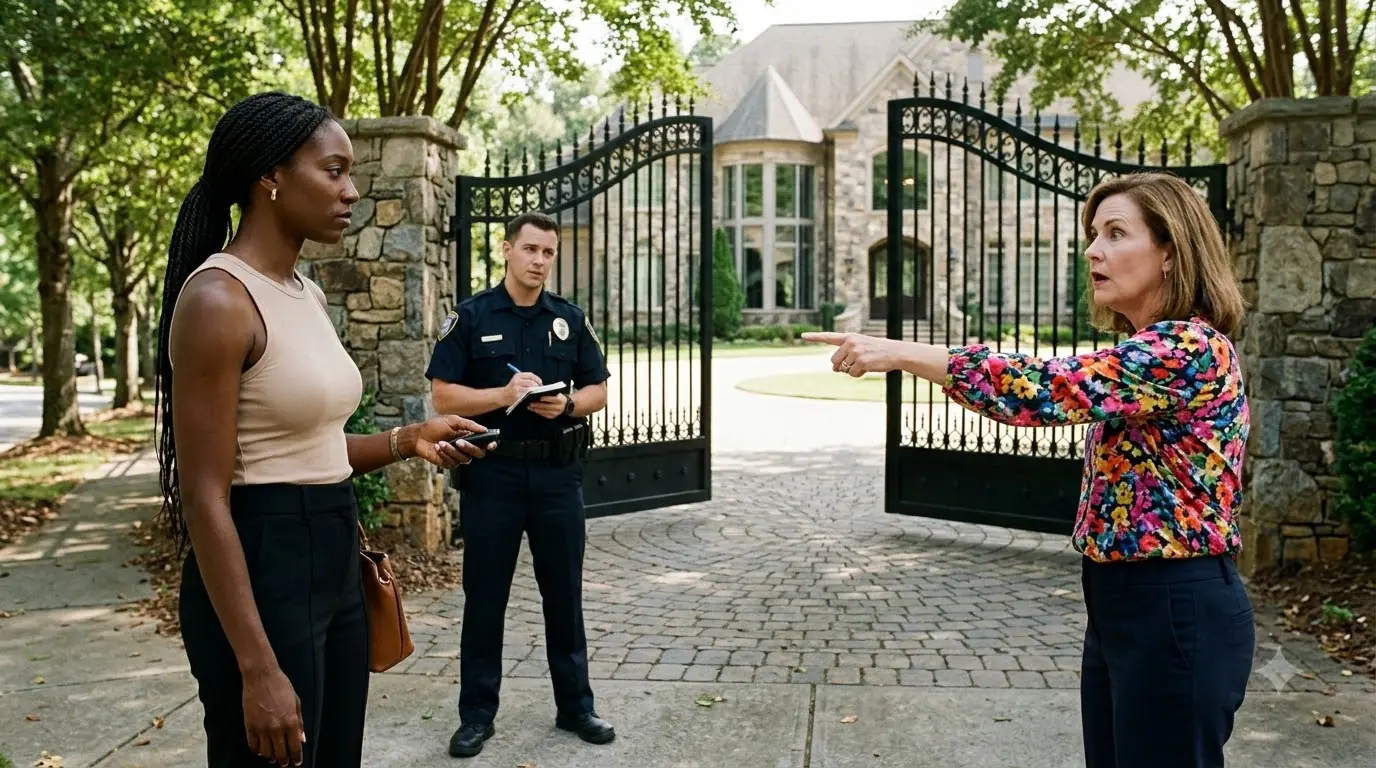
“Suspicious how?” Hayes asked.
Karen blinked. The question was not the response she had expected. She had been waiting for the officer to demand identification, perhaps to move Nia away from the neighborhood before she could cause trouble. Instead he was looking at Karen with patient concentration, pen hovering above his notebook.
“She has been circling these houses,” Karen said. “I told dispatch. She clearly doesn't live here.”
Nia's jaw tightened. She could feel the gaze of a man watering his lawn across the street, and she knew that whatever happened next would be remembered differently by everyone who saw it. She wanted to go home. She wanted her contractor to arrive. She wanted the ordinary afternoon back.
Then a soft electronic beep sounded behind them.
The wrought-iron gate began to move. The immense panels slid apart, revealing a long circular driveway and a stone-and-glass mansion beyond. Karen's words stopped in her throat. Hayes looked from the opening gate to the remote now visible in Nia's hand.
“Ma'am,” he said carefully, “whose house is that?”
Nia faced Karen and answered in a voice that carried no triumph at all.
“Mine.”
The silence lasted only seconds, but those seconds contained the beginning of a battle that would occupy the next several months of Nia Carter's life. What looked like an immediate public humiliation would turn into falsified neighborhood complaints, a paper trail no one intended her to read, and a question far more difficult than who owned the house.
Three weeks earlier, Nia had stood at the same gate carrying two grocery bags and thinking about how good quiet felt.
Willow Crest Estates lay outside Atlanta behind ornamental trees, manicured hedges, pale stone driveways, and wrought-iron gates that concealed much of the homes from the street. Nia had purchased her house eleven months before, after twelve years in commercial interior architecture and the sale of her stake in a small design firm. She had negotiated construction schedules, argued over materials, corrected contractors' mistakes, and spent enough nights in unfamiliar hotel rooms to know that luxury mattered less than the chance to close a door and hear nothing beyond it.
The home was expensive, and Nia had paid for it through work. She was thirty-four, tall and slim, with deep-brown skin, long braids usually pulled into a low ponytail, and a measured way of speaking that clients sometimes mistook for softness. On that earlier evening she wore black trousers and white sneakers, with a handbag hanging from one shoulder. She let herself through the gate and went straight to the kitchen, where she ate leftover food standing at the counter. She had no wish to become an important person in the neighborhood. She wanted to be a resident.