She showed up at his door with nothing but a worn suitcase, rain-soaked clothes, and a dead man’s last wish.
Caleb Thornton had not spoken to a woman with any real purpose in three years. He had not needed to, or at least that was what he told himself.
The farm was enough.
The silence was enough.
The steady work of the land was enough to keep his hands busy and his mind from wandering too far into places it had no reason to go.
But Lydia Harper was not asking for conversation.
She was asking for survival.
And the deal she put on his kitchen table that evening, cold, desperate, and impossible, would either save them both or destroy everything Caleb had left to his name.
The first thing people noticed about Caleb Thornton was not the scar. It was the way he moved through town like he was already apologizing for being there. His shoulders turned inward, his eyes stayed low, and the brim of his hat was pulled down far enough to cut the world in half.
He bought his supplies fast, and he left faster. Nobody called after him to ask how the harvest was coming along. Nobody asked if he had heard about the Dempsey boy breaking his leg on Birch Street, or whether he needed help before winter. Nobody called after him at all.
That was just how things were in Red Hollow.
The scar ran from the outer corner of Caleb’s left eye down past his jaw, a thick rope-like mark that had healed badly six years earlier and never stopped looking raw, even now. A farming accident, people said when they spoke of it at all. A thresher blade. A terrible moment of distraction. A man who had walked into that morning with one face and walked out with another.
Caleb knew what he looked like. He was not foolish about it. What he had not expected was how quickly people decided that a changed face meant a changed soul.
As if the blade had cut away something essential along with the flesh.
Within a year of the accident, Sunday dinner invitations stopped coming. Easy nods from men he had worked beside for a decade turned stiff and brief. A woman named Clara, who for a short and uncomplicated time had been something close to a sweetheart, wrote him a letter that was kind, careful, and final.
Caleb burned it in the kitchen stove without reading it a second time.
After that, he learned not to need things he could not have.
The Thornton farm sat four miles northwest of Red Hollow’s main street, tucked into a shallow valley where Miller’s Run cut through the land before disappearing into the cottonwoods. From the road, it did not look like much. A two-story clapboard house that needed paint. A decent barn. Sixty odd acres of mixed crop land. A kitchen garden that had gone mostly to weeds after his mother passed eight years before.
But it was his.
Every inch of it had been paid for in sweat, stubbornness, and two years of near starvation after his father’s debts came due all at once. Caleb had almost lost it then. He had been sitting in the county assessor’s office, preparing to sign away the north pasture, when Gerald Harper walked through the door, pulled up a chair without being invited, and told the assessor to hold off.
“I’ll back the loan,” Gerald said, as easily as if he were commenting on the weather. “Caleb Thornton is good for it.”
Caleb had stared at him. He barely knew Gerald Harper. The man owned a ranch on the east side of the valley and had a reputation for fairness, but they had never been friends.
“You don’t even know me,” Caleb said.
“I know your father raised you honest,” Gerald replied. “And I know an unfair situation when I see one.”
That was it. No lecture. No performance. No debt of gratitude demanded in return. Gerald Harper did a thing because he believed it was right, and then he went back to his life while Caleb went back to his.
Over the next several years, they exchanged maybe forty words total. A tip of the hat here. A brief discussion about corn prices there. But Caleb never forgot what Gerald had done.
A man did not forget someone who pulled him back from the edge when he had every reason to keep walking.
By the autumn of 1889, the Thornton farm was holding. Not thriving, but holding. The summer wheat had come in decently enough. The barn needed a new section of roof before winter, and the kitchen garden was still half overgrown, but the land was alive, and Caleb was keeping it that way.
He did the work himself from dawn to dusk, with only a red cattle dog named Rust for company. Rust was eleven years old, half blind in one eye, and stiff in the back legs. They suited each other.
Evenings were the hardest.
Not because Caleb was lonely exactly. He had made peace with solitude the way a man made peace with a bad knee. You did not stop walking. You adjusted. But autumn evenings had a weight to them, especially when the light stretched gold and long across the fields before dying behind the ridge.
He had been sitting on the porch with a cup of cooling coffee and an old newspaper he had already read twice when he heard wheels on the dirt lane.
He looked up.
It was a rented buggy from the livery in town. He recognized the gray mare, a lazy animal named Duchess that the stable boy always overcharged for. The buggy came down the lane unevenly, stopping and starting once, then veering left before correcting.
Caleb set down his coffee. Rust lifted his head from the porch boards, one cloudy eye catching the last of the light.
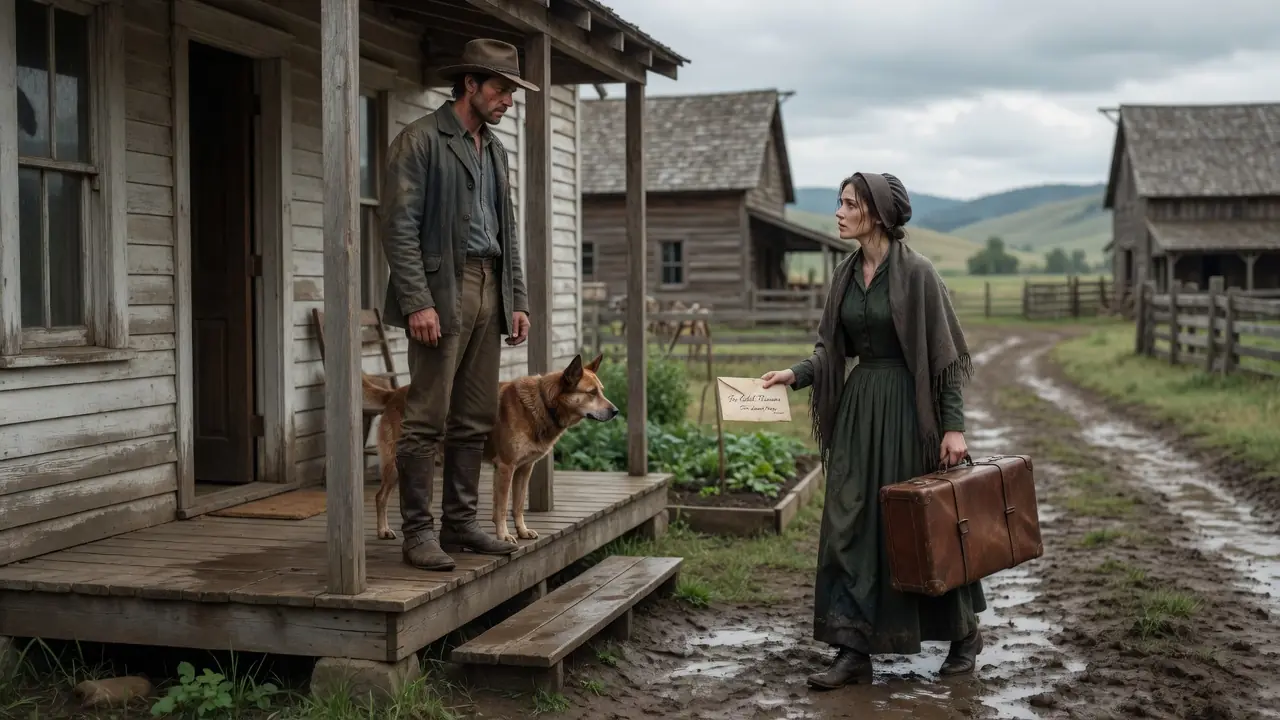
The buggy stopped at the gate, and a woman climbed down.
She was maybe twenty-five or twenty-six, with dark hair pinned up but coming loose from a long day of travel. Her dress had been pressed carefully at some point hours ago, but now showed every mile. She carried a suitcase held shut by a leather belt buckled around the middle, which told Caleb the latch was broken, and that told him something about the state of her life before she ever said a word.
She stood at the gate and looked at the house, then at him on the porch.
Something flickered across her face.
Relief and dread at the same time.
Caleb recognized that expression because he had seen it in his own reflection.
She opened the gate.
He stood.
“You’re Caleb Thornton,” she said.
It was not a question.
“I am.”
He came down the porch steps slowly, not wanting to startle her. He was aware, as he always was with strangers, of the scar. He watched for the moment her eyes found it. They widened slightly before she caught herself and looked him square in the face, making a deliberate decision about where to keep her gaze.
Most people did not bother with the decision.
“I’m Lydia,” she said. “Lydia Harper. Gerald Harper was my father.”
Caleb went very still.
“Was?”
“He passed six weeks ago.”
Her voice was steady, but there was something beneath it like old ice. The kind of steadiness a person developed not because they were not hurting, but because they had been hurting long enough to talk through it.
“Pneumonia,” she said. “It came fast.”
Caleb took off his hat. It felt inadequate, but it was the only thing he had.
“I’m sorry,” he said. “He was a good man. I owed him more than I could repay.”
“He knew that,” Lydia said. “He used to say you were one of the few people he backed in his life who never made him regret it.”
They stood there in the cooling evening air. Rust limped down the porch steps to investigate her with his nose. Lydia looked down, and something in her face softened. She let the old dog sniff her hand.
“He doesn’t bite,” Caleb said. “He barely walks.”
“He’s sweet.”
She straightened.
“Mr. Thornton, I don’t want to take up your evening. I’ve been traveling since before dawn, and I’m not at my best, so I’m going to say what I came to say plainly. I hope you won’t think worse of me for it.”
“Say what you need to say.”
She met his eyes.
“I have nowhere else to go.”
Caleb brought her inside.
He was not entirely sure why. Reflex, maybe. Or the memory of Gerald Harper walking through a door and pulling up a chair without being asked. Whatever it was, Caleb held the front door open, Lydia stepped inside with her battered suitcase, and he put a kettle on the stove because it was the only hospitable thing he knew how to do on short notice.
The kitchen was clean. He kept it that way, one of his mother’s insistences that had survived her. The rest of the house was functional but bare, the way a place became when a man lived alone long enough and stopped noticing what was missing.
Lydia sat at the kitchen table and wrapped her hands around the cup of tea he set before her like it was the first warm thing she had touched in days.
Maybe it was.
“Tell me,” Caleb said.
He pulled out the chair across from her and sat down.
She told him that after Gerald’s death, the ranch had passed to Lydia as his only surviving child. Her mother had died when Lydia was twelve, and her brother Thomas had gone east for work five years earlier and had not written in two. The ranch should have been manageable. It was not large, but it was solid, and Gerald had been careful with money.
What Gerald had not been careful about was his foreman.
Dale Doss had worked for him for eleven years. Gerald trusted him completely. In the last three of those years, Doss had quietly siphoned money from the ranch accounts, first in small amounts, then larger ones. He covered his theft with falsified records that Gerald’s failing eyesight and trusting nature had not caught.
After Gerald died, Lydia discovered the discrepancies and confronted Doss.
He turned it around on her.
He claimed she had authorized the transfers herself. He produced paperwork with what looked like her signature. Then he went to the county sheriff before she could.
The accusations moved fast, the way accusations always did in small communities. Broad embezzlement. A grieving daughter stealing from her own father’s estate. A woman alone making a mess of a man’s business and blaming someone else.
“It wasn’t true,” Lydia said.
Her voice remained steady.
“None of it was true. But once people hear something, especially about a woman alone…”
She stopped and pressed her lips together.
“The ranch hands quit. The neighbors stopped coming around. The bank froze the accounts pending investigation, and my father’s lawyer refused to take the case without a retainer I couldn’t access.”
“How did it resolve?” Caleb asked.
“It hasn’t. Not officially.” She looked down at her tea. “The sheriff took Doss’s word over mine. I had thirty days to vacate the property while the estate was held in review. That was three weeks ago.”
“Where have you been staying?”
A pause.
“A boarding house in Milfield until four days ago, when I couldn’t make the rent.”
Caleb was quiet. Outside, the wind had picked up, pushing against the kitchen window with a low, persistent sound.
“You said your father left a message,” he said. “You wrote that in your letter.”
Two weeks before, Lydia had sent him a brief, formal note saying she needed to speak with him about a matter concerning Gerald Harper’s final wishes. Caleb had read it three times and still had no idea what it could mean.
Lydia reached into her coat pocket and produced an envelope. She set it on the table between them.
“He wrote it himself,” she said. “The week before he died, when he knew he was running out of time. He asked me to give it to you in person.”
Caleb looked at the envelope.
Caleb.
The script was shaky, but recognizable. Caleb picked up the envelope and opened it.
The letter was short. Gerald Harper had never been a man to use ten words when five would do.
Caleb,
I do not have much time, and I will not waste it on preamble. Lydia is going to need help. Real help, not the neighbor-checking-in kind. She is stronger than she looks and more stubborn than she ought to be, which means she will not ask easily. When she does, please listen.
You are a good man, and I have always believed that. I am asking you to remember it when it matters.
Gerald
Caleb read it twice. Then he folded it carefully along its original creases and set it back on the table.
For a long moment, he said nothing.
Lydia watched him with those careful eyes, waiting without pushing.
“He wrote that before any of this happened,” Caleb said. “Before Doss. Before the accusation.”
“He knew I was proud,” Lydia said quietly. “And he knew I would wait too long to ask for help on my own. He wanted to make it easier by having someone already know they were supposed to help.”
Caleb understood that more than he wanted to admit.
“What is it you need?” he asked. “Specifically. Say it plain.”
She looked at him steadily.
Then Lydia Harper, who had been holding herself together with nothing but determination and an iron spine, said the things she had clearly been rehearsing for two hundred miles.
“I need a legal situation that stabilizes mine. I need a permanent address for the court proceedings. I need a husband standing beside me for the investigation. And I need someone who won’t throw me out when it gets complicated, because it will get complicated.”
The kitchen went very quiet.
“You’re talking about marriage,” Caleb said.
“A practical arrangement,” Lydia replied quickly. “I’m not asking for anything beyond what is necessary. You would have full use of a second pair of hands on this farm, which, from what I can see, you could use. I can work. I am not fragile. My father raised me on a ranch.”
She said it fast, as if saying it more slowly might make her lose courage.
“When the estate is resolved, if you want to dissolve the marriage legally and quietly, we can do that too. I’m not here to trap you into anything.”
Caleb sat back in his chair.
He looked at the woman across his kitchen table. She was exhausted, bone-deep exhausted in a way no amount of composure could hide. Her hands trembled slightly around the teacup, though she was trying to control them. Her eyes were clear and direct, the eyes of someone who had cried a great deal recently and had forbidden herself from doing it again.
He thought of Gerald Harper pulling up a chair in the county assessor’s office and saying he would back Caleb because it was right.
He thought of sitting on this porch alone every evening for the next thirty years, watching the light go gold across fields he worked by himself.
He thought of what it cost a person to walk up to a stranger’s gate with a broken suitcase and say, I have nowhere else to go.
“You’d have to stay in the house,” Caleb said. “There’s a spare room upstairs. I’ll fix the window latch. It lets in cold.”
Lydia stared at him.
“Are you saying yes?”
“I’m saying the window latch is broken and I’ll fix it.”
He picked up his coffee cup, found it cold, and stood to put it in the wash basin.
“There are things to sort out. Paperwork. Legal matters. We’d have to go to the courthouse. It would have to be real on paper. I won’t do something halfway and have it come apart on you later.”
“I understand.”
“I work before dawn most days. I don’t expect you to match that unless you want to.”
“I want to.”
He turned and looked at her.
She sat straighter now. The exhaustion was still there, but underneath it was something else. Something like a person who had been underwater for too long and had just broken the surface.
“There’s a room at the top of the stairs,” Caleb said. “Second door on the left. Sheets in the chest at the foot of the bed. It hasn’t been aired out in a while.”
“I don’t care.”
“Get some sleep.”
He started toward the door, then stopped.
“Miss Harper.”
“Lydia,” she corrected softly.
“Lydia,” he said.
Her name felt unfamiliar in his mouth. He had not used a woman’s first name in years.
“Your father was a fair man,” Caleb said. “I can’t be him. But I can be fair.”
Lydia nodded. Her chin was steady, but her eyes were bright.
“That’s all I’m asking.”
Caleb lay awake for two hours that night, listening to the old house settle around this new and improbable arrangement. What he had done made little logical sense. A woman had appeared at his gate with a dead man’s letter, a broken suitcase, and a legal situation full of thorns, and Caleb had said yes before thinking it through properly.
His neighbor Bill Acres would tell him he was out of his mind. The town would form an opinion within forty-eight hours, regardless of the facts. Margaret Blackwell, if she heard, would form two opinions and distribute both before Sunday church.
But beneath all logic was something simpler.
A man who had once done the right thing for Caleb had sent his daughter to Caleb’s door.
The least Caleb could do was open it.
The courthouse in Red Hollow had a marriage registry office on the second floor that also doubled as the property records department. That meant the clerk who processed their paperwork, a woman named Mrs. Gould with reading glasses and strong opinions, did so while managing a stack of land surveys and making it clear with every expression that she found the whole matter unusual.
They arrived on a Tuesday.
Caleb wore his best coat, which was not a very good coat. Lydia wore the same dress she had worn the night she arrived, though somehow she had made it look pressed again.
The ceremony took eleven minutes.
Mrs. Gould read the words. Caleb said what he was supposed to say. Lydia said what she was supposed to say. They signed the registry. Mrs. Gould stamped it with a heavy brass stamp that said County of Red Hollow and handed them each a copy.
“Congratulations,” Mrs. Gould said in a tone that conveyed no particular enthusiasm for marriage as an institution.
“Thank you,” Lydia said politely.
Outside on the courthouse steps, they stood for a moment in thin autumn sunlight. A wagon rolled past on the main street. A dog barked somewhere. Caleb looked at the document in his hand. Certificate of marriage. His name and hers, side by side in Mrs. Gould’s precise handwriting.
“Well,” he said.
“Well,” Lydia replied.
“We should get back. The south fence needs repair before the temperature drops.”
“I can help with fence.”
He glanced sideways at her. “You know fence work?”
“My father’s ranch ran four hundred head of cattle. I’ve mended more fence than you’ve probably seen.”
Caleb thought about that.
“I’ll get you a pair of work gloves. Your hands will thank you.”
She almost smiled. It was not quite a smile, only the preliminary motion of one, but he caught it. He looked away before it became something he was too aware of noticing.
Red Hollow noticed within the week.
Of course it did.
Red Hollow was not large. It had two general stores, a land office, a saloon that called itself a hotel, a doctor who doubled as a dentist and occasionally as a veterinarian, three churches that disagreed about nearly everything except the saloon, and roughly four hundred sixty people who all knew one another’s business with varying degrees of accuracy.
A scarred recluse farmer marrying a strange woman under mysterious circumstances was the most interesting thing that had happened since the bank was robbed three years earlier. And the bank robbery had involved only two men and a horse.
The first person to say anything to Caleb’s face was Bill Acres, his nearest neighbor. Bill was a decent man, but constitutionally incapable of minding his own business. He appeared at the farm gate on Thursday morning with a poor excuse about borrowing a fence staple, which Caleb saw through immediately because Bill owned twice as many fence staples as Caleb did.
“Heard you got married,” Bill said, leaning on the gate post.
“You heard correctly.”
“Fast.”
“Fast enough.”
Bill scratched his chin and looked toward the house. Lydia was visible through the kitchen window, moving around near the stove.
“She’s staying then?”
“She’s my wife,” Caleb said. “That’s generally how it works.”
“Don’t get prickly. I’m asking because people are asking me, and I don’t have answers. I’d rather give them something true than watch them make up something worse.”
Caleb considered that. It was reasonable.
“She’s Gerald Harper’s daughter,” Caleb said. “She ran into bad luck after he passed. We knew each other through him. I had room, and she needed a start. That’s the whole of it.”
Bill looked at him for a long moment.
“She seems capable,” he said. “Saw her repairing your kitchen garden fence this morning. She was using a level.”
“She knows what she’s doing.”
“Good. You could use someone who knows what she’s doing around here.” Bill straightened. “Just be careful, Caleb. You know how this town gets when it decides to have an opinion.”
“I know.”
Caleb did know.
He just did not know yet how bad that opinion would get.
Lydia took the farm in hand the way a person did when she had spent years watching something mismanaged and finally had the chance to do it right. She did not announce it. She did not ask permission for every small thing. She simply began.
The kitchen garden came first. It was October, late for most planting, but she ripped out the dead growth, turned the soil, and put in winter crops. Kale, leeks, late carrots. She built a small cold frame from salvaged wood she found in the barn and covered it with old window glass Caleb had stacked in a corner and forgotten.
“It will extend the growing season by six weeks,” she told him.
He had not known that.
He stood at the edge of the garden watching her work and thought, She knows things I don’t.
That was a strange thing to feel about another person. He had managed alone so long that the possibility of someone knowing something he did not had stopped occurring to him as a practical reality.
The house she tackled more carefully, room by room, asking before she changed anything. She found two broken chairs in the spare room and fixed them with boiled hide glue. She tracked the persistent cold draft in the sitting room to a gap behind the baseboard and sealed it with a mixture she made herself.
She was deeply and practically competent in a way that had nothing to do with presentation or performance. She simply knew how to do things, and then she did them.
What she could not fix was her legal situation, which hung over the household like a low cloud.
Twice a week, Lydia wrote letters at the kitchen table. To the county circuit court. To a lawyer in the territorial capital whom she had found through a newspaper advertisement. To anyone who might be able to act on her case. Her back stayed straight, her handwriting precise and controlled.
Occasionally, she stopped and pressed her fingertips to her eyes for exactly three seconds before returning to the pen.
Caleb noticed.
He had learned to read the small signals of a person who was managing because he had lived that way himself after the accident. He said nothing. Work was what she needed. Purpose was what she needed.
He understood that because it was what had kept him alive when the accident rearranged his world and the only thing stopping him from disappearing into himself was the fact that the farm needed tending regardless of how he felt.
One evening three weeks after she arrived, Caleb came in from the barn to find supper already made. Not the basic meals he usually ate standing over the stove, but food that had clearly taken time. Stewed beef with root vegetables. Fresh biscuits. Coffee timed to be ready when he came through the door.
He stood in the doorway with his hat in hand, genuinely thrown.
“You didn’t have to,” he started.
“I wanted to,” Lydia said. “Also, I found three different kinds of dried beans in the cellar and absolutely nothing done with any of them, which is a waste. Expect bean soup by the end of the week.”
“I like bean soup.”
“Good.” She placed a plate on the table. “Sit down before it gets cold.”
He sat. He ate.
For the first time in longer than he could measure, the house did not feel like a place he merely occupied.
It felt like somewhere someone lived.
He did not know what to do with that feeling, so he finished supper, said it was good, and went to check the barn.
Rust followed him with his uneven, arthritic gait. For once, the old dog seemed less interested in the barn and more interested in looking back at the lit kitchen window.
“Don’t make it complicated,” Caleb told him.
Rust sneezed.
Trouble arrived in the form of Margaret Blackwell, which was more or less how trouble often arrived in Red Hollow.
Margaret Blackwell was forty-seven, widowed, and wealthy in the way small-town wealthy people were wealthy. She was not rich by the standards of the wider world, but she had enough land, enough bank influence, and enough social leverage to decide who was acceptable in Red Hollow and who was not.
Over the years, she had decided Caleb Thornton was not.
It was not personal exactly, or rather it was personal in the way social cruelty was always personal while pretending to be propriety. Margaret had been the first to stop including Caleb in community events after the accident, framing it as consideration for the comfort of others. She had been the quiet voice suggesting that a man so unsociable must be hiding something.
When word of Caleb’s marriage reached her through Mrs. Gould, who attended the same church, Margaret processed the information and began working with it immediately.
The version she circulated had a particular shape.
Lydia Harper, a disgraced woman from the next county running from fraud accusations, had found Red Hollow’s loneliest and most desperate man and attached herself to him for shelter and whatever money he could provide. Caleb, poor scarred Caleb, was too hungry for company to ask the questions he should have asked. It was not a marriage at all, Margaret implied. It was a transaction, and Caleb was being cheated.
She did not say it all at once or in one place.
Margaret was smarter than that.
She said pieces of it to different people in different rooms, always framed as concern, always with the gentleness that made cruel things sound like worry.
Caleb heard the version that reached Bill Acres thirdhand on a Saturday at the feed store. He did not say anything. He paid for the feed, went home, unhitched the horse, and spent a long time in the barn being very still.
When he came inside, Lydia was standing at the stove. She turned when she heard him.
“What happened?”
“Nothing.”
She looked at him with direct eyes.
“Caleb.”
He had not expected her to use his name like that, as if she had a right to it, as if they were people who used each other’s names without formality. It caught him off guard.
“There’s talk in town,” he said. “About us. About you.”
Something shifted in her face. Not fear. Recognition.
“What kind of talk?”
He told her plainly. He did not soften it because she had asked him to be fair, and he thought fairness included not wrapping bad news in cotton.
Lydia listened with her arms crossed over her chest. When he finished, her jaw was tight.
“Margaret Blackwell,” she said. “I’ve been hearing that name. The general store owner’s wife mentioned her.”
“She has influence in this town.”
“More than she should, probably.”
Lydia turned back to the stove and adjusted something that did not need adjusting.
“What do you want to do about it?” she asked.
“I don’t know yet,” he said honestly. “I wanted you to know first.”
“She isn’t wrong about the practical facts,” Lydia said. “I did need somewhere to go. You were the arrangement that made that possible.”
Her voice was even, not defensive.
“But she is wrong about the character of it, and she is wrong about you.”
“I’m less concerned about me.”
“I’m not.”
She said it simply.
“You’ve been made into someone else’s story before. I can see it in the way you move through town. Someone else’s idea of who you are, worn on your skin whether you chose it or not.”
She paused.
“I won’t let this woman do that to you again because of me.”
Caleb looked at her.
She saw more than he realized.
“Get some sleep,” he said. “We have the north fence tomorrow.”
She nodded and did not push. But before she went upstairs, she said quietly, “I’m not going anywhere, Caleb. Whatever she says about this marriage, I’m not going anywhere.”
After she left, Caleb sat at the kitchen table, pressed both hands flat against the wood, and stared at the lamp flame for a long time.
Outside, the sky over the valley had gone the dark green color it took when weather was building.
Weather was changing.
He did not yet know how true that was.
The days found a rhythm Caleb had not expected. Before Lydia, his life had been structured by necessity. Get up. Work. Eat. Sleep. Repeat. That structure had been enough because he had nothing to compare it to.
Now there was a second lamp lit in the mornings. There were voices instead of silence. There was the sound of someone else in the kitchen. A book left face down on the sitting room table. A coffee cup washed and set to dry. Rust abandoning his usual corner for the rug by the kitchen fire because someone was more likely to pass by.
Once, Caleb paused in the barn doorway just to listen to Lydia in the garden. She was talking quietly to herself while she worked, not actual conversation, but the running commentary some people kept when they did not think anyone could hear. She cataloged tasks, argued with the soil, and seemed to be carrying on a dispute with one particular carrot that refused to cooperate.
Caleb turned away before she caught him standing there doing nothing.
Three weeks became four. Four became six.
The farm looked better. Not because of one dramatic change, but because of small things done consistently. That was how anything truly improved. The cold frame worked. The kitchen garden produced. The interior of the house lost its abandoned quality and became functional. Even Rust had more energy, probably because someone now gave him regular kitchen scraps and the quiet attention old animals particularly needed.
Something in Caleb slowly began to loosen.
He started explaining things as he did them. The way to handle the south field drainage. The temperament of the mare who pulled the plow and needed to be approached from the left. He did not mean to teach. It just happened.
Lydia listened with genuine attention. Not waiting to respond. Actually taking in what he said.
“Why do you rotate this pasture every two seasons instead of three?” she asked one afternoon. “My father did three.”
“Soil type,” Caleb said. “Your father was working different land. This valley clay wants more rest.”
She thought about that. “Would it work the same on the east acre?”
Caleb had not fully considered the east acre in those terms. He told her so, and they stood at the edge of the field in the October cold having a genuine conversation about crop rotation.
He realized she was interesting.
He found that mildly inconvenient.
The first good letter arrived from the territorial capital on a Wednesday. Lydia brought in the mail, and Caleb heard her go very quiet at the kitchen table before he came inside.
He found her sitting with a letter open in both hands. Her face held a look he had not seen before. Not devastation. Something more complicated. Like a person reading a map and finding that the road she needed was there after all, just longer than she had hoped.
“The lawyer in the capital,” she said. “He’s taken the case.”
“That’s good news.”
“It is.”
She set the letter down carefully.
“He says the forged signature is the key. He thinks there is enough evidence in the document irregularities to open a counter investigation into Doss. But it will take time. Maybe months. I’ll need to appear before a circuit court judge, which means more travel, more…”
“More uncertainty,” Caleb said.
“Yes.”
She looked at the letter.
“I know this was supposed to be temporary.”
“I know.”
“We said it would hold until it resolved,” he said. “It hasn’t resolved, so it holds.”
He paused.
“Is that clear enough?”
Something in her face changed.
“Yes,” she said softly. “Clear enough.”
The rumor reached Lydia on a Friday through Helen Pratt, the wife of the dry goods store owner. Helen was pleasant enough, with flour-dusted hands and a habit of saying difficult things in the softest possible voice, as if gentleness changed the content.
Lydia had come in for lamp oil and thread when Helen leaned over the counter.
“I just think you should know what’s being said,” Helen began. “Because I personally don’t believe a word of it.”
“Tell me,” Lydia said.
Helen told her the version circulating through Red Hollow. That Lydia had arrived deliberately, not desperately. That she had identified Caleb Thornton as a man too isolated and too hungry for human contact to ask the right questions. That the marriage was a legal shield designed to muddy the fraud investigation in the next county. That Caleb was too gone on having a woman in his house to see he was being used.
Lydia stood at the counter and listened without changing expression.
She paid for the lamp oil and thread. She thanked Helen Pratt. Then she walked out to the buggy and sat there for three full minutes without picking up the reins.
The anger was there. Hot, pressurized, sitting behind her sternum. But she had learned over the course of a terrible year not to act on anger immediately and not to swallow it entirely. Both caused damage. What you did was hold it, breathe through it, and figure out what it was telling you.
It was telling her this would not stop on its own.
Margaret Blackwell had made a calculation. She believed Lydia would retreat, that she would recognize the social weight aligned against her and make herself smaller. She believed Lydia would stay on the farm, keep her head down, and allow the story to harden around her.
Lydia picked up the reins.
She turned the buggy not toward home, but toward the center of town.
That evening was the monthly community meeting at the Grange Hall. It was supposed to be about water rights and winter road conditions, but most of Red Hollow attended because it was also the main social event of the month. Margaret Blackwell would be there. The Pratts would be there. Bill Acres, the banker, the feed store owner, and most of the people holding opinions about the Thornton marriage would be sitting in the same room.
Lydia had planned to skip it.
She revised that position.
When she got back to the farm, Caleb was on the barn roof with a hammer and nails, resetting shingles that had started to lift.
He looked down when she pulled up, reading her face the way he read things quickly without making a show of it.
“What happened?” he called.
“I need you to come to the Grange meeting tonight.”
He took the nails from his mouth. “I don’t go to those.”
“I know. Come anyway.”
He looked at her for a moment, then at the roof section he had been working on. She could see him calculating. Not whether she was serious, but whether he was going to let his own discomfort become her problem.
“What time?” he asked.
“Seven.”
“I’ll be ready.”
The Grange Hall was a plain building on the east end of town with oil lamps along the walls and rows of wooden chairs that scraped whenever anyone shifted. It smelled of sawdust, pipe smoke, and gathered bodies in cold weather.
By seven, it was nearly full.
Caleb walked in beside Lydia, and the room did what rooms did. No one gasped or pointed. It was subtler than that. Conversation paused fractionally. Attention redirected itself. Eyes moved toward them, then away, then back again.
Lydia felt Caleb feel it too. His shoulders braced slightly, the physical memory of being the thing people looked at.
She moved to seats near the middle and sat down. Caleb sat beside her.
“You don’t have to do anything,” she said quietly. “Just be here.”
“I’m here,” he replied.
The meeting opened with water rights, which occupied the first forty minutes and allowed the room to mostly forget about them. Lydia listened and asked one practical question about drainage timing that seemed to surprise the meeting chair because he answered it seriously and then looked at her as if recalibrating something.
Margaret Blackwell sat three rows ahead and to the left, accompanied by two women from her social circle. She was dressed with effortless precision and had not looked directly at Lydia once.
During the road maintenance discussion, Margaret made her move. Not loudly. Not even obviously to most of the room. She leaned toward one woman and murmured behind her hand. The woman’s eyes cut toward Lydia. Two other people leaned closer.
It was exactly the kind of thing a person could not confront directly without appearing to lose composure over nothing.
That was the point.
Lydia stood.
The meeting chair stopped mid-sentence.
“I’m sorry to interrupt,” Lydia said, and her voice was steady. “I know this isn’t on the agenda, but I’ve become aware that there are questions about my husband and me circulating through this community. I’d rather address them directly than let them continue in corners.”
The room went quiet.
“My name is Lydia Thornton. My father was Gerald Harper, whom some of you knew. He ranched East Valley for twenty years and dealt honestly with every man and woman in this county. When he died, I inherited a situation that had been corrupted behind my back by a man my father trusted. I won’t detail the legal particulars tonight because they are before a court.”
She paused.
“What I will say is that I came to Red Hollow with nothing, and Caleb Thornton offered me a fair arrangement when I needed one. That is the truth of our marriage. Not strategic. Not fraudulent. Two people making the best decision available with what they had.”
She looked at the room, not at Margaret.
“I don’t expect this community to trust me on the basis of one speech. Trust is earned. I understand that. But I ask that people extend the same courtesy to my husband that any of you would want extended to yourselves. Wait for evidence before you decide what someone is.”
Then she sat down.
Beside her, Caleb had gone very still.
The meeting chair cleared his throat. “Well. Thank you, Mrs. Thornton.”
He looked back at his paper.
“Road maintenance funding. Holt, you had the floor.”
The meeting moved on.
Afterward, as people filed out, something happened Lydia had not calculated. Three people came to speak with them. Not many, considering a room of eighty, but three where she had expected none.
A woman whose husband had known Gerald Harper. An older farmer who shook Caleb’s hand and said, “Good to see you out, Caleb.” Helen Pratt, who looked genuinely ashamed and began, “I shouldn’t have…”
“It’s fine,” Lydia said.
Margaret Blackwell walked past without speaking. She kept her gaze somewhere above and beyond them, which was its own kind of communication.
Outside, as Caleb and Lydia walked toward the buggy, Caleb was silent for a long time.
“You didn’t tell me you were going to do that,” he said.
“I didn’t entirely know I was going to do it until I did it.”
“That’s…” He stopped. “You didn’t have to make it about defending me.”
“Yes, I did,” Lydia said. “Because it was about you. What she has been saying is about you as much as it is about me.”
Caleb was quiet.
The lights of town fell behind them as they drove toward the farm road.
“People don’t usually…” He stopped again. There was something raw in his voice. “No one has said anything like that about me in a long time.”
Lydia did not rush to fill the silence. She had learned that Caleb needed space around certain things. After a moment, he said, “Thank you.”
“Don’t thank me,” she replied. “Just help me get the cold frames covered before the temperature drops tonight. I think we’re getting frost.”
“We are,” he said. “I smelled it this afternoon.”
They drove the rest of the way in silence, but it was a different silence now. Less careful. Less managed. The kind of silence shared by people who had stood next to each other in a difficult room and come out still standing.
The frost came hard that night, and the cold frames held.
The weeks that followed had a different quality. Not easier exactly, but more settled. Lydia’s confrontation at the Grange Hall had shifted how some of Red Hollow engaged with them. Not everyone. Not completely. But enough. There were nods at the dry goods store that had not been there before. Bill Acres came one morning with his son to help reset a fence section after a windstorm. He brought his wife too, and she had opinions about the kitchen garden that Lydia found useful once she got past the delivery.
Margaret Blackwell was not done. Caleb and Lydia both knew that. But for the moment, her influence had contracted slightly, like a fire encountering ground that would not readily burn.
The true difficulty came not from the town, but from the small daily act of two people learning to share space.
The big things were manageable. The farm work. The legal letters. The decisions about seed and fences and repairs. It was the small things that created friction.
Caleb kept the house so cold that Lydia thought it suitable for root vegetables rather than human beings. When she built up the kitchen fire, he did not complain, but she noticed him opening windows in rooms she was not occupying.
Lydia reorganized things. Not compulsively, but practically. She thought in systems, in whether tools were stored where they were used, in how to reduce wasted steps. After three weeks, she reorganized the barn tool storage. It was genuinely more efficient. Caleb said nothing for four days, then admitted it was better.
She did not say, I told you so.
She thought it with satisfaction.
Caleb had a habit of starting conversations in the middle of his own thinking.
“The east acre won’t do,” he said one evening at supper.
Lydia stared at him for a moment before realizing he was continuing a thought about crop rotation from four days earlier.
“Because of the drainage issue?” she asked.
He nodded and kept eating.
She had grown up with a father who talked constantly, narrating his thoughts like running commentary. Caleb was the opposite. His silences were not hostile. He simply did not say things until he had thought them through completely, which meant that by the time he spoke, he was ready to be done with the subject, and Lydia was just arriving at it.
They were working on it.
One evening in mid-November, Lydia came downstairs and found Caleb at the kitchen table with an accounting ledger spread before him. His face had the look she privately categorized as load-bearing worry, the expression that meant something was genuinely wrong and he was trying to solve it without mentioning it.
She sat across from him without being invited.
“What is it?”
He looked at the ledger, then at her. She saw him debating whether to minimize it.
“The spring seed order,” he said finally. “I planned to expand the wheat on the north field. I had the money set aside, but the roof repairs cost more than I calculated. I’m about ninety dollars short of what I need to do it right.”
Ninety dollars was not small.
“Show me the ledger,” Lydia said.
He hesitated.
“Caleb,” she said patiently. “Show me the ledger.”
He turned it toward her.
She studied it for a long time. She asked three questions, two about specific line items and one about the pricing he had received for last summer’s wheat.
“You’re undercharging Holt’s broker,” she said. “You have been undercharging him for at least three seasons.”
“He’s the only buyer local enough.”
“He’s not the only buyer in the county. He’s just the closest.”
She pointed to a number.
“Your wheat quality is better than average. The yield weight proves it. You should be getting six cents more per bushel. Over a season, that is more than ninety dollars.”
Caleb stared at the number.
“I didn’t know the county price was running that high.”
“It has been for two seasons. I know because my father sold at the county rate. He taught me to check it.”
Caleb sat back slowly. His expression was not defensive. It was honest, a little abashed, the look of someone realizing he had undervalued something for years without knowing it.
“You grew up learning this,” he said.
“I grew up on a working ranch. My father believed a person who couldn’t read the ledger had no business running land. He meant me as much as anyone.”
“He was a smart man.”
“He was.”
The words landed with their usual weight. She was better at carrying them now, but they still landed.
“We need to renegotiate with Holt’s broker in the spring,” Lydia said, pulling the ledger toward herself. “In the meantime, what is the minimum seed order that still makes the north field worth planting?”
They worked for an hour and a half. At some point, Lydia made more coffee without breaking the conversation. At some point, Caleb made a suggestion about soil amendment on the east acre that she had not considered, and she admitted it was probably right. They argued briefly about whether to plant the whole north section or only the viable portion. Neither convinced the other, so they settled on three quarters as a compromise that satisfied neither of them fully, which Lydia was beginning to understand was often what good decisions looked like.
By the time they finished, it was past ten. The farm’s plan for the following season was written in the margins of the ledger in two different handwriting styles. His narrow and precise. Hers angular and quick.
“Go to sleep,” Caleb said, gathering the ledger.
“I’m not tired.”
He looked at her.
“I’m less tired than I was,” she amended.
“That is almost the same thing.”
“It’s not,” Caleb said, but there was something at the corner of his mouth that was not quite a smile.
On the stairs, Lydia paused.
“Caleb.”
“Yes?”
“In the spring, when you go to renegotiate, let me come.”
A pause.
“Why?”
“Because I’m better at negotiating than you are.”
A longer pause.
“That’s probably true,” he said.
Lydia went to bed smiling.
The storm gave three days of warning before it arrived.
Caleb read all the signs correctly, and still he was not ready for what it became. On the first day, the sky turned a strange pewter color, not quite gray, with a yellow undertone like metal dissolved into the clouds. The cattle were restless. Rust spent the afternoon pressing himself against the inside of the back door, which he only did when the pressure in the air made him distrust the world.
The temperature dropped fourteen degrees between noon and sundown.
“Bad one coming,” Caleb said at supper.
“How bad?” Lydia asked.
“Bad enough. We should move the chickens into the south section of the barn. The coop won’t hold if the wind gets serious.”
They spent the evening moving chickens, which involved the particular chaos chickens brought to every human plan. Then they secured barn doors, checked the cold frames, and weighted the covers with boards. Lydia wrapped the base of the cold frames with burlap without being asked, which was exactly right, and Caleb noticed.
The second day, the temperature kept falling. A neighbor three miles north sent his twelve-year-old son over on a pony with a warning.
“Tell everyone to tie things down.”
They tied things down.
On the third day, the sky went greenish black by two in the afternoon. Caleb stood on the porch and looked at it with the attention serious weather always called up in him, the old part of his mind that understood the prairie in a language before words.
“Get inside,” he told Lydia. “The mare is still in the east paddock. I’ll get her. You get inside.”
She did not argue, which told him she had reached the same conclusion.
The storm hit at twenty-three minutes past three.
It came from the northwest like a wall moving sideways. At first there was no rain, only wind with actual weight, wind that pushed like something with a grievance. Then the rain arrived, horizontal and freezing. Behind it came sleet, and the afternoon turned the color of nothing.
Caleb got the mare inside and was latching the barn doors when the wind took the south-side hay cover. A tarpaulin he had staked down with iron pins, which should have held and did not. It flew up like a dark wing before the rain swallowed it.
The hay could not get wet. Three weeks of cut and dried winter hay for the cattle, his entire supply until spring. If it soaked and molded, the cattle would have nothing.
Caleb pulled his coat tighter and went after it.
He found the tarp wrapped around a fence post at the far corner of the south pasture, a piece of luck he would not have gambled on. He was unwrapping it with his face turned against the sleet when the fence line groaned.
He looked up.
The old cottonwood at the pasture’s edge had been compromised all summer. Part of the root base had rotted out. He had meant to address it. It was on the list of things to handle. It had stayed there too long.
Now the tree was moving in a way trees were not supposed to move. Not bending with wind, but swaying from the root.
Caleb had time to think, It’s coming down.
Then he heard Lydia’s voice behind him.
He spun.
She was there twenty feet behind him at the edge of the pasture, because of course she was. She had looked out, seen the tarp go, pulled on her coat, and followed. She was holding a spare rope and wearing the expression that meant she had come to help and did not anticipate being told to stay away.
Caleb moved before thought.
“Lydia!”
The tree fell in two stages. First the root system gave, and the whole thing tilted with a long, terrible groan. In that half second, Caleb was already running because the angle was wrong. The crown would come down across the fence line, and Lydia was standing there, looking at him instead of the tree.
He hit her with his shoulder and wrapped both arms around her.
They went down together in wet grass, mud, and sleet, rolling hard against the fence post. The tree came down with a crack like twenty rifles firing at once. Outer branches caught Caleb’s left leg and right shoulder and dragged. Something struck the back of his head hard enough to blank his vision for three seconds.
Then stillness.
The wind kept screaming, and the sleet kept falling, but around the fallen tree there was a strange local quiet.
Caleb was on his hands and knees in the mud, head down, waiting for his vision to return. His shoulder felt as if something had tried to pull it from its socket and reconsidered. His leg burned along the calf.
“Caleb.”
Lydia’s voice was beside him. Both her hands were on his arm.
“Caleb, look at me.”
He looked at her.
She was mud-covered and soaked, with a small cut on her chin from the fall. She was looking at his face with an expression he had never seen on her before. Not managed composure. Not careful steadiness. Something raw and broken open.
“I’m all right,” he said.
“You’re hurt.”
“So are you.”
She made a sound almost like a laugh, though it was not one. Her grip on his arm tightened without her noticing.
“Can you stand?”
“Yes.”
He stood. His leg protested but held. His shoulder was worse. There was something wrong with the rotation, but he would deal with that later. After the cattle were checked, after the barn was secured, after all the necessary things were done.
He had ignored physical damage long enough to have a system for it.
Lydia stood beside him.
For a moment, they both looked at the fallen tree and the flattened fence section. There had been six inches between where Lydia had stood and where the crown landed.
Six inches.
He did not say it.
He did not need to.
“The cattle,” he said, his voice slightly odd.
“The cattle,” she agreed.
The next two hours were focused, exhausting work. They checked the herd in the north pasture, moved three cows out of a damaged fence section, secured the barn’s water supply against the freeze, and settled frightened animals in miserable weather. Caleb’s shoulder grew harder to use, so Lydia took over anything requiring both arms above chest height. She did it without comment and without making it something he had to feel bad about.
By the time they reached the house, it was nearly dark. They came through the back door dripping on the kitchen floor, both shaking from cold and the collapse of adrenaline.
Lydia went straight to the stove and built up the fire. Caleb pulled off his coat and immediately regretted the movement. He stood half trapped in it until she turned, saw him, and came over.
Without a word, she helped him out.
“Sit down,” she said.
“I need to check the animals again.”
“You’ve checked everything. The animals are in. The barn is secured. Sit down.”
He sat.
She brought warm water and cloth and looked at the back of his head. There was a lump that hurt more than the shoulder when she probed it carefully.
“I don’t think it’s serious,” she said. “But if you feel sick or your vision goes strange, you tell me.”
“It won’t.”
“If it does,” she continued firmly, “you tell me.”
She moved to his shoulder, assessing with both hands. Caleb sat very still and watched her face, focused and intent, with the small cut on her chin already darkening.
“I don’t think it’s dislocated,” she said. “Badly wrenched. It will need rest.”
She paused, thumb finding a spot near the back of the shoulder joint.
“Did you know this was already damaged?”
He did not answer immediately.
“There is old scar tissue here,” she said.
“I know.”
“You’ve been compensating for it for a while.”
She made a small sound that communicated several uncharitable opinions about his habit of working through injuries without addressing them. Then she wrapped the shoulder with firm, practiced hands.
“Your father taught you that too?” he asked.
“My father broke his collarbone when I was sixteen, and the doctor was two days away. I learned because I had to.”
She tied off the wrap and sat back.
They were close. She was kneeling in front of him, eye to eye. The kitchen was dim and warm from the fire. Outside, the storm continued to work at the corners of the house.
“That needs cleaning,” Caleb said.
He meant the cut on her chin.
“I’ll do it.”
“I’ll do it.”
He reached for the cloth. His hands were steadier than they had any right to be. He cleaned the cut carefully while she held still, chin tilted slightly upward.
“You should have stayed inside,” he said.
“You should have told me the tree was compromised.”
“I would have told you when I got around to it.”
She exhaled through her nose.
“Caleb, if you’re going to have a partner in running this farm…”
She stopped.
The word landed in the room.
“If we are going to run this farm together,” she said more carefully, “I need to know the actual state of things. All of it. Not only what is convenient to mention.”
He looked at her.
“All right.”
“The tree,” she said. “What else?”
He thought honestly.
“The east fence line has two posts that need replacing. The loft pulley is seized, so I’ve been using the block manually. The water line to the north stock tank runs shallow and freezes before the others, which means I’ve been breaking ice by hand every morning since October.”
She stared at him.
“All winter?”
“It isn’t every morning. It takes ten minutes.”
“Caleb.”
She pressed one hand briefly to her forehead.
“We could have fixed that weeks ago. I would have helped.”
“I didn’t want to add to…”
“I’m your partner on this farm,” Lydia said. Her voice went quiet, which was more serious than loud. “Not a guest. Not a situation to be managed. I came here with nothing, and you let me in, and I am grateful for that. I will always be grateful. But I am not a charity case you’re protecting from the hard parts. That is not what I came here to be.”
He was silent.
Outside, a loose board on the barn banged rhythmically in the wind.
“I know that,” Caleb said. “I know that’s not what you came here to be.”
“Then act like it.”
“I’m trying.”
The way he said it, not defensive but genuinely effortful, changed her expression. He had lived so long inside his own self-sufficiency that letting someone in was work he had to do consciously.
“I know you are,” Lydia said. “I know.”
The storm ran itself out sometime around midnight.
They stayed up later than they should have. Lydia checked the cold frames by lantern light and reported that two had shifted but none had broken. Caleb counted cattle through the barn window because his shoulder would not let him sleep anyway.
At some point, Rust moved from under the kitchen table to the rug before the fire. Lydia sat on the floor beside him and rested a hand on his side. The old dog leaned into her touch with profound contentment.
Caleb sat in the chair near the fire, close enough to see the bruise forming on her chin.
“Does it hurt?” he asked.
“Some.” She kept her eyes on the fire. “Does your head hurt?”
“Some.”
She almost smiled. “We’re a pair.”
Caleb looked at her in the firelight. Mud still in her hair. Bruise on her jaw. Exhaustion resting on her face without pretense. Just a woman sitting on his floor beside his half-blind dog after a bad storm.
He thought about the six inches.
He thought about seeing the tree falling toward her and how every other thought had vanished. There had been only one urgent, wordless command inside him. Move.
He did not know what to do with that.
“Lydia,” he said.
She looked up.
“Earlier,” he started, then stopped.
“When the tree came down?” she said quietly.
“Yes.”
She looked back at the fire, her hand stilling on Rust’s side.
“I was frightened,” she said. “When I saw the tree going and you running, I couldn’t tell if you would reach me in time.”
“I wasn’t sure either.”
She looked at him.
“I’ve been telling myself this is an arrangement. That the practical facts of it are the whole of it. That we have a clear boundary, a clear understanding, no complications.”
“That’s what I’ve been telling myself too,” Caleb said.
Another pause.
“It isn’t working very well,” she said.
“No,” he replied. “It isn’t.”
The fire shifted in the grate. Rust sighed as if on behalf of everyone in the room.
Caleb looked at his hands.
“I don’t know how to do this,” he said. “I want to be clear about that. It has been a long time since I let myself near anything that could hurt me.”
She was quiet for a moment.
“I married you for practical reasons,” she said. “I told you we could dissolve it quietly when the time came. I meant that. I wasn’t lying.”
“I know.”
“But I’m not the same person I was when I said it.”
She looked at him directly.
“And I don’t think you are the same person you were when you agreed to it.”
He held her gaze.
“No,” he said. “I’m not.”
She nodded as if she had been waiting for him to catch up to something she had known for a little while.
“I’m not asking you to…”
“I know what you are not asking,” he said. “You don’t ask for things. It’s a quality I’ve noticed.”
“It gets me in trouble.”
“Sometimes.”
He looked at the fire, then back at her.
“But right now it’s all right, because I’m telling you myself. Whatever this is, I know what it is.”
The wind outside had dropped to something manageable. The storm was ending by degrees, the rage running out until there was only cold night, dripping eaves, and the silence after.
Lydia reached over and placed her hand on his.
Not a dramatic gesture. Not a declaration. Just her hand, warm from the fire, resting on his with quiet certainty.
Caleb turned his hand over beneath hers.
They stayed that way by the dying fire, while Rust snored softly between them and the farmhouse settled into stillness after the storm.
The next morning would bring a fallen cottonwood, a broken fence, storm debris in the lane, and a hundred tasks that needed doing. The work would not stop.
But Caleb Thornton sat by his own fire with Lydia Harper’s hand in his, and for the first time in longer than he could measure, the evening did not have the weight it used to have.
The farm was still standing.
So were they.
The bank letter arrived on a Monday.
Caleb would remember that later, not because Monday mattered, but because he and Lydia had spent Sunday evening at the kitchen table renegotiating the spring seed order and feeling, for the first time in months, as if the ground beneath them was solid.
Then Monday came, and the ground was not solid at all.
The letter came from Aldrich Voss, senior lending officer at the Red Hollow Territorial Bank. In Caleb’s experience, Voss conducted himself with the studied neutrality of a man paid to be neither friendly nor hostile. The letter was written in that same neutrality, which made its contents worse.
It informed Caleb that his outstanding farm loan, the one he had carried for six years, the one he had never missed a payment on, was being called in full. Not restructured. Not reviewed. Called in.
Full repayment within sixty days.
The bank cited a clause buried in the original loan agreement that allowed demand for repayment upon significant change in the borrower’s personal or financial circumstances.
His marriage apparently qualified.
Caleb read the letter twice before Lydia came downstairs. She read it once and set it down.
“Voss,” she said.
“Yes.”
“Has he done this before? Called loans on a technicality?”
“Not that I’ve heard.”
Caleb looked toward the gray morning outside.
“He’s been at that bank twelve years. Careful. By the book.”
“Someone leaned on him,” Lydia said.
“Yes.”
She did not say Margaret Blackwell’s name. She did not need to.
“Sixty days,” Lydia said.
Caleb had already done the math. The balance was four hundred twenty dollars. He could not produce that in sixty days without selling a substantial piece of the farm, and that would collapse the operation he had spent six years rebuilding. Once sold, he would never be able to buy it back.
“There’s an attorney,” Lydia said, already moving to the correspondence shelf. “Elias Marsh. The one handling my case in the capital. He mentioned he had some familiarity with frontier banking law.”
“A capital attorney costs more than I have to spend.”
“I know that. Let me write anyway. I want to know whether this call-in is enforceable under the clause they cited or whether they are counting on you not knowing how to challenge it.”
Caleb looked at her.
“What?” she asked.
“Nothing,” he said. “Write to him.”
She wrote that morning and sent it with the afternoon post.
In the meantime, Caleb went to see Voss himself.
The bank stood two doors down from the land office, a solid brick building that suggested stability. Caleb found that ironic. Voss received him in an office that smelled of paper, pipe tobacco, and the dry warmth of a room kept too hot.
“Thornton,” Voss said. “I expected you’d come.”
“Did you?”
Caleb sat without being invited and placed his hat on his knee.
“Then let’s skip the part where we pretend the letter is a surprise to both of us and talk about what it actually is.”
Voss’s neutral expression flickered.
“The clause is in your original agreement.”
“I know what’s in my agreement. I want to know who asked you to invoke it.”
The banker looked at his folded hands.
“The bank makes its own…”
“Voss.”
Caleb leaned forward slightly.
“I have never missed a payment. Not once in six years. You know that because you’ve managed this account for four of those years. Something changed recently that made this loan worth calling, and we both know what it was and who it involved. I’m not asking you to violate confidence. I’m asking you to look at me and tell me whether you believe this is right.”
A long pause.
Voss looked up. His professional neutrality cracked slightly, revealing a man uncomfortable with his own actions.
“The clause is legitimate,” Voss said carefully. “As written.”
“As written,” Caleb agreed. “And as deployed?”
Another pause.
“I would encourage you,” Voss said, “to review your loan agreement carefully. All of it. Including the sections regarding grounds for challenge.”
He looked directly at Caleb, then down at his desk.
Caleb understood.
Voss had said as much as he could.
“Thank you for your time,” Caleb said.
He went home and told Lydia.
She listened, then pulled the original loan agreement from the correspondence box. Caleb had not known she had found and filed it. His first instinct was the old defensive discomfort, but he caught it and let it go. She had been right to do it, and he needed to stop being surprised when she was right.
They went through the document together at the kitchen table.
The clause was real. That was the bad news. The good news was that two sections earlier, the agreement conditioned the bank’s right to invoke such clauses on there being a documented material increase in financial risk. The bank had not demonstrated that. It could not demonstrate it merely through the fact of a marriage that had improved the farm’s productivity.
“They would need to show the risk went up,” Lydia said. “Not just that circumstances changed.”
“Can they argue that?”
“They can try. But our ledger for the past four months shows the farm is more productive than before I came. The seed order is better positioned. The wheat plan is sound. Caleb, the argument against them is strong, but it needs someone who speaks this language formally.”
“Marsh.”
“I’ll write again.”
Marsh’s reply came faster than expected.
The call-in was legally shaky. It could be challenged on exactly the grounds Lydia identified. Marsh was prepared to draft a formal response to the bank.
But there was more.
The investigation into Dale Doss had taken a significant turn. A document examiner had found evidence that Doss’s forged documents extended beyond Lydia’s case to at least two other property transactions. The pattern suggested Doss had not acted alone.
“It’s bigger than I thought,” Lydia said, standing in the kitchen with the letter in hand. “Marsh thinks Doss had a partner with access to county record filings. Someone who could make fraudulent transfers appear legitimate.”
“Someone local,” Caleb said.
“Someone with influence in local institutions.”
They looked at each other.
“How much land has Margaret Blackwell acquired in the past four years?” Lydia asked.
It was not really a question.
“At least three parcels that I know of,” Caleb said. “Maybe more.”
“At below market prices, I’d wager.”
“That is speculation.”
“It is right now.”
Lydia folded the letter carefully.
“Marsh is looking into the county filings. If the pattern holds, the connection to whoever enabled Doss becomes a legal matter, not just a rumor.”
She paused.
“He says we need to be careful. If this is what it looks like, the person behind it has already shown a willingness to use institutions as weapons.”
Three nights later, Caleb woke at two in the morning to the smell of smoke.
He was out of bed and at the window before he was fully awake.
An orange glow licked at the base of the barn’s south wall.
Not a full fire yet.
The beginning of one.
Caleb was out the back door in thirty seconds, not fully dressed and not caring. He struck the flames with a bucket from the well, then another, then screamed for Lydia because one man with two hands and a well bucket was not enough.
She came out in her coat over her nightclothes, took in the situation in one glance, and went straight for the secondary water barrel by the east side of the barn.
Together, they put it out in twenty minutes.
It had been set against the south wall where old timber met a gap in the siding. If Caleb had slept another half hour, they would have lost the barn. As it was, the wall was charred eight feet wide, and the hay inside had scorched but not caught.
The cattle were terrified. It took another hour to settle them.
When Caleb and Lydia came inside, the sky was gray at the edges toward dawn. Both smelled of smoke.
Lydia sat at the kitchen table and pressed both hands flat to the wood.
“That was not an accident.”
“No,” Caleb said.
“Who knew we had Marsh’s letter? Who knew the investigation was expanding?”
“Word moves in this town.”
He looked at his hands. They were steady, which surprised him, because beneath the steadiness something cold and hard had settled. Not fear. Something closer to the end of patience.
“Someone felt the walls moving in,” Lydia said, “and decided to send a message.”
“It’s escalating.”
“Yes.”
“Then we escalate too,” Lydia said. “We can’t wait for Marsh to move through the courts at his own pace. If they are willing to burn the barn, the harvest is next. Or the house.”
She stopped.
“Caleb, if they destroy the harvest before we can sell it, the bank has its argument. We lose the case, and we lose the farm.”
He knew she was right.
“The county sheriff is Holt’s cousin,” he said. “Filing with him gets buried.”
“But there is a circuit court deputy at the county seat who isn’t connected to local politics. Marsh mentioned him. If we file an incident report directly through the circuit court office and attach it to the fraud documentation, it becomes part of the formal record. Harder to ignore. Harder to make disappear.”
“How long?”
“With Marsh filing it formally, maybe three or four days.”
She met his eyes.
“We need to protect the harvest until then.”
“I can’t watch the barn and the fields every night by myself.”
“You won’t have to.”
He was not sure what she meant until the next morning, when she drove into town and returned with Bill Acres sitting beside her in the buggy. Behind them were two of Bill’s farm hands and Owen Pratt, Helen’s husband, who in Caleb’s memory rarely did anything that did not benefit Owen Pratt directly. Lydia had apparently made an argument that reached him.
She had also spoken to three other men at the feed store who had dealings with Caleb over the years and their own suspicions about strange land transactions in the county.
“She told us what’s happening,” Bill said, standing in Caleb’s yard. “The loan call. The fire. The land deals.”
He looked Caleb directly in the face.
“I’ve had my own suspicions about two of those parcels. Where they went. Why they went so cheap. This isn’t just your fight.”
“It’s not your fight,” Caleb said.
“No,” Bill agreed. “But if they get away with it here, it doesn’t stop here.”
He shrugged.
“Also, I’ve been watching you get treated like you don’t belong in this valley for six years, and I was too much of a coward to say anything useful about it.”
He left the rest where it was.
Caleb looked at the men in his yard. Then he looked at Lydia, who stood slightly to the side wearing the expression of someone waiting to see whether he would be angry she had acted without asking.
“The north field runs about a quarter mile,” Caleb said. “If we split into two groups…”
“Show us,” Bill said.
They organized watch rotations that afternoon. Two men on the barn, two on the field edges, rotating every four hours through the night. Bill stationed himself near the barn’s south wall with a shotgun he described as his opinion on fire setting.
Caleb did not argue with the description.
The second night passed without incident.
On the third, around midnight, two men came up the eastern field road on horses with no lanterns. They reached within two hundred yards of the barn before Bill Acres stood from behind a fence post and fired once into the air.
The horses spooked. The riders wheeled and fled.
Caleb came running from the north end in time to see one horse clearly, a distinctive gray with a white sock on the left foreleg. He had seen that horse before in the livery paddock behind a property on the south end of Red Hollow, owned by a man who did occasional work for Blackwell interests.
Caleb filed that away.
The circuit court filing came through on the fourth day.
Marsh had moved faster than expected. The incident report, loan call documentation, Doss fraud evidence, and suspicious land transaction filing were now formally before the circuit court. Attached to them was a request for injunctive relief temporarily blocking the bank’s loan call pending judicial review.
Voss sent a brief note acknowledging the legal filing and stating that the call-in was under internal review. He signed it personally.
Caleb took that as the man’s version of an apology.
That same day, Marsh sent a telegraph.
Document examiner confirmed. Three land transactions show same forged filing pattern as Harper case. Common point of entry county record office. Cross-referencing Blackwell acquisitions. Prepare for county hearing. Date to be set. Do not discuss publicly until notified.
Caleb read it aloud in the kitchen.
Lydia sat very still when he finished.
“She built it into the county records,” she said. “Not just Doss working alone. Someone inside the structure helping him file things that looked legitimate.”
“That’s how she kept leverage,” Caleb said. “If Voss looked too closely at certain transactions, he would find his own institution’s records implicated.”
“And she used that,” Lydia said. “For years, probably.”
She looked at the telegraph.
“My father may have been a target specifically. His land. His position in the valley. Someone may have been working toward acquiring Harper land for a long time.”
Caleb thought of Gerald Harper walking into the assessor’s office to back a loan for a man he barely knew. He thought of what kind of person inspired that loyalty. Then he thought of what kind of person would spend years quietly trying to take everything Gerald had built.
Something in his chest tightened and stayed there.
“Whatever happens at the hearing,” Caleb said, “whatever they throw at us before then, we don’t lose the harvest. We don’t give them the financial argument. We hold.”
Lydia looked at him.
“We hold.”
The next two weeks were the hardest kind of waiting. The kind where everything possible had been done, and the result still depended on machinery larger than yourself.
Marsh sent updates every three days. The watch rotations continued, though after the riders fled, no further attempts were made on the property. Margaret Blackwell was not seen at the dry goods store or the Grange Hall. Helen Pratt sent word that Margaret had gone into the bank looking considerably less composed than usual.
The hearing date arrived in a letter from the circuit court clerk.
December twenty-second.
Seven days away.
They spent those seven days doing ordinary work because ordinary work still had to be done. They checked the cold frames in morning frost. They read Marsh’s preparation notes at night. They ate meals together and talked about everything except the hearing because they had already said all there was to say about it.
One evening, Caleb found Lydia at the kitchen table with Gerald Harper’s final letter unfolded before her.
She was not reading it.
She had memorized it long ago.
“I keep thinking he knew,” Lydia said. “Not the specifics. He couldn’t have known the specifics. But he knew something was unstable around him. He knew I’d be in the middle of it. He sent me to the right place.”
“He sent you to the only person he could think of who owed him something,” Caleb said. “That’s not the same as knowing what I’d do with it.”
She looked up.
“He knew what you’d do with it. That’s why he sent me here.”
She paused.
“He wrote that you were one of the few people he backed who never made him regret it. That wasn’t a statement about debt. It was a statement about character.”
Caleb looked at the letter.
“I don’t know that I’ve earned that.”
“You took in a stranger with a broken suitcase. You stood beside her before the county record. You organized a watch over your fields to protect a harvest and a marriage you had every practical reason to treat as temporary.”
She held his gaze.
“You earned it.”
He did not have an answer.
Outside, December cold pressed against the farmhouse. Inside, the lamp burned warm. In four days, they would walk into a courtroom and lay everything before people with the power to decide the future of their land, their name, and their life together.
But right then, in that kitchen, Caleb understood that whatever happened in court, the farm had already become something different.
The thing worth fighting for was no longer only the land.
He had known that for a while.
He just had not said it out loud yet.
The twenty-second of December came cold and clear, the kind of winter morning where the sky was hard pale blue and every breath made a cloud. Caleb hitched the buggy before dawn because he needed something to do with his hands. Lydia came out wearing her best dress beneath her winter coat, her hair pinned more carefully than usual.
They drove into Red Hollow without saying much.
Elias Marsh was waiting outside the county building. He was tall, in his fifties, with a gray beard and the unhurried quality of a lawyer who had spent enough time in courtrooms to know that urgency in the wrong moment worked against you.
“He’ll have representation,” Marsh said quietly. “Blackwell retained a man from the capital. Good lawyer. Expensive.”
“Better than you?” Lydia asked.
Marsh considered this without offense.
“Different kind of better. He is better at obfuscation. I am better at clarity.”
He opened the courthouse door.
“Today, clarity wins.”
The hearing room was nearly full. Caleb recognized Bill Acres near the back, Helen Pratt with Owen beside her, the men who had stood watch at the farm, the feed store owner, the Grange chair, and many others.
Margaret Blackwell sat in the far left row, isolated by a margin of empty seats. She was dressed formally and looked at a fixed point above the judge’s bench as though refusing to acknowledge what was happening might change it.
Her lawyer, Carver, arranged his papers with practiced comfort.
The circuit court judge was Honorable Clara Fitch, a woman around sixty with gray hair, reading glasses on a chain, and the kind of face that had heard many things and retained the ability to be impressed by very few of them.
The hearing took four hours.
Carver opened by arguing that the bank’s loan call was legitimate, that Caleb’s marriage to a woman under active fraud investigation represented a genuine increase in financial risk, and that the accusations against Margaret Blackwell were desperate efforts to deflect Lydia’s own legal jeopardy.
He was good.
Caleb listened and felt the argument land in the room with weight.
Marsh’s opening was shorter. He laid out three things with precision.
First, the loan agreement required demonstrable increased financial risk, and the bank could not show it. Second, the timing of the loan call, coming weeks after Lydia retained capital counsel, was not coincidental. Third, the fraud case had expanded through independent document examination to implicate a pattern of land acquisition connected to interests represented in the courtroom.
On that third point, he introduced the document examiner’s report.
Carver objected on grounds of relevance.
Judge Fitch looked at him over her glasses.
“Counselor, I’ll determine relevance. Proceed, Mr. Marsh.”
The report told a story in progressive silence. Forged transfers from the Harper estate. Identical filing patterns in three additional land transactions. County record office entries that made fraudulent transactions look legitimate. Access logs placing those entries during periods when Margaret Blackwell had documented access through her position on the county land advisory board.
Margaret sat without moving.
Carver interrupted twice and was told to wait.
When Marsh finished, Judge Fitch asked about chain of custody and record office dates. Marsh produced the answer to both from a second folder with the calm of a man who had expected exactly those questions.
Carver’s response lost weight. He challenged methodology, but the methodology held. Pushing against it only drew more attention to what it had found.
Lydia was called to testify.
She answered Marsh’s questions directly and without embellishment. When Carver cross-examined her and tried to characterize her arrival at Caleb’s farm as predatory and calculated, she looked at him steadily.
“My father asked me to go there,” she said. “He believed Caleb Thornton was a good man. He was right. You may characterize that however you need to for your argument, but those are the facts.”
The hearing room went very quiet.
Caleb was called briefly about the farm’s productivity records, the watch rotation, and the attempted barn fire. Marsh had coached him to be brief, and he kept to it.
But when Judge Fitch asked directly whether he believed the loan call had been made in good faith, Caleb said, “No, Your Honor. I don’t. And I think the bank’s own lending officer knows it.”
Voss, sitting in the third row where Caleb had not noticed him, looked at the floor.
Judge Fitch called a recess at noon.
Caleb and Lydia sat in the hallway on a hard bench. Marsh brought coffee, and they drank without tasting it. Lydia’s knee bounced slightly, the only sign she gave that something was costing her.
Caleb placed his hand on her knee.
It stopped.
When the hearing resumed, Carver made one final argument that the loan dispute and fraud case were separate matters. Legally, it was his strongest point.
Marsh responded with two sentences.
“The loan dispute and the fraud case share an origin point, the systematic undermining of Thornton Farm’s financial stability by an interested party who stood to benefit from its failure. They are not separate matters. They are the same matter viewed from two angles.”
Judge Fitch wrote something on her notepad.
Then she ruled.
The loan call was suspended pending full judicial review. The bank was barred from taking collection action against Thornton Farm during the review period. The fraud investigation against Lydia Thornton was formally closed, the evidence demonstrating beyond reasonable doubt that the contested signatures were forged. A referral was issued to the territorial attorney general regarding the pattern of land transaction irregularities and individuals implicated in facilitating them.
Judge Fitch said Margaret Blackwell’s name once in connection with that referral. She said it without emphasis, which made it more damning than any raised voice.
It was over in seven minutes.
Carver gathered his papers without speaking to Margaret.
Margaret Blackwell walked out before the public gallery had fully registered what happened. The rigid set of her shoulders was the last Caleb ever saw of her in any meaningful social context. Within six months, she sold her Red Hollow properties and relocated to her sister’s home in another state.
If it felt like justice, it also felt smaller than Caleb expected justice to feel.
Justice often did.
What Caleb remembered most was walking out of the courthouse into the December cold with Lydia beside him. Marsh shook both their hands and said, “Well done,” meaning it for both of them equally.
Bill Acres waited at the bottom of the steps.
“Come by for supper sometime this week,” he said. “My wife’s been cooking for an army since Tuesday in case there was something to celebrate.”
He paused.
“There is something to celebrate.”
Caleb looked at him.
“Yeah,” he said. “There is.”
The drive home was quiet, but nothing like the drive into town. The morning silence had been tight and coiled. The silence going home was the silence of people who had set something down.
Lydia sat with her hands folded in her lap, eyes on the road. At some point, she exhaled a long, slow breath that had been held for months.
Caleb said nothing.
He did not need to.
The cold frames were intact when they got home. The cattle were where they should be. Rust met them at the gate with arthritic dignity, looking at them with his one good eye as if he had expected nothing less.
That evening, Caleb built up the fire in the sitting room, which he almost never used, and they sat together.
“The spring seed order,” Lydia said.
“What about it?”
“We should increase the north field allocation now that the loan pressure is off. If the wheat price holds at county rate and we plant the full section…”
“Lydia.”
She looked at him.
“The seed order can wait until tomorrow.”
For a moment, she just stared. Then something in her face relaxed, the last held tension of the day releasing.
“All right,” she said.
They sat in silence.
“My father would have liked today,” Lydia said eventually.
“He would have had opinions about Marsh’s closing argument,” Caleb said.
She almost laughed. “He would have said it needed one more sentence.”
“He would have been wrong.”
“He usually was about specifics,” Lydia said. “He was better at the big things.”
She paused.
“He was right about you.”
Caleb looked at the fire.
“I wasn’t sure I’d be,” he said. “When you first came to the door, I wasn’t sure I had what it took to be what he thought I was.”
“Neither was I,” Lydia said. “About myself. I came here because I had nowhere else. Not because I thought I was capable of building something.”
She paused.
“I didn’t know I still had that in me.”
Caleb understood.
A person could lose confidence in their own capacity to build a life. Not through one failure, but through years of isolation, hard weather, and evidence that the world had decided they were less than they were. You learned to keep hopes small enough not to hurt when they failed.
Then sometimes, if you were fortunate in the way that had nothing to do with luck and everything to do with the right person arriving at the right time, you discovered you had been wrong about yourself.
Caleb reached over and took Lydia’s hand.
She turned hers over and held his.
He had something to say. He had been carrying it for a while, waiting for the right moment, then realizing he had been using the wrong moment as an excuse for not being brave.
“I know this started as a practical arrangement,” he said.
She looked at him.
“Caleb…”
“Let me finish.”
He kept his eyes on the fire because it was easier.
“I know what you said in the beginning, and I know what I said, and I know we meant it at the time. Then things changed, and I didn’t say what those changes meant because I didn’t know how. Because I was afraid that what I felt was more than what this was. That I had made it into something in my head that you didn’t.”
“Caleb,” she said again, softer.
He looked at her.
“I love you,” Lydia said simply.
No preamble. No careful framing. Just the words, plain in the firelight.
“I don’t say it to complicate anything. I say it because it’s true, and I’ve been carrying it around long enough that it’s getting heavy.”
Caleb looked at her for a long moment.
“I love you too,” he said. “I have for a while. I just didn’t know what to do about it.”
“I know,” she said. “You are not very good at saying things you feel.”
“I’m aware.”
“You’re getting better.”
He almost smiled. The full version this time.
“I’m working on it.”
By March, the loan matter was formally resolved. The bank issued written acknowledgment that the call-in lacked sufficient basis. The terms returned to what they had been. The account was current. No penalties attached.
Voss delivered the paperwork himself, which Caleb accepted as the man’s apology without making more of it.
In April, the territorial attorney general’s office opened a formal investigation into the land transaction irregularities. Dale Doss, facing charges far beyond the original accusations, cooperated in exchange for reduced sentencing and filled in the gaps. Three people were charged, two county functionaries with record office access and one man adjacent to the Blackwell interests whose name appeared at the center of financial arrangements.
Margaret Blackwell herself was never directly charged. The scheme had been built carefully enough to keep her one step removed.
Whether that was justice or the absence of it was a question Red Hollow answered differently depending on who was asked. Caleb found he could live with the ambiguity in a way he could not have six months earlier.
The spring planting went into the full north field allocation. Wheat at county negotiated rates. The east acre received its soil amendment and returned to rotation for the first time in four years.
Lydia renegotiated the broker arrangement in person, just as she had promised. The broker, apparently unaccustomed to a farmer’s wife who had read his pricing structure in detail and arrived with documentation, agreed to the revised rate after fifteen minutes.
On the drive home, Caleb said, “You were right. You’re better at negotiating than I am.”
“I know,” she said.
She looked out at the passing fields with the small, not-quite smile Caleb had come to recognize as her truest version of happiness.
“You’re better at growing things,” she added.
“We’re a pair,” Caleb said.
He had borrowed the phrase from her, and she knew it.
“We are,” Lydia replied.
The garden that summer was the best the farm had produced in years. Not because of any single decision, but because of the combination of many things. Soil amendment. Cold frames. Winter planning. Two people working toward the same future with their full attention.
The leeks Lydia planted in October came up thick and healthy. The kitchen garden doubled in size. Rust appointed himself guardian of the tomatoes, stationing himself in that corner of the garden with an air of solemn responsibility.
Neighbors began appearing. Not dramatically. Not all at once. But through small transactions of proximity.
Helen Pratt asked Lydia about cold frame construction, and Lydia spent an afternoon showing her. Two farmers who knew Bill Acres came to inspect the east acre rotation and stayed for coffee and a spirited argument about soil amendment timing that everyone involved seemed to enjoy.
At the September Grange meeting, Caleb sat in the middle of the room instead of at the edge, and nobody treated that as remarkable.
He still had the scar. That had not changed. It was not going to.
What changed was harder to name. The way he moved through the world, perhaps. Or the way the world moved around him. He did not know if the town had changed or if he had, and he suspected it was both.
Lydia had once said that someone else’s idea of who you were could be worn on your skin whether you chose it or not. Caleb thought about that often, about the long years of wearing other people’s smallness of him without fully knowing that was what he had been doing.
He had stopped wearing it.
Or he had started wearing something else.
Either way, the weight was different.
It was late August when Lydia told him.
She told him at the kitchen table, where the important things in their life seemed to happen. The ledger work. The planning. The letters. The conversations that changed everything.
She looked at him across the table with those direct eyes and said, “I’m expecting.”
Caleb put down his coffee cup.
“You’re sure?”
“I’m sure.”
He sat with that for a moment.
The kitchen was the same kitchen it had always been. Same table. Same lamp. Same view through the window of the yard, the barn, and the fields beyond. But it was completely different now, the way certain pieces of news rearranged everything without moving anything physically.
He stood, went around the table, and held her.
Not dramatically. Not like a scene from someone else’s story. Just his arms around her, her head against his shoulder, the two of them standing in the kitchen in August morning light.
She put her hands against his back and held on.
“Are you all right?” she asked, muffled against his shirt.
“Yes,” he said. “Are you?”
“Yes.” A pause. “Scared.”
“Me too,” he said. “That’s probably right.”
She gave a small tired laugh.
“Your father would have had opinions,” Caleb said.
“Your father would have had more.”
“He would have cried,” Lydia said. “He cried at everything important. He thought it was embarrassing and did it anyway.”
Caleb thought of Gerald Harper walking into the assessor’s office to back a loan for a stranger. He thought of the kind of man who did things like that, who moved through the world trusting that decency was worth the expense even when it cost him.
He had raised a daughter with the same instinct.
A daughter who, when she had nowhere else to go, did not quit. She knocked on a door.
Caleb thought of what it meant to be trusted with someone else’s most essential thing. Not a farm. Not a legal battle. A person’s willingness to believe the world could be better than it had shown itself to be.
He was still learning how to deserve that.
But perhaps that was the work.
Not arriving at deserving it, but the continuous daily practice of trying.
The fence posts. The ledger. The honest conversations. The cold frames. The hand held in firelight. The showing up. The staying.
He had been wrong for a long time about what life was supposed to look like. He thought it was something you built once and then maintained. Now he understood it was something you built continuously with the person willing to build beside you.
The building was the point.
The fields outside were gold in the August light. The harvest was coming, a good one, better than the year before. The barn stood solid on its repaired south wall. The cold frames waited in the garden for October. Rust slept in his corner, ancient and content.
The house was full in a way it had not been full in a very long time.
None of it was perfect.
Caleb’s shoulder still ached in cold weather. Lydia still reorganized things without announcing it. He still started conversations from their conclusions. Some nights, money pressed hard against what they wanted to do. Some mornings, things broke that they did not have easy money to fix. Some days, they disagreed with the stubbornness of two strong-willed people who had spent years trusting only themselves.
But there was this kitchen.
This table.
This person across from him who had come to his door with a broken suitcase and a dead man’s letter and turned out to be, against all reasonable calculation, exactly what the farm needed.
Exactly what he needed.
The frontier had given them hard years first, the way the frontier always did. It did not smooth the path. It did not reward anything except endurance and the willingness to stay.
But eventually, it had given them this.
A farm that was finally fully a home.
A family built from the ground up by two people who had lost enough to know what not to waste.
A future neither of them could have found alone.
A life that could only be built together, in the long, imperfect, necessary way anything real was built.
And for Caleb Thornton and Lydia Harper Thornton, that was enough.
More than enough.