"How dare you hide my son from me all these years?"
"You forfeited that right when you betrayed me with my sister."
The rain masking her footsteps was the only mercy of the night.
Behind the heavy oak doors of the manor, her fiancé's whispered promises were not meant for her. They were breathed against her own sister's lips.
In a single heartbeat, a future duchess became a ghost, taking his greatest secret with her.
In the autumn of 1844, London's high society revolved around one singular dazzling event, the impending nuptials of Silas Cavendish, the Duke of Westmore, and Miss Beatrice Montgomery.
The Montgomery family, though boasting an ancient and respected lineage, had been quietly drowning in debt for a decade. Lord Montgomery's penchant for terrible investments and the gambling tables of St. James's Street had left his estate mortgaged to the hilt.
Beatrice, the eldest daughter, was the family's quiet salvation.
Unlike the reigning beauties of the season, she did not possess an outgoing, vivacious charm. Instead, she had a serene, intelligent grace. She was a woman who listened more than she spoke, her deep chestnut hair and soft hazel eyes projecting a quiet strength that had unexpectedly captivated the famously cynical Duke of Westmore.
Silas was a man forged in the cold expectations of his title.
At 28, he possessed a vast fortune, a sprawling estate in Derbyshire named Chatsworth House, and a reputation for being entirely unapproachable.
Yet, beneath the icy exterior, Beatrice had found a fiercely loyal and tender man.
Their courtship had not been a mere transaction of titles and debts. It had grown into a profound, breathless romance.
In the shadowed corners of ballrooms, he had confessed his deepest fears to her. In the sprawling gardens of Hyde Park, he had promised her a life free from the suffocating constraints of their society.
Beatrice loved him with a quiet, consuming totality.
But there was another Montgomery sister.
Rosalind.
Where Beatrice was the gentle glow of a hearth, Rosalind was a wildfire. Two years younger, she possessed a striking, almost predatory beauty, golden blonde hair, piercing blue eyes, and a sharp, calculating mind that felt cheated by the accident of birth order.
Rosalind believed, with every fiber of her being, that she was meant to wear the Westmore diamonds.
She viewed Beatrice's engagement not as a family triumph, but as a personal theft.
It was the eve of the wedding.
The Montgomery townhouse in Grosvenor Square was a hive of chaotic energy. Seamstresses were making the final adjustments to the ivory silk gown. Florists were delivering cascades of white roses, and the clinking of crystal echoed from the dining room, where Lord Montgomery was drinking his way through a bottle of smuggled French brandy in premature celebration.
Beatrice, exhausted but glowing with an inner, incandescent joy, slipped away from the noise.
She held a small velvet box in her hands. Inside lay a bespoke silver pocket watch, inscribed with a private joke they shared about his terrible punctuality.
Silas had arrived an hour earlier for a private dinner with her father, and Beatrice wanted to steal a moment with him in the library before the formal festivities of the evening began.
The gas lamps in the hallway had been turned down, casting long, wavering shadows against the silk-paneled walls.
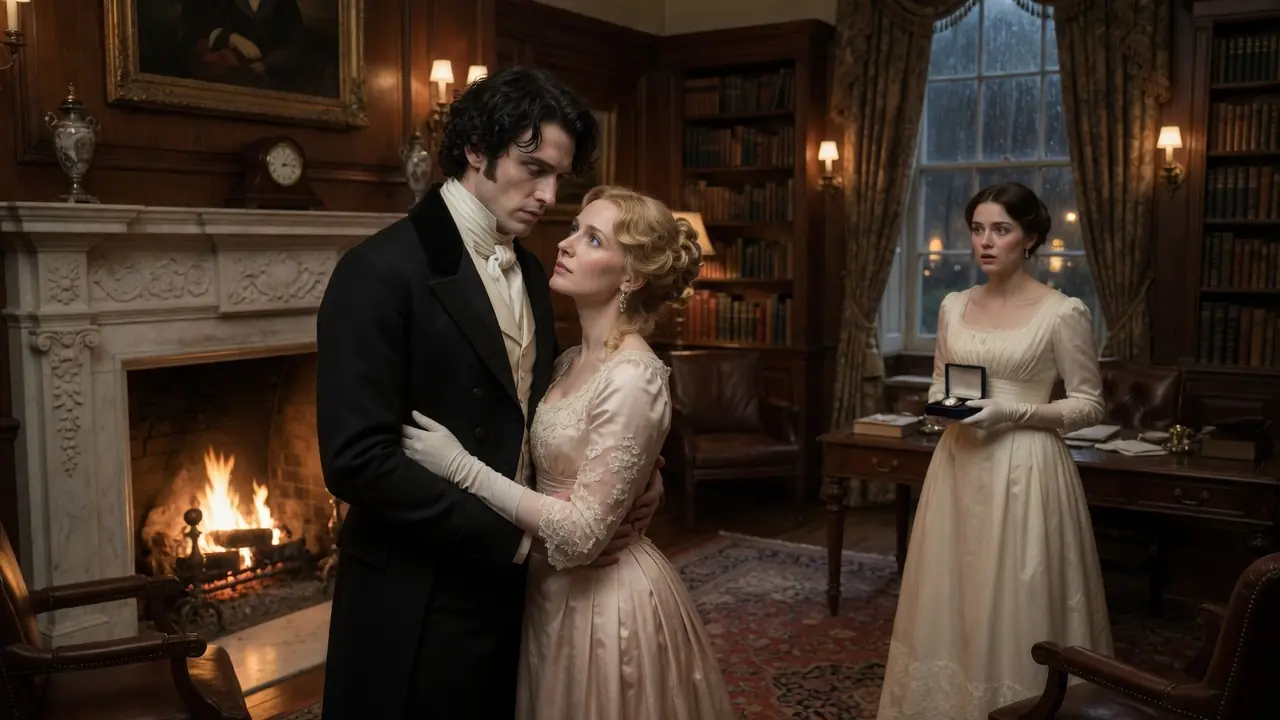
As Beatrice approached the heavy mahogany doors of the library, she noticed they were slightly ajar. A sliver of warm, golden light spilled onto the Persian runner.
She raised her hand to push the door open, a smile already forming on her lips.
Then, she heard the sound, a soft, breathless laugh.
It was Rosalind's laugh, low, triumphant, and intimate.
Beatrice froze.
She peered through the narrow gap.
The fire in the hearth was blazing, illuminating the high-backed leather chairs and the walls lined with gold-embossed spines.
Standing in the center of the room, illuminated by the flickering light, was Silas.
His coat was discarded on a nearby chair. His waistcoat was unbuttoned, and wrapped in his arms, her hands buried in his dark hair, was Rosalind.
Beatrice stopped breathing.
The world seemed to tilt violently on its axis.
She watched as Rosalind leaned back, her lips swollen, her eyes gleaming with a victorious light as she looked up at the Duke.
Silas's expression was flushed, his eyes heavy, his posture lacking the rigid control he always maintained. He looked disoriented, perhaps intoxicated, but he did not push her away.
Instead, he leaned down, capturing Rosalind's lips again in a kiss that shattered Beatrice's entire universe into irredeemable fragments.
She did not scream.
She did not throw open the doors and demand an explanation.
The betrayal was so profound, so absolute, that it stripped her of her voice.
The man she loved, the man who had whispered that she was the only peace he had ever known, was ravishing her sister in her father's home hours before they were to be wed.
Slowly, silently, Beatrice stepped back.
The velvet box slipped from her trembling fingers, landing on the thick carpet with a soft, muffled thud.
She turned and walked away.
She did not stop in her bedchamber to pack trunks of silk and lace. She bypassed the wedding dress that hung like a ghost in the corner.
She pulled a simple woolen traveling cloak from the wardrobe, took the small leather pouch of emergency sovereigns her mother had given her years ago, and walked out the servants' entrance into the freezing, driving rain of the London night.
By the time the Montgomery household awoke to find the wedding dress empty and the silver pocket watch lying outside the library door, Beatrice was already gone, swallowed by the unforgiving fog of the city.
The scandal that erupted the following morning was a tempest that nearly tore London society apart.
When Silas Cavendish awoke in a guest chamber of the Montgomery house, his head pounding with a severe, unnatural ache from the lingering effects of the laudanum Rosalind had slipped into his brandy the night before, he was summoned to the drawing room to face absolute chaos.
Beatrice's disappearance was the spark, but the discovery of the velvet box outside the library was the executioner's axe.
Rosalind played her part flawlessly.
She wept.
She confessed, with a theatrical display of shame, that the duke had cornered her, that she had been weak, that Beatrice must have seen them.
Lord Montgomery, sensing his financial salvation crumbling, demanded satisfaction. He threatened to drag the duke's name through the mud, to expose him as a lecher who ruined the younger sister and drove the elder to madness or the murky depths of the Thames.
Silas was paralyzed by a horrifying, fragmented memory of the night.
He remembered the heat, the smell of jasmine perfume, the taste of wine, but he had believed in his drug-addled state that he was holding Beatrice.
The realization that Rosalind had orchestrated the deception was a sickening blow, but the damage was done.
A shawl belonging to Beatrice was found abandoned near the docks at Wapping. The authorities presumed she had jumped into the freezing river.
The Duke of Westmore, trapped by guilt, scandal, and the cold reality of Rosalind's claim that she might be compromised, did the only thing a gentleman of his standing could do to prevent the utter destruction of both families.
Three weeks after he was supposed to marry Beatrice, Silas stood at the altar of St. George's, Hanover Square, and married her sister.
It was a funeral march disguised as a wedding.
Silas's eyes were dead. His vows were ashes in his mouth.
Rosalind had won her title, her diamonds, and her duke, but she had secured a ghost.
From the moment they returned to Chatsworth House, Silas locked the doors to the master suite. He provided her with an unlimited allowance, allowed her to host lavish, ostentatious parties that the ton attended merely for the gossip, but he never shared her bed.
The Duke of Westmore became a specter in his own life, pouring his grief and rage into ruthless business expansions, expanding his empire to the darkest corners of the country just to avoid the hollow echo of his own home.
Three hundred miles away, the ghost of Mayfair was learning how to bleed.
Beatrice had not gone to the river.
She had boarded a third-class carriage on a mail coach heading west, traveling until her money nearly ran out, stopping only when she reached the jagged, storm-battered cliffs of Polperro in Cornwall.
Here, she shed Beatrice Montgomery forever.
She became Mrs. Clara Harding, a supposedly widowed seamstress whose husband had been lost at sea.
The first winter nearly killed her.
Accustomed to roaring fires and hot tea brought on silver trays, she now lived in a drafty, one-room stone cottage perched on a cliffside where the wind howled through the floorboards and the smell of salted fish hung heavy in the air.
She took in mending from the local fishermen. Her delicate, uncalloused fingers were soon covered in needle pricks and blisters.
But the physical hardship was nothing compared to the terror that bloomed in her stomach two months after her arrival.
She was with child.
The realization sent her to her knees on the cold stone floor, weeping until her ribs ached.
She was carrying the heir to the dukedom of Westmore, the product of a passionate, secretive night she and Silas had shared in the greenhouse of his country estate a month before their ruined wedding.
It was a child conceived in absolute love.
Now, it was a glaring symbol of absolute betrayal.
When the time came, her labor was agonizing and solitary, attended only by Mrs. Higgins, a gruff but kind baker's wife who had taken pity on the poor widow.
When the cries of a newborn finally pierced the roaring squall outside, Beatrice took the child into her arms, prepared to resent him.
Instead, a fierce, primal love shattered her chest.
She named him Leopold, Leo.
As the years passed, Leo grew into a boisterous, dangerously intelligent boy. And with each passing year, Beatrice's heart broke a little more because Leo was the undeniable, living ghost of Silas Cavendish.
He possessed the same unruly, pitch-black hair. He had the same arrogant tilt to his chin when he was defiant. And most damning of all, he had Silas's eyes, a striking, vivid storm gray that looked entirely out of place on a poor fisherman's cliffside.
Beatrice worked herself to the bone to provide for him.
She expanded her sewing business, eventually saving enough to buy a small shop in the village square where she sold garments and offered reading lessons to the local children.
She built a wall of ice around her heart, focusing only on survival and the boy who was her entire world.
She never looked at a London newspaper. She never spoke of the past. She believed she was safe.
She believed the Duke of Westmore was a nightmare she had finally outrun.
She was wrong.
Five years is enough time to build an empire, but it is not enough time to forget.
By the spring of 1849, the Duke of Westmore was widely considered the most ruthless aristocratic industrialist in England.
His investments in the expanding railways and deep shaft mining had tripled his vast wealth, but society whispered that the Duke had no soul.
His marriage to Rosalind was an open, rotting wound.
The Duchess, desperate for the affection she realized she could never manipulate out of him, had turned to gambling and reckless affairs.
Silas ignored her entirely. His silence was a far more devastating punishment than any screaming match.
They had no children, and Rosalind's bitter, drunken taunts that the Cavendish line would die with him only fueled his relentless need to bury himself in work.
It was this need to escape London that drove Silas to Cornwall.
He had recently purchased the Penrose tin mines, a massive, failing enterprise that he intended to restructure.
He traveled without his usual entourage, bringing only his estate manager and riding a massive black stallion, seeking the punishing winds of the coast to clear the suffocating air of Mayfair from his lungs.
On a crisp, windy Tuesday afternoon, Silas rode into the village of Polperro.
The narrow, steeply cobbled streets were slick with sea spray, winding down toward the harbor.
Fishermen hauled nets, women carried baskets of bread, and the air was thick with the sharp tang of salt and seaweed.
Silas pulled his coat tighter around his neck, his storm-gray eyes scanning the dilapidated slate roofs with a calculating economic detachment.
Suddenly, a loud wooden clatter echoed to his left.
A small, intricately carved wooden boat bounced across the cobblestones, skidding to a halt directly beneath the hooves of Silas's stallion.
The horse let out a sharp whinny and danced backward, its iron shoes sparking against the stones.
Silas pulled back on the reins, expertly bringing the massive beast under control.
"Watch yourself," Silas barked, his voice carrying the sharp, authoritative crack of a man used to being obeyed instantly.
A small boy, no older than five, darted out from the alleyway, completely unfazed by the towering horse.
He wore a patched linen shirt and sturdy, scuffed boots. Without a word of apology, the boy knelt down to retrieve his toy boat, dusting it off with the hem of his shirt.
"Did you not hear me, boy?" Silas demanded, irritated by the child's brazen lack of fear. "You could have been trampled."
The boy stood up, clutching the boat to his chest.
He planted his small boots firmly on the ground, tilted his chin up in a gesture of pure, instinctual defiance, and looked directly at the duke.
Silas felt all the air leave his lungs in a sudden, violent rush.
The annoyance died on his tongue.
His hands, clad in fine leather gloves, tightened on the reins so hard the leather creaked. He stared down at the child, a chilling, impossible sensation creeping up his spine.
The boy had raven-black hair whipped into a frenzy by the coastal wind.
But it was his eyes that paralyzed the Duke.
They were not brown, nor blue, nor the watery green common in the village.
They were a piercing, unmistakable storm gray.
Silas was looking into a mirror reflecting a ghost from a quarter century past.
More than the eyes, it was the stance.
The boy stood with his shoulders squared, an innate aristocratic arrogance bleeding through the patched linen of a commoner.
As the wind caught the collar of the boy's oversized shirt, blowing it to the side, Silas caught a glimpse of a dark, crescent-shaped birthmark sitting high on the boy's right collarbone.
Silas's own hand instinctively went to his chest.
He bore the exact same mark.
"What is your name?" Silas asked, his voice suddenly hollow, a mere whisper over the howling wind.
"Leo," the boy said clearly, his tone guarded. "And you shouldn't ride your horse so fast in the square, sir. My mother says it's careless."
"Leo."
Leopold.
The name of Silas's late grandfather.
Before Silas could process the impossibility fracturing his mind, a woman's voice rang out from the doorway of a nearby shop, a shop with a faded sign reading Clara's Alterations and Yarns.
"Leo, get away from the road this instant."
The voice hit Silas with the force of a cannonball.
He knew that voice.
He had heard it in his dreams every night for five agonizing years. He had heard it whispering his name in the dark, tearing him apart piece by piece.
A woman stepped out onto the cobblestones.
She was wiping flour from her hands onto a simple canvas apron. Her hair was pulled back into a severe, practical knot, and her clothes were the drab, faded colors of the working class.
But the way she moved, the elegant, unmistakable carriage of her spine, belonged to the grand ballrooms of Mayfair.
Silas slowly dismounted.
His boots hit the cobblestones with a heavy thud.
He stepped around the horse, moving like a man walking through a dream.
The woman looked up, her expression shifting from maternal annoyance to mild curiosity.
And then, as her eyes locked onto the tall, imposing figure of the Duke of Westmore, she stopped completely.
The flour sack slipped from her hands, hitting the ground and bursting open in a white cloud around her worn boots.
It was Beatrice.
Older, thinner, her face weathered by the harsh sun and salt air, but the soft hazel eyes were exactly the same.
They stared at each other across the 20 feet of cobblestone, the noise of the village fading into absolute silence.
The ocean crashing against the cliffs seemed to vanish.
Beatrice's face drained of all color.
Pure, unadulterated terror seized her features.
She looked at Silas, then darted her eyes down to the dark-haired boy standing between them.
In that fraction of a second, Silas saw the entire truth written in the panic of her eyes.
She was alive.
The woman he loved had not drowned in the Thames.
She had fled.
And the defiant gray-eyed boy holding a wooden boat was not just a villager's son.
"Beatrice," Silas breathed, the name ripping from his throat like a physical wound.
Beatrice did not hesitate.
Survival instinct, honed over five brutal years of hiding, took over.
She lunged forward, grabbed Leo by the back of his shirt, hauled him against her side, and turned, fleeing back toward the dark doorway of her shop.
"Beatrice, wait!" Silas roared, his paralysis breaking.
He surged forward, his long strides eating up the distance.
The Duke of Westmore abandoned all propriety, all nobility, as he chased the ghost of his past and the living, breathing secret she had kept from him into the shadows of the Cornish coast.
The bell above the shop door did not just chime, it shrieked as Silas shoved his weight against the heavy timber.
Beatrice had managed to throw the deadbolt, but the wood of the doorframe, rotted by years of harsh coastal salt, splintered with a sickening crack under the Duke's desperate, unyielding strength.
He burst into the dim interior of the haberdashery, his chest heaving, his expensive woolen coat dripping with the sea mist.
The shop was a chaotic labyrinth of yarn spools, half-finished garments, and measuring tapes, but Silas's storm-gray eyes locked instantly on the narrow doorway leading to the private quarters in the back.
Beatrice was dragging a heavy oak cutting table across the threshold to barricade them in.
Leo was behind her, his small hands clutching her skirts, his expression more angry than frightened.
"Beatrice, stop!" Silas commanded, his voice shaking with a terrifying mixture of authority and absolute fracture.
"Do not come another step closer to us, Your Grace," Beatrice screamed.
The title was a venomous lash snapping through the small room.
She abandoned the table, realizing it was futile, and placed herself squarely between the Duke of Westmore and the dark-haired boy.
Her chest rose and fell in jagged, panicked gasps. She snatched a heavy iron fabric shear from the table, holding it out like a dagger.
"If you touch him, Silas, I swear before God I will bury this in your neck."
Silas stopped dead.
The sight of the woman he had mourned for five years, the woman whose supposed grave he had wept over until his throat bled, standing before him in a faded apron, wielding shears to protect a child that wore his own face, was a reality too vast, too agonizing to comprehend.
"He is mine," Silas whispered, his voice cracking.
He did not ask.
He did not question.
The truth was carved into the boy's jawline and painted in the storm gray of his irises.
"Beatrice. He is my son."
"He is my son," Beatrice snarled, her hazel eyes blazing with a feral, protective fire. "He belongs to no one else. He has no father. His father died the night he wed Rosalind Montgomery."
The name struck Silas like a physical blow.
He staggered, reaching out to grip the edge of a wooden display counter to keep himself upright.
"You did not drown," Silas rasped, his mind violently rearranging the history of his life. "The shawl by the river, the blood on the rocks. It was a lie, a damned lie. You let me believe you were dead. You let me rot in that hell, believing I had driven you to the grave."
"You did drive me to the grave," Beatrice cried out, the iron shears trembling in her grip as five years of suppressed, festering agony violently broke the surface.
Tears, hot and furious, spilled over her lashes.
"Beatrice Montgomery died that night. You killed her, Silas. I saw you."
Silas's brow furrowed in desperate confusion.
"Saw me? Saw me do what? Beatrice, I looked for you. The entire city looked for you."
"I was standing at the library door," she screamed, the sound tearing from her throat raw and devastated.
The silence that followed was suffocating, broken only by the ticking of a grandfather clock in the corner.
Beatrice swallowed hard, her voice dropping to a trembling, venomous whisper.
"I came to give you your wedding gift. I stood in the hall and I saw the door ajar. I heard her laughing, and I looked inside. Silas, I saw her hands in your hair. I saw your coat discarded. I saw you kissing my sister hours before you were to swear your life to me."
Silas stopped breathing.
The blood drained entirely from his face, leaving him ashen, like a statue carved from pale marble.
"No," he whispered.
"Do not insult my intelligence by denying it," Beatrice spat, her grip on the shears tightening. "I did the only thing I could do. I vanished so she could have what she always wanted, and so you could have the mistress you clearly preferred. I took nothing from you. I demand nothing from you. Go back to your Duchess, Silas. Leave us be."
"Beatrice. Listen to me," Silas said, stepping forward, his hands raised in a desperate plea for surrender.
He did not care about the shears. He would let her stab him if it meant she would listen.
"I swear to you on my immortal soul, I never touched your sister with a willing mind."
Beatrice let out a harsh, bitter laugh.
"Please."
"I was drugged," Silas roared.
The sheer volume of his voice made the spools of yarn vibrate on the shelves.
Leo flinched behind his mother, and Silas instantly softened his tone, horror washing over him as the fragments of that night finally, sickeningly aligned.
"Beatrice, I arrived early to speak with your father. Rosalind brought me a glass of brandy in the library. I thought nothing of it, but within minutes, the room began to spin. A heavy, suffocating heat took over my mind. I couldn't see straight. And then someone was there. Someone wearing your exact jasmine perfume. Someone with the same height, the same hair in the dim light. I thought it was you. I swear it, Beatrice. My mind was gone to the laudanum. By the time I woke the next morning, my head was splitting, and you were gone. And she..."
Silas swallowed a gag of pure revulsion.
"She wept to your father. She claimed I forced myself upon her. When your shawl was found by the river and everyone believed you had jumped, your father threatened to ruin the Westmore name, and Rosalind claimed she might be carrying my bastard. I married her to save both our families from absolute destruction. I married her because I thought I was paying penitence for murdering the only woman I ever loved."
Beatrice stared at him.
The iron shears slowly began to lower.
Her mind raced, desperately trying to find the lie in his words.
But as she looked into Silas's eyes, she saw the dark, bruised rings beneath them. She saw a man who had not lived for the past five years, but merely existed in a state of perpetual, tortured punishment.
"The jasmine perfume," Beatrice whispered, her voice barely audible. "My mother's bottle. It went missing from my vanity two days before the wedding. She planned it."
"Beatrice," Silas said, his voice breaking as a tear finally slipped down his aristocratic, weathered face. "She planned it to steal my title, and it cost me my life. It cost me you. It cost me five years of my son's life."
At the word son, Leo stepped out from behind his mother's skirts.
The boy did not cower.
He picked up a heavy wooden yardstick from the floor and stood in front of Beatrice, holding it like a knight's broadsword.
"You made my mother cry," the five-year-old said, his storm-gray eyes narrowed at the towering duke. "Go away."
Silas looked down at the boy.
A ragged sob tore its way out of the duke's chest.
He dropped to his knees on the dusty wooden floor of the haberdashery, ignoring the ruin of his expensive trousers.
He looked at Leo, seeing the exact miniature of himself, but filled with the fierce, unyielding spirit of Beatrice.
"I am so sorry," Silas wept, bowing his head as the agonizing weight of lost time crushed his shoulders. "I am so deeply, terribly sorry."
Beatrice watched the most powerful, ruthless man in England sob on the floor of her shop.
The wall of ice she had built around her heart over five brutal winters began to crack.
She dropped the shears. They hit the floorboards with a heavy thud.
Slowly, she knelt beside him, placing a trembling, calloused hand on his broad, shaking shoulder.
"Silas," she breathed.
He looked up, his face wrecked with grief.
"I will fix this," he swore, his voice suddenly shifting from despair to a cold, terrifying vow of vengeance. "I will tear the world apart to fix this, but you must swear to me, Beatrice. Swear you will not run again. Let me give him his name. Let me give you your life back."
Beatrice looked at Leo, then back to Silas.
The love she thought she had killed was still there, bleeding and bruised, but beating fiercely.
"I won't run," she whispered.
Silas did not stay in the shop.
Once he was assured Beatrice had sufficient funds and guards, he immediately hired six of the village's largest fishermen at an exorbitant daily rate to watch the cottage night and day.
He rode his stallion straight to the cottage's nearest railway station in Plymouth.
He arrived in London three days later, bringing with him a fury that would become legendary in the annals of British high society.
The Duke of Westmore did not go to his Mayfair townhouse.
He went straight to the offices of Mr. Harrison, the most feared and ruthless solicitor in the city.
Silas unleashed the full, terrifying extent of his wealth and influence.
His first move was to sever the financial lifeblood of the Montgomery family.
Lord Montgomery had survived the past five years entirely on the Duke's supposedly endless charity.
Within 24 hours, Mr. Harrison had quietly bought up every single one of Lord Montgomery's outstanding gambling markers and promissory notes.
The Duke called them in simultaneously.
By Tuesday afternoon, Lord Montgomery was bankrupt, his estate seized, and he was forced to flee to France to avoid debtors' prison.
But Silas reserved his true wrath for Rosalind.
He returned to Chatsworth House in Derbyshire, where the false Duchess was hosting a lavish, extravagant masquerade ball.
Hundreds of the ton's elite were drinking his champagne and dancing in his grand ballroom.
Silas walked through the gilded doors still wearing his mud-splattered riding boots and his dark, weather-beaten traveling cloak.
The music screeched to a halt.
The violins faltered.
The murmuring crowd parted like the Red Sea as the Duke, looking like an avenging angel of death, strode across the marble floor.
Rosalind, dripping in the Westmore diamonds, stood at the head of the sweeping staircase. Her face paled as her husband approached. She had not seen him in eight months.
"Silas," she stammered, trying to maintain her haughty composure. "You are interrupting. We were not expecting you."
"Pack your trunks," Silas said.
His voice was not loud, but it carried a deadly, razor-sharp edge that echoed perfectly in the cavernous silence of the ballroom.
"I beg your pardon?" Rosalind laughed nervously, looking around at the staring aristocrats. "Have you gone mad?"
"I have been mad for five years," Silas replied, his eyes colder than winter ice. "But I am finally cured. The marriage is over, Rosalind."
"You cannot divorce me," she hissed, abandoning all pretense, her true venomous nature showing. "I am the Duchess of Westmore. The scandal..."
"There will be no divorce," Silas interrupted, pulling a thick stack of legal parchments from his coat. "There will be an annulment based on absolute fraud and non-consummation. Furthermore, I have the signed confession of your former maid, Sarah, whom you paid 50 pounds to procure the laudanum you slipped into my glass on the eve of my wedding to your sister."
The collective gasp from the ballroom was deafening.
Rosalind staggered backward, clutching the banister, the color entirely draining from her face.
"You thought you won," Silas continued, stepping onto the first stair, his presence suffocating her. "But you only stole a ghost. Your father is bankrupt and fleeing to Calais. Your accounts have been frozen. You will remove the Westmore diamonds from your neck. You will pack only the dresses you arrived with, and you will be out of my ancestral home before the sun rises, or I will have the magistrate drag you out by your hair for the attempted poisoning of a peer of the realm."
Rosalind tried to speak, tried to summon her usual fire, but looking into Silas's eyes, she saw only her absolute, total ruin.
She unclasped the diamond necklace with shaking hands.
It dropped to the marble floor with a sharp clatter.
She turned and fled up the stairs, becoming a pariah before she even reached the landing.
The annulment, fast-tracked by heavy bribes to bishops and undeniable evidence of fraud, was finalized in a matter of weeks.
The scandal rocked London, but Silas did not stay to hear the gossip.
The moment the ink was dry, a magnificent, crest-emblazoned black carriage pulled by four perfectly matched greys arrived in the sleepy coastal village of Polperro.
Beatrice was standing on the cliffside, the wind whipping her skirts, her heart pounding in her throat as the carriage came to a halt.
The door opened, and Silas stepped out.
He was no longer the haunted, desperate man who had broken her door. He was standing tall, dressed immaculately, his eyes clear and burning with a profound, unconditional love.
He walked up the grassy knoll.
Leo was running ahead, no longer holding a yardstick, but rushing toward the towering man who had spent the last month sending him hand-carved wooden ships and detailed letters about the horses at Chatsworth.
Silas caught the boy, lifting him effortlessly into the air.
Leo laughed, the sound mingling with the crashing of the ocean waves.
Silas held his son against his chest, closing his eyes as he absorbed the reality that the nightmare was truly over.
Then, he set Leo down and walked toward Beatrice.
He stopped a few feet away, reaching into his pocket.
He pulled out a small, worn velvet box.
It was the same box Beatrice had dropped outside the library five years ago.
He opened it, revealing the silver pocket watch.
"You were right," Silas whispered softly, his storm-gray eyes locked onto hers. "I have always possessed terrible punctuality. I am five years late, my love. But I swear on my life, I will never keep you waiting again."
Tears streamed down Beatrice's face.
The harsh lines of her survival melted away, revealing the beautiful, vibrant woman she was always meant to be.
She stepped forward, closing the distance between them, and Silas wrapped his arms around her.
He buried his face in her hair, inhaling the faint scent of jasmine and sea salt, holding her as if she were the very air he needed to breathe.
Two months later, the doors of Chatsworth House opened wide.
The grand estate, which had been shrouded in gloom for five years, was ablaze with light and life.
The servants lined the grand hall, beaming with genuine joy as the true Duchess of Westmore stepped across the threshold, her hand resting firmly on her husband's arm.
Running ahead of them both, his laughter echoing against the high painted ceilings, was a dark-haired, gray-eyed boy, the undeniable, triumphant heir to the Duke of Westmore.
The threads of fate finally snapped back together, bringing a devastating truth to light and delivering the ultimate, ruthless vengeance upon a betraying sister.
A shattered love was rebuilt stronger, and a secret heir claimed his rightful, glittering throne.