They laughed when Elsie Morrow refused the new pump and started stacking old hay bales above her dying pond.
By noon, two men at the fence said she was trying to refill water with cow bedding.
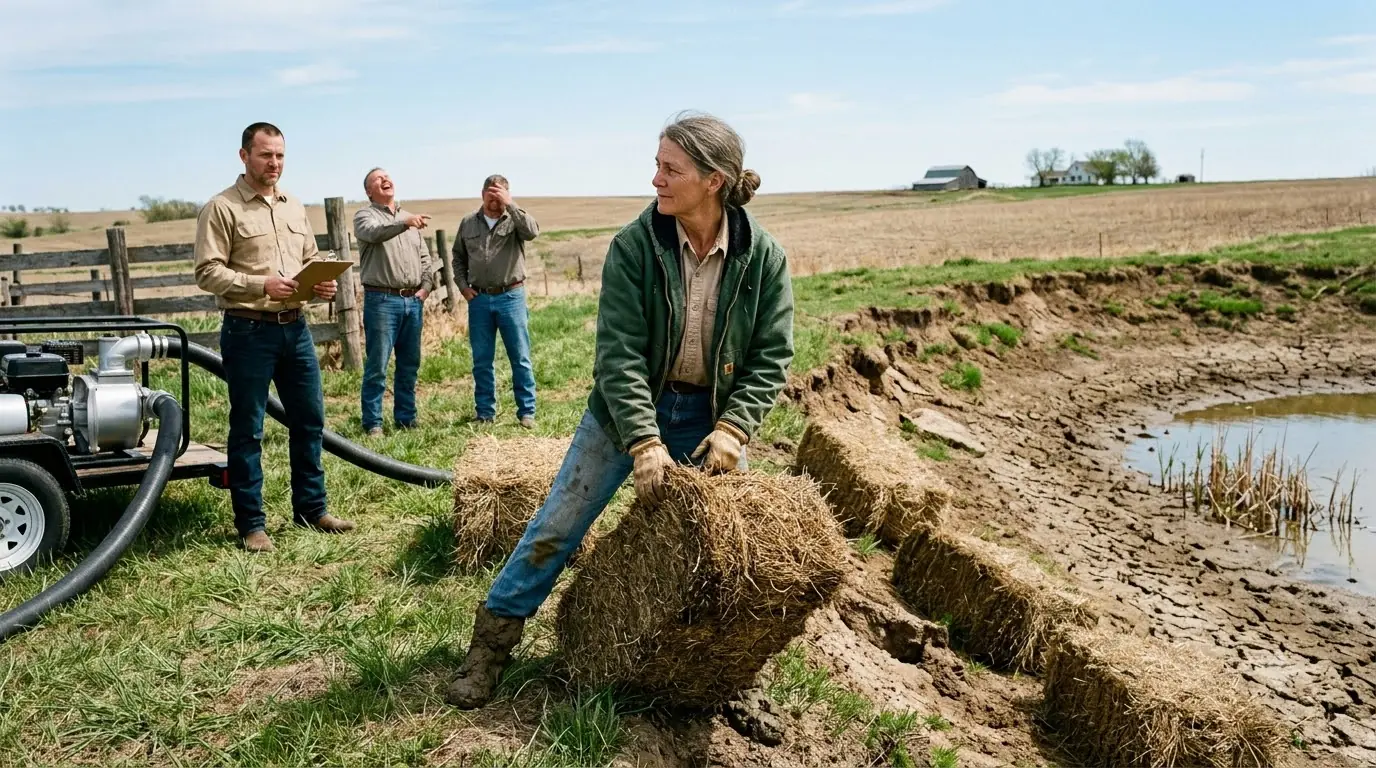
But Elsie was not trying to pump the pond full. She was trying to slow the rain her grandmother said had been leaving the farm too fast.
The pump salesman came on a Thursday morning with a trailer, two hoses, and a machine loud enough to make the cows lift their heads from the lower pasture. His name was Nolan Reeves.
He wore clean boots for a man standing beside a muddy pond, and he spoke like every problem on Earth had an engine attached to it. Elsie stood at the pond edge with her arms folded across her faded green jacket.
The water had dropped so low that the banks showed rings of cracked mud. Dragonflies still skimmed the surface, but even they seemed to be working with less room.
Nolan pointed toward the pump trailer. "This setup will move water fast," he said. "You pull from the lower creek, push it through the hose, and bring this pond up before summer gets worse." Elsie looked at the pond.
Then she looked at the hill above the north bank, where a shallow wash cut down through the grass like an old scar.
"How much?" she asked. Nolan named the price. Elsie did not blink, but her stomach tightened. It was more than she had paid for hay the year before.
Dale Mercer leaned on the fence and whistled. "That's a lot of money." Roy Bannon laughed. "So is losing a pond."
Nolan gave Elsie a careful smile. "If this dries out, you'll spend more hauling water than this pump costs." Elsie knew that might be true.
The pond watered the lower pasture. It held runoff after spring rain. It had carried the farm through dry spells when her grandmother Ruth was alive. But Ruth had never talked about the pond like it was a hole waiting to be filled. She talked about it like it was a hand. A hand that could hold water if the fingers above it were not broken.
Elsie looked again at the wash above the north bank. "I'm not buying the pump." Nolan stared at her. Dale pushed off the fence. "You're not?"
"No." Roy grinned. "What's your plan? Pray for rain?" Elsie turned toward the barn. "I'm going to stack hay."
By noon, she was dragging old square bales from the loft, the ones too weathered for feed and too loose to sell. Dale and Roy watched from the fence. Roy laughed first. "Now I've seen it. She's going to refill a pond with cow bedding."
Dale shook his head. "Elsie, that pond needs water." She lifted a bale into the wagon. "No," she said. "It needs to stop losing what already comes."
That evening, Elsie opened her grandmother's blue notebook at the kitchen table. Ruth Marrow had kept it for 31 years. The cover was faded blue, the corners soft, the pages swollen from damp hands and summer humidity. Ruth wrote down things other people forgot to respect. Rainfall, pond levels, which ditch cut deeper, which field held water longest, where grass yellowed first in July, where mud stayed black after a storm.
Elsie turned to the pond section. Her grandmother's handwriting was small and firm. "Pond does not die from lack of rain. It dies when rain leaves too fast.
Slow the wash above the north bank." Elsie read the line twice. Then she turned the page and found Ruth's map.
It was not pretty. Just a pencil sketch of the hill, the north bank, the old wash, the pond, and a row of little squares drawn across the slope. Beside them, Ruth had written, "Bales in staggered rows. Catch silt.