Rebecca Hale had spent the entire morning believing she was eleven minutes behind.
Eleven minutes behind schedule leaving her apartment.
Eleven minutes behind when the rideshare driver turned onto the wrong entrance ramp.
Eleven minutes behind when traffic slowed near the airport because a delivery truck had stalled across two lanes.
Eleven minutes behind when the airline app changed the security estimate from eighteen minutes to thirty-four.
It was an oddly specific number to carry inside her head, but Rebecca had spent most of her adult life thinking in numbers.
Minutes.
Deadlines.
Reservations.
Boarding groups.
Hotel confirmations.
Bank balances.
She trusted numbers because numbers did not ask how she felt.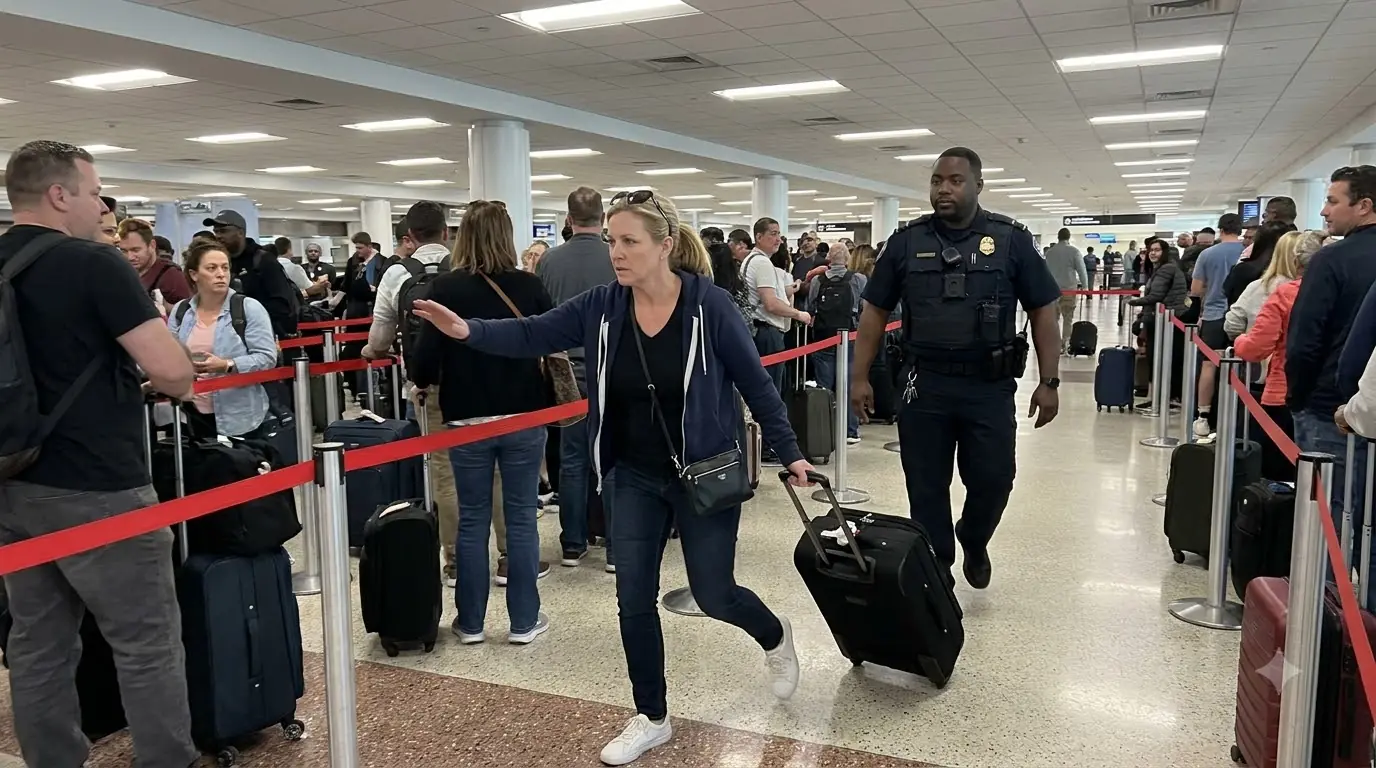
At 2:46 that Tuesday afternoon, Rebecca stood beneath the harsh fluorescent lights of Terminal C at Harrison International Airport outside Washington, D.C., and watched the security line bend around six red retractable barriers before disappearing behind a concrete column.
Her stomach tightened.
She checked her phone.
Boarding began at 3:18.
Flight closed at 3:43.
The gate was nearly half a mile beyond security.
Thirty-seven minutes.
Maybe.
If nothing went wrong.
Rebecca looked at the queue again.
Nothing in front of her suggested speed.
A family with three children was reorganizing backpacks.
An older couple was discussing whether bottled water had to be thrown away.
A college student was trying to remove a laptop without dropping a sweatshirt.
Two businessmen kept moving forward six inches, stopping, moving another six inches, and checking their watches as though that could somehow change the laws of time.
Rebecca gripped the handle of her black suitcase.
“Come on.”
Nobody heard her.
She said it again anyway.
“Come on.”
The suitcase was a standard twenty-two-inch black carry-on.
Hard shell.
Four spinner wheels.
Silver zipper.
Black telescoping handle.
Approximately half the airport appeared to own the same model.
Rebecca had purchased it two years earlier because the salesman told her black luggage looked professional.
Professional had mattered to her then.
It still did.
Rebecca herself looked controlled enough to suggest she had been designed for airports.
Forty-eight years old.
Blonde hair pulled into a loose ponytail.
Dark sunglasses pushed onto the top of her head.
Navy zip-up hoodie over a fitted black shirt.
Dark jeans.
White sneakers.
Small black crossbody bag.
Nothing extravagant.
Nothing sloppy.
Her clothes looked practical.
Her expression did not.
She kept checking the line, then her phone, then the line again.
A woman behind her finally said, “It’s moving.”
Rebecca glanced over her shoulder.
The woman was maybe thirty-five, carrying a sleeping toddler.
Rebecca replied, “Barely.”
The woman gave a polite smile and looked away.
Rebecca immediately regretted the tone.
Not because she cared what the stranger thought.
Because irritation wasted energy.
She turned forward.
The line moved another four feet.
Her phone vibrated.
MICHAEL
Rebecca stared at the name.
She did not answer.
The phone stopped.
Five seconds later, a message appeared.
Are you on the plane yet?
Rebecca typed:
Security.
Three dots appeared.
Then:
You said you’d be there.
Rebecca closed the message without responding.
Her jaw tightened.
She had said she would be there.
That was the entire reason she had changed flights.
The entire reason she had paid the ridiculous fare.
The entire reason she had skipped lunch, left work early, and ordered a car with forty minutes of padding.
She had calculated everything.
And somehow she was still standing beside a red fabric barrier watching a teenager argue with his mother about whether toothpaste counted as a liquid.
Rebecca checked the time.
2:51.
Five minutes gone.
The line had moved perhaps twelve feet.
She looked beyond the barriers.
The entrance to a priority lane stood twenty yards away.
Almost empty.
A uniformed employee checked documents at the opening.
Rebecca had no priority status.
She knew that.
But she also knew something else.
People often obeyed confidence.
Not rules.
Confidence.
If you walked as though you belonged somewhere, people frequently assumed you did.
Rebecca had built an entire career on understanding that principle.
She worked in commercial property management.
Negotiations.
Tenant disputes.
Vendor contracts.
People hesitated when they thought someone knew more than they did.
Rebecca had learned not to hesitate.
It had protected her.
Promoted her.
Made her difficult.
She knew that too.
At 2:54, the line stopped completely.
A security employee farther ahead raised one hand and called for everyone to remain where they were.
Rebecca stared.
“What now?”
Nobody answered.
A man near the front turned around and shrugged.
One minute passed.
Then another.
Rebecca’s breathing changed.
Her phone vibrated again.
Michael.
This time she answered.
“What?”
Her voice came out sharper than intended.
Michael hesitated.
“Rebecca?”
“I’m at security.”
“You sound angry.”
“I’m standing in a line that isn’t moving.”
“Okay.”
“No, it’s not okay.”
Silence.
Rebecca immediately heard herself.
The tone.
The familiar edge.
Michael knew it too.
He spoke carefully.
“You still have time.”
“You don’t know that.”
“They said they’re not starting until five.”
“I know what they said.”
“Then—”
“Michael, I cannot miss this.”
“You think I don’t know?”
Rebecca closed her eyes.
The terminal noise seemed louder.
Announcements.
Wheels.
Children.
Conversations.
A coffee grinder somewhere nearby.
Michael continued.
“He asked if you were coming.”
Rebecca opened her eyes.
Her voice changed.
“When?”
“Ten minutes ago.”
“What did you tell him?”
“That you were already on your way.”
Rebecca swallowed.
“Good.”
“He smiled.”
That hurt more than she expected.
Michael added softly, “Just get here.”
Rebecca looked at the unmoving line.
“I’m trying.”
She ended the call.
The woman with the toddler behind her had heard enough to become politely interested in something on the opposite side of the terminal.
Rebecca stared down at her suitcase.
Then toward the empty priority entrance.
2:58.
The line finally moved.
Three feet.
Stopped again.
Something inside Rebecca snapped.
Not dramatically.
No shouting.
Not yet.
Just a decision.
She stepped sideways.
The woman behind her looked surprised.
Rebecca pulled her suitcase beneath the red barrier.
“Excuse me,” the woman said.
Rebecca ducked under the second belt.
A man in front turned.
“Ma’am, the line’s back here.”
“I know.”
She crossed the aisle between the queue lanes.
He stared.
Rebecca kept moving.
The suitcase wheels rattled behind her.
A young airport employee near the priority entrance raised one hand.
“Ma’am?”
Rebecca walked faster.
“Ma’am, you can’t enter there without—”
“I’m not using the lane.”
She stepped past another red barrier.
“You need to return to the regular queue.”
“My flight boards in twenty minutes.”
“So do a lot of flights.”
Rebecca stopped.
The employee was maybe twenty-two.
That somehow made the instruction worse.
Rebecca pointed toward the motionless crowd.
“That line hasn’t moved properly for fifteen minutes.”
“I understand.”
“No, you obviously don’t.”
Several people turned toward them.
The employee maintained a professional expression.
“Please return to your place.”
Rebecca laughed once.
“I’m not going back to the end.”
“You won’t have to go to the end. You can return where you were.”
“Then open this barrier.”
“I can’t do that.”
Rebecca stared at him.
“Why?”
“Because this is the priority screening entrance.”