The statue had been in my family longer than I had.
That was the first thing Karen Whitmore never understood.
To her, it was a piece of stone standing beside a row of hydrangeas in a backyard she believed the homeowners association had some right to control.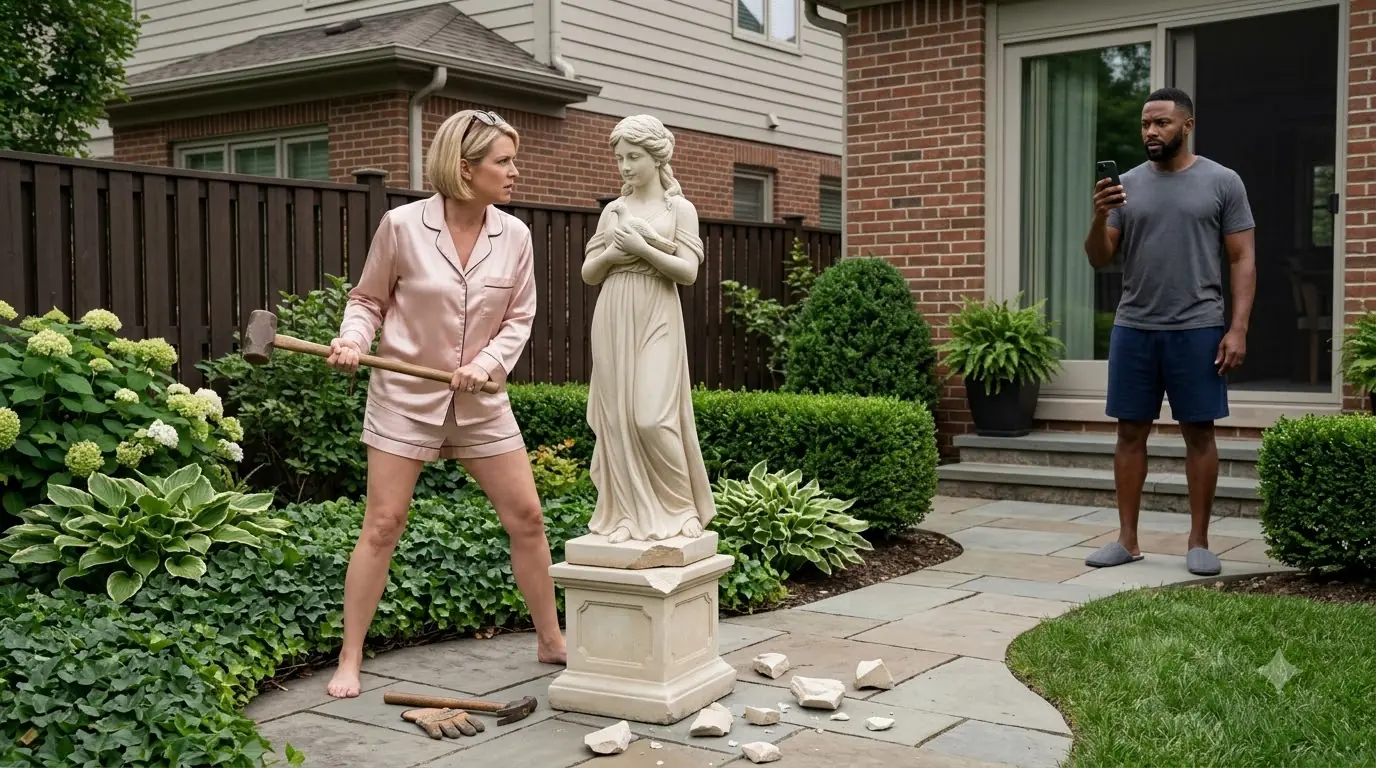
To me, it was the last thing my mother had chosen for herself before she got sick.
My name is Marcus Reed. I was forty-two years old, lived in a quiet development outside Raleigh, North Carolina, and until the spring Karen Whitmore decided to make my garden her personal project, I had never thought of myself as somebody who could spend weeks arguing about a statue.
I worked from home three days a week as a commercial estimator for a construction company.
My house was a two-story gray craftsman near the back of Briar Glen Estates, a neighborhood of broad sidewalks, neat lawns, young oak trees, and enough HOA rules to keep everyone moderately irritated without usually ruining anyone’s life.
My backyard was small but carefully planned.
A curved stone path ran from the patio to the rear gate.
Blue and purple hydrangeas lined the fence.
I had boxwoods near the patio, climbing ivy on a cedar trellis, and a narrow garden bed my mother, Evelyn Reed, had helped me design when I bought the house seven years earlier.
At the center of that bed stood the statue.
It was pale limestone, just over five feet tall, carved as a young woman in a flowing dress holding a dove gently against her chest.
Her head tilted toward the bird.
Her expression was calm.
There was nothing dramatic about the sculpture.
That was why my mother loved it.
She had found it at an estate sale outside Charleston almost fifteen years earlier.
At the time, neither of us knew it was unusual.
The owner had told her it came from an old coastal property and had spent decades in a garden beneath magnolia trees.
Mom bought it because she liked the dove.
She used to say the woman looked like she was listening to something nobody else could hear.
After my mother died, the statue stayed at her house for two years.
When my sister sold the property, I moved it to Briar Glen.
A professional stone conservator named Elaine Porter cleaned it, stabilized several old cracks, and mounted it on a proper stone base in my garden.
I had paperwork for everything.
Invoice.
Photographs.
Installation diagram.
Conservation report.
I even submitted the landscaping modification to Briar Glen because the HOA rules required approval for permanent decorative structures visible above four feet.
That approval was granted five years before Karen became president.
I assumed that was the end of it.
It wasn’t.
Karen Whitmore entered my life on a Tuesday afternoon in April.
I was standing on the patio watering newly planted herbs when I saw her beside the hydrangeas.
Not outside my fence.
Inside my backyard.
Karen was forty-eight, white American, with a neat chin-length blonde bob, small gold hoop earrings, and the kind of polished appearance that made even casual clothes look planned.
That afternoon she wore a pale pink satin blouse and matching shorts, sunglasses pushed onto her head, and white slip-on sandals.
She stood with one hand on her hip, staring up at the statue.
I lowered the hose.
“Karen?”
She turned as if I had interrupted her.
“Marcus.”
“What are you doing back here?”
“Inspection.”
“My gate was closed.”
“Not locked.”
“That doesn’t answer the question.”
Karen looked toward the statue again.
“We received a complaint.”
“About what?”
“This.”
She pointed.
I looked at the woman holding the dove.
“The statue?”
“Yes.”
“What did it do?”
Karen did not smile.
“It may be an unapproved exterior structure.”
“It was approved.”
“Do you have documentation?”
“Yes.”
“Current documentation?”
I stared at her.
“What would current documentation mean? The approval doesn’t expire.”
“That depends on whether the structure has been modified.”
“It hasn’t.”
Karen walked around the base.
I didn’t like how close she stood to it.
“Has it been professionally assessed recently?”
“Why would the HOA care?”
“Safety.”
“It’s stone.”
“Exactly.”
I waited for an explanation.
None came.
“Karen, I’m going to need you to leave.”
She looked at me as though the sentence surprised her.
“I’m conducting association business.”
“You entered my backyard without asking.”
“The gate was accessible.”
“So is my front porch. That doesn’t mean you walk into my house.”
Her expression tightened.
“There’s no need to become hostile.”
“I’m not hostile. I’m asking you to leave my property.”
Karen walked toward the gate.
Before she opened it, she turned.
“You should locate your approval.”
“I already know where it is.”
“Good.”
Then she left.
The first notice arrived two days later.
EXTERIOR ARCHITECTURAL REVIEW REQUIRED.
According to the letter, a “large freestanding decorative structure” had been observed in my rear garden and required verification of approval.
I scanned the original HOA approval and emailed it to the management company.
The document was simple.
Approved: limestone garden sculpture, rear landscape bed, maximum height 65 inches.
It had the signature of the architectural committee chair from five years earlier.
I expected the matter to disappear.
Instead, Karen emailed me directly.
The submitted document does not establish that the structure presently on the property is identical to the structure originally approved.
I read that sentence three times.
Then I wrote:
It is the same statue.
Karen replied:
Please provide evidence.
I almost laughed.
Evidence that my statue was still my statue.
I found photographs from the installation.
Same base.
Same hydrangea bed.
Same woman.
Same dove.
I sent them.
Karen responded the next morning.
Images received. Further review pending.
That should have told me this was not about documentation.
But at that point I still assumed Karen was simply enjoying authority too much.
Briar Glen residents had been complaining about her for months.
She became HOA president after running on a platform she called “Restoring Community Excellence.”
Nobody knew exactly what excellence had been lost.
Karen seemed determined to find it.
She issued notices for faded mailbox numbers.
Visible garden hoses.
Children’s bicycles left beside garages.
Patio umbrellas that exceeded an approved color palette nobody remembered voting on.
My neighbor, Daniel Brooks, received a warning because his basketball hoop had been left facing the street after sunset.
Daniel was thirty-eight, Black American, an emergency-room nurse, and one of the calmest people I knew.
Karen had managed to make him angry over the direction of a basketball hoop.
“She likes the process,” he told me one evening.
“What process?”
“Whatever makes somebody respond to her.”
I showed him the statue emails.
He read them on my phone.
“She asked you to prove the statue is the same statue?”
“Yes.”
Daniel handed the phone back.
“You may have won.”
“That’s not reassuring.”
The next week, Karen returned.
This time she stayed outside the fence.
I saw her through my kitchen window taking photographs between the boards.
I walked out.
“Karen.”
She lowered her phone.
“You keep appearing.”
“This is a scheduled compliance route.”
“Then schedule it somewhere else.”
“I’m on common property.”
“You’re photographing my backyard through my fence.”
“Visible exterior conditions are subject to review.”
“The statue is already approved.”
“That question remains open.”
“No, it doesn’t.”
Karen’s voice became colder.
“You’re misunderstanding how architectural approval works.”
“I work in construction.”
“That doesn’t make you an HOA attorney.”