He was at the end of her driveway.
Maya Reyes could see his headlights through the curtain. Nineteen nights. Same truck. Same man. The one she had reported to HR six months ago.
Tonight, he was closer.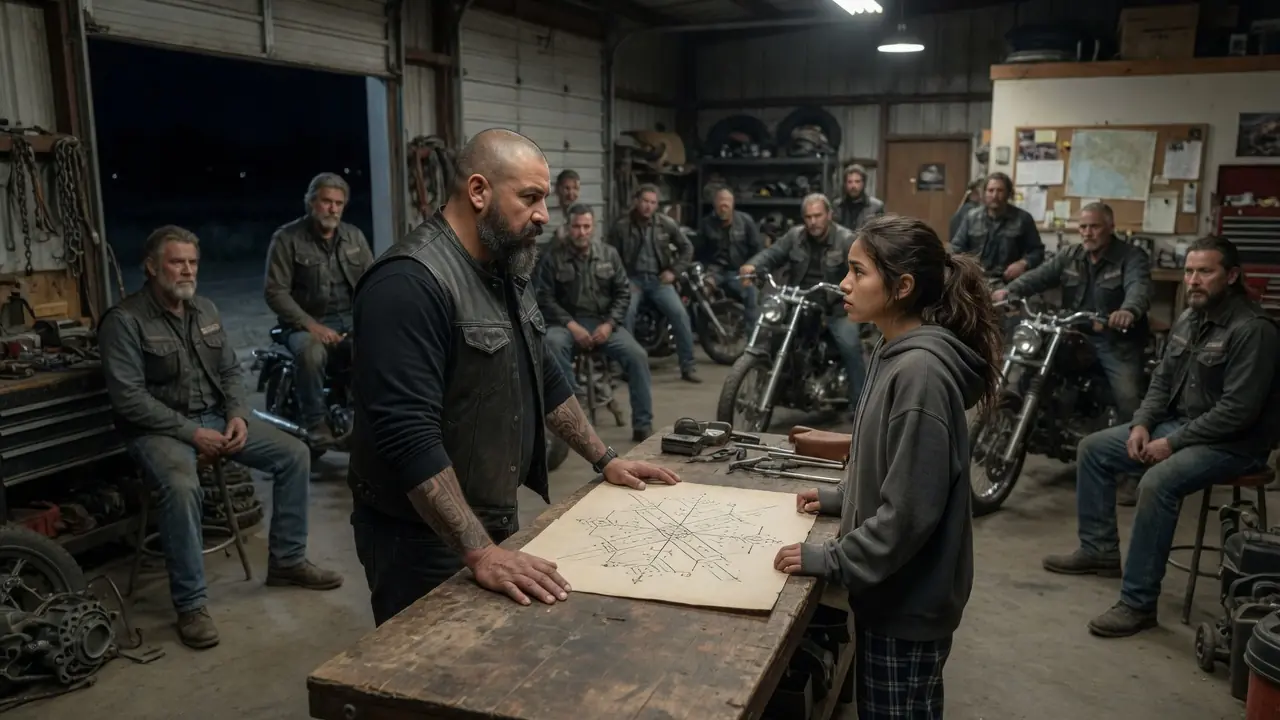
She did not scream. She did not run. She did not call the police first. She grabbed the bag of salt from the counter and drew a pattern on the ground that most people had never seen.
And one man, fourteen miles away, a biker named Cruz, had taught her that pattern himself.
Within minutes, fifty Harleys filled her street.
Her stalker never saw it coming.
The back fence splintered at 2:19.
Maya heard it from the kitchen. That specific sound, wood giving way under deliberate, unhurried force, made her body move before her mind fully caught up.
She killed the kitchen light, backed against the counter, grabbed her phone, and dialed 911.
“911, what’s your emergency?”
“There’s a man breaking into my property. Rear fence. He’s been stalking me for nineteen days. I have documentation. I have a case number.”
“Ma’am, what’s your address?”
She gave it fast and clear.
“Okay, I’m dispatching a unit now. Response time in your area is—”
“How long?”
A pause lasted one second too long.
“Forty minutes. Maybe forty-five.”
Maya ended the call.
She stood in the dark kitchen and looked at the back door. Locked. Deadbolt. Chain. She had added all three on the first night the truck appeared outside her house nineteen nights ago, and she had checked them every night since.
Footsteps moved across the back patio now.
Slow. Deliberate. Not the footsteps of someone startled or rushing. The footsteps of a man who had decided tonight he was done waiting.
Her phone showed one bar of signal.
She dialed Cruz.
Straight to voicemail.
She dialed again.
Voicemail.
Then she looked at the counter, at the bag of salt sitting beside the dish rack where she had placed it three weeks earlier.
The night Cruz had told her, “Keep it somewhere you can reach it fast. Don’t put it in a drawer.”
She grabbed it.
“Maya.”
His voice came through the back door, almost gentle.
That was the most frightening thing about Derek Holt. Not his anger. Not his aggression. His gentleness. The complete, practiced composure of a man who had learned that calm could be more effective than force.
“I just want to talk,” Derek said. “That’s all this has ever been. I just want the chance to explain my side.”
Maya was not in the kitchen anymore.
She had moved to the front of the house, away from his voice, and crouched at the front door with the salt in her hands.
His side.
Six months earlier, Derek Holt had sat in a hospital boardroom across from Maya, her supervisor, and three HR representatives. In a calm, reasonable voice, he described his version of what happened in the supply corridor on that Tuesday afternoon.
He used words like misunderstanding, context, and professional disagreement.
He looked at the people in that room with steady eyes and the devastating confidence of a man who had never once been told that the story he told about himself was wrong.
Three people in that room had believed him.
Maya had watched it happen in real time. She had watched doubt move across their faces like a weather front. She had felt the ground shift under her feet.
She had reported it anyway.
And he had lost everything.
Then he had found her address.
Maya opened the front door just enough. The chain lock stayed on. Six inches of cold night air slipped in from the empty street beyond her small front yard.
She crouched down. Her pulse was fast, but her hands moved from memory.
Jagged cross. Left arm longer than the right. Three short strokes at the base.
Cruz had made her practice it three times on a paper napkin before he was satisfied. She had laughed at herself for getting the proportions wrong twice.
He had not laughed.
He had looked at her across the diner table with an expression she had not fully understood at the time and said, “When you draw it, I come. No matter what else is happening, I come.”
Maya pulled the door shut, reset the chain and deadbolt, then backed against the door and slid down to the floor.
From the back of the house came silence.
Worse than the footsteps. Worse than his voice.
The silence of a man changing his approach.
The front door handle moved at 2:23.
Slowly. Testing. The specific motion of someone checking whether a door was locked before deciding what to do next.
Maya did not move. She did not breathe.
“You filed a report,” Derek said from the front porch, still quiet, still reasonable, still almost gentle. “You cost me everything. Seventeen years of my career. My reputation. My pension.”
A pause.
“Did you think there were no consequences for that?”
Maya’s jaw tightened.
She thought about the supply corridor. She thought about the way he had looked at her afterward, not guilty, not ashamed, only annoyed. The specific annoyance of a man who had been interrupted.
She thought about the three people in the boardroom who had looked at her with doubt in their eyes.
She thought about Lily, safe at her mother’s house tonight, asleep and unaware.
And she thought about what could have happened if she had stayed quiet.
“Leave my property,” Maya said, steady and clear.
Then Derek said, “Those chain locks don’t hold. You know that, right?”
Quiet. Conversational. Like he was sharing a useful piece of information.
The door handle moved again, harder this time.
Maya pressed her back against the door, looked at the ceiling, and breathed through her nose.
“Come on, Cruz,” she whispered. “Come on.”
The handle went still.
Five seconds of silence.
Ten.
Fifteen.
Then footsteps retreated off the porch, across the yard, and around the side of the house.
Back to the rear, where the fence was already broken.
Maya got to her feet and moved.
She grabbed the heaviest thing within reach, the cast iron pan from the stove, twelve pounds of solid metal. She held it with both hands and positioned herself in the center of the kitchen, facing the back door.
This is where it ends, she thought. One way or another.
She heard Derek at the back door now.
The handle tested once.
Then came a different sound. Lower. Metal against the door frame with patience and intention.
Slow. Precise.
The deadbolt held.
For now.
Then another sound.
The window beside the door.
His palm pressed flat against the glass, testing the frame. The latch was old. Maya knew it was old. She had told herself it would hold.
The glass shattered.
Maya tightened both hands around the pan.
One more push and that latch would give.
Her phone buzzed.
One bar.
Cruz’s name on the screen.
She answered without taking her eyes off the window.
“I’m here,” Cruz said, calm and close. “Look out your front window.”
She did not move toward the front window.
She did not need to.
Because she could already hear it.
Low at first. A vibration more than a sound, felt through the floor, through the soles of her feet, up through her legs and into her chest.
Then louder.
Then unmistakable.
Fifty Harley-Davidson engines moved in formation down her street.
The kitchen filled with light. Headlights swept through the back window, the side window, every window at once, turning the dark house bright and sudden and completely visible.
Nowhere to hide.
Nothing left in shadow.
Every corner of the property was lit like midday.
The pressure at the window stopped.
Complete silence from the other side.
Then footsteps, fast this time.
For the first time all night, Derek Holt moved fast.
Back across the patio. Across the yard. Toward the broken fence. Toward whatever calculation he thought he could still make from the other side of it.
Maya lowered the pan, set it on the counter, and looked at her hands.
They were steady.
Both of them.
The whole time.
She exhaled for what felt like the first time in nineteen nights.
Cruz found Derek at the side of the house, caught between the broken fence and the wall. A flashlight hit Derek’s face. Cameras were recording from two angles before he took his next breath.
Cruz stopped six feet away and looked at him the way weather looks at something small.
Derek raised one hand.
“I haven’t—”
“Broken fence,” Cruz said, quiet and precise. “Your face on three cameras. Timestamp. Location.”
He tilted his head slightly.
“You want to keep talking?”
Derek looked at the cameras. He looked at the fifty men visible on the street beyond the side gate. Then he looked at Cruz.
For the first time all night, his composure slipped.
Only for a second.
But it slipped enough.
The expression of a man who had completely run out of room.
“Walk to your truck,” Cruz said.
Derek walked.
He did not look back. Not at the bikes. Not at the cameras. Not at Maya’s house.
He got into his truck with the careful movements of a man who knew every second was still being recorded. Then he pulled away from the curb in absolute silence.
Cruz watched the taillights reach the end of the block, turn right, and disappear.
Then he looked down at the salt pattern on the driveway.
White lines on cold asphalt, catching the streetlight, still holding their shape.
The front door opened.
Maya stood in the doorway. No pan. No phone. Just standing there, looking at the empty end of the street where Derek’s truck had been.
Cruz looked at her.
“He’ll be picked up before sunrise,” he said. “I called Carver forty minutes ago. She’s been waiting on him for eight months.”
Maya looked at him.
“Federal?”
“Federal.”
A silence.
“It’s over,” she said, not quite believing it yet.
Cruz looked at the salt pattern one more time.
“For him,” he said. “Yeah. It’s over.”
Maya leaned against the doorframe, closed her eyes for exactly one second, then opened them.
“How did you get here so fast?”
Cruz looked at her steadily.
“I was already moving when you drew it,” he said. “I told you. No matter what.”
Maya looked at him for a long moment.
Then she looked at the salt on her driveway.
The pattern Cruz had taught her on a paper napkin fourteen months earlier, in a diner booth, on an afternoon when neither of them knew how badly she would need it.
“Why?” she asked quietly. Not accusatory. Just honest. The question she had never asked directly in fourteen months. “Why do you have this code at all? Why did you teach it to me?”
Cruz was quiet for a moment.
He looked down the empty street.
When he spoke, his voice was different. Quieter. Something beneath it had shifted.
“Because of a boy,” he said. “And because of you.”
He looked at her.
“You saved his life eighteen months ago. You didn’t have to, and you did.”
Maya went still.
Cruz nodded slowly.
“My son,” he said. “Room 412. 11:47 on a Tuesday night.”
And that was where the story really began.
Not on a driveway at 2:00 in the morning. Not with a broken fence, a bag of salt, or fifty bikes filling a residential street.
It began eight months earlier in a hospital corridor, with a nurse who made a choice nobody asked her to make.
And a man whose life changed completely because she did.
Saint Carmine Medical Center.
Third floor.
Room 412.
The monitors had been screaming for eleven seconds before Maya got through the door.
She was not supposed to be on that floor. Her shift ended at 11:30. She had her jacket on, keys in hand, badge half unclipped, already thinking about the drive home and whether Lily had eaten dinner properly at her mother’s.
It was 11:47 on a Tuesday night, and she was done.
Except the monitors were screaming.
The night nurse assigned to 412, a good nurse and a careful nurse, was three rooms down handling an emergency that had pulled every available body to the east end of the corridor.
Maya heard the alarm through the stairwell door.
She stood there for exactly one second.
Then she pushed the door open and ran.
The boy in room 412 was twenty-two years old. His name was Marco. He had been admitted that morning after a motorcycle accident on Route 9.
Stable. Monitored. Expected to be discharged within forty-eight hours.
The kind of admission that looks straightforward on paper right up until it does not.
Maya came through the door and read the monitors in three seconds.
Internal bleeding.
Pressure dropping.
The specific fast deterioration of a situation that had been quietly building for hours while the numbers stayed just inside the acceptable range and nobody caught the trend.
She hit the call button, grabbed the IV line, and started talking to him.
Low. Steady. The voice she used in every room where someone needed to hear that another person was present and paying attention.
“I’ve got you. Stay with me. What’s your name?”
“Marco.”
“Good. Keep talking to me, Marco. Keep your eyes open.”
The resident arrived in four minutes.
The attending in six.
By then, Maya had two lines in, pressure stabilizing, and the situation moving from crisis to controlled in the specific way crises move when someone catches them early enough to matter.
The attending looked at her across the bed.
“You’re not on this floor,” he said.
“No,” Maya answered.
He looked at the monitors, at the lines she had placed, at Marco conscious, stable, eyes open.
“Good catch,” he said.
Maya removed her gloves and picked up the jacket she had dropped on the chair when she ran in.
“He would have caught it himself,” she said, meaning Marco. Meaning he was strong. He was fighting. She only helped him find the edge.
Then she went home.
She did not think about it again.
Not specifically.
It was the kind of night that happened in nursing. The near miss that did not become a miss. The shift that ran twenty minutes long for reasons that mattered. She filed her notes, drove home, and checked on Lily.
But someone else thought about it.
Cruz had been in the waiting room since 2:00 in the afternoon.
Nine hours. Same chair. Same cold coffee he kept replacing, not because he wanted it, but because having something to do with his hands helped him think.
Around him, the waiting room cycled through its ordinary population of fear, boredom, and exhausted relief.
Cruz sat in the middle of it and did not move.
His son was on the third floor.
Marco, twenty-two years old, the boy with Cruz’s jaw and his mother’s laugh. The boy who took corners too fast, the habit that had scared Cruz for years before it finally caught up with him.
The last update Cruz had received was four hours old.
Stable, the nurse had said.
But Cruz had been in enough rooms with enough doctors to know the difference between stable and safe.
He had not prayed in thirty years. Not since his mother’s funeral in a church in Tucson with bad carpet and a ceiling fan that turned too slowly.
He did not believe it worked. He had seen too much to believe it worked.
But somewhere around hour seven, with the waiting room down to three other people and the overhead lights dimmed for the night, he pressed both hands flat against his knees and whispered the only thing he knew how to say.
“Not yet. Not this one. Please.”
Three words.
The most honest thing he had said in years.
He did not know if anyone heard it.
Then the energy at the nurses’ station changed.
Subtle. The kind of shift someone only notices after watching for hours.
Cruz stood.
A nurse at the desk held up one hand.
“Sir—”
“My son is in 412.”
She looked at her screen, picked up the phone, said something he could not hear, then looked back at him.
“Someone caught it early,” she said carefully. “He’s stable. The doctor will be out to speak with you in a few minutes.”
Someone caught it early.
Four words.
The four most important words anyone had said to him in nine hours.
Cruz sat back down, put both elbows on his knees, pressed his hands flat against his face, and stayed like that for a long time.
He found out her name three days later.
Not by asking the hospital. He knew better than to do that. He found out the way he found out most things: carefully, quietly, through people who owed him attention if not answers.
Maya Reyes. Thirty-two years old. Eight years at Saint Carmine. Night shifts mostly. Single mother. One daughter.
The kind of nurse other nurses called when something went wrong and they needed someone who would not panic.
He sat with that information for a week before doing anything with it.
Cruz was not a man who acted on impulse. Nineteen years leading a chapter had burned that out of him early. He understood that the first move mattered more than every move after it.
Patience was not weakness. It was precision.
He thought about what he wanted to say to Maya. Whether saying anything at all was appropriate. Whether showing up in her life, a Hell’s Angels president with a leather cut and a reputation that entered rooms before he did, was a gift or an imposition.
Then he went to the diner where she sometimes stopped after her night shifts.
He sat at the counter, ordered black coffee, and waited.
Maya came in on a Thursday morning at 6:48, still in her scrubs. She moved with the particular walk of someone at the end of a long night, not tired exactly, but passing through a different layer of the world than people who had slept.
She sat two stools down from him without noticing.
She ordered black coffee and looked at the counter.
Cruz watched her for a moment.
Then he said quietly, without looking at her, “Room 412.”
Maya looked up.
She looked at him, at the cut, at the death head patch, at the face of a man she had never seen before who had just said two words that meant something specific only to the two of them in that room.
“You’re his father,” she said.
Not a question.
Cruz looked at her directly for the first time.
“He’s home,” he said. “Discharged Monday. He’s good. He’s going to be good.”
Maya nodded, the small, quiet nod of someone receiving information she had hoped for but had not known to expect.
“I’m glad,” she said simply.
No performance. No dramatic warmth. Just truth.
Cruz turned his coffee mug in his hands.
“I wanted to say thank you,” he said. “Not through the hospital. Not through anyone else.”
He paused.
“You didn’t have to go back in. Your shift was over.”
Maya looked at her coffee.
“Somebody had to.”
“But it was you,” Cruz said.
She looked at him.
He held her gaze.
“It was you,” he said again. Quiet. Absolute. The way he said things that mattered without decoration.
“And I don’t forget things like that.”
They talked for forty minutes.
Not about the hospital in detail. Not about Marco in the way people replay a crisis.
They talked the way two people talk when they have recognized something in each other they were not expecting to find.
Cruz told her about the chapter, not the version people assumed from the outside, not the noise, the reputation, or the headlines. The real version. The men. Where they had come from. What brotherhood meant when stripped of everything outsiders thought it meant.
Maya listened without pretending interest. She asked one question.
“Why Montana?”
His answer took twelve minutes and was the most honest thing he had said to anyone outside the chapter in years.
She told him about nursing. About night shifts. About the specific education people receive between 2:00 and 5:00 in the morning, when the hospital is at its most honest, when the performance of wellness drops away and what remains is just people afraid, needing someone to stay present with them.
Cruz listened without interrupting.
When the coffee was gone, Maya looked at her watch and started gathering her things.
Then she stopped.
“Can I ask you something?”
“Yes.”
“The men in your chapter,” she said carefully. “If someone needed help, someone who had nowhere else to go, someone the system had already failed, would they come?”
Cruz looked at her for a moment.
“Yes,” he said.
“How would they know?”
He was quiet, thinking.
Then he picked up a paper napkin from the holder and set it on the counter between them.
“I’ll show you,” he said. “Practice it until you get the proportions right.”
She got it wrong twice.
The first time, the cross was too even, both arms the same length. Cruz shook his head.
The second time, the base strokes were too long. He adjusted them with one finger, moving her hand to show her the angle.
The third time, he looked at it and nodded once.
“When you draw that,” he said, “I come. No matter what else is happening.”
He folded the napkin and set it aside.
“No matter what.”
Maya looked at the pattern on the paper.
“Why a salt cross?” she asked.
Cruz picked up his coffee.
“Because everybody has salt,” he said. “And nobody thinks twice about it.”
She asked one more thing before she left.
Standing at the diner door, jacket on, keys in hand, she turned back.
“Has anyone ever used it? The signal?”
Cruz looked at her across the length of the diner.
“Once,” he said. “Before I formalized it.”
He paused.
“We were too late.”
Maya held his gaze.
She understood without him saying the name.
She would learn it later.
Angela Reyes. Eighteen years old. Four years gone. The absence that had shaped every decision Cruz had made since the Tuesday afternoon when he sat at that same counter and first said, “We lost a girl.”
“I’m sorry,” Maya said.
Cruz nodded.
Maya pushed the door open. Cold morning air came in, sharp and clean, the particular clarity of a Montana morning after a night shift, when the world is still quiet and everything feels temporary and real at the same time.
She stepped through.
The door swung shut behind her.
Cruz sat at the counter for a long time after she was gone. Then he picked up the folded napkin with the salt pattern on it, looked at it, put it in his coat pocket, and went back to his coffee.
That was fourteen months before the broken fence.
Fourteen months before the truck started appearing outside Maya’s house.
Before the HR report.
Before Derek Holt sat in a boardroom and made three people doubt what they knew, then lost his job anyway because Maya Reyes did not stay quiet.
Fourteen months of the napkin sitting in Cruz’s pocket. First the original, then a copy he made when the original wore through.
A small folded square of paper that represented the simplest possible answer to a question neither of them had wanted to need answered.
What do you do when the system fails you?
You find the people who will not.
But Derek Holt driving away that night, turning right at the end of Maya’s block, was not the end of it.
Cruz knew that.
He had made two calls before the bikes left Maya’s street.
The first was to Agent Carver, federal, Billings, eight months into building a case that needed one more piece to close.
The second was to a man named Dez, who had been sitting on information for six weeks and needed to know it was time.
By sunrise, Derek Holt’s careful, patient world was going to start coming apart.
And Maya Reyes, who had reported him when it was hard, who had held her ground when the system wavered, who had crouched on her kitchen floor at 2:00 in the morning with a bag of salt and trusted a promise made over coffee, was going to watch it happen.
Agent Carver arrived at 6:12 in the morning.
She drove from Billings in three hours and forty minutes on roads that did not deserve that speed. She came through Maya’s front door with a badge, a laptop bag, and the specific expression of a woman who had been waiting a long time for a phone call that finally came.
She sat at Maya’s kitchen table, opened the laptop, and said, “Tell me everything from the beginning. Don’t edit.”
Maya had met federal agents before. Once, years ago, in a routine interview about a patient. Professional. Impersonal. The kind of interaction that left no residue.
Carver was different.
She was forty-one, sharp-featured, the kind of woman who listened with her whole body. Not performing attention, but actually giving it. Leaning slightly forward, eyes moving between Maya’s face and her notes with the precision of someone assembling something that needed to fit exactly right.
She did not interrupt. She did not express sympathy in the way people sometimes do when they want you to feel heard but are actually waiting for you to finish.
She just listened.
When Maya finished, Carver sat back and looked at her notes for a long moment.
“Nineteen nights,” she said.
“Nineteen.”
“You documented them?”
Maya pushed a folder across the table.
Dates. Times. Photographs taken through the curtain gap. Dark and grainy, but timestamped. The truck visible in each one. The plate readable in four of them.
Carver looked through the folder without speaking.
“You should have called us sooner,” she said finally.
Not accusatory. Just honest.
“I called the county sheriff twice,” Maya said. “First time, they said they needed evidence of a direct threat. Second time, the deputy I spoke to went to school with Derek Holt.”
Carver looked up.
“Same deputy who told you the restraining order application would take six to eight weeks.”
Maya went still.
“You already knew that.”
“We’ve been building this case for eight months,” Carver said. “Derek Holt is not the only name in it. He is not even the most important name in it.”
She closed the folder.
“He is, however, the one we needed to move first. Last night gave us what we needed.”
Maya looked at her.
“How many people?”
Carver was quiet for a moment, deciding how much to say.
“Enough,” she said. “A network. Billings mostly. Some connections farther east.”
She paused.
“The supply corridor incident at Saint Carmine was not the first time Derek Holt did what he did. It was the first time someone reported it and did not withdraw the complaint.”
The kitchen went very quiet.
Maya looked at the table.
She thought about the boardroom, about the three faces shifting toward doubt, about the six months of process and pressure, about the specific grinding exhaustion of being a person telling the truth in a room full of people who found the truth inconvenient.
“How many women didn’t report?” Maya asked.
Not really a question.
Carver looked at her.
“Four that we know of,” she said carefully. “Possibly more.”
Maya pressed both hands flat on the table.
Four women.
Four women who had looked at the same system she had looked at. The same HR processes. The same chain of command. The same deputy who went to school with Derek Holt.
And they had decided, rationally, that the cost of reporting was higher than the cost of staying silent.
“They’ll be contacted,” Carver said quietly. “As part of the investigation. They’ll have the chance to come forward now with federal backing, not just an internal HR process.”
She paused.
“That changes the calculation.”
Maya nodded slowly.
“Because of last night.”
“Because of last night,” Carver confirmed. “And because of the eight months before it. And because you didn’t withdraw.”
Derek Holt was taken into federal custody at 8:47 that morning.
Not dramatically. Not loudly.
Two agents at his apartment door. A building twenty minutes from the hospital he no longer worked at, in a neighborhood he had moved to eight months earlier when the HR process concluded and his name was removed from the staff directory.
He came to the door in the clothes he had driven home in.
Still composed.
Still almost reasonable.
The composure lasted until the agent named the charges.
Stalking. Harassment. Violations tied to the broader federal investigation.
And third, quietly, with the weight of something carefully assembled over a long time: conspiracy to obstruct an investigation into workplace misconduct.
His lawyer arrived at 9:15.
By 10:00, the apartment was being searched.
By noon, two other names from the network Carver had described were in federal custody in Billings.
Maya heard about it from Carver directly.
A text message. Three sentences. Sent at 10:42 while Maya was sitting on her back porch in the thin morning sunlight, drinking coffee and looking at the fence Cruz’s men had repaired before they left.
New latch.
Solid.
The kind of repair done by people who know what solid means.
Maya read the text twice. Then she set her phone face down on the arm of the chair and sat there for a long time, looking at nothing in particular, letting the information settle into her body.
Cruz came by at noon.
He knocked twice, then waited with the unhurried patience of a man who understood that some doors needed a moment before they opened.
Maya let him in.
She made coffee, two cups, automatic, the muscle memory of a woman who had spent eight years functioning on caffeine and forward motion.
They sat at the same kitchen table where Carver had sat four hours earlier.
Cruz looked at the new fence through the back window.
“Dez,” he said, meaning Dez had done the repair before sunrise without being asked.
“I know,” Maya said. “Tell him thank you.”
“Tell him yourself,” Cruz said. “He’ll be embarrassed, but he’ll appreciate it.”
A silence settled between them.
Comfortable in the way silence can be between people who have been through something together and do not need to fill the space with noise.
“Carver called me this morning,” Cruz said.
Maya looked at him.
“She said Derek Holt’s lawyer is already talking. About the network. About the names above his.”
He turned his coffee mug slowly.
“She said it moves fast from here.”
Maya nodded.
“She also said four other women didn’t report,” Cruz said.
“I know.”
Cruz looked at her.
“You knew it was going to be hard,” he said, not a question. “When you filed, you knew how it might go, and you did it anyway.”
Maya looked at the table.
She thought about the morning she had walked into the HR office. Not confident. Not certain. But deliberate.
She had sat across from the HR director and said the words she had rehearsed for three days. Then she felt the room shift around her the moment she said them.
She had known it would be hard.
She had done it anyway.
“Someone had to,” she said.
Cruz looked at her for a long moment.
Then, quietly, with the weight of a man who did not say things he did not mean, he said, “Marco asks about you.”
Maya looked up.
“He knows what you did,” Cruz said. “He’s known since the week he came home. He wanted to come last night. I told him no.”
A pause.
“He’s twenty-two years old, and he wanted to get on his bike at 2:00 in the morning because a woman who saved his life needed help.”
Maya looked at the table.
Something moved across her face. Not tears. Not yet. Something quieter.
The expression of a person who had spent a long time giving and had not fully understood, until that moment, how much had been given back.
“He’s his father’s son,” she said quietly.
Cruz looked at his coffee.
“Yeah,” he said. “He is.”
Maya picked up Lily at 3:00 that afternoon from her mother’s house.
Yellow porch. Ten minutes away. The smell of something baking from the street.
Lily came out the front door before Maya reached the porch. Seven years old. Full speed. The particular velocity of a child who had been patient for as long as she was capable of being patient and had now made the executive decision that patience was finished.
Maya caught her, held her, and pressed her face into her daughter’s hair.
Lily squirmed after four seconds.
“Mom, too tight.”
“Sorry.”
Maya loosened her grip, but did not let go entirely.
“Grandma taught me to make biscuits,” Lily announced. “I made nine. I ate two. You can have the rest.”
“That’s very generous of you.”
“I know.”
Lily pulled back and looked at her mother’s face with the direct, unsentimental assessment of a seven-year-old who noticed everything and had not yet learned to pretend she did not.
“You look tired.”
“I am tired.”
“Did something happen?”
Maya looked at her daughter. At the face that trusted her completely. At the eyes waiting for an honest answer the way children’s eyes wait, openly, without armor, certain that the answer will be something they can handle.
She thought about what to say.
Not the details. Not the fence, the truck, the 2:00 in the morning, or the fifty bikes filling a residential street. Not yet. Maybe not for years.
But something true.
“Something hard happened,” Maya said. “And then something good happened because of it.”
Lily considered that seriously.
“What was the good part?”
Maya thought about Cruz at the counter of a diner. About a paper napkin with a pattern on it. About fifty men who got on their bikes in the middle of the night because a woman they barely knew had drawn a signal in salt and trusted a promise.
She thought about four women in Billings who would get a phone call that week, who would be told for the first time that the calculation had changed, that someone had not withdrawn, that the door which had looked closed for a long time was open.
“The good part,” Maya said, “was finding out that when you do the right thing, even when it’s hard, the right people show up.”
Lily thought about this.
“Like how?”
Maya stood and took her daughter’s hand.
“I’ll tell you when you’re older,” she said. “But I’ll tell you.”
Lily accepted this with the practical grace of a child who had learned that some answers come in installments.
“Can we get the biscuits first?”
“Absolutely,” Maya said.
Three weeks later, Maya received a letter.
No return address. Billings postmark.
Inside was a single index card. Handwriting she did not recognize. Two sentences.
I saw what you did.
I’m ready to talk now.
No name.
Maya stood at her kitchen counter and read it twice. Then she called Carver.
Carver answered on the first ring.
“I know,” Carver said before Maya could speak. “She called us this morning. She’s the third one.”
Maya leaned against the counter.
“Third?”
“Third,” Carver said.
Then a pause.
The specific pause of a person choosing words carefully because the words mattered.
“None of them would have called if you hadn’t filed. If you had withdrawn, if you had decided—”
She stopped.
“You know what I’m saying.”
Maya looked at the index card on her counter. Two sentences. No name. The handwriting of someone who had been quiet for a long time and had finally, carefully decided to speak.
“Yeah,” Maya said quietly. “I know what you’re saying.”
She hung up and stood at the counter for a long moment.
Then she opened the drawer next to the stove, the one with the rubber bands and spare batteries and things that did not have another place to go.
She placed the index card inside, beside the bag of salt.
Six months later, Maya walked the third-floor corridor of Saint Carmine Medical Center the same way she had walked it for eight years.
Badge clipped. Scrubs clean. The particular walk of someone who knew every crack in every floor tile and had stopped seeing them consciously but would notice immediately if one changed.
She stopped at the nurses’ station.
Her supervisor, Linda, twenty-two years at Saint Carmine, looked up from her screen.
“Reyes,” Linda said. “Derek Holt pleaded guilty this morning.”
No preamble. No softening. Just the fact, delivered directly, because directness was a form of respect.
“Carver called me twenty minutes ago. Thought you should know before your shift.”
Maya stood at the counter.
She had known it was coming. Carver had told her two weeks earlier that plea negotiations were in their final stage. Maya had prepared herself for the information.
She was not entirely ready.
Not because it was bad.
Because it was over.
And things being over, really over, completely over in the official and documented way, had a specific weight that preparation did not fully account for.
“How long?” Maya asked.
“Federal sentencing guidelines. Carver said minimum seven years. Possibly more, depending on cooperation.”
Linda paused.
“The network case is still moving. Three other names. It doesn’t stop with him.”
Maya nodded.
“And the women?”
Linda’s expression shifted. Barely. Just enough.
“All five came forward,” she said. “Carver confirmed it last week.”
All five.
It had been four when Carver told her in the kitchen that morning six months earlier.
The fifth had called two weeks later.
A woman named Grace, thirty-four years old, former pharmaceutical rep, who had spent three years telling herself that what happened during a medical industry event was something she had misread.
She had not misread it.
She had called Carver on a Wednesday afternoon and talked for two hours. At the end, according to Carver, Grace had said, “I kept waiting for someone else to go first. I didn’t know someone already had.”
Maya had sat with that for a long time.
I kept waiting for someone else to go first.
She knew that feeling.
She had felt it herself in the weeks before she filed. The specific paralysis of a person looking at a door that needed to be opened and waiting for someone else to reach for the handle.
She had reached for the handle.
And five women had walked through after her.
She thought about that often in the months that followed.
Not with pride. Pride was not quite the right word.
Pride implied performance. An audience.
It had not been that.
It had been a decision made in private, in the specific privacy of a person sitting alone with what they knew and what they were going to do about it.
Marco came by the diner on a Saturday morning.
Not Saint Carmine. The diner on Route 9, where Cruz had sat at the counter eighteen months earlier and said, “Room 412.”
Maya had started coming there on Saturday mornings when she was not working.
Coffee. Window table. One hour of not being anywhere in particular.
Marco was twenty-three now, taller than she remembered. Or maybe she had not been paying attention to height when she met him the first time, in a hospital bed, in the context of keeping him alive.
He sat across from her without asking.
“Dad said you come here Saturdays.”
“Cruz told you where to find me.”
“Cruz told me where to find you.”
He did not look embarrassed.
“I’ve been trying to come for six months. I kept…” He stopped and looked at the table. “I didn’t know what to say.”
Maya looked at him.
He had Cruz’s jaw and his mother’s eyes. Dark. Direct. The kind of eyes that said what the mouth was still deciding whether to say.
“You don’t have to say anything,” Maya said.
“I know.”
He looked up.
“I wanted to anyway.”
She waited.
“I was awake,” he said, “that night when you came in.”
He paused.
“I heard you before I saw you. Your voice. You said, ‘I’ve got you. Stay with me.’”
He stopped again. Something moved across his face that he worked hard to keep steady.
“I had been alone in that room for hours. The monitors had been going, and I didn’t know how long. Then you came through that door and said those words, and I decided to stay.”
His voice dropped.
“Because you told me to.”
The diner was warm around them. Coffee machine humming. Someone laughing at the counter. The ordinary sounds of a Saturday morning moving forward without drama in every direction.
Maya looked at Marco.
Twenty-three years old.
Cruz’s jaw. His mother’s eyes.
Alive.
“I’m glad you stayed,” she said.
Marco nodded, looked at his coffee, then back at her.
“Dad told me about Derek Holt. About what happened. About the signal.”
He paused.
“He told me you drew it right the first time.”
Maya looked at the table.
“Third time,” she said.
Marco almost smiled.
“He said first time.”
“He’s being generous.”
“He doesn’t do that,” Marco said. “Not about things that matter.”
Maya looked out the window at Route 9 in the thin October light. At the road that had brought Marco to Saint Carmine eighteen months ago on a night that had changed the shape of several lives in ways none of them had planned.
“Thank you,” Marco said, “for staying in that corridor. For not walking past. And for not staying quiet about Holt. For not deciding it wasn’t worth it.”
Maya looked at him.
She thought about the HR office. The boardroom. The six months of process and doubt. The index card in her kitchen drawer. Five women. A federal case. A network in Billings still unraveling.
She thought about what happens when one person decides the door needs to be opened and reaches for the handle.
“It was worth it,” she said simply.
Because it was.
Cruz was in the parking lot when she came out, leaning against his bike. Not on his phone. Not talking to anyone. Just there.
The way he had been there on the night she needed him most.
And the fourteen months before that, with a folded napkin in his pocket that he had hoped he would never need to use.
She stopped beside him.
Neither of them spoke for a moment.
The Montana sky in October was cold and clear, the kind of light that made everything look like it was being seen for the first time.
“Linda called me,” Cruz said. “About the plea.”
“I know. Seven years minimum.”
“I know.”
A silence.
“How do you feel?”
Maya thought about it genuinely, the way Cruz asked questions that deserved genuine answers.
“Like it cost something,” she said. “And like it was worth the cost.”
She paused.
“Both at the same time.”
Cruz nodded slowly.
“That’s usually how the right things feel.”
Maya looked at the road.
“Angela would have been twenty-three this year,” she said quietly.
She had learned the name four months earlier. She had asked Cruz directly on an afternoon when it felt like the right time to ask.
He had told her simply.
Angela Reyes. Eighteen years old. The girl they had been too late for. The absence that had shaped every decision Cruz had made since.
The absence that had made the napkin, the signal, and the promise.
Cruz was quiet for a long moment.
“Yeah,” he said. “She would have.”
They stood together in the parking lot and looked at the road.
Some losses do not resolve. They become part of the person who carries them. You build around them. You make something out of what remains.
A signal in salt.
A promise kept at 2:00 in the morning.
Five women who finally made the call.
Maya drove home at noon, parked in the driveway, and sat in the car for a moment before going inside.
She looked at the driveway.
The salt pattern was long gone, washed away by the first rain three days after that night. The asphalt was ordinary now. No marks. No signal. Nothing to tell a stranger what had happened there.
But Maya knew.
She got out of the car, walked up the porch steps, put her key in the lock, then stopped.
She reached into her jacket pocket and felt the small folded square of paper she had put there that morning. A new napkin, folded exactly right, the pattern drawn in pen on the inside.
Jagged cross. Left arm longer than the right. Three short strokes at the base.
She folded it once more, put it back in her pocket, and went inside.
Lily was at the kitchen table, homework spread in every direction, a glass of orange juice threatening to make contact with a worksheet about state capitals.
“Mom, what’s the capital of Montana?”
“Helena.”
“How do you spell it?”
“H-E-L-E-N-A.”
Lily wrote it down with serious deliberation.
Maya hung up her jacket, moved the orange juice six inches to the left, and put the kettle on.
“Mom?”
“Yeah?”
“You said you’d tell me.”
Lily looked up from her worksheet. Direct. Patient. The particular patience of a child who had been waiting for an installment that was overdue.
“About the right people showing up. You said when I was older.”
Maya looked at her daughter. Seven years old. Eight in three months. A face that trusted her completely.
She thought about Cruz in the parking lot.
That’s usually how the right things feel.
She thought about the index card in the drawer. About Grace, who had kept waiting for someone else to go first. About Angela, who was not here anymore. About the signal on a paper napkin that began with loss and bent toward something else.
Maya pulled out the chair across from Lily and sat down.
“Okay,” she said. “I’ll tell you.”
Lily put her pen down and folded her hands on the table. The body language of someone ready for this conversation.
Maya looked at her daughter and began.
The driveway outside was ordinary asphalt now. No marks. No signal. Nothing that would tell a stranger what happened there on a Tuesday night in October at 2:19 in the morning.
Nothing that would tell them a woman crouched in the cold and drew a pattern in salt, trusting a promise made over coffee by a man who did not forget things that mattered.
But the people who were there remembered.
Cruz remembered. He still carried the napkin, a third copy now, the second having worn through last spring. He had taught the signal to four more people in the past six months. Not because he went looking for people to teach it to, but because the right people kept finding him.
Marco remembered. He returned to nursing school in January, not because of that night alone, but because of a voice in a hospital corridor that said, “I’ve got you. Stay with me.” Because he understood what it meant to be the person in the room who heard the monitors going and ran toward them instead of past.
Carver remembered. The case was still moving, with names she could not discuss yet, a network larger than Billings and older than anyone first understood. She remembered because it was her job to remember, and because cases like that often began with one person deciding the door needed to be opened.
And five women remembered.
Five women in three states made calls they had been putting off for months, for years, and in one case for almost a decade.
Because someone they had never met had filed a report and did not withdraw it.
Because the calculation had changed.
Because the door was open.
That was what the story was about.
Not motorcycles. Not a salt pattern on a driveway at 2:00 in the morning. Not even a woman who drew a signal and trusted a promise.
It was about the specific, unglamorous courage of doing the right thing in private, when no one is watching.
When the system has already told you it may not help.
When the cost is real and the outcome is uncertain.
When all you have is the knowledge of what happened and the decision of what you are going to do about it.
It was about what happens when communities stop waiting for broken systems to protect them and start protecting each other.
It was about the people who show up.
Not always in the way you expect.
Sometimes it is fifty bikes on a residential street at 2:00 in the morning.
Sometimes it is a nurse at the end of her shift who hears the monitors going and runs toward them instead of past.
Sometimes it is an agent in Billings who has been building a file for eight months and answers the phone on the first ring.
Sometimes it is the person who goes first so everyone behind them can follow.
And sometimes, the door is not made of salt, motorcycles, leather, or fear.
Sometimes the door is made of the same thing it has always been made of.
The decision to reach for the handle.