Daniel Carter first noticed the white envelope because somebody had taped it directly across the center of his front door.
Not placed beneath the mat.
Not slid into the mailbox.
Not clipped politely beside the handle.
Taped.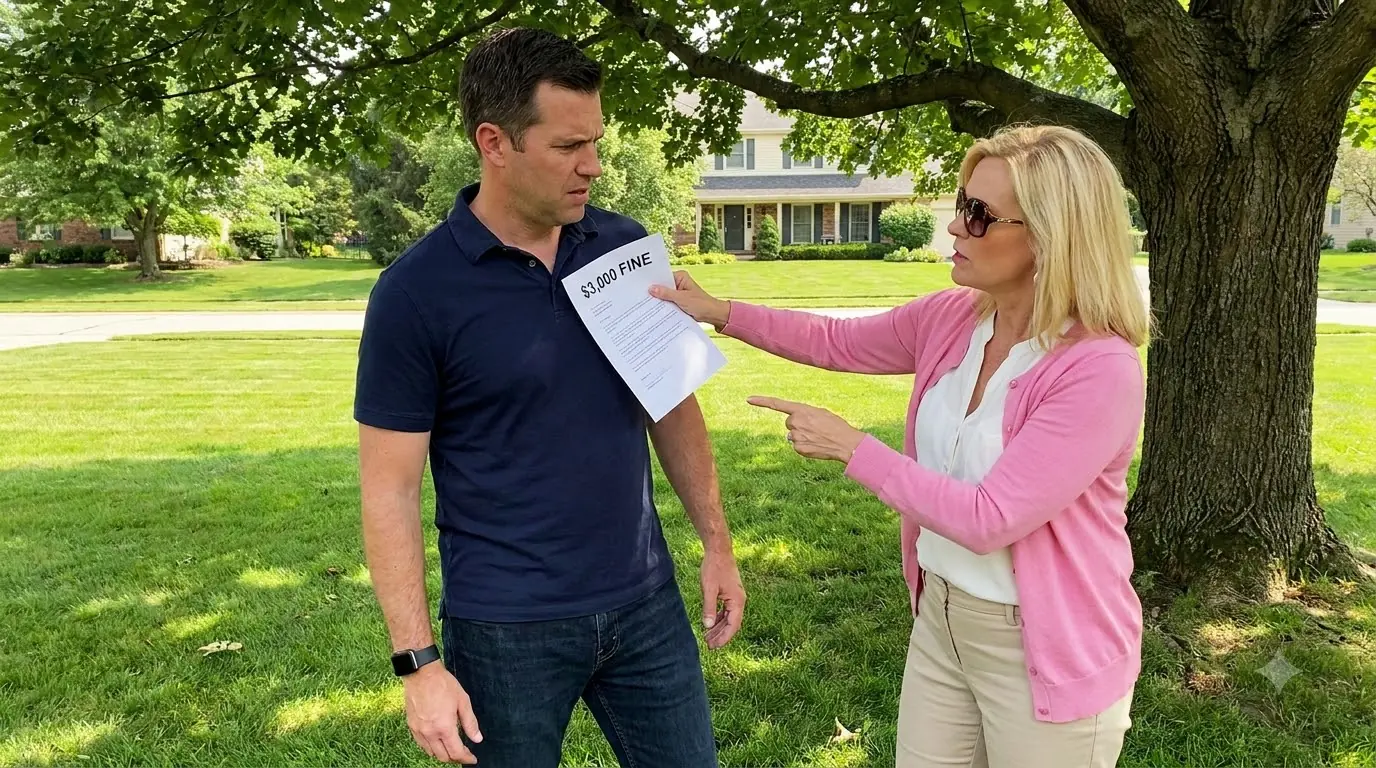
Four strips of bright blue painter’s tape formed a rectangle around it, making certain nobody walking past his house could miss the words printed across the front.
FINAL COMPLIANCE NOTICE.
Daniel stood on his porch for several seconds with one grocery bag hanging from each hand.
It was ninety-two degrees in Brookhaven Ridge that afternoon, and the heat had turned the concrete walkway pale beneath the sun.
Across the street, sprinklers clicked over a perfectly trimmed lawn.
A lawn service truck hummed near the corner.
Everything looked ordinary.
That made the envelope feel stranger.
Daniel set the groceries beside the door and pulled the notice free.
The first page contained a number large enough to make him read it twice.
$3,000 FINE.
Below it:
Immediate payment required. Failure to remit may result in lien proceedings.
Daniel laughed once.
Not because it was funny.
Because the alternative was yelling.
He turned the page.
The alleged violation involved the large maple tree growing beside his driveway.
According to the notice, Daniel had committed repeated violations by refusing to remove what the association described as an “unauthorized mature landscaping obstruction affecting neighborhood uniformity.”
Daniel looked over his shoulder.
The maple had been there for twenty-three years.
Longer than Daniel.
Longer than most houses on the street.
It shaded half the front yard and had survived hurricanes, ice storms, three previous homeowners, and at least two neighborhood redesign committees.
When Daniel bought the property eight years earlier, the tree had been listed as a protected landscape feature on the closing documents.
Now apparently it was worth three thousand dollars in fines.
Daniel carried the groceries inside.
His seventeen-year-old daughter Maya was sitting at the kitchen island with a laptop open in front of her.
She looked up.
“What happened?”
Daniel held up the notice.
“Your tree owes money.”
Maya blinked.
“My tree?”
“The maple.”
“What did it do?”
“Apparently refused to comply.”
She stared at him.
Daniel placed the notice on the counter.
Maya read the amount.
Her eyes widened.
“Three thousand dollars?”
“Yes.”
“For a tree?”
“Yes.”
“Did it rob someone?”
Daniel smiled.
“According to Karen, it disrupted neighborhood uniformity.”
Maya looked through kitchen window toward maple.
“It’s literally the nicest tree on street.”
“That might be the problem.”
Maya kept reading.
“Wait. She says you were warned three times.”
“I received one email.”
“Did you answer?”
“Yes.”
“What’d you say?”
“I asked for rule number.”
“And?”
“She sent a photograph.”
Maya laughed.
“Of rule?”
“Of tree.”
“That’s not rule.”
“I know.”
Daniel poured himself water.
Maya turned page.
“She says lien proceedings.”
“I see that.”
“Can she do that?”
“Not because she writes it in bold.”
“But can HOA put lien on house?”
“Under certain circumstances, yes.”
Maya stopped laughing.
Daniel saw concern enter her face and regretted sounding too casual.
He sat beside her.
“Don’t worry.”
“I’m not worried.”
“You’re staring at paper like it might explode.”
“I’m thinking.”
“About?”
“How much three thousand dollars is.”
Daniel smiled faintly.
“Still don’t worry.”
Maya tapped signature at bottom.
Karen Whitmore, President, Brookhaven Ridge Homeowners Association.
“You don’t like her.”
“That’s not relevant.”
“You definitely don’t.”
“I don’t like anyone who answers questions with threats.”
“That sounds relevant.”
Daniel took notice from her.
He had known Karen Whitmore for nearly four years.
At first, she had seemed exactly like what Brookhaven Ridge needed.
Organized.
Punctual.
Energetic.
The previous HOA president had resigned after disputes over pool maintenance and landscaping contracts.
Karen volunteered.
She immediately created new committees, digitized notices, scheduled monthly inspections, and sent cheerful newsletters decorated with seasonal borders.
Residents praised efficiency.
Then efficiency became enforcement.
A mailbox painted wrong shade of black generated warning.
Basketball hoop left beside driveway overnight generated violation.
A garden hose visible from street generated notice.
Children’s chalk drawings on sidewalk created “temporary visual disturbance.”
Most people rolled eyes and complied.
Daniel asked questions.
That was apparently unforgivable.
The first real conflict happened two years earlier when Karen cited him for placing trash bin outside before six in evening.
Daniel checked security camera.
The bin appeared at 5:52.
Karen insisted rule was six.
Daniel requested written policy specifying exact time.
She sent a reminder that repeated noncompliance could result in escalating fines.
Daniel asked again.
Two days later, board secretary sent governing document.
It said only that containers should not remain visible “for unreasonable periods before scheduled collection.”
No six o’clock rule existed.
Daniel responded politely.
Karen never apologized.
Fine disappeared.
After that, notices became more frequent.
Grass.
Bicycle.
Temporary lumber stacked beside garage during home repair.
A contractor van parked in driveway for three hours.
A porch light she claimed exceeded approved brightness, though bulb had been installed before Daniel purchased house.
Each time he requested rule citation.
Each time Karen became more irritated.
Daniel did not enjoy conflict.
That surprised people who assumed persistence meant aggression.
In his professional life, Daniel designed highway structures.
He spent days dealing with regulations, tolerances, material specifications, and inspections.
He was accustomed to questions having written answers.
If steel beam required specific grade, document identified grade.
If bridge deck required certain thickness, plan identified thickness.
Nobody could simply say, “Because I’m in charge.”
Daniel brought same expectation home.
Karen seemed to experience that as personal challenge.
The maple tree dispute began in April.
Karen sent photograph from street showing several branches extending above sidewalk.
Subject line:
LANDSCAPE CORRECTION REQUIRED.
Daniel trimmed low branch.
Then she said canopy remained “visually inconsistent.”
Daniel asked which covenant prohibited mature trees from being visually inconsistent.
No response.
Two weeks later, second message arrived asking for removal.
Daniel declined.
He included survey, closing landscape record, and county arborist evaluation confirming tree healthy.
Karen replied:
The association retains broad discretion to preserve community aesthetics.
Daniel answered:
Please identify provision granting authority to require removal of protected existing tree.
Silence.
Until three-thousand-dollar notice.
That evening Daniel spread documents across dining room table.
Maya sat opposite doing homework but mostly watching.
“You’re doing bridge face.”
Daniel looked up.
“What?”
“Bridge face.”
“I don’t have bridge face.”
“Yes you do.”
“What does it look like?”
“Like somebody calculated something wrong and you’re about to ruin their Tuesday.”
Daniel smiled.
“I’m reviewing dates.”
Maya leaned closer.
“What’s wrong?”
“Board meeting was Monday.”
“So?”
“This notice says board authorization Tuesday.”
Maya stared.
“Maybe they approved it Tuesday.”
“No meeting Tuesday.”
“Emergency meeting?”
“Would require notice.”
“Maybe committee.”
Daniel examined bottom.
It stated:
Penalty approved pursuant to board vote.
He opened HOA portal.
Minutes from Monday meeting had already been posted in draft.
Agenda item seven:
Lot 114, Carter residence, mature tree enforcement.
He clicked.
A short summary appeared.
Motion to impose $3,000 cumulative penalty and initiate removal order. Motion failed, 2-3.
Daniel stopped.
Maya noticed.
“What?”
He turned laptop.
She read line.
“Failed?”
“Yes.”
“So they voted no.”
“Yes.”
She looked at notice.
“Then why did she send it?”
Daniel said nothing.
The notice was dated Tuesday morning.
One day after board rejected fine.
He checked email metadata.
Received Wednesday.
Maya whispered:
“She just made it up.”
Daniel shook head.
“We don’t know that.”
“It literally says board approved.”
“It might be administrative error.”
Maya gave him look.
“Dad.”
“Possibilities first.”
“You think Karen made it up.”
“I think I’m going to ask.”
Maya leaned back.
“You always say not to accuse people before you know.”
“Yes.”
“And then you save every screenshot.”
“Yes.”
“So you can accuse accurately later.”
Daniel smiled.
“That’s not exactly lesson.”
“Close enough.”
The next morning Daniel emailed board.
He did not address Karen alone.
He included vice president Robert Ellis, treasurer Martha Dean, secretary Emily Harper, and architectural chair Paul Simmons.
Subject:
Request for clarification regarding $3,000 fine.
Daniel attached notice.
Then wrote:
The document states that the penalty was approved pursuant to a board vote. Draft minutes from Monday indicate that motion failed 2-3. Please confirm whether a subsequent board action occurred and provide date, vote, and authority supporting notice. Until clarified, I dispute fine in full.
He sent it at 8:14 a.m.
At 8:22, Karen replied.
Only Karen.
Daniel, continued attempts to relitigate association decisions will not delay enforcement. Payment remains due Friday.
Daniel responded:
Please answer question regarding board approval.
No answer.
At 9:06, Robert Ellis wrote:
I am checking this. Please do not make payment until board responds.
At 9:11, Karen replied all.
Robert, please avoid interfering with enforcement procedures outside formal meeting.
At 9:17, Robert answered:
Karen, board voted against this fine. Why was notice issued?
No response.
Daniel leaned back in office chair.
His concern changed.
This no longer felt like tree dispute.
At 11:32, phone rang.
Unknown number.
Daniel answered.
“Daniel Carter?”
“Yes.”
“This is Thomas Greene.”
Name seemed familiar.
Then Daniel remembered.
Thomas Greene had served as HOA treasurer before Martha Dean.
He resigned eighteen months earlier.