The storm reached Maricopa County after ten at night, turning the Arizona desert into a black wall of wind and rain. Inside the small two-bay garage beside her farmhouse, Evelyn Harper barely noticed it. At fifty-eight, Evelyn had spent most of her life solving problems with her hands, and that evening the problem was a worn 1994 Ford pickup belonging to a retired schoolteacher who could not afford another repair bill. Her silver-blonde ponytail was slipping loose, grease covered both gloves, and an old country station played quietly from the radio her late husband Roy had mounted above the workbench.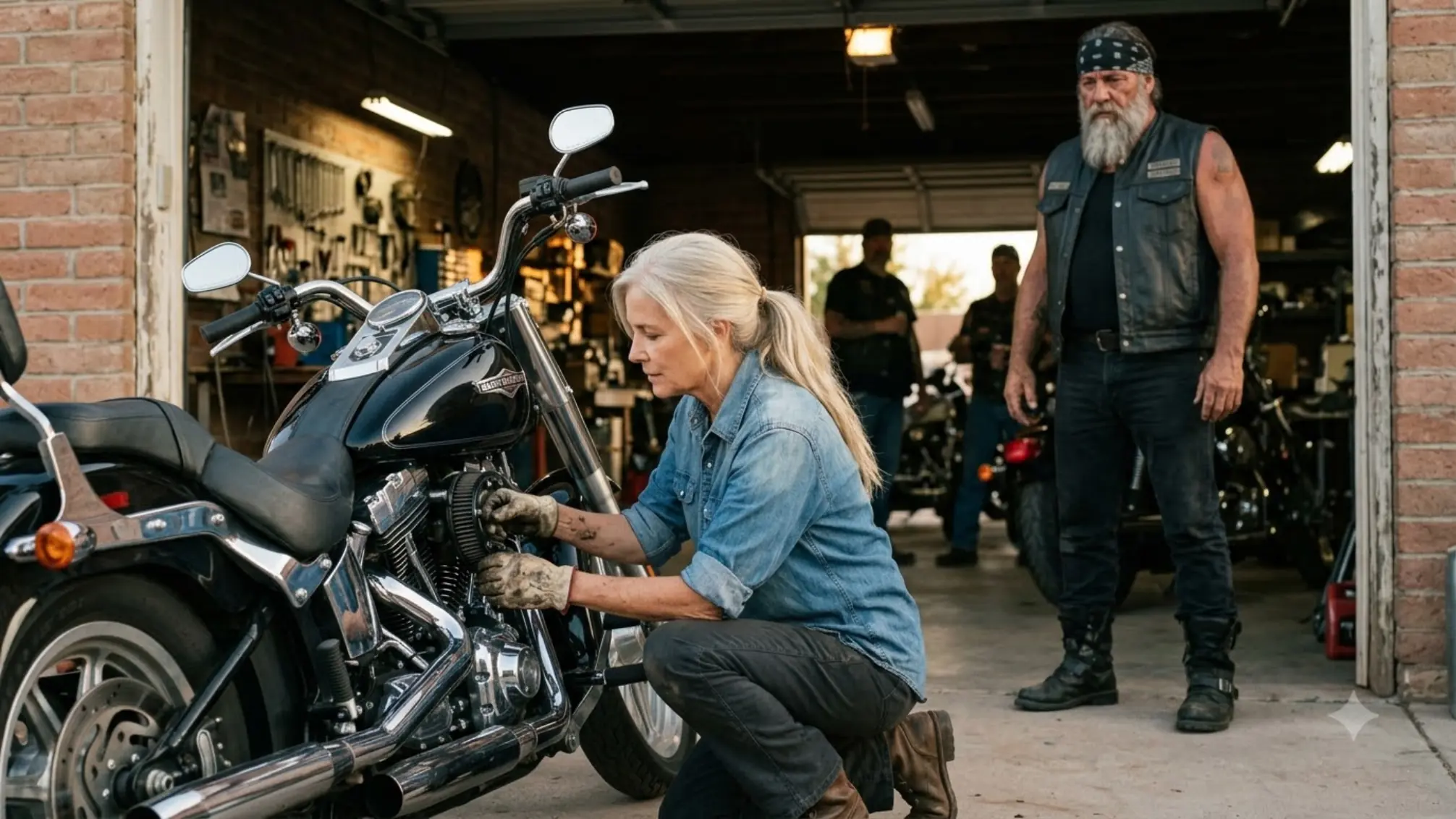
The garage was the last thing Roy had built for her before his death six years earlier. He had been a carpenter, not a mechanic, but he had spent two summers constructing the building exactly the way Evelyn wanted it, down to the long parts shelf along the back wall. Evelyn had never rearranged that shelf. People assumed grief was the reason, but the simpler truth was that Roy had organized it perfectly.
She heard the motorcycles before she saw them. Six machines rolled slowly into her gravel lot through the rain, two being pushed and the others coughing badly enough that Evelyn could hear the mechanical trouble beneath the storm. Their riders wore heavy leather vests and road gear, and even through the rain she recognized the patches. She also recognized the careful way the men stopped at the edge of her property instead of charging toward the garage.
The largest rider dismounted first. He was around fifty-six, broad through the shoulders, with weathered skin, a black bandana, tired dark eyes, and a long gray beard hanging over his leather vest. He approached only as far as the edge of the light spilling from the garage.
“Ma’am,” he called, “we’re sorry to bother you. We had trouble on the highway. Is there another repair shop anywhere close?”
Evelyn looked at the rain.
“Not one open tonight.”
The man nodded once. “Figured.”
He started to turn.
“Come inside.”
He looked back.
Evelyn pointed toward the garage. “You’re soaked, and those motorcycles aren’t getting better out there.”
The biker hesitated. “We don’t want to cause trouble.”
“I didn’t ask whether you wanted to. Bring them in.”
For a moment, all six men simply stared at her.
Then they obeyed.
The big man introduced himself as Ryder. The others were Dex, Cole, Stretch, Mackey, and Parish. Evelyn handed each of them coffee before inspecting the motorcycles, and within fifteen minutes she had identified a cracked fuel line, a failing regulator, water intrusion around an electrical connector, and two machines suffering from problems made worse by weeks of neglect.
Ryder stood several feet behind her while she worked on his Harley.
“You’ve been doing this long?”
“Since sixteen.”
“You sure you want to stay up fixing these?”
Evelyn looked over her shoulder. “You asking because you’re worried about me or because you think I can’t?”
Ryder almost smiled.
“Worried about you.”
“That answer saved you.”
He laughed quietly.
The men stayed out of her way. When Evelyn asked for a light, someone handed it to her. When she needed pressure held against a line, they held it. Nobody argued about instructions, nobody tried explaining motorcycles to the woman repairing theirs, and by midnight Evelyn had decided she liked them better than many customers who arrived in clean shirts and expensive trucks.
Ryder eventually sat on a stool near the workbench.
“Your husband build this place?”
Evelyn looked toward the oak shelf.
“How’d you know?”
“Everything’s old, but nothing looks accidental.”
She smiled faintly. “Roy didn’t know how to do accidental.”
“Still around?”
Evelyn tightened a bolt.
“Gone six years.”
Ryder did not offer the usual phrases.
He just nodded.
That small silence meant more to her than sympathy.
Around two in the morning, Stretch came closer while Evelyn finished Parish’s electrical repair. He was younger than the others, maybe twenty-six beneath the road grime and leather. His eyes kept moving around the garage with an expression Evelyn could not quite identify.
“Ma’am?”
“What?”
“We’ve been riding three weeks.”
“That sounds uncomfortable.”
He smiled.
“What I mean is, this is the first place anybody opened the door for us.”
Evelyn looked up.
Stretch shrugged. “People see the patches.”
“And?”
“They already know who they think we are.”
There was no anger in his voice.
That bothered Evelyn more than anger would have.
“You’re used to it.”
“Pretty much.”
She turned back toward the wiring.
“Well, you’re in my garage now.”
By three-thirty, all six engines were running cleanly.
Evelyn started each bike separately and listened with her eyes almost closed. Her father had taught her that machines spoke before they failed, if a person bothered listening. Each motor settled into the deep, smooth rhythm it was supposed to have.
Ryder reached inside his vest.
He produced a thick stack of cash.
“Name the number.”
Evelyn shook her head.
“Put it away.”
“Evelyn.”
It was the first time he had used her name.
“You spent the whole night working.”
“I know what I did.”
“Then let us pay you.”
“No.”
Ryder’s expression became serious. “Why?”
“Because you needed help.”
“That’s it?”
“That’s enough.”
He looked at the money, then back at her.
“Let us do something.”
Evelyn considered him.
Finally she said, “Help somebody else.”
Ryder frowned.
“What?”
“Someday, you’ll see somebody who needs something you can give. Help them. Don’t ask what you’re getting back. Just do it.”
The garage fell quiet.
Ryder slowly folded the money and put it away.
Then he reached into his breast pocket and removed a small card.
His name.
A phone number.
“Day or night,” he said.
Evelyn tucked it into her shirt pocket.
“Travel safe.”
They left at sunrise.
Six engines disappeared down the wet highway, leaving Evelyn standing in the garage doorway with Roy’s coffee mug in her hand.
She thought the story was over.
It was not.
Three weeks later, the first letter arrived.
According to the county tax office, Evelyn owed more than thirty-one thousand dollars in unpaid property assessments dating back decades. The number was absurd. Roy had kept every receipt, and Evelyn had continued the habit after his death.
She called.
Transferred.
Waited.
Left messages.
Nobody gave her an answer.
Then Victor Crane appeared.
He arrived in a black SUV wearing a suit that cost more than Evelyn’s pickup. At fifty-five, Crane was a property developer whose company had been quietly acquiring land between the highway and the ridge for years.
He smiled professionally.
“Mrs. Harper, I’d like to purchase your property.”
“It isn’t for sale.”
“My offer would be considerably above market value.”
“It still isn’t for sale.”
Crane looked toward the garage.
“You might want to consider your current circumstances.”
Evelyn wiped her hands on a rag.
“My circumstances are fine.”
His smile remained.
“Of course.”
He left.
Four days later, another letter arrived.
This one claimed that a company called Sonoran Land Holdings owned part of Evelyn’s eastern acreage through an unrecorded 1987 transfer supposedly signed by Roy’s father.
Evelyn stared at the photocopied deed.
She had never seen it.
Then county inspectors arrived.
Fourteen code violations.
Electrical.
Ventilation.
Waste handling.
Building compliance.
The garage had passed inspection fourteen months earlier.
“Standards change,” the inspector told her.
“Do they change backward?”
He refused to answer.
That evening, Evelyn called her longtime lawyer, Bill Garrett.
He listened quietly.
Then asked, “Has Victor Crane approached you?”
“Yes.”
Bill sighed.
“Then this makes sense.”
He explained that Crane had used similar tactics against other small property owners. Purchase offers came first. Then zoning trouble, tax disputes, environmental complaints, title problems, or anything else capable of making resistance expensive.
“How much will this cost to fight?”
Bill named a figure.
Evelyn said nothing.
She did not have it.
That night she walked into Roy’s garage and rested both hands against the workbench.
For the first time since the letters started, she admitted the truth.
She was scared.
Not of Crane.
Of losing what Roy had built.
Three nights later, somebody entered the farmhouse.
Nothing valuable disappeared.
Only paperwork.
The original deed was gone.
Evelyn stood in front of the opened filing cabinet, feeling something inside her turn cold.
They had entered Roy’s home.
They had touched Roy’s files.
The fear disappeared.
Anger replaced it.
She reported the break-in, then sat at the kitchen table at two in the morning surrounded by old documents.
That was when she saw the card.
Ryder.
Day or night.
Evelyn held it for nearly five minutes.
She had spent her whole life helping people precisely because she did not want help to become a debt.
Calling felt like collecting.
Then she remembered what Roy always told her.
If somebody offers you a hand honestly, refusing it can be another kind of pride.
She dialed.
Ryder answered after four rings.
“Yeah?”
“Ryder, it’s Evelyn Harper.”
His voice changed immediately.
“I know who you are.”
Something tightened in her throat.
“I think I need help.”
A brief pause.
“Tell me everything.”
So she did.
Twenty minutes.
Every letter.
Every inspection.
Every missing document.
Every threat.
Ryder never interrupted.
When she finished, his first question surprised her.
“Are you physically safe tonight?”
“Yes.”
“Doors locked?”
“Yes.”
“All right. Don’t touch that filing cabinet again. I know somebody who handles document fraud. I’m making calls.”
“Ryder, you don’t have to—”
“Evelyn.”
His voice softened.
“You told me to help somebody someday.”
Silence.
“I think we found her.”
The next morning, an attorney named Marcus Webb called.
Within forty minutes he had already identified problems with Crane’s paperwork. The notary listed on the alleged 1987 transfer had stopped practicing years earlier. One corporation supposedly involved in the chain of ownership did not legally exist until decades after the claimed transaction.
“The deed is fabricated,” Marcus said.
Evelyn closed her eyes.
“So we can beat this?”
“Yes.”
Then his voice became more serious.
“But Crane won’t stop because we caught one lie.”
Marcus was right.
The pressure increased.
Phone calls.
More notices.
Rumors around town.
Then Crane personally visited Evelyn’s friend Tom Burch and suggested that anyone helping her might find themselves facing expensive legal complications.
Tom came straight to Evelyn.
“He’s trying to isolate you.”
Evelyn leaned against the workbench.
“Is it working?”
Tom looked offended.
“No.”
Two nights later, the garage burned.
Evelyn had gone inside early with a headache.
At 11:30, a deep thump shook the windows.
She ran outside.
Roy’s garage was already engulfed.
Flames tore through the roof.
Thirty years of tools.
Parts.
Records.
Customer vehicles.
Roy’s workbench.
His shelves.
The entire building disappeared while Evelyn stood barefoot in her robe and watched firefighters prevent the flames from reaching the house.
The fire chief approached her afterward.
“Mrs. Harper, this does not look accidental.”
She already knew.
Later, sitting alone at the kitchen table with smoke still clinging to her clothes, Evelyn called Marcus Webb.
“They burned my garage.”
“Are you hurt?”
“No.”
“Inside the house?”
“Yes.”
“Lock everything. I’m calling the sheriff and the Attorney General’s office.”
After the call, another vehicle entered her driveway.
Victor Crane.
Evelyn opened the door before he reached the porch.
He stopped beneath the light.
“I heard about the fire.”
“Get off my property.”
“I’m sorry for your loss.”
“Get off my property.”
His smile disappeared.
“You are sixty-eight years old.”
She stared at him.
“You’ve lost your business. You’re buried in legal problems. You’re alone out here.”
He stepped closer.
“I’m offering you a clean exit.”
Evelyn moved to the edge of the porch.
“You want me to leave?”
Crane waited.
“Then you’re going to have to drag me off this land yourself, because I buried my husband here and I’m not going anywhere.”
His eyes hardened.
“You cannot fight everyone.”
Evelyn thought of the card.
“I’m not alone anymore.”
She shut the door.
Then she called Ryder.
“He came here.”
Silence.
“Tonight?”
“Yes.”
“He stood on your porch?”
“Yes.”
Ryder exhaled slowly.
“Evelyn, how many motorcycles can fit on your property?”
She blinked.
“What?”
“The lot. Field. Road frontage.”
“Maybe three acres altogether.”
“That’ll work.”
“Ryder, what are you doing?”
“You opened the door for six men.”
His voice remained calm.
“Tomorrow, we’re opening one for you.”
At dawn, Evelyn heard thunder.
Not weather.
Engines.
She walked onto the porch.
Headlights filled the highway.
Dozens became hundreds.
Motorcycles rolled toward her property two by two until the entire road seemed alive.
Ryder arrived first.
He stopped near the burned garage and removed his helmet.
Evelyn stared past him.
“How many?”
“Last count?”
He glanced toward the highway.
“Five hundred and twelve.”
Her hand tightened around the porch railing.
“Some of them rode all night?”
“Some rode two.”
“Why?”
Ryder looked at her.
“Because you mattered to six people.”
He nodded toward the road.
“And six people told everybody else.”
Flatbed trucks arrived next.
Lumber.
Steel.
Concrete.
Generators.
Tools.
Welding equipment.
Then attorneys.
Investigators.
Contractors.
The property transformed before Evelyn understood what was happening.
Ryder stood beside her.
“You need a garage.”
“Ryder, this is insane.”
“No.”
He pointed toward the burned foundation.
“What happened there was insane.”
Within hours, crews were pouring a new foundation.
A lawyer working with Marcus explained that Crane’s shell companies had been connected directly to the fraudulent property claim. Emails showed coordination with county employees regarding inspections and the tax assessment.
Then came the biggest development.
A private arson investigator found evidence that accelerant had been applied at multiple points around Evelyn’s garage.
Crane had made a mistake.
Paperwork could hide.
Fire attracted people who asked harder questions.
By afternoon, state investigators had opened a case.
The following morning, federal investigators became involved after interstate shell companies appeared in the fraud scheme.
Crane called.
Not with arrogance.
With an attorney.
He offered settlement money.
Enough money for Evelyn to walk away wealthy.
The offer contained confidentiality provisions.
Evelyn sat across from her lawyer.
“What happens to the other families?”
“Nothing.”
“And the people who lost land?”
“Nothing.”
She pushed the document back.
“Then no.”
Her lawyer studied her.
“This could take years.”
“So?”
“You could lose.”
Evelyn looked through the window.
Outside, hundreds of strangers were rebuilding a garage because she once repaired six motorcycles for free.
“I’ve already lost what scared me most.”
She looked toward Roy’s burned foundation.
“Now I want the truth.”
By the second evening, the new garage walls were standing.
Stretch found Evelyn and handed her a hammer.
“Ryder says you have to do one.”
“One what?”
He pointed toward a nail started halfway into the framing.
“That.”
Evelyn took the hammer.
She understood immediately.
Someone had placed the nail deliberately.
She raised the hammer and drove it home with two clean strikes.
Applause began.
First from Stretch.
Then Ryder.
Then the nearest workers.
Within seconds, hundreds of people were clapping.
Evelyn lowered the hammer.
Her eyes filled.
She had not cried when the garage burned.
Now she did.
Ryder approached later carrying two sandwiches.
“You okay?”
“No.”
He sat beside her.
“Good or bad?”
“I don’t know.”
They watched the new structure.
Evelyn finally said, “I fixed six motorcycles.”
Ryder nodded.
“This is not equal.”
“No.”
“Then why?”
Ryder considered the question.
“Because kindness isn’t accounting.”
She looked at him.
“Most of these men know what a locked door feels like.”
His eyes moved toward the riders scattered across her land.
“People see leather. Patches. Beards. Motorcycles. They decide before we speak.”
He looked back at Evelyn.
“You opened your door anyway.”
“That’s all?”
“For somebody used to locked doors?”
Ryder smiled.
“That’s everything.”
Eleven weeks later, Victor Crane was indicted on charges connected to fraud, corruption, and the criminal investigation surrounding the property scheme and garage fire. Several families joined the civil action after investigators discovered they had been targeted with similar pressure. The fake tax claim against Evelyn disappeared, the deed was invalidated, and her title was confirmed.
Crane’s resort project never happened.
Evelyn stayed.
So did the new garage.
It was larger than Roy’s original building, but one feature had been reproduced almost exactly.
The parts shelf.
Ryder’s friend Briggs spent two days rebuilding it from measurements Evelyn remembered by heart.
When he finished, she ran her fingers across the oak.
“Roy’s was pine.”
Briggs looked concerned.
“You want me to redo it?”
Evelyn smiled.
“No.”
“This one’s yours.”
Before the riders left, Evelyn cooked dinner.
Not for five hundred.
That would have been impossible.
The town helped.
Tom brought food.
Dolores brought stew.
Church women arrived with casseroles.
Restaurants donated trays.
The field became one enormous table beneath the Arizona stars.
Evelyn sat beside Ryder after most people had finished eating.
“You know,” she said, “I never thanked you properly.”
“Don’t.”
“I’m serious.”
“So am I.”
He looked toward her.
“You gave us the instruction.”
“What instruction?”
“Help somebody else.”
He smiled faintly.
“We did.”
The next morning, motorcycles began leaving.
One group at a time.
Stretch stopped near the porch.
“I’ll remember what you did that first night.”
Evelyn pointed toward him.
“No.”
He looked confused.
“Remember what you’re supposed to do next.”
He smiled.
“Yes, ma’am.”
Ryder left last.
He sat on his motorcycle looking toward the rebuilt garage.
Then he removed a card from his vest.
Another copy.
He handed it to Evelyn.
On the back he had written:
Day or night. Always.
Evelyn looked at him.
“You think I lost the first one?”
“No.”
He smiled.
“I just want you to have two.”
She laughed.
Then her expression softened.
“Ryder.”
“Yeah?”
“If the bike breaks again…”
He waited.
“…you don’t need it as an excuse to come back.”
Ryder’s smile slowly widened.
“I was hoping you’d say that.”
He started the Harley.
The engine ran perfectly.
Of course it did.
Evelyn had repaired it.
Months later, a small framed note appeared above the new parts shelf.
Visitors often asked about it.
No trophy.
No photograph.
No newspaper clipping.
Just five handwritten words.
She opened the door first.
Evelyn kept Roy’s old coffee mug beneath it.
The garage became known for an unwritten rule.
If someone was stranded and Evelyn could help, she helped.
If they could pay, fine.
If they could not, they were given the same instruction Ryder had received.
Help someone else someday.
And every few months, usually without warning, a familiar black Harley rolled into the gravel lot.
Ryder never pretended anything was broken anymore.
Sometimes he brought coffee.
Sometimes parts.
Sometimes nothing.
He simply leaned against the fence while Evelyn worked and stayed until she finally asked whether he planned on making himself useful.
The first time he returned after everything had ended, Evelyn was rebuilding a carburetor.
Ryder watched for several minutes.
She finally looked up.
“You’ve been standing there a long time for a man with a perfectly good motorcycle.”
He folded his arms.
“Maybe the motorcycle isn’t why I keep coming back.”
Evelyn smiled.
Then returned to her work.
“Good.”
Ryder waited.
“That’s all?”
She glanced toward him.
“No.”
Her smile widened.
“Coffee’s inside.”
For a man who had spent years finding locked doors everywhere he went, it was more than enough.