The morning Tessa Roland walked into Iron Meridian Auto Salvage, she was running on two hours of sleep, cold gas station coffee, and the particular kind of fear that does not shake your hands.
It sits still inside you, quiet and hollow, like the moment before a crash, when your body already knows what is coming but your mind has not caught up yet.
She almost did not stop. She had driven past the entrance twice, slowing down both times, staring at the hand-painted sign hanging crooked over the chain-link gate.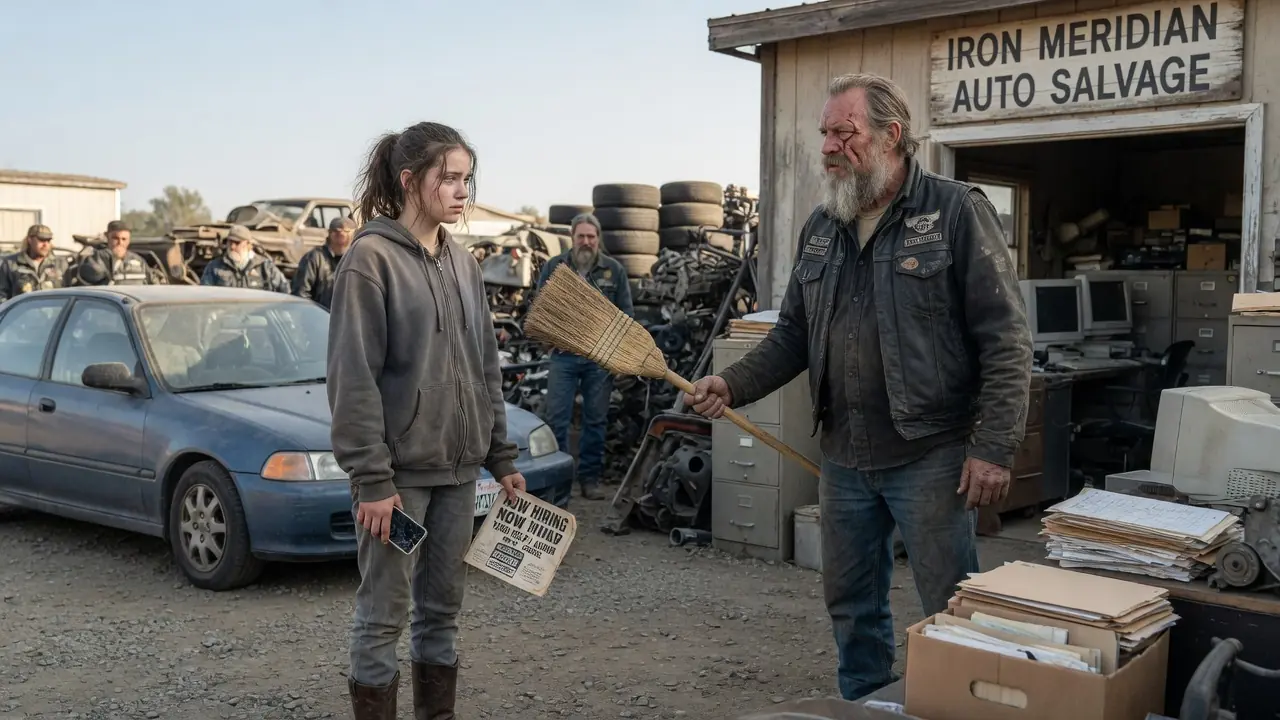
Iron Meridian Auto Salvage. Est. 1987. No Trespassing.
She thought, No, this is not the place. This is not safe. Keep driving.
But she had done the math three times on a gas station napkin outside Bakersfield, and the math kept coming out the same. If she kept driving, she would drop under $3,000 before she crossed into Nevada. If she crossed into Nevada, Preston would find her within a week.
He had people in Nevada.
He had people in a lot of places.
So she turned around. She pulled her 2009 Honda Civic into the gravel lot, killed the engine, and sat there for four full minutes just breathing.
The yard was bigger than she expected. Mountains of crushed metal rose on all sides, organized in a way that only made sense if you had been there long enough to learn its logic. Rows of stripped cars, towers of engine blocks, walls of tires stacked six high.
Moving between all of it were men in leather vests with road-worn faces. Men who did not look up when a strange car pulled into the lot.
That was the first thing that struck her.
None of them looked up.
She had expected hostility. She had prepared herself for it. What she had not prepared for was indifference, not cruel indifference, but the kind that came from a world with its own gravity, its own rules, and no need to orbit around strangers.
At 7:42 in the morning, Tessa got out of the car.
She was 31 years old, five-foot-four, with dark hair pulled back into a knot because there had not been time to do anything else with it. She wore jeans, a gray pullover, and boots she had bought from a Goodwill outside Fresno because her own shoes had been left behind in the apartment she once shared with Preston.
Along with most of her clothes.
Her good coat.
And three years of her life she was never getting back.
She walked to the front office, a low building with a metal roof and a screen door hanging slightly crooked. A handwritten note was taped to the glass.
Ring bell or don’t.
Either way.
She rang the bell.
Nothing happened for a long moment. Then the screen door swung open, and Rafe Calder walked out.
Rafe was 58, six-foot-two, with a gray beard down to his collarbone and a scar running from the corner of his left eye to his jaw like a crack in old concrete. He wore a worn Hells Angels vest and moved the way large old things moved: slowly, without hurry, with the confidence of something that had never needed to rush.
He looked at her, not through her or past her, but at her, like a man studying a piece of machinery he was trying to understand.
“Help you?” he said.
Two words. Flat. Not warm. Not cold.
“I heard you were hiring,” Tessa said. “Office records. Intake. Filing.”
He studied her. “Where’d you hear that?”
“Flyer at the truck stop on Route 14.”
“That flyer’s three weeks old.”
“I figured if the job was filled, you would have taken it down.”
Something moved across his face. Not quite a smile. More like the private acknowledgment of a point well made.
“You got experience?”
That last part was a gamble.
It was also the truest thing she had said.
Rafe watched her for five long seconds. Then he turned and walked back inside.
“Come on,” he said.
She followed him.
The inside of the office was a wreck. A long counter ran across one wall. Behind it stood metal warehouse shelves absolutely buried in paper, folders, binders, loose receipts, manila envelopes, and plastic bins overflowing with forms.
On the counter sat two old computers, a receipt printer that looked older than smartphones, a coffee maker, and a corded landline telephone.
On the floor, shoved into the corner behind the door, were taped cardboard boxes labeled with dates going back to 2014.
Tessa looked at it all and kept her face neutral.
“Previous girl quit four months ago,” Rafe said. “One before her lasted three weeks. One before that didn’t make it through the first day.”
He opened a drawer, pulled out a heavy ring of keys, and set it on the counter. Then he reached into another drawer, pulled out a broom, and set that beside it.
“Three things,” he said. “You don’t touch anything you don’t understand. You don’t make copies without asking me first. And if somebody comes in asking questions about the yard, the inventory, or anybody who works here, you tell me before you tell them anything.”
“Understood.”
“Pay is $16.50 an hour to start. Cash weekly. Monday through Saturday, eight to five. Half hour for lunch. You take it at the counter. You don’t go into the yard without telling somebody.”
He paused.
“Questions?”
“One,” she said. “What’s the broom for?”
Rafe picked it up and handed it to her.
“Start with the corner behind the filing cabinet. Hasn’t been swept since March.”
That was the interview.
That was the whole thing.
Tessa took the broom and went to work.
The corner behind the filing cabinet had, in fact, not been swept since March. There were drifts of grit and metal shavings, a sprung mouse trap, three old receipts from 2019, and a red-handled screwdriver she placed carefully on the counter without comment.
She swept. And while she swept, she watched.
Men came in and out of the office throughout the morning. Some handed paperwork to Rafe. Some asked questions in low voices. Some glanced at Tessa once, sized her up, then moved on.
One man with a shaved head and faded tattoos stopped when he saw her.
“New girl?”
“New intake clerk,” Rafe said without looking up.
The man looked at Tessa. “You know what you got into?”
“A job,” she said.
He thought about that, then smiled a small, genuine smile and walked out.
By 9:30, Tessa had finished sweeping, found trash bags under the third cabinet from the left, cleared the mouse trap, and begun to understand the scope of the disaster.
The filing system was not random. That mattered. It was the wreckage of a system that had once worked, then passed through too many careless hands.
There was logic buried under the mess. She could feel it the way you can feel the structure of a building even when the walls are damaged.
She pulled a stool to the counter and started with the most recent box.
“What are you doing?” Rafe asked.
“Starting with the newest records and working backward. If there are compliance issues, inspection tags, permits, or environmental certifications, they’ll show up faster that way.”
A pause.
“You know permit compliance for scrap operations?”
“I know permit compliance for operations that handle hazardous materials and mixed waste,” she said. “Fluids, batteries, tires, catalytic converters. Different states regulate them differently, but the structure is usually similar.”
Rafe stared at her for a moment. Then he poured a second mug of coffee and set it near her without a word.
That was how Rafe Calder said, You are not just passing time here.
She understood immediately.
By 10:15, she had found the first problem. Forty-three scrap intake tickets from the previous year had been flagged for secondary inspection, but none had a documented follow-up clearance form.
She pulled a yellow legal pad from the printer shelf and began a list.
Rafe passed by and glanced down.
“What’s that?”
“Documentation gaps,” she said. “I’m cataloging before I correct anything. If someone asks what the status was when I started, I need a baseline record.”
He was quiet.
“Smart.”
“I’ve worked for people who created problems and blamed the person who came in after,” she said. “I document everything.”
A silence settled between them, not uncomfortable, but full of recognition.
“I’ll get you a second legal pad,” he said.
By noon, she had three stacks: documents in order, documents with gaps, and documents that belonged somewhere else entirely. She labeled each with sticky notes and marked urgent folders with red tape.
By 1:30, she was building a picture.
Iron Meridian had been running for 37 years. Its compliance history was not bad. Someone had cared. Someone had built a solid documentation system and maintained it well.
Then something had shifted.
The careful hand had been removed, and the cracks had widened.
She found misclassified hazardous material forms, permits renewed but not attached to original applications, inspection certificates referencing vehicles not in current inventory. She started another column on her legal pad.
Possible liability exposure.
Clinical. Plain. Unpanicked.
She was not here to create fear.
She was here to build clarity.
At 2:40, her phone buzzed.
She kept it face down at first, but she knew before she looked.
A message from an unknown number.
Preston had a way of getting new numbers.
Heard you left the city. Interesting choice. We should talk about the things you took when you left.
Her hands went still on the papers.
She had taken nothing. Clothes. Cash she had saved quietly for 14 months. Her cracked phone. That was all.
But Preston had never needed a real reason.
He made them.
She set the phone face down again and kept working.
By 4:00, she had identified 61 documentation gaps, prioritized them by risk level, and corrected the first 43. The core permits were solid. The primary hazardous waste certifications were current. The problems were real, but fixable.
Rafe came to stand beside her.
“You did this in one day?”
“I didn’t fix everything. I mapped it.”
“Mapping is the part nobody does.”
She nodded once.
He looked at the legal pads, then at her.
“You’re not here just because you needed a job, are you?”
She kept her eyes on the papers.
“I needed a job,” she said. “I also needed somewhere I could think. Somewhere I could breathe. Somewhere a man coming through the gate looking for me would have a harder time than he expected.”
“Somebody like who?”
She looked at him directly.
“His name is Preston Vale. He’s going to come here. I don’t know when. When he does, he’ll try to make it sound official. He’ll wave papers around and talk about forms and violations. That’s how he works. He makes himself sound reasonable. He is very good at it.”
Rafe looked at her for a long moment.
“Can he find something real?”
“He could have this morning,” she said. “He’ll have a harder time tonight.”
The corner of Rafe’s mouth shifted.
“Finish what you’re doing,” he said. “Then we’ll talk about tomorrow.”
Outside, the late afternoon light cut low through the towers of metal. One biker paused near the gate and looked out at the road.
Nothing was there yet.
But something was coming.
Tessa felt it the same way she had felt it the morning she left Preston.
Hollow. Still. Certain.
He was coming.
The next morning, she came back.
That was the thing nobody expected. Not Dutch, the silver-braided older biker who watched her car pull in at 7:58. Not Marco, the younger one with the dark beard who stopped mid-sip when he saw her headlights.
Not even Rafe, who had his back to the door when she entered but went still for just a fraction of a second.
She had come back.
She hung her bag on the crooked hook behind the door and picked up exactly where she left off.
“Coffee’s on the burner,” Rafe said.
“Thank you.”
That was the whole conversation.
But it meant something.
At 8:45, Dutch came in, poured himself coffee, and leaned on the counter.
“You know Rafe doesn’t let people stay in motels long-term when they work here.”
Tessa looked up.
“There’s a room above the parts warehouse,” Dutch said, staring into his mug. “Cot, sink, one window. Not the Ritz, but it’s on site and it’s got a deadbolt.”
A deadbolt.
He said the word like he knew she was counting locks.
“I’d have to ask Rafe.”
“Already asked him.”
Dutch set down his mug and walked out.
She sat with that for a moment, then went back to work.
At 9:15, her phone buzzed again.
Different number. Same voice.
I know you’re still in state. You should call me before this gets complicated. I’m trying to be fair.
Fair.
Preston always used that word to mean whatever made him look reasonable and her look unstable.
She put the phone in her bag, zipped it, and worked faster.
By 11:45, she found the first real problem.
Not a documentation gap. A permit condition.
The secondary hazardous materials storage permit was valid, current, and signed, but attached out of sequence behind it was a notice issued eight months earlier. It required a site inspection to confirm upgraded containment barriers.
The inspection had never been scheduled, or at least no record of it existed here.
A lapsed permit condition was the kind of thing a determined regulator, or a determined man with a lawyer, could use to challenge the entire permit’s validity.
“Rafe,” she said. “Come look at this.”
He read the notice. His jaw tightened.
“Did you know?”
“Somebody told me it was handled.”
“Who?”
“Previous office manager.”
Tessa nodded.
“Okay. The permit is still valid. The condition is lapsed, not expired. We are likely in a grace window. If the site work was actually completed, we can file for retroactive inspection and close the condition.”
Rafe looked at her.
“You know how to file for that?”
“I’ve done it before.”
He was quiet.
“You showed up yesterday with a broom.”
“You didn’t ask what else I knew how to do.”
Another full silence.
Then Rafe said, “Dutch was here when the containment upgrades happened. Start with him.”
Dutch remembered the work. Better than that, he had photographs on his phone from the installation. By 1:15, Tessa had built a photo log, cross-referenced each image to the site diagram, and started the retroactive inspection application.
At 1:45, the gate intercom crackled.
A smooth voice came through.
“Good afternoon. I’m looking for the owner or manager of record for Iron Meridian Auto Salvage. I have documents regarding compliance status.”
Tessa’s hands stopped moving.
She knew that voice.
She had heard it in conference rooms, parking lots, and once in a courthouse hallway where Preston had stood close enough for her to smell his aftershave and whispered that she was making a mistake.
Preston Vale was at the gate.
He had not waited 48 hours.
He had waited 14.
Rafe was already moving toward the intercom. He looked back at Tessa once.
She lifted her chin.
He pressed the button.
“Come to the office.”
She had four minutes.
Four minutes to decide what posture she would hold, which documents would be visible, and how much of what she had built she would let him see before showing him what it meant.
She pulled the correction ledger to the center of the counter. She set the photo log on top. She opened the permit file to the conditional notice and placed the half-finished retroactive inspection application beside it.
Then she folded her hands on the counter and breathed.
Behind her, Rafe said quietly, “Tell Dutch and Marco. Now.”
The screen door opened.
Preston Vale walked in.
Tall, well-dressed, carrying a leather portfolio that cost more than Tessa’s first month of rent had. He wore a tie. He was the only person within thirty yards wearing one.
His eyes found her in under two seconds.
She watched him reset.
He had expected her small, cornered, caught. Instead, he found her standing behind a counter covered in organized documents, next to a man built like a stone wall, in a yard full of men who had not been told to leave.
“Tessa,” Preston said warmly. Practiced warmth. “I didn’t expect to find you working.”
“Hello, Preston.”
“I’m here on a professional matter. I represent a party with a compliance interest in this property, and I have documentation that management needs to review.”
“What party?” Rafe asked.
Preston looked at him. “That is something I would prefer to discuss privately.”
“This is my office,” Rafe said. “My office has one conversation style. You want to talk about my yard’s compliance, you talk here, with her present, because she is my records manager and she knows this yard’s documentation better than anyone in this room.”
He paused.
“Including you.”
Preston recalculated.
“Fine,” he said. “Let’s start with the hazardous materials storage permit.”
“Let’s,” Tessa said. “Which section?”
Preston pulled out the conditional notice.
“This condition has not been met. The inspection was required within 90 days. It has been eight months.”
“That is a lapsed condition on a valid permit,” Tessa said. “The permit holder may file for retroactive inspection provided they can demonstrate substantive compliance with the underlying condition.”
She turned the correction ledger toward him.
“The site work was completed. I have dated photographic documentation cross-referenced to the permit diagram, and a retroactive inspection application will be filed tomorrow morning.”
Preston stared at the ledger.
“That application has not been filed yet.”
“No,” she said. “But the documentation exists. The compliance exists. The filing is procedural.”
She held his gaze.
“You’re welcome to revisit this conversation once you have accurate information.”
“There are other issues,” he said quietly.
“I’m sure there are,” she said. “I identified 61 documentation gaps in this yard’s records. I have corrected most of them in the last day and a half. Every correction is dated and cross-referenced. Whatever you think you found, I found it first.”
The room went still.
Rafe stood beside her like a wall.
Dutch appeared in the doorway.
Preston did not sit down. That was the first tell. Tessa knew him well enough to know that Preston always sat down when he felt in control.
Here, he stood.
He produced another document, claiming it came from Pacific Rim Environmental Compliance Group.
Tessa read it once.
Then she looked up.
“This citation is wrong for this yard. It references a regulatory pathway that does not apply to Iron Meridian’s permit category. If Pacific Rim wants to conduct a legitimate review, they need documentation that correctly identifies the licensing authority and the applicable code. This isn’t that document.”
For the first time in three years, Tessa saw Preston not know what to do next.
Only for two seconds.
But she saw it.
He tried vehicle title records next. She had the binder ready.
He tried battery disposal. She had the service logs.
He tried tire manifests. Current.
He tried four VIN numbers. Three were complete. One was already flagged on her ledger with a DMV records request path.
Finally, she folded her hands.
“Preston, I know what is here. I know what was missing. I know what I corrected. If there is something real in that portfolio, show it to me.”
Silence.
The kind of silence a prepared argument makes when it hits a wall.
Rafe spoke then.
“I’m going to call the California Department of Toxic Substances Control and ask about Pacific Rim. Then the State Bar to confirm your license and disciplinary history. Then the County Assessor to ask whether any formal complaint exists against this property. You want to change anything before I make those calls?”
Preston’s hand tightened around the portfolio.
“I’m acting within my legal rights.”
“I didn’t say you weren’t,” Rafe said. “I asked if you wanted to change anything.”
Marco appeared from the back room and stood near Rafe.
The geometry of the room changed.
Preston looked at Rafe, Dutch, Marco, and finally Tessa.
“You’re making a mistake,” he said, quiet and directed at her.
“I’ve made mistakes before,” she said. “I’ve learned to recognize them early. This isn’t one.”
Preston closed his portfolio.
“I’ll be in touch.”
“You have our address,” Rafe said.
Preston walked out.
Nobody moved for five seconds.
Then Dutch exhaled. “Huh.”
Marco looked at Tessa. “Pacific Rim Environmental Compliance Group. Not real?”
“No,” she said. “Not real.”
Rafe’s eyes stayed on her.
“He came here for you.”
“He came because of me,” she said. “But the play was against the yard. That’s how he works. He comes at what’s around the thing he wants.”
Rafe opened his drawer and pulled out a printed contract.
Iron Meridian Auto Salvage Employee Agreement.
Records and Yard Intake Manager. Temporary Status.
She looked at it.
“Temporary?”
“Ninety days. Then we renegotiate. $21.75 an hour. Paid weekly. Room above the parts warehouse included. No rent.”
He tapped the title.
“Records and intake manager makes you the documented point of contact for regulatory inquiries. If anybody comes back, they go through you officially.”
She read the contract twice. Then she called the lawyer Rafe recommended, Karen Selby, and had her review it.
Karen called back thirty minutes later.
“Clean. Fair. Sign it.”
So Tessa did.
Her signature was steady.
Rafe shook her hand.
The handshake was large, rough, and completely solid.
She had shaken hands with people her whole life without feeling much.
This one, she felt.
The next morning, Tessa found the deeper problem.
A 2018 black Mercedes-Benz E-Class had passed through the yard fourteen months earlier. The file was clean on the surface, but it had moved through a holding company called Pacific Coast Asset Management, LLC.
Pacific Coast.
Pacific Rim.
Different names. Same hollow corporate structure.
The kind of names built to sound legitimate and be difficult to trace.
Rafe stood beside her and looked at the file.
“I’ve been trying to answer that question for fourteen months,” he said.
Tessa found a notary stamp on the chain of custody form.
“That’s a thread,” she said.
By 8:31, she had also located the missing 2019 environmental citation notice, printed it from the public enforcement database, attached it properly, and closed the final gap.
Sixty-one gaps.
Sixty-one corrections.
Done.
At 8:45, Dutch appeared in the doorway.
“Black sedan on Route 14. Quarter mile past the gate. Been there since eight.”
Preston was waiting.
Then Rafe’s phone rang.
A county contact told him someone had filed an environmental complaint against Iron Meridian at 8:03 that morning. The complaint referenced the 2019 citation and claimed the remediation documentation was incomplete.
Filed by Pacific Coast Asset Management.
Tessa looked at the completed file.
“He filed before he knew I closed the gap.”
Karen filed the response within the hour.
The county received it. Logged it. Reviewed it against the corrected documentation.
No actionable basis for inquiry.
At 10:22, Dutch came back to the doorway.
“Sedan’s gone.”
Three words that held the whole morning inside them.
Tessa exhaled.
The pressure had lifted, not forever, but for today.
And today mattered.
Rafe set a fresh legal pad on the counter. At the top, in blocky handwriting, he had written:
Phase Two.
“What’s phase two?” Tessa asked.
“Everything else,” Rafe said.
Payroll documentation. Intake formalization. DMV record requests. Tire manifests. Insurance riders. Permit follow-ups.
She pulled the pad toward her and picked up her pen.
“Start with payroll,” she said. “Broadest liability exposure.”
Rafe nodded.
By noon, she had filled four pages.
By late afternoon, Karen texted.
County complaint response submitted and logged. You’re clean. Call me tomorrow. I reviewed the harassment documentation. I think we have enough to move forward.
Tessa set the phone down face up.
Face up.
Four days ago, every notification had been something to brace for. Now her phone sat on the counter of her office, in the yard where she worked, below the room where she slept, in the place she had made solid by refusing to become smaller than she was.
She looked at the key ring hanging by the door.
Twenty keys.
Each one a door.
Each one something she had been trusted with.
She looked at the correction ledger, every gap addressed in her own handwriting. She looked at the signed contract waiting in the tray by the printer.
Tessa Roland had arrived at Iron Meridian Auto Salvage with $3,816, a cracked phone, and a threatening text from a man who believed fear was the most reliable tool in the world.
Now she had a title, a weekly paycheck, a lawyer who answered on the first ring, a room with a deadbolt, a phase-two list that would take months to finish, and the absolute knowledge that she had not been rescued.
She had built this herself.
With a broom.
With four legal pads.
With sixty-one documentation gaps.
With the kind of courage that does not look like courage from the outside.
The kind that looks like showing up.
Staying at the counter.
Reading the document one more time.
Not flinching when the door opens.
That was what she had.
That was everything.
And it was enough.