England, 1867.
The chandeliers of Hobart House cast a warm golden glow across the grand ballroom, illuminating the faces of London's most distinguished aristocrats.
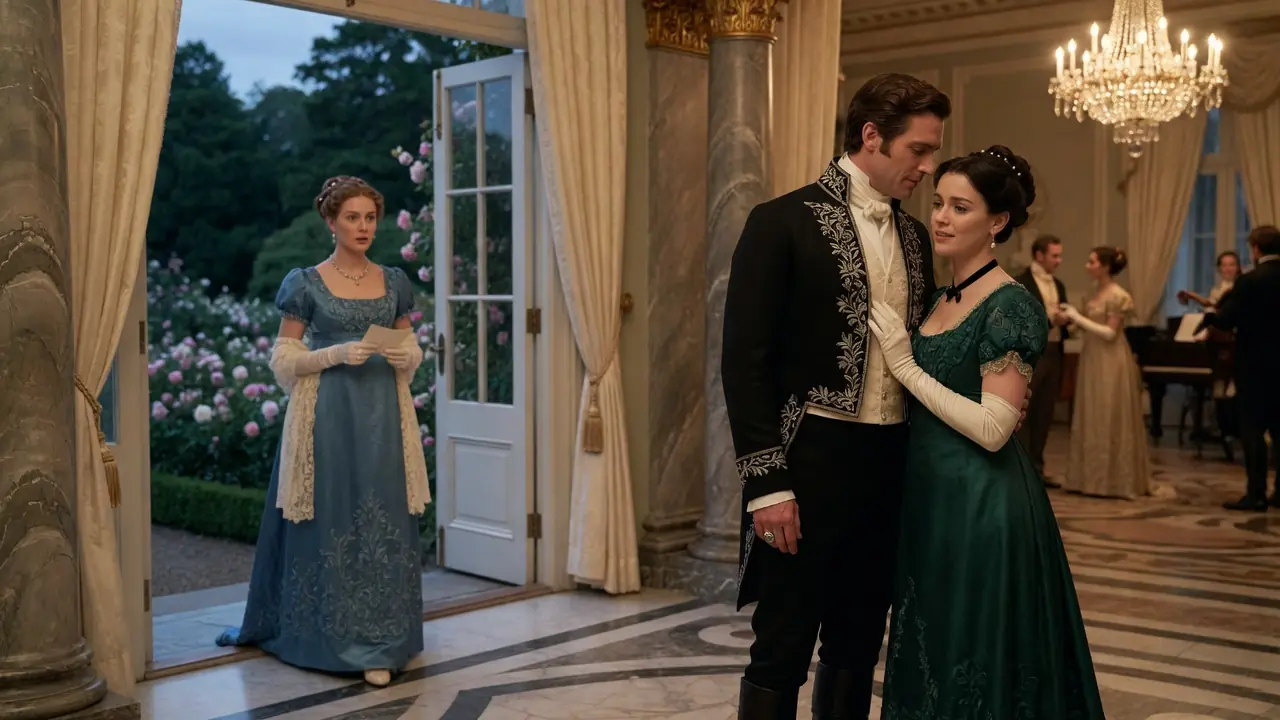
At the center of attention stood Lady Anne Hobart, her long golden hair elegantly styled with pearl pins, her cerulean gown complementing her fair complexion.
She smiled graciously as guests offered congratulations on her engagement to the Duke of Westmere, a match that promised to elevate the already respectable Hobart name to new heights of prominence.
"My dearest sister," exclaimed Marie Hobart, approaching with outstretched arms.
Unlike Anne's golden beauty, Marie possessed striking raven hair and penetrating dark eyes that seemed to absorb light rather than reflect it.
"How splendid you look tonight. The Duke is most fortunate indeed."
Anne embraced her younger sister warmly.
"Thank you, Marie. Your support means everything to me."
From across the room, Charles Blackwood, the Duke of Westmere, observed the sisters with a measured smile. Tall and commanding, with chestnut hair and aristocratic features, he was the most eligible bachelor in three counties.
The union had been arranged primarily by their fathers, though Anne had been pleased with the match. The Duke was handsome, wealthy, and possessed a certain charm when he wished to display it.
"I dare say your sister seems particularly delighted this evening," remarked Lady Pembroke, an elderly countess with a reputation for keen observation.
Anne smiled.
"Marie has always been my greatest champion."
"Indeed," the old woman replied, her eyes narrowing slightly. "How fortunate you are to have such a devoted sister."
Later that evening, as the celebration continued, Marie slipped away to the terrace. The cool April air provided relief from the stifling heat of the ballroom. She closed her eyes, breathing deeply, trying to quell the bitterness that had taken root in her heart years ago.
"Miss Hobart, are you unwell?"
Marie turned to find the Duke of Westmere standing in the doorway, concern etched across his features, or what appeared to be concern.
"Your Grace," she curtsied. "Merely seeking a moment of respite. The excitement of the evening has been overwhelming."
He stepped closer.
"I understand completely. These affairs can be rather suffocating."
"I would have thought you'd be accustomed to such attention, Your Grace."
"Charles, please," he said, his voice softening. "At least when we're away from prying eyes."
Marie raised an eyebrow.
"That would hardly be proper, sir. You are to marry my sister."
"Yes," he replied, his gaze lingering on her face. "A most fortunate arrangement."
"Anne is indeed fortunate. She will make you a fine duchess."
The Duke stepped closer, close enough that Marie could detect the scent of his cologne.
"And what of you, Miss Hobart? What fortune awaits you?"
Marie turned away, facing the darkened gardens.
"I shall remain as I am, the devoted sister, the dutiful daughter. Always in the shadow."
The words struck her like physical blows. He had articulated the very thought that had tormented her for years.
"I must return," Marie said abruptly. "Anne will wonder where I've gone."
As she moved to pass him, the Duke gently caught her wrist.
"Meet me tomorrow in the gardens at Aldridge Manor. Two o'clock."
Marie pulled her hand away.
"Absolutely not. It would be improper."
"To discuss my concerns regarding your sister. Surely a brother should be able to consult with his future sister-in-law."
Marie hesitated.
"What concerns?"
"Tomorrow," he repeated. "The maze garden at Aldridge. Two o'clock."
Before she could respond, he returned to the ballroom, leaving Marie alone with a dangerous seed planted in fertile ground.
The following afternoon found Marie pacing nervously near the entrance to the hedge maze at Aldridge Manor. She had told herself she came only out of concern for Anne, to hear whatever worries the Duke might harbor. Yet deep within, she recognized another motivation entirely.
"You came," Charles said, appearing suddenly around the corner of the hedge.
Marie startled.
"Your Grace."
"Charles," he corrected. "We are to be family, after all."
"What concerns do you have regarding my sister?" Marie asked directly.
The Duke's expression shifted subtly.
"Walk with me," he suggested, offering his arm.
Against her better judgment, Marie accepted, and they entered the maze together.
"Your sister is a remarkable woman," Charles began. "Beautiful, accomplished, everything a duchess should be."
"Then what troubles you?"
He paused at a stone bench nestled within a small alcove of the maze.
"Please, sit."
When they were seated, Charles continued.
"I wonder if you might help me understand her better. She seems distant at times."
"Anne has always maintained proper decorum," Marie defended. "If you mistake propriety for distance..."
"No," he interrupted. "It's more than that. When I look at her, I see a woman playing a role. But when I look at you..."
His voice trailed off as his eyes met hers.
Marie felt her heartbeat quicken.
"Your Grace, this conversation is most inappropriate."
"Is it?" he asked softly. "Is it inappropriate to acknowledge that I may have proposed to the wrong sister?"
The words hung in the air between them, dangerous and intoxicating.
"You must not say such things," Marie whispered, though she made no move to leave.
"Why not? Because society dictates I should marry the eldest? Because your father and mine arranged it so? What of the heart, Marie?"
"The heart has no place in marriages of our station," she replied, repeating the lesson she had been taught since childhood.
Charles leaned closer.
"Then why does mine race whenever you enter a room?"
Marie stood abruptly.
"An engagement that can be broken," he suggested.
"At the cost of her reputation? Of our family's standing?"
"Some prices are worth paying."
Marie shook her head.
"You cannot mean this. We barely know each other."
"Then allow me to remedy that," Charles said, rising to stand before her. "Meet me again tomorrow."
Marie knew she should refuse, knew she should report this conversation to her father or to Anne. Instead, she heard herself say, "Same time. Same place."
As she hurried away, Marie told herself she would use tomorrow's meeting to discourage the Duke's inappropriate attention. Yet the seed of possibility had taken root, and with it, the dark satisfaction of finally stepping from her sister's shadow.
What began as a single clandestine meeting multiplied into weeks of secret encounters. What started as curiosity transformed into obsession, and what Marie initially justified as mere conversation evolved into forbidden touches and whispered promises.
The bitterness she had harbored for years found expression in her growing attachment to Charles, attachment that, to her surprise, seemed genuinely returned.
Three weeks before Anne's wedding, the scandal broke.
The Duke of Westmere publicly announced the termination of his engagement to Lady Anne Hobart and, in the same breath, declared his intention to marry her younger sister, Marie.
Society was aghast. The Hobart family was devastated, and Anne, gentle, trusting Anne, was shattered.
The drawing room of Hobart House had never felt so suffocating.
Anne sat rigidly on the settee, her face a mask of composure that belied the turmoil within. Opposite her, her father, Lord Edmund Hobart, paced furiously, his face flushed with rage and humiliation.
"A disgrace," he thundered. "An absolute disgrace. How could she do this to our family? To you?"
Lady Eleanor Hobart dabbed at her eyes with a lace handkerchief.
"I never thought Marie capable of such treachery."
Anne stared at the intricate pattern of the Persian rug beneath her feet. Three days had passed since Charles had publicly broken their engagement. Three days of whispers and pitying glances. Three days of pretending she wasn't dying inside.
"What will become of you now?" her mother lamented. "The season is half over, and every eligible bachelor believes you somehow deficient, having been cast aside for your own sister."
"Eleanor," Lord Hobart admonished. "Mind your words."
Anne finally spoke, her voice remarkably steady.
"I am not concerned with finding another match this season."
"Nonsense," her father replied. "We must act quickly to salvage your reputation."
"My reputation?" Anne looked up, a flicker of anger breaking through her careful composure. "I have done nothing wrong, yet society treats me as though I have. Meanwhile, Marie and Charles are merely weathering a storm of gossip before emerging as the Duke and Duchess of Westmere."
Lord Hobart's expression softened slightly.
"It is unjust, my dear. Cruelly so."
A knock at the door interrupted them.
Simmons, the family butler, entered with a silver tray bearing a calling card.
"His Grace, the Duke of Norfolk, requests an audience with Lady Anne," he announced.
All three Hobarts exchanged puzzled glances.
Lord David Harrington, the Duke of Norfolk, was one of England's most powerful peers and a distant cousin of the Hobarts through Lady Eleanor's side. Though he occasionally attended the same social functions, he had never before called specifically on Anne.
"Show him in," Lord Hobart decided quickly.
A visit from such an influential peer might help quell the rumors surrounding the family.
Moments later, the Duke of Norfolk entered the drawing room, tall and broad-shouldered, with dark hair and penetrating gray eyes. Lord Harrington cut an imposing figure. At 32, he was older than most of society's eligible bachelors, yet his failure to marry had done nothing to diminish his desirability.
"Your Grace," Lord Hobart greeted warmly, perhaps too warmly. "What a pleasant surprise."
"Lord Hobart, Lady Hobart," the Duke acknowledged with a respectful bow before turning his attention to Anne. "Lady Anne, I hope I find you well."
Anne rose and curtsied.
"As well as can be expected, Your Grace."
An uncomfortable silence descended upon the room, broken when Lady Hobart suddenly declared, "Edmund, I believe we have that matter to attend to in the library."
Lord Hobart looked momentarily confused before understanding dawned.
"Ah, yes, that urgent matter. If you'll excuse us, Your Grace. Simmons will remain just outside should you require anything."
Once her parents had departed with transparent haste, Anne gestured to the settee across from her.
"Please, be seated, Your Grace."
The Duke sat, his posture perfect yet somehow not rigid.
"I'll come directly to the point, Lady Anne. I've called to express my concern for your well-being in light of recent events."
Anne's carefully constructed facade threatened to crumble at this unexpected kindness.
"That is most considerate, Your Grace, though hardly necessary."
"On the contrary, I believe it entirely necessary," he countered. "What has transpired is unconscionable."
"These things happen in society," Anne said, repeating the platitude her mother had been offering to curious callers.
"No," Lord Harrington said firmly. "They do not. Not among honorable people."
The bluntness of his response startled Anne into honesty.
"Then perhaps my sister and the Duke of Westmere are not honorable people."
"Perhaps not," he agreed. "Though I confess my concern lies not with their characters, but with the injury done to you."
Anne studied him, trying to discern his purpose.
"Why should my situation concern the Duke of Norfolk? We are but distant relations who have exchanged no more than polite greetings at various functions."
Something flickered in his gray eyes, discomfort perhaps, or uncertainty.
"I have observed you from afar, Lady Anne. Your grace, your kindness to others, your genuine interest in the less fortunate, these qualities are rare in our circles."
"You have observed me?" Anne repeated, astonished.
Lord Harrington cleared his throat.
"Perhaps observed is not the right word. Noticed. Admired. From a respectful distance, I assure you."
"For how long?"
"Three years," he admitted. "Since Lady Thornbury's midsummer ball, when you spent the evening reading to her blind father rather than dancing."
Anne remembered that night. Most of society had considered her decision to attend the elderly Viscount rather than participate in the festivities as peculiar at best, pitiable at worst.
"I had no idea," she murmured.
"Nor should you have had. I maintained my distance out of respect for your station and youth. When I heard of your engagement to Westmere, I resigned myself to admiring your character from afar indefinitely."
Anne felt a flush creeping up her neck.
"And now?"
"Now," he said carefully, "I find myself in the position to offer friendship if you would accept it. Nothing more presumptuous than that."
"Friendship?" Anne couldn't hide her skepticism. "Your Grace, while I appreciate the sentiment, I am currently the subject of London's most vicious gossip. Associating with me does your reputation no service."
The Duke smiled for the first time, a small, controlled expression that nonetheless transformed his serious countenance.
"Lady Anne, I am the Duke of Norfolk. My reputation can withstand a great deal more than being seen in the company of a woman of impeccable character who has been wronged."
Despite everything, Anne found herself returning his smile.
"In that case, Your Grace, I would be honored to accept your friendship."
"Excellent," he replied, standing. "Then perhaps you would consider accompanying me on a carriage ride through Hyde Park tomorrow afternoon. The spring blooms are particularly fine this year."
Anne hesitated only briefly before nodding.
"I would like that very much."
After the Duke had departed, Anne remained in the drawing room contemplating this unexpected turn of events.
For the first time since the scandal broke, she felt something other than humiliation and betrayal.
It wasn't happiness, not yet, but perhaps the first tentative step toward it.
The following weeks brought dramatic changes to Anne's life. While Marie and Charles faced a measured but significant social backlash for their actions, Anne found herself unexpectedly shielded by the formidable protection of the Duke of Norfolk's attention.
Lord Harrington was true to his word, offering friendship without presumption. Their carriage rides became a regular occurrence, gradually expanding to include visits to exhibitions, attendance at concerts, and even charitable endeavors that Anne had long wished to pursue but had never found support for within her own family.
Through these shared experiences, Anne discovered a man far different from the somber, intimidating figure she had previously perceived. David Harrington possessed a quiet wit, a brilliant mind, and a compassionate heart carefully concealed behind his reserved exterior.
Most surprising of all was his genuine interest in her opinions and ideas, a novelty that both flattered and puzzled her.
"You seem surprised whenever I ask your thoughts," he observed one afternoon as they strolled through the British Museum.
Anne considered her response carefully.
"I suppose I am. The Duke of Westmere rarely sought my opinion on matters of substance."
"Then he is even more of a fool than I suspected," David replied. "Your insights are invariably thoughtful and often quite profound."
The compliment warmed her, yet stirred an uncomfortable question.
"Why did you never approach me before if you had admired me for so long?"
David's pace slowed.
"At first, it was a matter of propriety. You were quite young and I was cautious. Later, when I learned of your engagement, honor dictated I keep my distance."
"And now?" Anne pressed. "Is it pity that motivates your attention?"
David stopped walking entirely, turning to face her with an intensity that made her breath catch.
"Pity? No, Lady Anne. Admiration, respect, and a deepening affection that I dare not name fully, but never pity."
The honesty in his expression left her momentarily speechless.
"Forgive me," he said, resuming their walk. "I spoke too boldly."
"No," Anne replied softly. "I asked, and you answered truthfully. That is refreshing."
As spring gave way to early summer, Anne found herself healing in ways she had not thought possible. The pain of Marie's betrayal remained, but its sharp edges had begun to dull.
In its place grew something new, a quiet appreciation for David's steady presence, his unwavering support, and the way his rare smiles seemed increasingly reserved for her alone.
Then came the invitation that threatened her fragile peace.
Charles and Marie Blackwood, Duke and Duchess of Westmere, requested the honor of her company at a small dinner party celebrating their one-month wedding anniversary.
"You cannot possibly be considering attending," Lady Eleanor exclaimed when Anne mentioned the invitation.
Anne traced the embossed lettering with her fingertip.
"I believe I must."
"Must? Why on earth would you subject yourself to such an ordeal?" her mother demanded.
"Because avoiding them forever is impossible in our circles," Anne explained. "Better to face them now on my terms than be ambushed at some larger function."
Lord Hobart, who had been silently observing the exchange, nodded.
"There is wisdom in that approach."
"Edmund," Lady Eleanor protested.
"The girl is right, Eleanor. This confrontation is inevitable. Better to have it done with."
Anne squared her shoulders.
"I shall ask the Duke of Norfolk to accompany me."
Her mother's expression shifted instantly from outrage to calculation.
"Yes, yes, that would be most appropriate. His presence would certainly strengthen your position."
That evening, Anne penned a note to David explaining the situation and requesting his company. His response arrived the following morning, a simple message assuring her of his support and offering to call for her in his carriage on the appointed evening.
When that evening arrived, Anne dressed with particular care, selecting a gown of deep sapphire silk that highlighted her fair coloring. If she must face her sister and former fiancé, she would do so looking her absolute best.
"You are a vision," David said softly when she descended the stairs to meet him.
"Thank you," she replied, accepting his arm. "I confess I am in need of courage tonight."
His hand covered hers where it rested on his arm.
"You possess more strength than you know, Lady Anne, but whatever you lack, I shall gladly provide."
The journey to Westmere House passed in comfortable silence, each lost in private thoughts. As the carriage approached the impressive mansion, Anne felt a flutter of anxiety in her chest.
"We need not stay long," David assured her. "A brief appearance, polite conversation, and a timely departure."
Anne nodded gratefully.
"A sound strategy."
The Duke of Westmere and his new Duchess received their guests in the grand foyer. Anne steeled herself as they approached, her hand tightening involuntarily on David's arm.
"Lady Anne," Charles greeted, his expression carefully neutral. "How kind of you to accept our invitation."
"Your Grace," Anne replied with a perfect curtsy. "One must observe the proprieties."
Charles's jaw tightened almost imperceptibly at her pointed remark.
Marie stepped forward, her dark eyes seeking Anne's.
"Sister, I..."
"Duchess," Anne interrupted smoothly. "You look well. Marriage clearly agrees with you."
A flash of hurt crossed Marie's face before she composed herself.
"May I present my husband to your companion?"
"Of course," Anne replied. "Your Grace, may I introduce Lord David Harrington, Duke of Norfolk. Your Grace, the Duke and Duchess of Westmere."
The men exchanged terse bows, sizing each other up with the practiced assessment of aristocrats accustomed to measuring power and influence.
"Norfolk," Charles acknowledged. "I don't believe I've had the pleasure of hosting you before."
"Indeed not," David replied coolly. "I select my social engagements with great care."
The implied slight was subtle but unmistakable.
Before Charles could respond, a butler announced dinner, providing a timely interruption to the tense exchange.
Throughout the meal, Anne maintained a facade of perfect composure, contributing to the general conversation without directly engaging either Charles or Marie. David remained attentive at her side, his steady presence a balm to her frayed nerves.
As the gentlemen prepared to withdraw for port and cigars, leaving the ladies to their coffee, Charles approached Anne.
"Might I have a private word?" he asked quietly.
Anne hesitated, glancing at David, who had paused in the doorway.
"A brief conversation in the adjoining sitting room," Charles clarified, "with the door open, of course."
After a moment's consideration, Anne nodded.
"Very well."
David's expression darkened with concern.
"I shall remain within view," he assured her before reluctantly joining the other gentlemen.
In the sitting room, Charles maintained a respectful distance, his hands clasped behind his back.
"I wish to offer an apology," he began. "My actions caused you pain and embarrassment, which was never my intention."
Anne regarded him steadily.
"What was your intention, then?"
Charles hesitated.
"I discovered feelings I could neither ignore nor suppress. It was wrong of me to pursue them while engaged to you, and for that I am truly sorry."
Anne felt a curious lightness as she realized the pain of his words had diminished considerably.
"You loved her from the start, didn't you? Even while courting me?"
"No," he insisted. "Our engagement was genuine, but as I came to know Marie, something changed."
"Something changed," Anne repeated softly. "Yes, I believe I understand that now."
Charles studied her face, his expression shifting to one of curiosity.
"Norfolk seems quite devoted."
"Lord Harrington has been a true friend during a difficult time," Anne replied carefully.
"Just a friend?" Charles pressed, a note of something like jealousy in his voice.
Anne felt a flash of indignation.
"That is hardly your concern anymore, Your Grace."
"No," he conceded. "I suppose it isn't."
From the doorway, Marie's voice interrupted them.
"The ladies are retiring to the music room, Anne. Will you join us?"
Anne turned to find her sister watching them with undisguised apprehension. The sight stirred a complex mixture of emotions: anger, loss, and an unexpected pang of pity.
"Of course," she replied, moving toward the door without a backward glance at Charles.
As she passed Marie, her sister whispered, "Are you well?"
Anne paused, meeting her sister's gaze directly for the first time that evening.
"I am becoming so," she answered truthfully.
The remainder of the evening passed without incident, and when David suggested their departure after an appropriate interval, Anne gratefully accepted.
As they waited for their carriage in the foyer, Marie approached once more.
"May I write to you?" she asked hesitantly.
Anne considered the request. The anger that had sustained her through the initial betrayal had begun to fade, leaving room for more complex feelings.
"You may," she finally answered. "Though I cannot promise a swift reply."
Relief flooded Marie's features.
"Thank you."
Outside in the cool night air, David helped Anne into the carriage before joining her. As they pulled away from Westmere House, he studied her profile in the dim light.
"You handled that with remarkable grace," he observed.
Anne sighed deeply.
"It was easier than I anticipated."
"Because of your strength," he said.
She shook her head slightly.
"No, because I realized something tonight. What I felt for Charles, what I thought was love, was merely the excitement of a first attachment, pleasant but ultimately shallow."
David remained silent, allowing her to continue.
"When he spoke to me privately, I felt nothing of the turbulent emotions I expected, no lingering attachment, no desperate longing, just acceptance."
"That is a valuable realization," David said carefully.
Anne turned to him, the street lamps they passed casting alternating light and shadow across her features.
"Yes, most valuable indeed."
Summer unfurled across England like a verdant tapestry, bringing with it the annual exodus of society from London to country estates.
The Hobart family retreated to Oakwood Park, their ancestral home in Kent, grateful for the respite from the capital's persistent gossip.
For Anne, the pastoral setting offered both solace and perspective. Morning rides across dew-kissed fields and afternoons reading beneath ancient oaks provided space for reflection that had been impossible amid London's social whirl.
Marie’s promised letters arrived regularly, tentative at first, gradually growing more open as Anne's brief responses encouraged continued correspondence.
Through these exchanges, Anne began to piece together a clearer understanding of her sister's actions.
"I have no right to ask your forgiveness," Marie wrote in one particularly candid letter. "What began as petty jealousy transformed into something I neither expected nor controlled. I told myself Charles truly loved me, that it justified everything. Only now do I understand the pain we caused you."
Anne found, somewhat to her surprise, that forgiveness was gradually becoming possible. The process was neither swift nor simple, but the crushing weight of betrayal had begun to lift, allowing her to contemplate a future unmarred by bitterness.
That future, she increasingly realized, featured David Harrington with remarkable consistency.
Though he had returned to his own estate in Derbyshire, his letters arrived weekly, thoughtful, engaging missives that Anne found herself anticipating with growing eagerness.
In early August, an invitation arrived from Lady Caroline Brentwood, a mutual acquaintance whose estate bordered Norfolk's lands. Her summer house party would bring together a select group of guests for two weeks of leisure and entertainment.
"You must accept," Lady Eleanor insisted when Anne mentioned the invitation. "Lady Brentwood's gatherings are always most exclusive, and I understand the Duke of Norfolk is certain to attend, given the proximity to his estate."
Anne pretended not to notice her mother's meaningful glance.
"I had considered accepting."
"Excellent. We shall need to review your wardrobe immediately. Your father has been most generous with your allowance this quarter in light of recent difficulties."
Recent difficulties, her mother's preferred euphemism for Anne's broken engagement and subsequent scandal.
Still, Anne recognized the genuine concern beneath her mother's mercenary considerations.
"Thank you, Mother. I shall write to Lady Brentwood today."
Two weeks later, Anne found herself settled in a beautifully appointed guest chamber at Brentwood Hall, a handsome Palladian mansion nestled among rolling hills and ancient woodland.
Lady Caroline, a vivacious widow in her 40s, had welcomed Anne with particular warmth.
"My dear Lady Anne, how delighted I am that you've joined us," she exclaimed, linking her arm through Anne's as she personally escorted her to her chambers. "I've placed you in the East Wing. The morning light is simply divine, and the views of the rose garden are unparalleled."
"You're most kind, Lady Brentwood," Anne replied, genuinely touched by the considerate gesture.
"Caroline, please," the older woman insisted. "And it's not kindness at all, merely sensible hostessing. The right setting can make all the difference to a guest's experience."
As they reached Anne's assigned room, Caroline paused, her expression becoming more serious.
"I should mention that I've invited your sister and her husband as well."
Anne stiffened slightly.
"I see."
"If that presents difficulties, I can arrange..."
"No," Anne interrupted gently. "We must all learn to coexist in society. Better here among friends than elsewhere."
Caroline studied her face.
"You're a remarkable young woman, Anne Hobart, far more resilient than many give you credit for."
"Thank you," Anne replied simply.
"Rest now," Caroline suggested. "We gather for drinks on the terrace at seven, dinner at eight, and I believe Lord Harrington is expected to arrive tomorrow morning."
With that parting information, delivered with a knowing smile, Caroline departed, leaving Anne to settle into her accommodations.
The first evening passed pleasantly enough. Marie and Charles had not yet arrived, allowing Anne to become acquainted with the other guests without the complication of their presence.
She retired early, citing fatigue from travel, though in truth she wished to be well rested for David's arrival the following day.
Anne woke to brilliant sunshine streaming through her windows. After breakfast with the other early risers, she decided to explore the extensive gardens for which Brentwood Hall was renowned.
Armed with a parasol against the August sun, she wandered the formal parterres before discovering a winding path that led to a secluded rose garden enclosed by ancient yew hedges.
The garden was a riot of late summer blooms, damasks and centifolias displaying their final flush of the season, while hardier varieties still offered abundant blossoms. Anne inhaled deeply, savoring the mingled fragrances.
"I thought I might find you among the flowers."
The familiar voice startled her. Anne turned to find David standing at the garden entrance, his tall figure silhouetted against the green hedge behind him.
"Your Grace," she greeted, unable to suppress the smile that rose to her lips. "You've arrived earlier than expected."
"I found myself eager to reach my destination," he replied, approaching her. "The roads were kind and my horses swift."
"Lady Brentwood will be pleased by your promptness."
David's expression suggested Lady Brentwood's pleasure was not his primary concern.
"You look well, Lady Anne. The country air agrees with you."
"Thank you. Oakwood Park has been a sanctuary these past weeks."
"And your correspondence? Has that provided any comfort?"
The question held a note of uncertainty, rare in his usually confident manner.
"More than you know," Anne admitted. "Your letters have been a great source of pleasure."
The word seemed inadequate to describe the anticipation with which she received his correspondence, the care with which she composed her replies, but it was all she dared express.
"I am glad," he said simply.
They strolled together through the garden, conversation flowing easily between them as they reestablished the comfortable rapport that had developed during their time in London.
David spoke of his estate, of agricultural improvements and tenants' concerns. Anne shared her observations of rural life and her renewed interest in botanical drawing.
"I should like to see your sketches sometime," David said.
"They're amateurish at best," Anne demurred.
"I doubt that very much. You approach everything with such care and attention. I imagine your drawings reflect that same dedication."
The compliment, delivered with such sincerity, warmed her.
"Perhaps I shall show you one day."
"I shall hold you to that promise," he replied with a smile.
They had completed a full circuit of the rose garden when the sound of approaching voices reached them. Anne recognized her sister's laugh immediately, followed by the deeper tones of Charles responding to something Marie had said.
David noticed her sudden tension.
"Shall we depart? There are other gardens to explore."
Before Anne could respond, Marie and Charles rounded the corner, stopping abruptly at the sight of them.
"Anne!" Marie exclaimed, surprise evident in her voice. "Good morning."
"Good morning, Marie, Your Grace," Anne replied, inclining her head in greeting.
"Norfolk," Charles acknowledged, his expression guarded.
"Westmere," David returned coolly.
The air between them crackled with unspoken tension.
Marie glanced anxiously between the men before addressing Anne again.
"Lady Brentwood mentioned you arrived yesterday. I had hoped to speak with you before dinner."
"I'm sure we'll have ample opportunity over the coming days," Anne replied, neither encouraging nor dismissing the overture.
David placed a protective hand at the small of her back.
"We were just about to explore the woodland walk. Perhaps we shall see you at luncheon."
Without waiting for a response, he guided Anne toward a path leading away from the rose garden.
Once they were out of earshot, Anne released a breath she hadn't realized she was holding.
"Thank you," she said quietly.
"For what?"
"For understanding. For not forcing a prolonged interaction."
David's expression softened.
"I would never wish to cause you discomfort, Anne."
It was the first time he had addressed her without her title, and the intimacy of it sent a flutter through her chest. Rather than correcting him or drawing attention to the familiarity, she simply smiled, letting the moment exist between them.
They spent the remainder of the morning exploring the estate's extensive grounds, returning to the house just as the luncheon bell sounded.
The next several days established a pleasant rhythm, mornings spent in various activities arranged by their hostess, afternoons left to guests' discretion, and evenings filled with music, cards, and conversation.
Anne found herself gravitating toward David's company whenever possible, a preference their hostess seemed to encourage with subtle manipulations of seating arrangements and activity pairings.
Marie made several attempts to engage Anne in private conversation, which Anne neither encouraged nor rebuffed, maintaining a polite distance that gradually softened as the days passed.
On the fifth day of the house party, Caroline announced a picnic excursion to a picturesque ruined abbey located on the estate's grounds.
The weather proved perfect, warm sunshine tempered by a gentle breeze, fluffy white clouds drifting across an azure sky.
As the guests scattered across the grassy expanse surrounding the ancient stone ruins, Anne found a quiet spot beneath the shade of a sprawling oak.
David, who had been engaged in conversation with their host, soon joined her.
"May I?" he asked, gesturing to the empty space beside her on the blanket.
"Of course," she replied, making room for him.
They sat in comfortable silence for a moment, watching the other guests. Marie and Charles were visible some distance away, examining the crumbling architecture of the abbey's remaining walls.
"You seem more at ease in their presence," David observed.
Anne considered this.
"I am, I suppose. Time has not healed exactly, but perhaps numbed the worst of it."
"And your correspondence with your sister? Has that helped?"
"Surprisingly, yes," Anne admitted. "I won't pretend to understand fully what transpired between them, but I've begun to accept that feelings cannot always be controlled or directed as propriety might demand."
David's expression grew thoughtful.
"No, they cannot. Though actions in response to those feelings remain a choice."
"True," Anne agreed. "Their actions were wrong, regardless of their feelings. But I find I can no longer sustain the energy required to hate them for it."
"That is not weakness, but strength," David said firmly. "The truly strong can afford to be merciful."
Anne studied his profile against the sunlit landscape.
"You are a remarkable man, David Harrington."
His eyes met hers, surprise and pleasure evident in his gaze.
"As you are a remarkable woman, Anne Hobart."
The moment stretched between them, charged with unspoken meaning.
Anne felt herself drawn toward him as if by some invisible force, the distance between them seeming both vast and infinitesimal.
"Anne," David murmured, his voice lower than before.
She met his gaze, heart quickening at the undisguised emotion she saw there.
"Yes?"
Before he could respond, Caroline's voice rang out across the abbey grounds, calling everyone to gather for refreshments.
The spell broken, Anne felt both disappointment and relief wash over her.
"Shall we join the others?" David asked, offering his hand to help her rise.
"Yes, I suppose we must," Anne replied, taking his hand and feeling a curious reluctance to release it once she was standing.
As they walked toward the gathering, Charles appeared in their path, his expression uncharacteristically hesitant.
"Lady Anne, might I have a moment?" he asked, glancing briefly at David.
Anne felt David tense beside her, but nodded.
"A brief one, yes."
David reluctantly stepped away, though he remained within sight, his protective instincts evident in his watchful stance.
"I've wanted to speak with you privately," Charles began once they were relatively alone, "about what happened between us."
"I'm not certain there's anything left to say," Anne replied evenly.
Charles's gaze flickered to where David stood.
"You've grown quite close to Norfolk."
"Lord Harrington has been a true friend when I most needed one."
"Just a friend?" Charles pressed, his tone suggesting something more.
Anne studied him, puzzled by his interest.
"That is hardly your concern anymore, Your Grace."
"No," he conceded, then hesitated before adding, "I sometimes wonder if I made a mistake."
Anne's eyes widened.
"A mistake? You're married to my sister."
"Yes, of course," Charles said quickly. "And I care for her deeply. But seeing you again, especially in Norfolk's company, I find myself remembering what might have been."
Anne felt a surge of indignation.
"What might have been? You relinquished any right to such speculation when you broke our engagement."
"I know," he admitted. "It was unpardonably selfish to say so. Please forget I spoke."
"Gladly," Anne replied coldly. "Now, if you'll excuse me, I believe refreshments are being served."
She turned away, her composure intact, but her thoughts in turmoil.
What game was Charles playing? And why now, when she had finally begun to heal?
David met her halfway, concern etched on his features.
"Are you well? What did he want?"
"Nothing of importance," Anne assured him, though her voice trembled slightly. "A misguided attempt at... I'm not entirely sure what."
David's expression darkened.
"If he has upset you..."
"He hasn't," Anne interrupted firmly. "Not in the way you might think. I'm merely confused by his behavior."
They reached the gathering, where footmen were distributing glasses of champagne and plates of delicacies. Anne accepted a glass, sipping the cool sparkling wine as she tried to make sense of Charles's words.
Across the lawn, she caught sight of Marie watching her with an unreadable expression. When their eyes met, Marie approached hesitantly.
"Might I speak with you, Anne? Alone?"
Anne glanced at David, who nodded his understanding and moved discreetly away.
Once he was out of earshot, Marie spoke in a rush.
"Charles spoke to you. What did he say?"
The directness of the question surprised Anne.
"How did you..."
"I know my husband," Marie interrupted, a hint of bitterness in her voice. "And I saw his expression when he returned. Please, Anne, what did he say to you?"
Anne hesitated, unsure how much to reveal.
"He expressed some regret about our broken engagement."
Marie's face paled.
"I feared as much. He's been distant lately, watching you and Lord Harrington with such intensity."
She twisted her hands anxiously.
"Anne, I know I have no right to ask anything of you, but please be cautious around him."
"You cannot possibly think I would..."
"No," Marie exclaimed. "No, of course not. I know you better than that. It's just..."
She faltered.
"The excitement of our situation has begun to fade. I believe Charles misses the thrill of forbidden feelings."
Anne felt a wave of pity for her sister.
"Marie, I have no interest in Charles whatsoever. My heart lies elsewhere."
As soon as the words left her mouth, Anne realized their truth. Her heart indeed lay elsewhere, with the steady, honorable man who had become her most trusted confidant.
Marie's expression softened.
"With Lord Harrington?"
When Anne didn't deny it, Marie continued.
"I've seen how he looks at you. How you look at him. It's different from what you had with Charles. Deeper, somehow."
"It is," Anne acknowledged quietly.
"I'm glad," Marie said with surprising sincerity. "You deserve that kind of devotion."
An awkward silence fell between them, years of sisterly affection warring with recent betrayal.
"I miss you," Marie admitted finally. "I know what I did was unforgivable."
"Not unforgivable," Anne interrupted. "Difficult to forgive, yes, but not impossible."
Hope brightened Marie's features.
"Do you mean that?"
"I'm beginning to," Anne replied honestly. "Time and distance have provided perspective. What happened was painful, but I cannot deny that I'm happier now than I would have been as Charles's wife."
Marie's eyes filled with tears.
"I never thought to hear you say such a thing. I've been consumed with guilt even in my happiest moments with him."
Anne reached out impulsively, squeezing her sister's hand.
"Perhaps it's time we both found peace with what happened."
The gesture, simple though it was, marked a significant turning point in their fractured relationship. As they rejoined the main group, Anne felt a weight lifting from her shoulders. Not completely, but enough to breathe more freely.
The remainder of the day passed pleasantly, the countryside bathed in golden late afternoon light as the party returned to Brentwood Hall.
Anne found herself beside David for the journey back, seated comfortably in an open carriage as their driver navigated the winding country lanes.
"You seem lighter, somehow," David observed. "Your conversation with your sister went well."
"Better than I expected," Anne admitted. "We've taken the first steps toward reconciliation, I think."
David's smile was warm with approval.
"I'm glad. Family bonds should not be discarded lightly, even after significant hurt."
"Your wisdom continues to astonish me, Your Grace," Anne teased gently.
"Hardly wisdom," he replied, "merely observation. My own family has weathered its share of storms."
Anne realized how little she knew of his personal history.
"You rarely speak of your family."
"There is little to tell. My parents died when I was young, my father of fever, my mother of a broken heart not long after. I was raised primarily by my grandfather, the previous duke."
"I'm sorry for your losses," Anne said softly.
David's expression grew distant.
"My grandfather was a good man, if stern. He taught me the responsibilities of my position, the importance of honor and duty, but there was little warmth in our home after my mother's passing."
"Is that why you never married?" Anne asked, then immediately regretted her boldness. "Forgive me. That was impertinent."
"Not at all," David assured her. "And yes, perhaps that contributed. I saw little evidence of love in marriages around me, merely arrangements of convenience and advantage. I decided I would either marry for deeper reasons or not at all."
The carriage rounded a bend, bringing Brentwood Hall into view, its windows glowing amber in the setting sun.
"And now?" Anne asked, her voice barely above a whisper.
David's gaze met hers, intense and unwavering.
"Now I find myself reconsidering that position. Quite significantly."
The implications of his words hung between them as the carriage rolled to a stop before the house. Before Anne could respond, footmen appeared to assist them, and the moment for intimate conversation passed.
That evening, as the guests gathered in the drawing room after dinner, Lady Caroline announced an impromptu musical entertainment.
"We have several accomplished musicians among us," she declared. "I insist we take advantage of such talent."
Various guests were cajoled into performing. A gentleman played the violin rather skillfully. A young lady sang an Italian aria with more enthusiasm than precision. And Charles demonstrated unexpected talent at the pianoforte.
"And now," Caroline announced, "we simply must hear from Lady Anne. I'm told your playing is quite exceptional."
Anne demurred.
"You're too kind, Lady Caroline, but I fear my skills have grown rusty with disuse."
"Nonsense," the hostess insisted. "Lord Harrington mentioned your beautiful rendering of Beethoven just the other day."
Anne glanced at David, who looked both pleased and slightly embarrassed at being revealed as her advocate.
"Very well," she conceded, moving to the instrument as Charles vacated the bench.
The pianoforte was a fine one, responsive to her touch as she began a Chopin nocturne from memory. Anne lost herself in the music, the haunting melody filling the room as her fingers moved with increasing confidence across the keys.
When she finished, the applause was genuine and appreciative. She looked up to find David watching her with such undisguised admiration that her cheeks grew warm.
"Magnificent," Caroline declared. "Now, Lord Harrington, I believe you owe us a song."
David looked startled.
"I fear you're mistaken, Lady Caroline. I possess no musical talent whatsoever."
"Then recite something for us," she persisted. "Poetry, perhaps? Every educated gentleman has a verse or two committed to memory."
Cornered, David rose and took a position near the fireplace.
"Very well. A brief selection from Tennyson, if I may."
Anne watched as he composed himself, surprised by this unexpected development. When he began to speak, his rich baritone gave new dimension to the familiar lines.
"Now sleeps the crimson petal, now the white. Nor waves the cypress in the palace walk. Nor winks the goldfinch in the porphyry font. The firefly wakens. Waken thou with me.
Now folds the lily all her sweetness up, and slips into the bosom of the lake. So fold thyself, my dearest, thou, and slip into my bosom and be lost in me."
The room fell silent when he finished, the atmosphere charged with emotion. Anne felt her heart racing, the poet's words and David's gaze combining to create a moment of profound connection.
Caroline broke the spell with enthusiastic applause.
"Splendid! I had no idea you had such a gift for recitation, Lord Harrington."
The evening progressed with more music and conversation, but Anne remained acutely aware of David's presence, of every glance they exchanged, every accidental brush of hands as he passed her a cup of tea.
Later, as guests began retiring for the night, David approached her in a quiet corner of the room.
"Would you walk with me in the gardens tomorrow morning?" he asked. "There is something I wish to discuss with you."
Anne's pulse quickened.
"Yes, of course. After breakfast?"
"Perfect," he replied, his smile warming his serious features. "Until then, sweet dreams, Lady Anne."
She watched him depart, a curious mixture of anticipation and anxiety fluttering in her chest. Something had shifted between them, something significant and irrevocable.
In her chamber that night, Anne stood by the window, gazing out at the moonlit gardens where she would meet David tomorrow. Whatever he wished to discuss, she sensed it would change her life forever, and found herself embracing that change with open arms.
Dawn arrived with gentle insistence, pale golden light filtering through the curtains of Anne's chamber. She had slept fitfully, her dreams filled with fragments of poetry and David's voice. Now fully awake, she found herself both eager for and apprehensive of their morning meeting.
After a careful toilet, Anne selected a walking dress of pale blue muslin, simple yet becoming, with a fitted bodice and flowing skirt, suitable for a country morning. Her maid arranged her golden hair in a neat chignon, adorned with a single blue ribbon that matched her gown.
"You look particularly lovely this morning, my lady," the maid observed as she adjusted a final pin.
"Thank you, Fletcher," Anne replied, a slight blush coloring her cheeks. "That will be all for now."
Breakfast was a casual affair at Brentwood Hall, with guests appearing as they pleased between eight and ten. Anne found the dining room relatively empty when she arrived, with only a few early risers present.
David was not among them, which simultaneously disappointed and relieved her. She managed a light meal of toast and tea, exchanging pleasant conversation with an elderly countess while inwardly counting the minutes.
At half past nine, she excused herself and made her way toward the garden terrace.
The morning was perfect, warm sunshine tempered by a gentle breeze, the gardens fragrant with late summer blooms. Anne followed the familiar path to the rose garden where she had first encountered David upon his arrival at Brentwood Hall.
The symmetry seemed appropriate somehow.
He was already there, standing beside a marble bench, his tall figure silhouetted against the verdant hedge behind him. When he turned and saw her, his expression brightened perceptibly.
"Lady Anne," he greeted, moving forward to meet her. "You look beautiful this morning."
"Thank you, Your Grace," she replied, suddenly shy under his admiring gaze. "It's a lovely day for a walk."
"Indeed," he agreed, offering his arm. "Shall we?"
They strolled in companionable silence for a time, following the winding paths through immaculately tended gardens. Anne sensed David gathering his thoughts and did not press him, content to wait until he was ready to speak.
Eventually, they reached a secluded alcove furnished with a stone bench overlooking a small ornamental pond. David guided her to the bench and, once she was seated, took a position beside her, maintaining a proper distance while still conveying intimacy.
"I've rehearsed this conversation a dozen times," he began with uncharacteristic hesitation. "Yet now I find myself struggling for words."
Anne's heart quickened.
"Sometimes the simplest words are best," she suggested softly.
David smiled at that.
"Wise counsel, as always."
He took a deep breath.
"Very well then, simple words. Anne Hobart, from the moment I first truly saw you, not merely observed, but saw, I have admired you deeply."
Anne remained silent, scarcely breathing as he continued.
"Your grace in adversity, your kindness to those around you, your quiet strength, these qualities captivated me long before recent events brought us into closer acquaintance. What began as admiration has grown into something far more profound."
He shifted slightly to face her more directly.
"I had resigned myself to admiring you from afar, believing you destined for another. When circumstances changed, I permitted myself to hope, cautiously at first, then with increasing conviction as our friendship deepened."
"David," Anne whispered, using his given name without hesitation.
He reached for her hand, enclosing it gently between both of his.
"I love you, Anne, wholly, completely, irrevocably. I cannot imagine a future without you by my side."
The simple declaration, delivered with such earnest emotion, brought tears to Anne's eyes.
"Oh, David," she managed, her voice trembling.
Concern clouded his features.
"Forgive me if I've spoken too boldly or presumed."
"No," she interrupted quickly. "No, you have presumed nothing that is not true."
She gathered her courage and continued.
"My heart is yours, David. I believe it has been from the moment you first called upon me after... after everything happened. You saw me at my lowest point, yet treated me with such dignity and respect."
Relief and joy transformed his expression.
"Then you would consider, that is..."
He paused, composing himself with visible effort.
"Lady Anne Hobart, would you do me the extraordinary honor of becoming my wife?"
Though she had anticipated the question, hearing it spoken aloud still took her breath away.
"Yes," she answered without hesitation. "Yes, with all my heart."
David's composure finally broke, his reserved demeanor giving way to unrestrained happiness. He lifted her hand to his lips, pressing a fervent kiss to her knuckles.
"You have made me the happiest of men."
"And I the happiest of women," she replied, her eyes shining with unshed tears of joy.
For a moment, they simply gazed at each other, savoring the profound shift in their relationship.
Then, with characteristic thoughtfulness, David said, "I should speak with your father as soon as possible. Perhaps we might return to London earlier than planned."
"Yes," Anne agreed. "Though I confess, I'm reluctant to leave this place. It will forever hold a special place in my memory now."
"As it will in mine," David assured her. "But we have a lifetime of memories to create together, my love. This is merely the beginning."
The endearment, spoken so naturally, warmed her heart.
"A lifetime," she echoed, marveling at how completely her prospects had transformed in a matter of months.
They remained in their secluded alcove for some time, speaking of practical matters, when to announce their engagement, where they would live, how soon they might marry, and more personal ones, sharing hopes and dreams long held private.
The conversation flowed with remarkable ease, evidence of the solid foundation of friendship upon which their deeper feelings had been built.
Eventually, the chiming of a distant clock reminded them of the passing time.
"We should return to the house," David suggested reluctantly. "Your absence will soon be noted."
"As will yours," Anne replied with a smile. "Though I suspect Lady Caroline might approve of our disappearance."
David chuckled.
"I'm quite certain she would. I believe she's been orchestrating opportunities for us to be alone since the moment we arrived."
"A most accomplished matchmaker," Anne agreed as they rose from the bench.
They walked back toward Brentwood Hall hand in hand, no longer concerned with maintaining the formal distance propriety usually demanded. Their new understanding created a private world between them, one that would soon enough be shared with others, but for now remained beautifully, preciously their own.
As the main house came into view, Anne spotted Marie walking alone along a parallel path. Her sister looked up, noticed their clasped hands, and paused, uncertainty evident in her posture.
Anne made a swift decision.
"Wait here a moment," she requested, gently disengaging her hand from David's.
He followed her gaze, understanding immediately.
"Of course. Take whatever time you need."
Anne crossed the lawn to where Marie stood. For a moment, the sisters regarded each other in silence, their complicated history hanging between them.
"I see congratulations are in order," Marie finally said, her voice careful but sincere.
"Thank you," Anne replied. "It's very recent, just this morning, in fact."
Marie nodded.
"He is a good man, far better than..."
She trailed off, leaving Charles's name unspoken.
"Yes, he is," Anne agreed simply.
Marie hesitated, then asked, "Are you happy, Anne? Truly happy?"
The question held genuine concern, perhaps even a touch of wistfulness.
Anne considered her answer carefully.
"I am," she said finally. "Not in the way I once imagined happiness would feel, all excitement and grand gestures. This is deeper, calmer, more certain."
Understanding flickered in Marie's dark eyes.
"That sounds like something worth cherishing."
"It is." Anne paused, then added, "I hope you find that certainty, too, Marie, in your own way."
A shadow crossed Marie's face, quickly masked.
"Perhaps. Charles and I... we have much to learn about each other still."
The implication was clear. What had begun in passion now required the harder work of building a lasting bond.
Anne felt a surprising surge of sympathy for her sister.
"You will find your way," she offered, "just as I have found mine."
Marie's eyes brightened with unshed tears.
"Thank you, Anne, for everything. Your forgiveness most of all."
Anne reached out impulsively, squeezing her sister's hand.
"Family remains even when everything else changes."
The gesture, simple though it was, seemed to bridge some of the distance between them. Not completely, some chasms were too wide to close entirely, but enough to allow the possibility of a new relationship, different from what had been, but perhaps, in time, equally valuable.
With a final nod of understanding, Anne returned to where David waited. He received her with a questioning look.
"All is well?" he inquired gently.
"Getting there," Anne replied honestly. "Some wounds heal slowly, but they do heal."
David's smile was warm with approval.
"Your capacity for forgiveness is remarkable."
"Not forgiveness, precisely," Anne clarified. "Understanding, perhaps, and a choice to move forward rather than remain anchored to past hurts."
"Wise as well as beautiful," David murmured, offering his arm once more. "Shall we face the house party together, my love?"
Anne placed her hand on his arm, feeling the solid strength beneath the fine fabric of his coat.
"Together," she agreed. "Now and always."
They entered Brentwood Hall side by side, ready to share their joy with the world. Lady Caroline, ever observant, noted their radiant expressions immediately and gave them a knowing smile from across the drawing room.
Within hours, news of their engagement had spread throughout the house party. Congratulations flowed, along with speculations about the wedding and the merging of two great estates. Through it all, Anne remained grounded by David's steady presence at her side, his quiet joy matching her own.
That evening, during a moment of relative privacy on the terrace, David presented Anne with a ring, an exquisite sapphire surrounded by diamonds, set in platinum.
"It was my mother's," he explained as he slipped it onto her finger. "My grandfather gave it to me before he died, saying it should adorn the hand of the woman who would one day hold my heart."
Anne admired the way the stones caught the evening light.
"It's beautiful, David. I shall treasure it always."
"As I treasure you," he replied, raising her hand to his lips.
The following day, arrangements were made for their early departure from Brentwood Hall. Lady Caroline, though expressing appropriate disappointment at losing them as guests, was clearly delighted by the outcome of her matchmaking efforts.
"I knew from the moment I saw you together in London last season," she confided to Anne as they said their farewells. "Such a perfectly suited pair, in intellect, in character, in heart. I merely provided the setting. You two did the rest."
"Nevertheless, we owe you our gratitude," Anne replied warmly. "Brentwood Hall will always hold special memories for us."
"You must return for your anniversary each year," Caroline insisted. "I shall expect it."
The journey to London passed swiftly, filled with conversation about their future together. David spoke of Harrington House, his London residence, and Norfolk Park, his country estate in Derbyshire.
"It needs a woman's touch," he admitted. "The house has been without a mistress for too long. But the grounds are beautiful, rolling hills, ancient woodlands, a lake that reflects the sky perfectly on still mornings."
"It sounds wonderful," Anne said, already imagining walks together through those woodlands, picnics by the lake, a lifetime of shared moments in their own private paradise.
"It will be, with you there," David assured her. "Everything will be."
Lord and Lady Hobart received news of their arrival, and the reason for it, with mixed reactions.
Lord Hobart was clearly delighted by the match, the Duke of Norfolk representing an even more prestigious connection than the Duke of Westmere had been.
Lady Hobart, while pleased with the social elevation, seemed more genuinely moved by her daughter's evident happiness.
"You look radiant, my dear," she observed as they sat together in the drawing room after dinner, the men having retired to Lord Hobart's study to discuss settlements. "Positively transformed."
"I feel transformed," Anne admitted. "I never imagined I could be so happy, especially after... after that unpleasantness with Westmere."
"Well, it seems that unfortunate episode led to something far better. Norfolk is a fine man, reserved perhaps, but steady and honorable."
"He is all of those things," Anne agreed, "and so much more when you truly know him."
Lady Hobart patted her hand.
"I am pleased for you, Anne, truly pleased."
The formal announcement of their engagement appeared in The Times the following week, setting London society abuzz with speculation and congratulations.
Letters arrived from friends and acquaintances, including a particularly warm note from Marie.
"Dearest Anne, words cannot express how truly happy I am for you. Lord Harrington is everything a husband should be, honorable, devoted, and clearly besotted with you. The way he looks at you, it is as if you are the sun around which his world revolves. I pray that you will find in marriage all the joy and fulfillment you so richly deserve. Perhaps in time, our families might find occasions to meet without painful memories overshadowing the present. With deepest affection, Marie."
The letter touched Anne deeply, representing another small step toward healing the rift between them. She replied with equal warmth, expressing hope for the future of their relationship as sisters, and eventually as friends once more.
The months leading to the wedding passed in a whirlwind of preparations. David proved to be an attentive fiancé, involved in planning their future together, while never overwhelming Anne with excessive dictates or demands.
They discovered a natural compatibility in tastes and preferences that boded well for their shared life.
On a crisp October morning with autumn colors painting the trees in shades of gold and crimson, Anne Hobart became the Duchess of Norfolk in a ceremony at St. George's, Hanover Square.
The church overflowed with aristocracy and gentry, all eager to witness the culmination of what had become London's most romantic tale of the season.
Anne wore a gown of ivory silk and Brussels lace, her golden hair adorned with orange blossoms and a diamond tiara that had belonged to David's grandmother.
As she walked down the aisle on her father's arm, her eyes found David waiting at the altar, his expression one of such profound love and reverence that she nearly wept with joy.
Their vows were exchanged with steady voices and unwavering certainty. When David placed the gold band on her finger, his hand trembled slightly, the only outward sign of the deep emotion he contained within his dignified exterior.
"With this ring, I thee wed," he promised, his gray eyes holding hers. "With my body, I thee worship, and with all my worldly goods, I thee endow."
The ancient words, spoken with such sincerity, sealed their bond before God and man.
The wedding breakfast that followed at Hobart House was a sumptuous affair, yet Anne found herself eager for it to end, longing for the moment when she and David would depart for Norfolk Park to begin their life together in earnest.
That moment finally arrived in late afternoon.
As their carriage pulled away from Hobart House amid a shower of rice and rose petals, David took Anne's hand in his.
"Happy, my Duchess?" he inquired, his smile warming his serious features.
"Perfectly so, my Duke," she replied, squeezing his hand. "Though I can scarcely believe it's real, that you are truly mine, and I yours."
"Believe it," he assured her, lifting her hand to his lips. "For all our days, Anne, for all our days."
As their carriage carried them toward their future together, Anne reflected on the strange, winding path that had led her to this moment. The pain of betrayal that had once seemed insurmountable had ultimately guided her to a deeper, truer love than she had ever imagined possible.
What she had once perceived as the worst of fortunes had revealed itself in time to be the greatest blessing.
In losing Charles, a man who had never truly seen or valued her, she had found David, whose steady heart and unwavering devotion had become her anchor and her joy.
And in that joy, she had also found the strength to forgive, to heal, and to embrace a future brighter than any she had dared to dream.
One year later, Anne stood on the terrace of Norfolk Park, watching as autumn leaves danced on the breeze across the expansive lawns. The estate had flourished under her care, just as she had flourished as its mistress.
Strong arms encircled her from behind, and she leaned back against her husband's solid chest with a contented sigh.
"What thoughts occupy that brilliant mind of yours, my love?" David inquired, pressing a gentle kiss to her temple.
"I was thinking about how life can surprise us," she replied. "How what seems like an ending can actually be a beginning."
David turned her in his arms to face him.
"A philosopher as well as a Duchess?" he teased gently.
Anne smiled up at him.
"I received a letter from Marie this morning. She and Charles are expecting their first child in the spring."
"And how do you feel about that news?"
The question was asked with genuine concern, evidence of his constant care for her emotional well-being.
"Happy for them," Anne answered honestly. "And grateful for our own blessings."
Her hand drifted to her own slightly rounded abdomen, where their child grew steadily. The news of her pregnancy, confirmed just a month ago, had brought David to tears of joy, a rare display of unbridled emotion from her usually composed husband.
"Speaking of blessings," David murmured, covering her hand with his own. "How are you feeling today?"
"Wonderfully well," she assured him. "The morning sickness has finally subsided."
Relief softened his features.
"Good. I hate to see you unwell, even for such a joyous cause."
Anne reached up to touch his cheek.
"David Harrington, I would endure far worse to bear your child, though I appreciate your concern."
He turned his face to press a kiss against her palm.
"I never imagined such happiness was possible," he confessed. "For so many years, I observed life rather than truly living it. Now, with you, every moment feels precious and real."
"Even the ordinary ones," Anne teased gently.
"Especially those," he affirmed. "Breakfasting together, reading in the library, walking the grounds, these simple pleasures with you bring me more joy than all the grand occasions of my previous existence."
Anne's heart swelled with love for this man who had transformed her life so completely.
"I feel the same," she told him. "Every day with you is a gift I never take for granted."
Behind them, the great house of Norfolk Park stood solid and welcoming, its windows reflecting the golden autumn light. Before them stretched the vast estate that would one day belong to the child they had created together. And between them flowed the deep, abiding love that had grown from friendship into something far more profound and enduring.
"Shall we go in?" David suggested as a chill breeze rustled the fallen leaves. "Cook has promised your favorite dessert for dinner."
Anne nodded, taking his offered arm.
"Lead on, my Duke."
Together, they walked toward the house, two people who had found in each other not merely passion or convenience, but true partnership.
Their story, which had begun in betrayal and heartache, had blossomed into one of profound love and lasting joy, proof that sometimes the most difficult journeys lead to the most perfect destinations.
Tonight, as the stars quietly watch over your rest, allow me to share a truth that Anne revealed to us, not through grand gestures, but in the quiet strength of her heart.
She chose herself first, and it was in that simple, sacred act of self-love that true love found its way to her.
At the very moment when pain threatened to shape her destiny, Anne did something courageous. She refused to let betrayal define her. She refused to let her heart turn bitter. Instead, she chose peace. She chose dignity. She chose to honor who she was, even if the world had momentarily forgotten.
It is here, dear friend, that your story gently touches hers.
You who have lived through seasons of joy and sorrow, who carry within you decades of wisdom, you know that life rarely goes as planned. But you also know this deeper truth. Choosing yourself isn't selfish. It is the most noble act of survival.
When Anne walked into that room where her sister Marie stood as a new Duchess beside the very man who had once been promised to her, she didn't go looking for revenge or attention. She went to stand tall, to reclaim her place, to remind herself she was never less than.
And it was in that quiet radiance that David, the Duke of Norfolk, saw her. Truly saw her. Not as someone broken, but as someone beautifully whole.
Love found Anne because she had already found herself.
So tonight, as you lay your head to rest, I invite you to remember, it is never too late to choose yourself, to say, "I deserve peace. I deserve joy. I deserve to be cared for."
And maybe that care starts with something small, a warm cup of tea you prepare just for you, a moment watching the sunset from your favorite window, or simply whispering to yourself, "I did my best today, and that is enough."
Anne's story reminds us of something gentle yet powerful. When we choose ourselves, life begins to meet us right where we are.
Sometimes in the form of unexpected love, other times in healing, and often in the soft quiet of a night well lived.
Rest well tonight. Feel protected, cherished, and at ease. Tomorrow is a new beginning, a new chance to stand in your light.
And when you do, don't be surprised if love, in one of its many forms, begins to find you, too.