Martha Green had only thirty-two dollars in her purse when she saw the boy standing outside the supermarket.
It was a windy afternoon in Cleveland, Ohio, the kind of afternoon when gray clouds hung low over the rooftops and every person hurried through the parking lot with their shoulders lifted against the cold. Martha was seventy-seven years old, small and slightly bent at the waist, with soft white hair tucked beneath a knitted blue hat and careful hands that had spent a lifetime cooking, sewing, cleaning, and holding people through grief.
She lived alone in a narrow brick house on Hawthorne Street, three blocks from the supermarket. Her husband, Paul, had died eleven years earlier. Her only daughter, Linda, lived in Florida and called every Sunday, always saying, “Mom, you should move closer,” and Martha always answering, “Not yet, sweetheart.”
The truth was simple.
Martha did not want to leave the house where Paul had planted the lilacs, where Linda had learned to bake biscuits, where every floorboard still remembered someone’s footsteps. The house was old, lonely, and expensive to maintain, but it was hers. So she stretched her pension, clipped coupons, bought food near expiration dates, and told herself that wanting little was almost the same as having enough.
That day, her grocery list was short: oatmeal, eggs, bread, soup, tea, and maybe apples if they were on sale.
Then she saw the boy.
He stood near the entrance, not asking anyone for money, not holding a sign, not making noise. He simply watched people push full carts past him. He looked around ten years old, with messy brown hair, a thin green jacket, and sneakers with worn-out soles. His cheeks were red from the cold, and his lips were pressed together tightly, as if hunger had become something he was trying to hide with discipline.
Beside him sat a younger girl, maybe six, on the edge of the curb. She had dark curls, a pink coat too small for her, and both hands tucked between her knees for warmth. She leaned against a backpack that looked almost as big as she was.
Martha slowed.
A woman walked past them carrying two bags of groceries. The little girl looked at the bags, then looked away quickly.
The boy noticed Martha watching and stiffened.
“We’re not bothering anyone,” he said.
Martha’s heart tightened.
“I didn’t say you were.”
“We’re waiting for our mom.”
“What’s your name?” Martha asked gently.
The boy hesitated. “Owen.”
“And hers?”
“My sister. Rosie.”
Rosie looked up but did not speak.
Martha nodded. “I’m Martha Green.”
Owen’s eyes moved to her purse, then quickly away, ashamed of himself for looking.
“How long have you been waiting?” Martha asked.
“Not long.”
Rosie whispered, “Since before the red car left.”
Owen shot her a look.
Martha glanced at the parking lot. Cars came and went constantly. That answer meant nothing and too much at the same time.
“Where is your mother?”
“At work,” Owen said too quickly. “She told us to wait here.”
“At the supermarket?”
“She cleans houses near here. She said she’d come back.”
Martha looked at Rosie’s trembling hands.
“Have you eaten today?”
Owen lifted his chin. “Yes.”
Rosie whispered, “We had crackers.”
Owen’s face flushed. “Rosie.”
Martha did not embarrass him by reacting. She only looked toward the supermarket doors, then back at the children.
“I was about to buy groceries,” she said. “Would you two help me choose apples?”
Owen frowned. “Why?”
“Because my eyes are not what they used to be, and I don’t like bruised apples.”
“We can’t go with strangers.”
“That is a good rule,” Martha said. “So here is another option. You can stay right where the cashier can see us, and I’ll buy you something to eat from the front counter.”
Owen shook his head. “We don’t have money.”
“I didn’t ask for money.”
“I can’t take food from you.”
Martha looked at him for a long moment. “Then take it for your sister.”
That broke through him.
He looked down at Rosie, whose small face had gone quiet and pale.
“Just something small,” he said.
Inside, Martha bought two hot chicken sandwiches from the deli, two cartons of milk, bananas, and a small container of soup. She paid with a twenty-dollar bill and felt the thinness of her purse immediately afterward.
Her own groceries would have to change.
Oatmeal, bread, and soup. No eggs. No apples.
That was fine.
When she brought the food outside, Owen stared at it.
“This is too much.”
“No,” Martha said. “Too much would be a Thanksgiving turkey. This is lunch.”
Rosie reached for the milk first, then stopped and looked at Owen for permission.
He nodded.
They ate on the bench near the entrance, careful and quiet at first. Then hunger took over. Rosie held the sandwich with both hands. Owen tried to slow himself down, but Martha could see how badly he needed food.
She looked away to give them dignity.
After a few minutes, Owen said, “I’ll pay you back.”
Martha smiled softly. “Children are always trying to pay debts adults should never create.”
“I mean it.”
“I believe you.”
He looked suspicious. “Then why are you smiling?”
“Because I also know you are ten.”
“Eleven next month.”
“Ah. Practically a banker.”
Rosie giggled with her mouth full.
Owen tried not to smile and failed.
When they finished, Martha asked, “Do you know your mother’s phone number?”
Owen’s smile vanished.
“She doesn’t have minutes right now.”
“Where do you live?”
He looked toward the road.
“Owen,” Martha said softly, “I’m not trying to get your mother in trouble.”
“People always say that.”
“I know.”
He stared at his shoes. “We were staying at the Sunrise Motel.”
Martha knew it. A tired place near the highway where families paid by the week when they had nowhere else to go.
“Were?”
Owen swallowed. “Mom was short. The manager said we had to leave this morning. Mom said she was going to ask someone from work for help. She told us to wait here because it was safer than the motel parking lot.”
Rosie leaned against him. “I’m cold.”
Martha looked at the sky. The clouds were darkening. It would rain before evening.
She should have called someone immediately. A shelter. A church. Child services. Anyone with authority. But she also saw the fear in Owen’s face, the way he had already learned to protect his mother from judgment.
So she began with the simplest rescue.
“You can wait at my house,” she said.
Owen shook his head. “No.”
“It is three blocks away. I have heat, a phone, and a couch. You may sit by the front window and watch for your mother if you want. Then we will call someone safe together.”
“We can’t.”
“Yes, you can.”
“You don’t even know us.”
Martha looked at Rosie, shivering in the too-small coat.
“I know enough for the next hour.”
Owen hesitated.
Martha added, “And you can hold my grocery bag if that makes you feel useful.”
That worked.
They walked slowly to Hawthorne Street. Owen carried the bag as if it were his responsibility to protect it. Rosie walked close to him, occasionally glancing up at Martha with shy curiosity.
Martha’s house smelled of lavender soap, old wood, and soup. The living room was neat, with framed photographs on the mantel and a quilt folded over the back of the sofa. Rosie noticed a photo of a little girl in a yellow dress.
“Is that you?” she asked.
Martha laughed. “No, dear. That’s my daughter, Linda.”
“Where is she?”
“Florida.”
“Is that far?”
“Very far when your knees are old.”
Rosie considered this seriously.
Martha gave the children blankets and warmed the soup she had bought. Then she called the supermarket, the motel, and finally a local family outreach center whose number was taped to her refrigerator from a church bulletin.
By five o’clock, the rain had started.
By five thirty, Owen was standing at the window, trying not to cry.
By six, Martha’s phone rang.
A woman’s frantic voice came through. “Mrs. Green? This is Claire Bennett. Someone at the supermarket said my kids might be with you.”
Martha closed her eyes with relief. “Yes. Owen and Rosie are safe.”
Claire began sobbing. “Oh God. I thought they were gone. I came back and couldn’t find them.”
“They are here. They’ve eaten. They’re warm.”
“I’m coming. I’m so sorry. I’m coming now.”
Twenty minutes later, Claire Bennett arrived soaked from the rain, breathless, and shaking. She was in her early thirties, with tired hazel eyes, wet hair stuck to her face, and the desperate look of a mother who had been one bad hour away from losing everything.
Rosie ran to her first.
Owen followed, trying to stay strong until Claire pulled him close and he broke.
“I’m sorry,” he cried. “I didn’t know what to do.”
“No, baby,” Claire sobbed. “I’m sorry. I should never have left you there.”
Martha stood quietly near the kitchen doorway.
When Claire finally looked up, shame flooded her face.
“Mrs. Green, I don’t know how to thank you. I’m not a bad mother. I swear I’m not.”
Martha’s voice was gentle. “I didn’t think you were.”
Claire wiped her face. “I had a job lined up cleaning a house. The lady said she might advance me part of the pay, but when I got there, she said her husband changed his mind. My phone died. I walked back as fast as I could.”
“Do you have somewhere to sleep tonight?”
Claire looked down.
That was answer enough.
Martha thought of her grocery money, her empty pantry shelves, the old house with two unused bedrooms, and Paul’s voice in her memory saying, “If we have a roof, Martha, we have something to share.”
“You’ll stay here tonight,” she said.
Claire shook her head. “No. I can’t ask that.”
“You didn’t ask.”
“I can’t impose.”
“Then don’t impose. Accept.”
Claire cried again, quieter this time.
One night became three.
Three became two weeks.
Martha learned their story in pieces. Claire’s husband had left the year before. Medical bills from Rosie’s surgery as a toddler had followed them. Claire worked whatever jobs she could find, but childcare was expensive, rent was unforgiving, and poverty punished every delay with fees. The motel had taken nearly everything she earned.
Martha helped without making her feel small.
She watched the children while Claire worked. She made simple meals stretch. She helped Owen with homework at the kitchen table and taught Rosie how to fold napkins into little fans. She called her church, and within days, casseroles appeared, then winter coats, then job leads.
The house changed.
Rosie’s drawings covered the refrigerator. Owen left library books on the sofa. Claire cleaned the kitchen every night no matter how tired she was. For the first time in years, Martha heard footsteps in the hallway and laughter from the spare room.
She had thought quiet meant peace.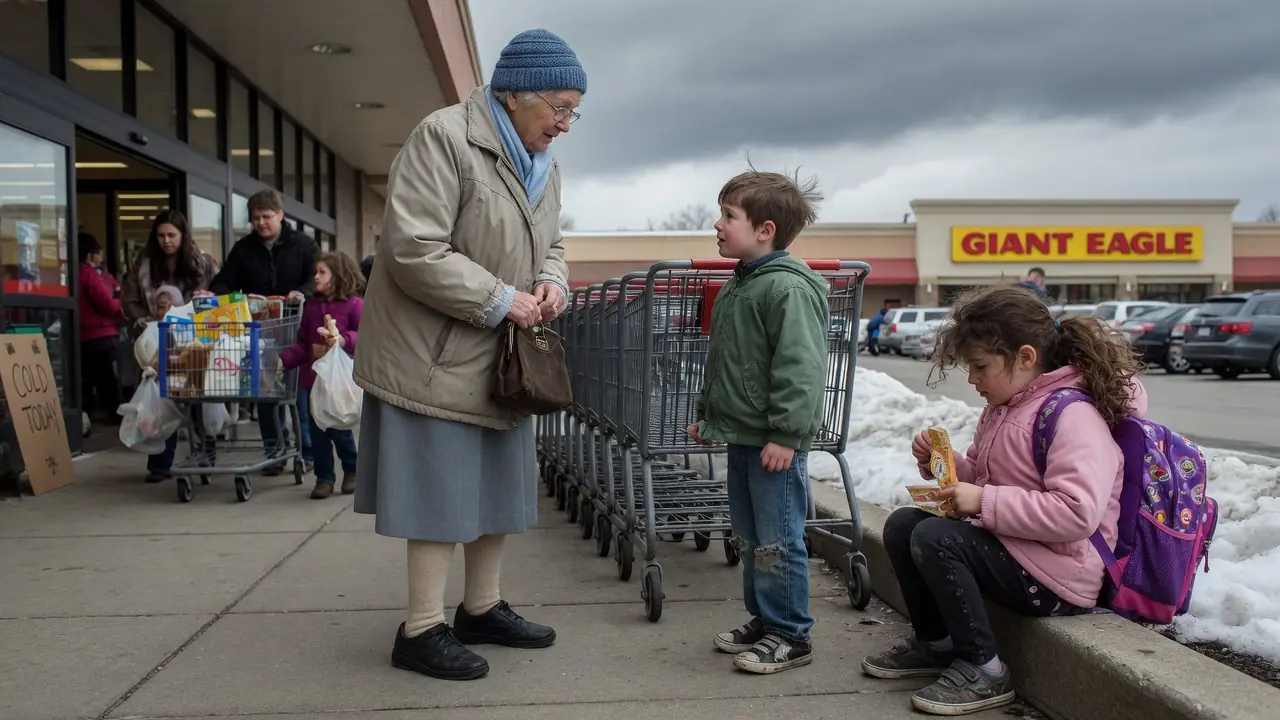
Now she realized quiet had sometimes been loneliness wearing polite clothes.
Owen remained cautious longer than Rosie. He helped with everything: carrying laundry, taking out trash, setting the table, sweeping the porch. One evening, Martha found him washing dishes while standing on a chair.
“You are a guest,” she said.
He kept scrubbing. “Guests leave.”
Martha paused.
Then she picked up a towel and stood beside him. “Family helps.”
He looked at her quickly.
She did not push the word.
But she let it stay in the kitchen.
By spring, Claire had a steady job at a senior care center and enough savings for a small apartment. The day they moved out, Rosie cried so hard Martha nearly begged them to stay. Owen stood on the porch holding a cardboard box.
“I’ll pay you back,” he said again.
Martha smiled. “Still a banker?”
“I mean it.”
“I know you do.”
He hugged her suddenly, tightly, then pulled away as if embarrassed.
“I’ll come visit,” he said.
“You’d better.”
He did.
Every Sunday after church, Claire brought the children to Martha’s house. Sometimes they ate soup. Sometimes pancakes. Sometimes only tea and cookies if money was tight for everyone. Owen grew taller, quieter, and more serious. He became fascinated with cooking, mostly because Martha taught him how cheap ingredients could still become something warm and good.
At twelve, he learned to make biscuits.
At fourteen, he cooked chicken stew without help.
At sixteen, he got a part-time job washing dishes at a neighborhood restaurant and came home smelling like onions and ambition.
“I want to own a place one day,” he told Martha while helping her peel potatoes.
“A restaurant?”
“Maybe. But not fancy. A place where people can eat even if they don’t have much.”
Martha looked at him across the kitchen.
“That sounds like a holy thing,” she said.
He laughed. “It’s just food.”
“No,” Martha said. “It never is.”
Years moved forward.
Owen graduated high school, then attended culinary school on scholarships, part-time jobs, and stubbornness. Rosie became a bright, funny teenager who loved art and called Martha “Grandma Green” as naturally as breathing. Claire remarried years later to a kind mechanic named Thomas, but she never let Martha feel replaced or forgotten.
Owen called often, visited when he could, and brought new recipes for Martha to test.
She always told the truth.
“Too much salt.”
“Not enough butter.”
“This one tastes like you were angry.”
He trusted her completely.
By the time Owen was twenty-seven, he had worked in kitchens in Chicago, Pittsburgh, and Cleveland. He became known for simple food made beautifully, the kind of food that reminded people of home even if they had never had one.
Martha bragged about him to everyone at church.
“My Owen is a chef,” she would say.
No one corrected her.
But Martha’s life was becoming harder.
The house on Hawthorne Street needed repairs she could not afford. The roof leaked near the back bedroom. The furnace failed twice in one winter. Her pension barely covered bills and medication. She began skipping proper meals, telling herself tea and toast were enough.
They were not.
One afternoon, Martha stood in the supermarket with a small basket: oatmeal, bread, soup, tea. The same kind of list she had carried years before. Prices had risen again. She counted the money in her purse and quietly put the tea back.
At the checkout, she was short.
Not by much.
Three dollars and seventeen cents.
The young cashier looked uncomfortable. “I can take something off.”
Martha smiled politely. “Take the soup, dear.”
A voice behind her said, “No. Leave it.”
Martha turned.
Owen stood there in a dark wool coat, tall and broad-shouldered, with the same serious eyes she remembered from the boy outside the store. He placed a card on the counter.
“Owen,” she whispered.
He paid without taking his eyes off the basket.
When they got outside, he looked at her with hurt all over his face.
“Why didn’t you tell me?”
Martha tried to laugh. “It was soup, not a tragedy.”
“You were short on groceries.”
“Only by a little.”
“Grandma Green.”
The name stopped her.
His voice softened. “You gave us your grocery money when you barely had enough for yourself.”
“That was different.”
“How?”
“You were children.”
“And you are family.”
Martha looked away, tears burning her eyes.
Owen took her grocery bag gently. “I came to show you something. But first, we’re going home, and I’m cooking you dinner.”
He made chicken stew in her kitchen that night. The same kind she had once made for him, but richer, deeper, full of herbs and memory. Rosie came too, now a young illustrator. Claire and Thomas arrived with bread. For the first time in months, Martha’s kitchen felt alive again.
After dinner, Owen placed an envelope on the table.
“What is this?” Martha asked.
“A lease agreement.”
She frowned. “For what?”
“My restaurant.”
Martha’s eyes widened. “You got it?”
“I got it.”
Rosie bounced in her chair. “Tell her the name.”
Owen smiled nervously.
He pulled out a folded drawing of a sign.
MARTHA’S TABLE
Beneath it, in smaller letters:
Eat First. Pay When You Can.
Martha stared at it.
“No,” she whispered.
“Yes,” Owen said.
“Owen, you should name it after yourself.”
“I did.”
She looked confused.
He leaned forward. “Everything I know about feeding people started with you. You fed us when your own grocery bag was nearly empty. You gave Mom a place to stand up again. You taught me that food is not just business. It’s dignity.”
Martha pressed a hand to her mouth.
Owen continued, “The restaurant will have a regular menu, but every day there will be meals available for people who can’t pay full price. No shame. No questions at the table. Just food.”
Claire was crying quietly.
Martha looked at the sign again.
“You remembered.”
“I remember everything,” Owen said.
The restaurant opened six months later in a renovated corner building not far from Hawthorne Street. It had wooden tables, bright windows, shelves of donated cookbooks, and a small framed photograph near the entrance: Martha sitting at her kitchen table years earlier, with Owen and Rosie beside her, both children smiling over bowls of soup.
Opening night was full.
Neighbors came. Church friends came. Former teachers came. People from the supermarket came. The cashier who had once watched Martha put back soup came with flowers and cried when she saw the sign.
Martha sat at the best table, wearing a soft lavender dress Rosie had helped her choose.
Owen came out of the kitchen carrying the first bowl of chicken stew.
He placed it in front of Martha.
“For the woman who taught me,” he said.
Martha looked around the restaurant, overwhelmed.
“This is too much.”
“No,” Owen said. “This is lunch.”
She laughed through tears, remembering.
Years passed, and Martha’s Table became more than a restaurant.
It became a place where elderly neighbors ate soup on cold afternoons, where single parents brought children after long shifts, where students worked part-time and learned to cook, where no one was embarrassed for ordering the community meal.
Owen set up a small fund to help seniors with groceries. Rosie painted a mural on one wall showing a long table stretching from a little brick house all the way to the city skyline. Claire managed the front desk on weekends, greeting everyone like family.
And Martha never skipped meals again.
Owen made sure of it.
He repaired her roof. Fixed the furnace. Installed a safer railing on the porch. He did not ask permission for half of it, which annoyed her deeply and pleased her secretly.
On Martha’s eighty-sixth birthday, the restaurant hosted a dinner in her honor. She protested, of course.
“No fuss,” she said.
Everyone ignored her.
At the end of the night, Owen stood with a glass of water in his hand because Martha disliked champagne.
“When I was eleven,” he said, “I stood outside a supermarket with my little sister, hungry and scared, trying to pretend I knew what to do. Martha Green saw us. She had only enough money for her own groceries, but she fed us first.”
The room grew quiet.
“She did not make us feel poor. She did not make my mother feel ashamed. She opened her home, then her kitchen, then her heart. I used to tell her I would pay her back one day.”
Martha shook her head, crying.
Owen smiled. “She always said I didn’t have to. She was right. You can’t pay back love like that. You can only pass it on.”
He raised his glass.
“So every meal served here with dignity is part of her kindness still moving forward.”
Everyone lifted their glasses.
“To Martha.”
Martha covered her face and laughed through her tears.
Later, after the guests left, Owen walked her home. The night was cool, and the repaired porch light glowed softly over the steps.
At the door, Martha paused.
“I thought I was just buying two children lunch,” she said.
Owen smiled. “You bought us time.”
“I didn’t have much.”
“You gave what you had.”
Inside, the house smelled faintly of lilacs and soup. Rosie’s paintings hung on the wall. Claire had left tea on the stove. Owen placed the leftover stew in the refrigerator, just as Martha had once packed food for him.
Martha looked at him, no longer the hungry boy outside the supermarket, but a man who had built a table large enough for others.
“You really did pay me back,” she whispered.
Owen shook his head.
“No, Grandma Green,” he said softly. “I’m still passing it on.”
And long after Martha Green’s steps grew slower, long after her hands trembled too much to peel potatoes, her name remained above the restaurant door.
Martha’s Table.
A place where hungry children ate without shame.
A place where tired parents were treated with respect.
A place where old people were never left alone with empty cupboards.
A place born from thirty-two dollars, two sandwiches, and one old woman who decided that even when she had little, kindness was still something she could afford.