She gave a lost rider shelter in a blizzard. He came back in spring and stayed.
The snow came sideways across the ridge, and Dory Voss knew from the way it moved that it would not stop before morning.
She pulled the shutters tight against the frame and wedged a rag into the gap where the wind always crept through.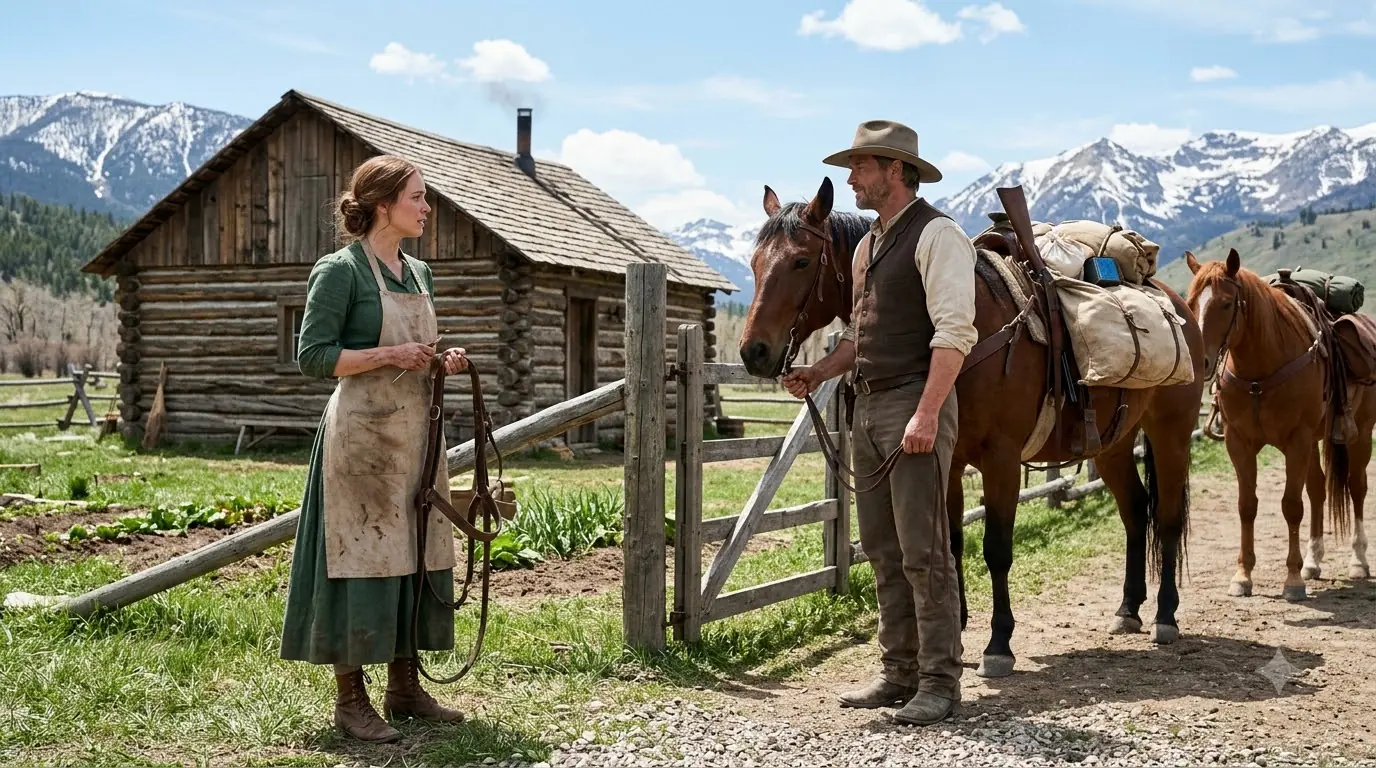
The cabin was small, four walls of chinked pine, a stove that ate wood faster than she could split it, and a loft where she slept beneath every quilt she owned. Outside, the wind screamed like something lost.
She had been alone on the homestead since October, when her father's cough finally carried him off. He had died in the chair beside the stove, and she had buried him behind the barn where the soil was soft enough to dig. The nearest neighbor was eleven miles down the valley, and the snow had already closed the pass twice since November. Dory was twenty-six years old, capable with an axe and a rifle, and frightened in ways she would never have admitted to another living soul.
She was banking the stove when the horse screamed.
It was not a sound she expected, not in a blizzard and not at that hour. She took the lantern from its hook and opened the door against the wind. The cold hit her like a wall of water. Through the swirling white, she saw the shape of a horse standing at the edge of the yard, its head low and its sides heaving.
A man was slumped in the saddle, one hand tangled in the mane and the other hanging limp. Dory set the lantern on the porch rail and waded through the drifts. The horse shied when she reached for the bridle, but it was too exhausted to run. The man did not move when she spoke to him.
She pulled his boot from the stirrup. He slid sideways, and she caught him beneath the arms before he struck the ground. He was heavy, broad through the shoulders, and his coat was crusted with ice. She dragged him across the yard, through the door, and onto the floor beside the stove.
She heated water and pressed warm cloths against his feet and chest. She spoke to him the way she spoke to animals when they were hurt, low and steady, telling him things that did not matter simply to keep the sound going. She told him where he was, that his horse was alive, and that he was not going to die on her floor. Whether he heard her or not, she could not tell.
He woke sometime before dawn. His eyes were gray and confused, and the first thing he said was, "The horse."
Dory told him the horse was in the barn with hay, water, and a blanket. It was true because, after she had gotten the man warm, she had gone back into the blizzard to see to the animal. Lachlan tried to sit up and could not. She told him to lie still.
He looked at her for a long moment, then closed his eyes and obeyed.
The storm lasted three days. During that time, Dory learned that Lachlan Pride was thirty-one, that he had been trading horses since he was seventeen, and that he had no family left except a brother in Montana whom he had not spoken to in four years. He learned that Dory had buried her father two months earlier, that the roof leaked over the loft whenever the snow melted, and that she had forty-three dollars, a milk cow, and not much else to see her through until spring.
He was a quiet man, not given to unnecessary words. Dory appreciated that. He ate what she cooked without complaint and thanked her each time as though the meal were something remarkable. When his strength returned, he fixed the shutter she could not reach and re-chinked the wall behind the stove where the daubing had crumbled.
He did those things without being asked. She let him without protest. Something settled between them that was more comfortable than anything she had known with another person.
In the evenings, they sat on opposite sides of the stove and listened to the wind. Lachlan whittled small things: a spoon, a peg for the coat hook, and a wedge for the wobbly table leg. Dory mended clothing or read from the single book she owned, a battered copy of Pilgrim's Progress that had belonged to her mother.
They did not speak much during those hours, but the silence between them was not the silence of strangers. It was the silence of two people who had each been alone long enough to know the difference between solitude and companionship. Once, near midnight, Lachlan looked up from his whittling and found her watching him. Neither of them said anything.
She returned to her book, and he returned to his knife. The stove ticked and settled. The storm pressed against the walls like something trying to get inside.
On the fourth morning, the sky cleared. The snow lay in great white drifts that buried the fence posts and turned the valley into something unrecognizable. Lachlan stood on the porch and studied it for a long time. Then he went to the barn and saddled his horse.
Dory watched from the doorway. She did not ask him to stay. She had learned long ago that asking for things only made it worse when they were refused.
He led the horse to the porch and stopped. He looked at her with those gray eyes, and she could see that he was working something out behind them, some calculation she was not part of.
"I have business in Laramie," he said. "Horses to deliver."
"I know," she said.
"The pass will be open by now."
"Likely."
He stood there another moment. Then he touched the brim of his hat, mounted, and rode down the valley without looking back.
Dory went inside, closed the door, and sat in her father's chair. She did not cry because crying was a luxury she could not afford. She had known him for four days, and that was not enough time to earn the right to grieve his leaving.
But the cabin felt different after he was gone. The shutter he had fixed no longer rattled, and the wall behind the stove held the heat the way it should. They were small repairs and small kindnesses, but they lingered in the wood and daubing like handprints she could not wash away. She caught herself looking at the chair where he had sat and made herself stop because that way lay a kind of foolishness she could not afford.
Winter ground on. January was brutal, and February was worse. The milk cow went dry, and Dory lived on beans, cornmeal, and the venison she had smoked in the fall. When the thaw came in March, she patched the roof while standing on a ladder her father had built, hammering tin over the leaks as snowmelt ran down her arms.
She split wood until her hands bled and her shoulders ached. Each night, she fell asleep before she could think about being lonely. The homestead demanded every hour she had, and she gave those hours without resentment because the land was the only thing that had never left her.
April came softly. The snow retreated up the ridgelines, and the meadow below the cabin turned green in patches. Dory found wildflowers along the creek, small purple ones whose name she did not know. She picked a handful and placed them in a jar on the table.
For the first time since October, the cabin felt less like a place where someone had died and more like a place where someone was living.
She was mending harness in the barn on a Thursday afternoon when she heard hoofbeats on the valley road. She stepped outside with the awl still in her hand and shaded her eyes against the late sun. A rider was coming up the track, leading two horses behind him. The lead horse was a chestnut mare with a blazed face, and behind it came a sturdy bay gelding with a pack saddle loaded high.
Lachlan Pride reined up at the yard gate. He looked different from how she remembered him, thinner in the face and browner from the sun, but his eyes were the same, gray and steady and working something out.
"I brought you a horse," he said.
Dory looked at the bay gelding. It was a good horse, well-muscled, with calm eyes and clean legs. The pack saddle was loaded with supplies: flour, salt, coffee, sugar, a bolt of calico, and a set of tools wrapped in canvas. She looked at all of it and then looked at him.
"I cannot pay for a horse," she said.
"I did not ask you to pay."
"Then why?"
He dismounted and stood holding the reins. He was taller than she remembered, or perhaps she had become smaller over the winter. He looked at the cabin, the barn, and the fence she had repaired with wire and stubbornness. He looked at the tin patches on the roof.
"You saved my life," he said. "A man does not forget that."
"I gave you a floor to lie on and some warm water. That is not the same as saving a life."
"It is exactly the same."
They stood in the yard looking at each other while the horses shifted and the creek made its steady sound. Dory felt something open in her chest that she had spent the entire winter keeping closed.
"I do not need charity," she said, because it was the only defense she had left.
"It is not charity," Lachlan replied. "It is a man bringing a horse to a woman whose homestead needs one. And, if she will allow him, he would like to stay and help with the fencing. I noticed in January that your south fence was leaning."
"You noticed that during a blizzard?"
"I notice things."
She almost smiled. She felt it pulling at the corners of her mouth and fought it because smiling at him felt like agreeing to something she had not yet decided.
"The south fence is not just leaning," she said. "It is flat."
"Then I had better stay more than a day."
He stayed more than a day. He stayed a week, then two weeks, and soon the weeks stopped being something either of them counted. He rebuilt the south fence with posts he cut from the timber above the meadow. He repaired the barn door that had sagged on its hinges since before her father died.
He re-chinked the entire north wall of the cabin and built a proper shelf for the kitchen, something Dory had wanted for two years. She cooked for him, and he ate. In the evenings, they sat on the porch while the light faded over the valley.
He told her about the places he had been, the towns and trails and high passes. She told him about the homestead, the seasons, and the way the elk came down to the meadow in September. They spoke the way people speak when they have decided to trust each other but have not yet said so aloud.
Dory's neighbor, Frank Muller, rode up in May to check on her, as he did every spring. He found the fences mended, the barn sound, a new horse in the corral, and a man he had never seen sitting on the porch oiling a saddle. Frank looked at Dory. She looked back at him with an expression that did not invite questions.
Frank tipped his hat and left.
In the weeks that followed, Lachlan proved himself as steady as the mountains that ringed the valley. He dug a new root cellar behind the cabin, lining it with flat stones from the creek bed so the walls would hold through the thaw. He cleared the irrigation ditch that fed the kitchen garden, pulling out deadfall and silt until the water ran clear and strong.
Dory planted beans, squash, and a row of sunflowers along the south side of the cabin. Lachlan built a low fence of woven willow to keep deer from the seedlings. They worked from dawn until the light was gone, and the homestead began to look the way her father had always intended it to look: prosperous, tended, and alive.
The talk started in town, as talk always does. A woman alone on a homestead with a man who was neither her husband nor her kin gave people something to discuss. The postmaster mentioned it to the minister's wife, who mentioned it to the women's auxiliary, who discussed it over tea and cake with the gravity of a court proceeding.
None of them had met Dory more than twice. None of them had ridden eleven miles to learn whether she was alive during the winter. They had opinions nonetheless.
Dory heard about the talk when she went to town for supplies in June. Mrs. Pemberton at the general store said nothing directly, but said everything with her eyebrows and silence. The minister's wife, Mrs. Alcott, was more forthcoming.
"A woman in your position must be careful of her reputation," Mrs. Alcott said, folding her hands the way she did when she was about to say something she believed was charitable.
"My position?" Dory asked.
"Alone, unprotected, with a man of uncertain character on your property."
"His character is not uncertain. He is a horse trader from Casper, and he is helping me repair my homestead, which no one in this town offered to do after my father died."
Mrs. Alcott's mouth thinned. "I am only thinking of your welfare."
"Then you might have thought of it in December, when I was snowed in with forty-three dollars and a dry cow."
Dory bought her supplies, rode home, and said nothing to Lachlan about the conversation. That night, however, she sat on the porch longer than usual. When he asked whether something was wrong, she told him everything: the eyebrows, the silence, and Mrs. Alcott's charitable concern.
When she finished, Lachlan remained quiet for a long time.
"Do you want me to leave?" he asked.
"No."
"Then I will not leave."
"The talk will not stop."
"I do not care about talk."
"I do not care about it, either," Dory said, and realized as she said it that it was true.
She had spent twenty-six years caring what people thought, and it had brought her nothing but loneliness. The man sitting beside her on the porch had come back. That was the only thing that mattered.
In July, Lachlan rode to Casper and returned with a wagonload of lumber and a question. He asked her on the porch at sunset, without ceremony, without kneeling, and without any of the theater she had read about in novels. He simply said that he would like to build another room onto the cabin, stay permanently, and marry her.
Dory looked at the valley, the light on the mountains, and the man who had returned.
"Yes," she said.
They were married by a circuit judge in August, with Frank Muller and his wife as witnesses. Lachlan built the room he had promised, a proper bedroom with an east-facing window so the morning light could enter. He built a writing desk for Dory because she had once mentioned that she used to keep a journal.
He also built a crib. Neither of them spoke about why. He set it in the corner of the new room, where the afternoon light fell across it.
The homestead grew beneath both their hands. Lachlan brought in more horses, good stock that he bred, trained, and sold to ranchers across the territory. Dory kept the garden, the house, and the books. She learned to shoe horses because Lachlan said she had steadier hands than he did, which might or might not have been true, but pleased her regardless.
Winter came again. When the blizzard howled across the ridge, Dory banked the stove, pulled the shutters tight, and went to bed beside a man who was warm, solid, and present. The cabin was still small, still drafty in the corners, and still hungry for firewood.
But it was no longer a place where someone was enduring. It was a place where someone was home.
She had given shelter to a stranger in a storm, and the stranger had become the life she had not known she was waiting for.