The first thing Nora Brennan reached for on her wedding night was not her new husband’s hand.
It was the kitchen knife hidden beneath her pillow.
Her fingers closed around the cloth-wrapped handle as Eli’s boots crossed the cabin floor outside the bedroom. The Wyoming wind pressed against the walls in long, angry breaths, making the small window tremble in its frame. Every sound seemed larger in the lonely ranch house—the hiss of the oil lamp, the scrape of leather tack outside, and the slow movement of something heavy across the hallway boards.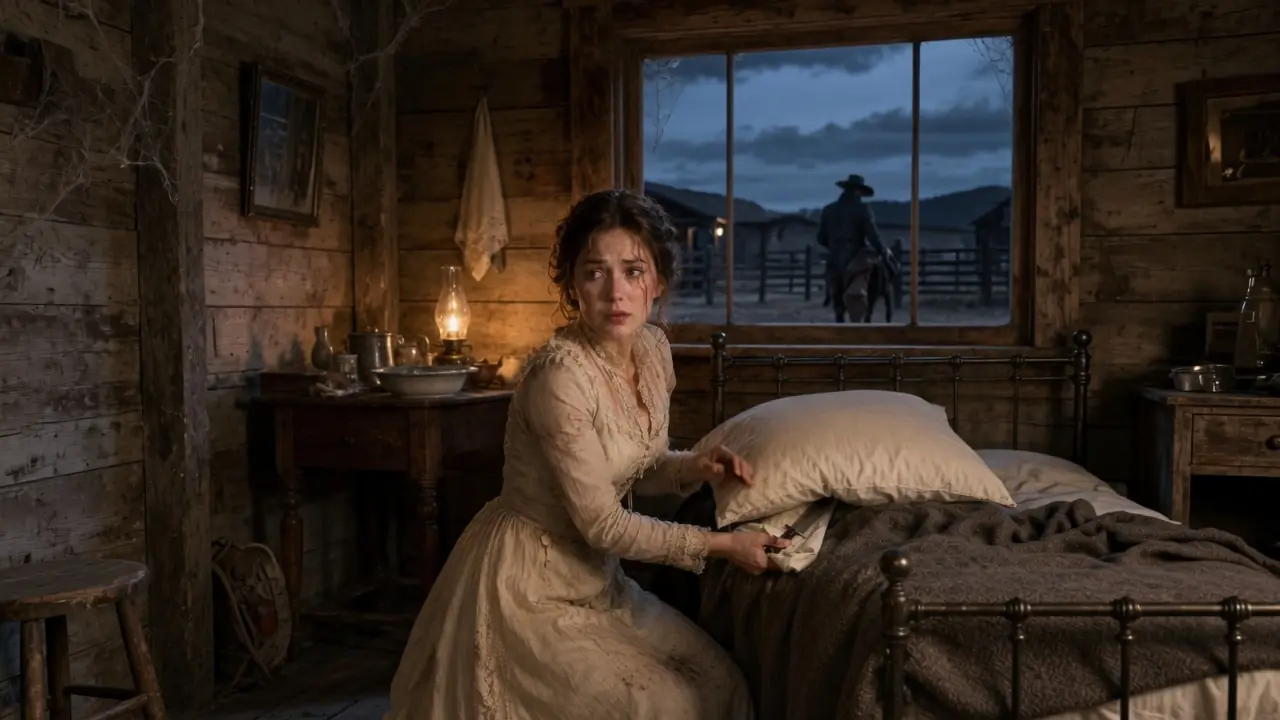
Nora sat upright on the edge of the iron bed.
Her dusty wedding dress pulled tightly across her ribs, where the dressmaker in St. Louis had laced it too firmly and laughed when Nora asked her to loosen it. One pearl button was missing from the bodice, and coal soot darkened the hem from the train journey west. Her hair had fallen from its pins, leaving damp brown curls against her cheeks.
The chair scraped again.
Then it stopped directly outside the bedroom door.
Nora’s heart struck painfully against her chest. She imagined Eli wedging the chair beneath the handle so she could not escape after he entered through the window, or perhaps so no one could hear her if she cried out. Fear did not need logic when it had been fed for years.
The door remained closed.
“Mrs. Brennan,” Eli said from the hallway, his voice low and careful. “That chair isn’t there for the reason you think.”
Nora tightened her grip around the knife.
“Why did you wedge that chair against my door?”
There was a pause long enough for her to imagine him choosing a lie.
“Because the man you escaped followed your train,” Eli answered. “And I won’t let him reach you.”
Nora stopped breathing.
Eli continued before she could respond.
“I saw him near the feed store after the wedding. Dark coat, gray horse, scar along his jaw. He asked the stable boy which road we took.”
Gideon Price.
Even hearing his description made Nora’s body remember the pressure of his fingers around her wrist and the sweet, oily tone he used when speaking about their future. Her aunt had called him respectable because he owned two warehouses and attended church every Sunday. Nora knew better.
Gideon smiled most brightly when someone weaker was frightened.
“How do you know I escaped him?” Nora asked.
“I don’t know much,” Eli said. “Only that you watched every door in the justice’s office, and that you flinched when the clerk mentioned St. Louis.”
“That proves nothing.”
“No.”
“Then why are you sleeping outside my room?”
“Because if I’m wrong, I lose a night’s rest. If I’m right, you stay alive.”
The simple answer frightened her more than anger would have.
Cruel men always explained their cruelty as sacrifice. Gideon said he frightened her because he cared enough to correct her. Her aunt said insults would prepare Nora for marriage. Every wound had arrived wrapped inside the language of protection.
Nora slid from the bed without releasing the knife.
She crossed the room and opened the door two inches.
Eli sat on the hallway floor with his back against the wall. A folded blanket rested beneath him, and his revolver lay several feet away where he could reach it but not quickly. The chair had been wedged beneath the outside handle so anyone in the main room would need to move it before entering.
He had not trapped Nora inside.
He had created a warning.
A second chair blocked the front door.
Eli looked toward the small opening but did not rise.
“You can lock the bedroom from inside,” he said. “The chair will make noise if someone tries the handle.”
Nora stared at the revolver.
“Why is your gun on the floor?”
“So you can see my hands.”
His palms rested open on his knees.
Nora had known him for less than a day. Their correspondence had lasted four months, and every letter had been shorter than she expected. Eli wrote about cattle prices, the leaking barn roof, and how the cottonwoods bent during spring storms. He never asked for her measurements or whether she could produce sons.
His marriage advertisement had been equally plain.
Wyoming rancher, thirty-six, widowed, seeking practical woman willing to build an honest home. No promises of wealth. No demand for beauty. Separate room available. Respect expected from both.
Nora answered because the words separate room available seemed almost impossible.
She had not told him about Gideon.
She had not told him about her aunt’s plan to marry her to a man she feared.
She had written only that remaining in Missouri had become unsafe.
Now Eli sat outside her bedroom on their wedding night, protecting a secret she had not trusted him enough to explain.
Nora lowered the knife slightly.
“Please let tonight be different.”
The words escaped before she could stop them.
Eli’s face changed.
Pain moved across it—not insult, not anger, but recognition.
“It will be different,” he said. “No man enters this room unless you invite him.”
She looked at him for another moment, then closed the door and turned the lock.
Nora did not sleep.
She remained beside the bed, listening to Eli breathe on the other side of the wall. Twice, horses shifted in the corral. Once, something brushed the cabin roof, likely a branch carried by the wind. Each time, Eli rose quietly, checked the windows, and returned to the hallway.
Near midnight, a rider passed along the distant ridge.
The rhythm of hoofbeats reached the cabin and then disappeared.
Eli did not knock on her door.
At dawn, Nora woke sitting against the wall with the knife still in her hand.
The oil lamp had burned out, leaving pale light across the floorboards. She unlocked the door carefully. Eli remained asleep against the hallway wall, his head tilted to one side and the blanket gathered around his shoulders.
The revolver still lay untouched.
Nora stepped over him and entered the kitchen.
She prepared coffee because she did not know what else to do with gratitude. The stove smoked before the flame caught, and she burned the first piece of bacon. When Eli entered, stiff from sleeping on the floor, he acted as though finding his new wife holding a knife beside a ruined breakfast was entirely ordinary.
“You should sit,” Nora said.
“So should you.”
“I slept.”
He looked toward the dark circles beneath her eyes but did not challenge the lie.
They ate quietly at the rough wooden table. Eli did not ask about Gideon until Nora set down her cup and began speaking on her own. She told him about her mother’s death, her father’s debts, and the aunt who took her in at fourteen.
Aunt Beatrice provided food, clothing, and education, then reminded Nora of the expense each time she wanted obedience.
At twenty-six, Nora began working in Beatrice’s dress shop. That was where Gideon Price first saw her. He ordered shirts he did not need, invented excuses to return, and treated Nora’s refusal as flirtation.
When he proposed, Beatrice accepted before Nora answered.
Gideon’s behavior changed immediately. His hand remained too long at the back of her neck. He began choosing her dresses, reading her letters, and warning male customers not to speak with her. Once, when she objected, he pressed her against a storeroom wall and whispered that marriage would cure her stubbornness.
Nora escaped six days before the wedding.
She carried thirty-two dollars, one satchel, and Eli’s letters.
“I thought Wyoming was far enough,” she said.
Eli looked toward the window.
“It may not be.”
Nora’s stomach tightened.
“You regret marrying me.”
“No.”
“You married a woman with a dangerous man following her.”
“I married a woman who warned me Missouri was unsafe.”
“I did not tell you why.”
“You told me what you could.”
His acceptance made her angry because anger felt safer than relief.
“You should demand the whole truth.”
“I’m listening now.”
“And if I had never told you?”
“Then I would have guarded the door without knowing his name.”
Nora stood and carried the plates to the basin. Her hands shook as she poured water. Eli did not come closer.
“What happens now?” she asked.
“We speak to Sheriff Coleman.”
“No.”
Eli remained seated.
“Gideon knows respected people,” Nora continued. “He will say I stole from my aunt or broke a legal promise. Men like him make lies sound reasonable.”
“Did you steal anything?”
“No.”
“Did you sign a marriage contract?”
“No.”
“Then you’re a grown woman who left Missouri by choice.”
“He will not describe it that way.”
“Then we describe it first.”
Nora turned toward him.
She had spent years surrounded by people who used certainty as a weapon. Eli’s certainty felt different. It did not erase her fear or tell her she was foolish. It simply stood beside the facts.
Sheriff Amos Coleman arrived before noon after Eli sent a ranch hand into town.
He was a heavyset man with a white beard and tired eyes. Nora expected him to question why a respectable merchant would travel so far without reason. Instead, he listened without interrupting and wrote down every detail.
“Price hasn’t broken Wyoming law yet,” Coleman said, “but he has no claim over you.”
Nora looked at him. “What if he says I belong to him?”
The sheriff’s expression hardened.
“People are not livestock.”
Eli leaned against the wall behind Nora, close enough to support her but far enough that she did not feel surrounded. Coleman promised to warn the stage station, feed store, and nearby ranches. If Gideon appeared, the sheriff would question him.
Nora wanted to believe that would be enough.
It was not.
Three days passed without trouble.
Eli slept in the loft above the barn, though Nora told him the hallway floor was no longer necessary. He never entered the bedroom, and he knocked before walking into any room where she stood alone.
That courtesy made the cabin feel larger.
During the day, Nora learned the ranch routines. She fed chickens, repaired torn shirts, and discovered that Eli’s bread could bend nails. He showed her how to close the stove damper and where to find water if the pump froze.
Their conversations remained small.
Small things became trust.
Eli asked before touching her elbow when she slipped near the corral. Nora asked before moving the photograph of his late wife from the mantel. He explained that Sarah Brennan had died during a fever outbreak four years earlier.
“I loved her,” he said.
Nora waited for comparison.
None came.
One evening, she found Eli repairing a broken rocking chair on the porch.
“Was it hers?” Nora asked.
“My mother’s.”
“You kept it all this time?”
“I keep things longer than I should.”
His eyes moved toward the closed bedroom window.
Nora understood he was not speaking only about furniture.
“Why did you advertise for a wife?”
Eli sanded the wooden arm before answering.
“The ranch needs more than one person.”
“That is practical.”
“I said I was practical.”
“Nothing else?”
He looked up.
“I was tired of hearing only my own footsteps.”
Nora’s chest tightened unexpectedly.
“Did you expect love?”
“No.”
The answer hurt, though she had no right to feel wounded.
Eli noticed.
“I expected honesty,” he added. “I hoped love might come later if it wished.”
Nora looked toward the mountains.
“What if it doesn’t?”
“Then there are worse things than sharing a decent life with someone you respect.”
She thought of Gideon describing love as ownership.
Eli described it as a guest who could not be forced through the door.
The rider returned that night.
Nora woke to the sound of a horse near the corral. She reached beneath the pillow but found only the empty handkerchief. Two days earlier, she had returned the kitchen knife to the drawer.
For one terrible moment, she regretted it.
Then Eli’s voice came through the wall.
“Nora, stay inside.”
A fist struck the front door.
“Nora Whitfield!” Gideon shouted. “Open this door!”
Her old name filled the cabin like smoke.
Eli stepped into the main room with the revolver lowered beside his leg. He had already lit the lamp, and its flame cast a pale circle across the doorway.
Gideon struck the wood again.
“I know you’re in there. Your aunt is ill from what you’ve done.”
Nora stood behind the bedroom door, unable to move.
Gideon’s voice softened.
“She forgives you. I forgive you. Come home before this becomes embarrassing.”
The same tone.
The bait before the trap.
Eli did not answer him.
Gideon laughed.
“You think that farmer wants you? He bought a desperate woman because no decent bride would come this far.”
Nora closed her eyes.
The words found every wound Gideon had helped create.
Eli finally spoke.
“She isn’t property, Price.”
“You know my name.”
“I know enough.”
“I have papers proving she was promised to me.”
“Show them to the sheriff.”
“I’m speaking to my future wife.”
“You’re speaking to mine.”
The statement should have frightened Nora.
Instead, Eli stepped away from the bedroom door, leaving the path open behind him.
He was not claiming her.
He was naming the promise he had made.
Gideon kicked the front door.
The chair shifted loudly beneath the handle but held.
Eli glanced toward Nora’s room.
“Back window,” he said calmly. “If he enters, you can leave.”
Nora realized he had positioned himself between Gideon and the bedroom while preserving her escape route. He expected to defend her, not command her to stay.
The front window shattered.
Gideon’s arm reached through the broken glass toward the latch. Eli crossed the room and struck his wrist with the revolver’s wooden grip. Gideon cursed and withdrew.
A shot cracked outside.
The bullet entered the ceiling above the table.
Nora screamed.
Eli dropped behind the stove, then fired once through the lower door panel. The shot struck the ground outside, forcing Gideon away from the porch without hitting him.
Hoofbeats sounded from the road.
Sheriff Coleman had posted a deputy nearby after learning Gideon purchased ammunition in town. The deputy arrived with two ranchers just as Gideon tried to mount his horse.
He was captured before reaching the gate.
Nora remained frozen inside the bedroom until Eli called her name.
“Are you hurt?”
“No.”
“Coleman has him.”
She opened the door.
Eli stood beside the broken window with blood running from a cut across his cheek. The wound was small, caused by flying glass, but seeing it made Nora cross the room before fear could stop her.
She pressed a clean cloth against his face.
“You could have been killed.”
“So could you.”
“You should have let me leave through the window.”
“You had the choice.”
Nora stared at him.
“You would have let me go?”
“I would rather lose you than keep you by force.”
That answer broke something inside her.
Not violently.
Quietly, like ice releasing a river.
Gideon carried forged papers claiming Nora had stolen jewelry and money from her aunt. A search of his saddlebags revealed letters from Beatrice admitting Nora had taken nothing but begging Gideon to retrieve her before neighbors learned the truth about the failed wedding.
The sheriff charged Gideon with attempted kidnapping, assault, destruction of property, and firing into an occupied home.
He was sent east for trial.
Aunt Beatrice never came west. She wrote Nora one letter demanding gratitude for the years of shelter she had provided. Nora burned it without replying.
The cabin took several days to repair.
Eli replaced the broken window and patched the bullet hole in the ceiling. Nora sanded the damaged front door while he shaped a new panel.
At night, Eli returned to the barn loft.
One evening, Nora stood at the foot of the ladder.
“You can sleep in the house.”
He looked down.
“Where?”
“The bedroom.”
Eli remained still.
Nora’s face grew hot.
“You do not have to touch me.”
“I know.”
“You can sleep on the other side.”
“If you change your mind, I’ll leave.”
She nodded.
That night, they lay beneath the same wool blanket with several inches between them. The distance felt enormous and strangely intimate. Eli faced the ceiling while Nora watched his profile in the fading lamplight.
“Are you awake?” she whispered.
“Yes.”
“Why aren’t you looking at me?”
“Because you didn’t ask me to.”
Nora reached across the space and placed her hand beside his.
Not on it.
Beside it.
Eli did not move.
After several minutes, Nora turned her palm upward.
He placed two fingers gently across hers.
That was all.
It was more tenderness than she had known in years.
Winter tightened around the ranch.
Snow covered the pasture fences, and mornings began with frozen water troughs and smoke rising straight into the white sky. Nora grew stronger beneath the steady demands of ranch life.
She also grew less afraid.
Not quickly.
Healing did not move in a straight line.
Some nights, a dropped pan sent her running for the knife drawer. Sometimes Eli entered too quietly, and she flinched before recognizing him. He never acted wounded by her fear.
“It remembers before you do,” he once said.
“What does?”
“Your body.”
Nora looked at him with surprise.
“Who taught you that?”
“Sarah was afraid of doctors after losing a child before we met.”
He spoke carefully, protecting the privacy of a woman who could no longer ask for it.
Nora understood then that Eli’s patience had not appeared from nowhere. It had been learned through grief, failure, and the knowledge that love did not erase fear by demanding it disappear.
Spring arrived late.
The first green shoots pushed through the thawing ground, and calves stumbled beside their mothers in the north pasture. Nora planted onions near the cabin and hung clean curtains over the repaired window.
One morning, she found Eli placing the heavy hallway chair inside the storage shed.
She touched the worn backrest.
“You’re putting it away?”
“The door doesn’t need guarding now.”
Nora looked toward the cabin.
“Maybe we should keep it.”
“For what?”
“To remember.”
Eli waited.
“Not Gideon,” she said. “The choice.”
“What choice?”
“You sat outside the door instead of entering.”
He lowered his eyes.
“I was afraid you would hate me.”
“I was afraid you would hurt me.”
“Both fears were wrong.”
“Not entirely.”
She stepped closer.
“The fear was real. We simply did not let it decide what happened next.”
Eli looked at her.
Nora had once believed love would arrive as a grand feeling that erased everything before it. What grew between them was quieter.
It appeared when Eli warmed her boots before dawn.
It appeared when Nora left coffee beside his tools.
It appeared when he asked permission before touching her and when she began answering yes without forcing herself.
On the first anniversary of their wedding, Eli repaired his mother’s rocking chair and placed it on the porch.
Nora brought out two cups of coffee.
They watched the sunset spread across the Wyoming plains, turning the distant mountains purple.
“Do you regret answering my advertisement?” Eli asked.
Nora considered the question.
“I regret needing to run.”
“That isn’t what I asked.”
“No.”
She looked at him.
“I don’t regret where I stopped.”
Eli smiled.
It was not Gideon’s confident smile or Beatrice’s thin approval.
It asked for nothing.
Nora leaned toward him and rested her head against his shoulder.
The kitchen knife remained in its drawer.
She knew where it was.
Knowing no longer meant she needed to reach for it.
The first night in Wyoming, Nora had whispered, “Please let tonight be different.”
A year later, she understood that one night had not changed because danger disappeared.
It changed because a man stood outside her door and proved that protection did not require possession.
Eli did not save Nora by making choices for her.
He saved the space in which she could begin making them for herself.
And in that space, slowly and without force, love finally entered.