The buffalo calf cost two dollars at the Comanche County dispersal sale on a Wednesday morning in May of 1932.
The reason he cost two dollars was simple.
Nobody standing around that pen expected him to live until Sunday.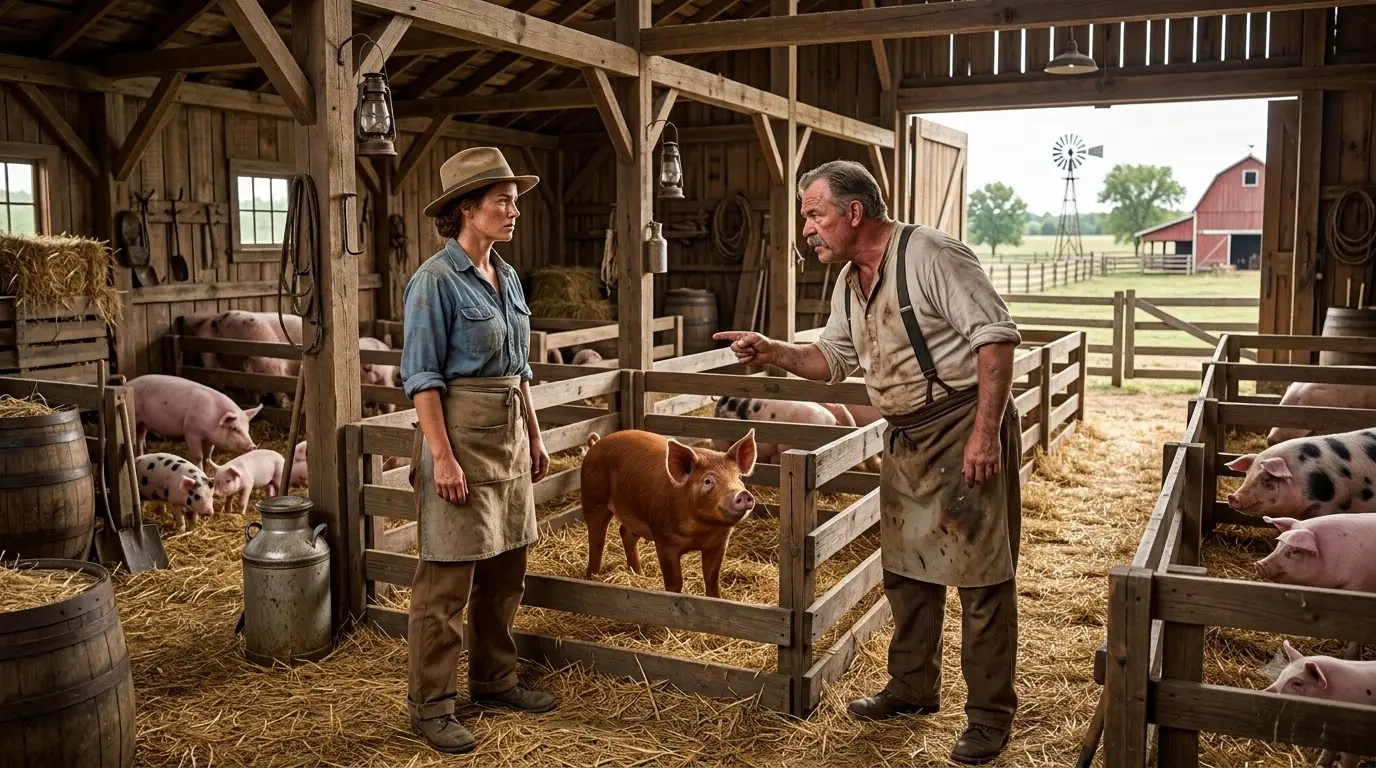
Not the auctioneer.
Not the ranch hands.
Not the cattle buyers leaning against the rails with their thumbs hooked into their suspenders.
Not Hollis Vance from the feed store, who later swore he had nearly bid a dollar for the hide alone but decided even that would have been foolish.
Nobody except Delphine Aldridge looked at the calf and saw a question worth answering.
She had not come to Coldwater to buy an animal.
She had come for fence wire and a used harness.
By ten in the morning she had already walked away from both.
The wire had gone higher than she could justify.
The harness had a split trace and dry rot around one buckle that the seller had somehow forgotten to mention.
Delphine had eleven dollars in the household account.
Not eleven dollars available for whatever caught her interest.
Eleven dollars total.
Eleven dollars between the farm and the next wheat payment.
Eleven dollars between her kitchen table and whatever went wrong next.
So when the harness reached four dollars, she stopped bidding.
When the wire went to six, she stepped away.
She told herself that walking home empty-handed was better than walking home broke.
Then she reached the last pen.
Nobody was standing near it.
That was the first thing she noticed.
At a farm auction, people gathered around anything they thought might be worth money.
Good horses drew men.
Good cattle drew more.
Machinery drew everyone, whether they needed it or not.
But the small pen beside the loading chute had been left almost entirely alone.
Inside stood a reddish-brown calf.
He was small, too small.
His legs were planted wide beneath him as though he needed all four corners of the earth to keep himself upright.
His ribs showed.
His coat had the faded, dull look of an animal that had not been properly fed for weeks.
A rounded hump already rose slightly over the shoulders.
The head was broad in a way no Hereford calf’s head should have been.
Delphine stopped.
She knew what he was before she asked.
“What is it?”
The auctioneer glanced over.
“Buffalo.”
He said it like the word itself was an inconvenience.
“Coldwater ranch herd. Rest went to a zoo outfit in Wichita.”
Delphine stepped closer to the rail.
“What happened to him?”
“Dam died calving.”
“How long ago?”
“Three weeks. Maybe a little better.”
“He’s been bottle-fed?”
The auctioneer laughed.
“If you call it that.”
A ranch hand standing nearby spat into the dirt.
“We had fifty head of cattle to sort and trucks to load. That thing took a bottle when somebody remembered.”
Delphine looked at the calf.
The calf looked back.
Dark eyes.
Alert.
Not bright exactly.
But present.
That mattered.
“How’s his stool?”
The ranch hand frowned.
“What?”
“Is he scouring?”
“Was.”
“Still?”
“Don’t know.”
“Temperature?”
“No idea.”
“Cough?”
“A little.”
The auctioneer waved one hand.
“Lady, if you want him, give me two dollars and make him your problem.”
A few men nearby laughed.
Delphine did not.
She watched the calf breathe.
There was a rasp.
Not deep enough to sound like he was drowning.
But enough to tell her he had been fighting something.
He shifted his weight.
For a moment she thought he might fall.
He did not.
The calf caught himself.
Held.
Then continued looking at her.
Delphine knew that look.
She had seen it in calves after winter storms.
Seen it in old horses after colic.
Seen it in her father three days before he died.
Not strength.
Not surrender either.
The narrow space between them.
She raised her hand.
The auctioneer stared.
“Two?”
“Yes.”
“You understand I’m not guaranteeing tomorrow.”
“I understand.”
“No refund if he dies in your barn.”
“I understand.”
Hollis Vance had wandered close enough to hear.
He laughed.
“Delphine, you came for wire.”
“I know.”
“That calf will eat the wire money before he’s buried.”
“Then it’s a good thing I didn’t buy the wire.”
The auctioneer shook his head.
“Sold. Two dollars.”
No competing bid.
No second call.
No ceremony.
A dying buffalo calf changed ownership for less money than some men at the sale had spent on lunch.
Delphine paid in cash.
Two silver dollars.
The clerk wrote the receipt.
LOT 47. BISON CALF. $2.00.
Delphine folded the paper into her pocket.
She would keep that receipt for the rest of her life.
At twenty-six, Delphine Aldridge had already learned how quickly a life could narrow.
Three years earlier, she had still believed the farm belonged to her father in every meaningful way.
Thomas Aldridge knew every boundary stone.
Every low place where rain pooled.
Every stretch of wheat that came in thin after a dry winter.
He could walk across one hundred sixty acres and tell you which soil had been turned too wet ten years earlier.
He could tell rain by smell.
He could tell a cow was sick before the cow understood it.
He had also spent fifteen years ignoring warnings from his own heart.
Chest pressure.
Short breath.
Pain down one arm.
He called it indigestion.
Then nerves.
Then age.
In October 1930, he fell beside the machine shed while carrying a bucket.
Delphine found him.
He was alive long enough to complain that she had left the gate open.
Then he died before the doctor reached the farm.
Her older brother, Samuel, stayed through harvest.
By Christmas, he had accepted shop work in Wichita.
“I can send money,” he told her.
Delphine hated him for leaving.
Then hated herself for hating him.
The farm could barely support one person.
The factory paid cash every week.
Samuel sent what he could.
It was not much.
But it was honest money.
So Delphine stayed.
One hundred sixty acres.
Eleven Herefords.
Two horses.
A milk cow.
An aging truck.
A wheat crop that had disappointed everyone two years running.
And a mortgage that did not care whether she was a woman, whether her father had died, or whether rain came.
The dry years had changed southern Kansas.
Grass went gray earlier.
Creeks shrank.
Topsoil loosened.
Farmers talked differently at the feed store.
Less joking.
More numbers.
More men staring at the floor before admitting they needed another month.
The Depression was not something Delphine understood through newspapers.
She understood it through empty houses.
Auction notices.
Neighbors leaving before dawn because they did not want anyone watching the truck.
She understood it through the eleven dollars in her account.
That was why buying a buffalo calf made no financial sense.
That was also why she did it.
For three months, she had been reading everything she could find about bison.
It started with a county extension bulletin.
The bulletin itself was only six pages.
Mostly pasture rotation, poultry disease, drought preparation.
On the last page was a short notice about the American Bison Society and continuing efforts to rebuild private and public herds.
Delphine read it twice.
Then requested more information.
The reply from Manhattan took almost a month.
A packet arrived with old reports, population estimates, management notes, and a letter from an extension clerk who sounded faintly amused that a wheat farmer in Comanche County wanted information on buffalo.
Delphine read every page.
The story bothered her.
Bison had once covered the plains in numbers difficult to imagine.
Then by the late nineteenth century they had been reduced to a fraction of that.
Small private herds, protected groups, park herds, and government efforts had slowly pulled the species back from the edge.
But the recovery remained uneven.
Many herds were isolated.
Some shared too much blood.
Others existed because a few stubborn owners had kept animals that made little commercial sense.
That part interested Delphine.
Animals with almost no conventional market.
Poor fit for ordinary cattle systems.
Still valuable.
Just not in the usual way.
Her father had once told her something when she was sixteen and wanted to throw away a strange-looking runt pig.
“The unusual thing is either worthless or worth everything.”
Delphine had laughed.
“That doesn’t help.”
“It’s not supposed to.”
“How do I know which?”
“You look longer than everybody else.”
The buffalo calf stood in the sale pen almost ten years later.
Delphine looked longer.
Loading him took four people.
Not because he fought.
Because he barely could.
They spread straw in the truck bed.
Two men lifted under his chest and hindquarters.
Delphine climbed in beside him.
The auctioneer called:
“You riding back there?”
“Yes.”
“You know he’s not a dog.”
“I know.”
The calf tried to stand.
His legs slipped.
Delphine put one hand against his shoulder.
“Easy.”
He stayed upright.
The drive home took nearly an hour.
Delphine kept one hand on him through every turn.
The sun was already high.
Dust followed the truck.
The calf breathed hard.
At one point he lowered his head against her knee.
Delphine did not move it.
When they reached the farm, she backed toward the barn.
Twenty minutes later, Hollis Vance drove past.
He slowed.
Saw the animal.
Stopped completely.
“Is that what I think it is?”