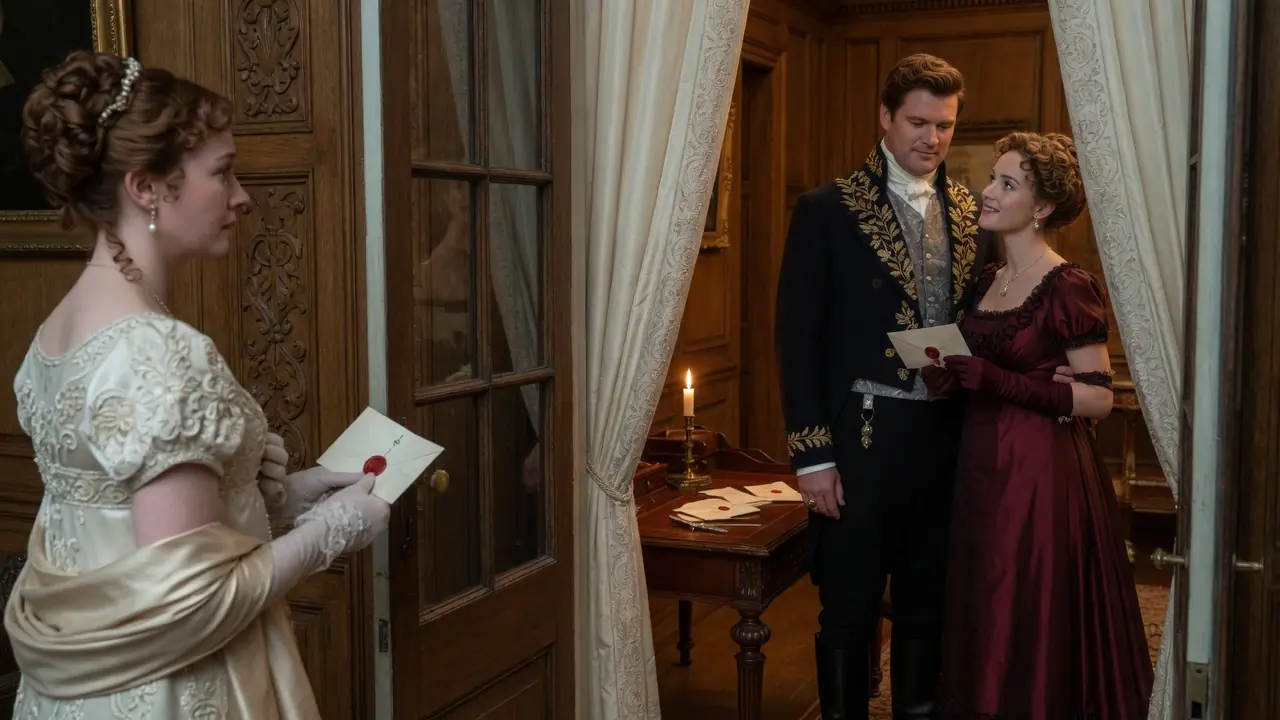
The candle on the writing desk burned low as the Duke pressed a folded note into his mistress's gloved hand. He glanced toward the corridor before he spoke, his voice dropping to barely a whisper.
"Tell no one you came here tonight," he said. "If my wife asks, you were never in this house."
His mistress tucked the note into her sleeve and smiled, the kind of smile that knew secrets were currency. She turned to leave through the servants' passage, the one built for exactly this purpose, hidden affairs slipping unseen through the walls of a respectable home.
But the Duke was not finished. He caught her wrist gently and pulled her back for one final word, the one that would undo everything.
"She'll forgive me," he murmured. "She always does."
Neither of them noticed the door to the adjoining study standing open just a crack. Neither of them noticed the Duchess standing perfectly still on the other side of it, a letter for her husband still clutched in her hand, a letter she had walked across the house to deliver herself.
She did not gasp. She did not drop the letter. She simply turned, smoothed her skirts, and walked away before either of them could see her face.
The Duchess's name was Margaret Thorncombe, and for nine years, she had run her husband's house with a steadiness that never once cracked in front of the servants. She walked from the study that night with her spine straight and her face calm, but her hands shook the whole way to her bedchamber.
She did not call for her maid. She did not weep into a pillow. She sat by the window and stared at the dark garden below, turning over the words she had just heard until they stopped sounding like words and started sounding like a wound.
Her husband, Duke Reuben Thorncombe, ruled over Ashvale Hall, a house that had stood for three generations and had never once been touched by scandal until now. He was a tall man with a square jaw and tired eyes, the kind of man people called dependable because he showed up to church on time and signed every paper his stewards placed before him.
But dependable men can still be careless, and careless men can still believe their wives will forgive anything if they wait long enough and apologize with enough flowers.
He found her at breakfast the next morning, sitting at the long table with a cup of tea she had not touched. The steam was long gone, the cup untouched and cooling. He smiled at her the way he always did, as if nothing in the world had shifted, and asked about her plans for the day.
She answered him plainly, told him she intended to visit her sister in the village, and watched his shoulders relax as though her calm tone meant safety.
He buttered his toast and spoke briefly of the weather, of a letter from a neighboring lord, of nothing that mattered at all, and she answered each comment with just enough warmth to keep his guard lowered.
He did not know yet that she had seen everything.
His mistress, a woman named Wilhelmina Crane, had been part of his life for nearly a year, tucked away in a small cottage two miles from the estate, paid for with money drawn from accounts the Duke believed his wife never checked.
Wilhelmina was clever in a way that made people underestimate her. Soft-spoken in public and sharp-tongued in private, she had grown comfortable believing that the Duke's wife was a woman too proud or too tired to ever cause trouble.
Margaret rode to the village that morning, but she did not go to her sister's house first. She went instead to the small office of her late father's solicitor, a thin man named Bartholomew Quince, who had handled her family's affairs since before her marriage.
She asked him quietly to review every account tied to her husband's name, every ledger, every payment, every property she did not already know about. Quince raised his eyebrows but did not argue. He had served her father long enough to know that when a Thorncombe woman asked a quiet question, the answer mattered more than anyone realized.
While Margaret sat across from her solicitor with her gloved hands folded in her lap, the Duke returned to his study and wrote a letter to Wilhelmina, telling her that the danger had passed, that his wife suspected nothing, that they could continue exactly as before.
He sealed it with his own ring and handed it to a footman he trusted, a young man named Cassius Bramwell, who had served the household for three years and who, unknown to the Duke, had grown fond of the Duchess in the quiet way servants grow fond of masters who treat them with kindness.
Cassius delivered the letter, but on his way back to the house, he paused at the edge of the garden and thought of the Duchess's face that morning. Calm on the surface, but tight around the eyes. He did not know what she knew. He only knew something in the house had shifted, and shifts like that rarely stayed quiet for long.
By the time Margaret returned from the village that afternoon, she had already begun to understand the shape of what she would need to do. She did not go to her sister's house at all in the end, choosing instead to spend the extra hours with Quince, walking through every ledger twice, making certain her memory would not fail her later if she needed to recall a date or a sum without the papers in front of her.
She wanted no gaps in her own account, no place where her husband could later claim confusion had clouded her judgment.
She also asked Quince a second question before she left, one that seemed to surprise even him. She wanted to know what would happen to the estate's tenants, the families who depended on the Thorncombe name for their cottages and their work, if scandal ever reached far enough to touch the family's standing.
Quince told her honestly that tenants rarely suffered for the sins of their landlords, but reputations could be slow to heal, and she nodded as though filing the answer away for later use.
She found herself wondering how long he had practiced that laugh, how many nights he had rehearsed the version of himself that fooled everyone, including her, for nine years.
Penhallow leaned toward her during a quiet moment and asked if she was well, his voice gentler than she expected from a man with his reputation. She told him she was simply tired.
He studied her for a moment longer than politeness required, then returned his attention to the Duke, though something in his expression suggested he had noticed more than he said. Penhallow had spent enough years studying liars in courtrooms to recognize the particular silence of a woman holding something heavy.
He made a quiet note to himself to ask after her again before he left Ashvale Hall, though he could not yet say why the instinct felt so strong.
Across the table, a young cousin of the Duke's named Thaddeus Quill watched the exchange with mild curiosity. Thaddeus had come to stay at Ashvale Hall for the autumn season, hoping to learn estate management from his older relation, and he had quickly developed a fondness for the Duchess, who treated him with far more patience than his own mother ever had.
He noticed her quietness that night, but assumed it was simply the weariness of managing a household supper, and he thought nothing more of it until much later.
Near the end of the meal, Penhallow mentioned, almost in passing, a recent case in the county courts involving a wife who had successfully separated her own inheritance from a husband's mounting debts. He spoke of it lightly, as a curiosity rather than advice, but Margaret listened with far more attention than the topic seemed to deserve, and Thaddeus noticed that, too, though he still could not guess the reason.
The Duke, busy refilling Penhallow's glass and laughing at his own joke about lawyers and their endless paperwork, did not notice his wife's stillness at all. He had grown so used to reading her as calm and unbothered that he no longer thought to look closer, a habit that would soon cost him more than he understood.
Margaret excused herself shortly after, claiming a headache, and retired to her room earlier than usual, leaving the men to their wine and their easy laughter.
After supper, when the guests had gone and the candles had burned low, Margaret found her husband alone in the study, the same room she had stood outside the night before.
He looked up at her and smiled, the same easy smile, and told her she had seemed distracted all evening.
She studied him for a long moment before she spoke.
"You once told me that I forgive too easily," she said. "Do you still believe that?"
He laughed, surprised by the question, and told her it was one of the things he admired most about her, her patience, her steadiness, the way she never let small troubles grow into large ones.
He told her that whatever burden she carried, he was certain she would forgive it because that was simply who she was.
She nodded slowly, said nothing else, and left the room.
He did not understand why his chest felt tight as he watched her go. He sat alone for a long while afterward, staring at the dying fire, telling himself the unease in his stomach meant nothing at all. He poured himself a second glass of wine and drank it slower than the first, as if delaying the moment he would have to climb the stairs and face whatever silence waited for him in their shared bedchamber.
By the time he finally went up, she was already asleep, or pretending to be, and he chose not to test which one was true.
Three days passed, and the Duke noticed small changes he could not quite name. His wife still greeted him at breakfast. She still managed the household with her usual care, but she stopped asking him how his day had gone, stopped reaching for his hand when they walked together after supper, stopped looking at him the way a woman looks at a man she still hopes will surprise her.
He told himself it was nothing. He told himself she was simply tired from managing the estate, or perhaps troubled by news from her sister, or perhaps only quiet because autumn made everyone a little quiet. He repeated this to himself so often that he almost believed it, the way men often believe whatever keeps them comfortable.
Quince, the solicitor, returned to Ashvale Hall on a gray morning with a folder of papers tied in string. He met Margaret in the small parlor reserved for her private correspondence, and he laid out everything he had found.
A cottage purchased under a false name, payments drawn quietly from an account meant for the estate's tenant repairs, a pattern of withdrawals stretching back nearly a year, each one timed to visits the Duke had told her were business trips to Bristol.
Margaret read every page without expression. When she finished, she asked Quince a single question: whether the law offered a wife any protection in matters such as this, should she choose to act rather than simply suffer in silence.
Quince explained, carefully and without judgment, that her options were limited but not non-existent, especially given the size of her own inheritance, which had never been fully absorbed into her husband's estate thanks to the foresight of her late father.
She thanked him, asked him to keep everything documented and ready, and sent him on his way before her husband returned from his morning ride.
As Quince climbed into his carriage, he found himself thinking that he had rarely seen a woman absorb such painful news with so little visible struggle. And he wondered quietly what storm was building beneath that calm surface.
He glanced back once toward the house before the horses pulled away, half expecting to see her watching from a window, but the glass stayed empty and still.
That same afternoon, Wilhelmina grew impatient. She sent a note to the Duke through a hired boy, asking why he had not visited in nearly a week, asking whether something had gone wrong.
The Duke read the note in his study and felt a flicker of irritation rather than concern, the irritation of a man who believed he had already smoothed over every danger and resented being reminded that danger still existed.
He rode to the cottage that evening under the cover of a visit to a neighboring landowner, a lie he had used many times before. Wilhelmina greeted him with crossed arms and a sharp tongue, demanding to know why he had been so careless as to let his wife nearly discover them.
He assured her again that his wife suspected nothing, that she was a woman built for forgiveness, that nothing would change between them.
Wilhelmina pressed further, asking what he intended to do if his wife ever did learn the truth fully, not just suspect it. He waved the question away, telling her such a thing would never happen, that Margaret had no reason and no means to investigate matters that had always remained hidden.
Wilhelmina watched him say this with the particular doubt of a woman who had learned long ago that men rarely understood the women they claimed to know best. She turned away from him toward the small window of the cottage, watching the dark road outside, and said quietly that confidence had ruined cleverer men than him before.
He did not know that Cassius, the footman who had carried his letters, had grown uneasy enough to mention the pattern of late-night rides to an old friend who worked in the stables, a stable hand named Phineas Coldwell, who happened to be walking near the road that evening and recognized the Duke's horse tied outside a cottage that belonged to no one the household knew.
Words like that do not stay still for long, especially in a house full of people who notice everything and say nothing until the right moment arrives.
Phineas mentioned what he had seen to the housekeeper, a stern but fair woman named Agatha Pruitt, who had served the Thorncombe family since before Margaret's wedding day, and who had long suspected something was amiss without ever having proof solid enough to speak of it.
Agatha did not run to the Duchess with gossip, for that was not her way. Instead, she simply began watching more closely, noting which evenings the Duke claimed business elsewhere, noting how often those evenings matched the nights Margaret seemed quietest at supper.
She kept her observations to herself, the way she had always managed difficult truths inside the household, certain that the Duchess would come to her own conclusions in time.
Still, she began setting aside small details in her memory, the exact dates, the exact excuses, in case the day ever came when such things needed to be spoken aloud.
Margaret, meanwhile, sat with her sister, a sharp-witted woman named Beatrix Aldemore, who had married into a modest but respectable family, and who listened to Margaret's careful, half-spoken account of the situation with growing anger on her sister's behalf.
Beatrix urged her not to wait, not to manage her pain quietly the way she managed everything else, but Margaret only shook her head and said she needed proof solid enough that no one, including her husband, could later claim she had acted out of jealousy or imagination.
Beatrix asked her directly what she intended to do once she had everything she needed.
Margaret did not answer right away. She looked out the window at the lane leading back toward Ashvale Hall and said only that she intended to make certain her husband finally understood the difference between being forgiven and being allowed to believe he was forgiven.
Before Margaret left her sister's home that day, Beatrix gripped her hand and told her that whatever she chose to do, she would stand beside her without question, even if it meant facing whispers from neighbors who would surely take the Duke's side simply because he wore a title.
Margaret thanked her quietly, grateful for a loyalty that asked for nothing in return.
On the ride home, Margaret found herself thinking of the early days of her marriage, when her husband had still seemed nervous around her, still eager to earn her good opinion rather than assume it. She wondered when exactly that effort had stopped and whether he had even noticed the moment he began coasting on her patience instead of working to deserve it.
The thought hardened something inside her that had, until that morning, still felt soft and uncertain.
She returned home that evening to find her husband already there, freshly changed, smiling at her as though he had spent the day exactly where he claimed.
He asked her to walk with him in the garden the way they used to before the years grew busy and distant. She agreed, mostly to study him, to watch the careful performance he had clearly perfected.
He spoke of small things, the harvest, a letter from his cousin, a horse he hoped to purchase in the spring. He reached for her hand the way he always had, and for the first time in days, she let him take it, if only to see how easily he could lie while holding her.
He told her, as they reached the end of the garden path, that he loved her steadiness more than anything else in his life, that he knew he was not always the husband he should be, but that he trusted her patience the way other men trusted gold.
She stopped walking and turned to face him fully, her eyes steady and unwavering.
"You told your mistress I would forgive you," she said. "You said it with such certainty that I have spent days wondering if you were right."
The color drained from his face so quickly that he nearly stumbled backward. He opened his mouth to deny it, to claim she misunderstood, but the words would not come because he could see in her eyes that denial would only insult her further.
"I heard everything," she said quietly. "Every word."
He reached for her hand again, his voice cracking as he begged her to let him explain, to let him make it right. Certain even now that his apology would be enough, the way it always had been before.
Margaret pulled her hand away.
"You were wrong," she said. "I will not forgive this. Not this time."
He stood frozen for a moment, his mind racing through every excuse he had ever used before, searching for the words that had always worked, only to find that none of them rose to his lips.
For the first time in his marriage, he had nothing prepared, no smooth phrase to soften the blow, no easy charm to bridge the gap he had created.
She walked back toward the house alone, leaving him standing in the garden in the fading light, the certainty that had carried him through every careless choice finally beginning to crack.
Behind the hedge nearest the path, young Thaddeus had been walking back from the stables and had heard just enough of the exchange to understand that something in the house had changed forever, though he said nothing and slipped quietly away before either of them noticed him.
He would carry that secret with him for days, unsure whether loyalty to his cousin meant silence or whether loyalty to the truth meant something else entirely.
News of the quarrel in the garden did not stay buried for long. Servants notice everything, even when they say nothing, and within two days, the whisper had reached every corner of Ashvale Hall that the Duke and Duchess had fallen into open conflict.
Most assumed it was a small matter, a disagreement over money or guests, something that would mend itself within the week. None of them guessed the truth, except for the few who already carried pieces of it quietly in their own minds.
The household staff adjusted their habits without being told, moving more quietly through the halls near the Duke's study, avoiding idle conversation in case a careless word betrayed knowledge they were not meant to have.
Agatha watched more closely than ever, and even young Thaddeus, who had overheard the worst of the garden argument by accident, had found himself avoiding both his cousin and the Duchess at meals, unsure how to behave around either of them now that the comfortable surface of the household had cracked so visibly.
The Duke spent those two days trying everything he knew.
He sent flowers to her chamber door, the largest bouquet the village could provide, and she had them removed without comment. He requested her company at breakfast, and she came, polite and distant, answering his questions with short, careful sentences that gave him nothing to hold on to.
He wrote her a letter, then tore it apart before sending it, certain that words on paper would only sound hollow after everything he had already said and broken.
Margaret, for her part, had stopped waiting for an apology that meant anything. She spent her mornings with the household ledgers, learning every detail of the estate's finances with a thoroughness she had never bothered with before, since her husband had always insisted such matters were his alone to manage.
She spent her afternoons writing letters to her own family, distant relations in the north, who might offer shelter if her plans required it, and her evenings sitting quietly with Quince's documents spread across her writing desk, memorizing every figure until she could recite them without looking.
She found, somewhat to her own surprise, that the work steadied her in a way grieving never could have. There was comfort in numbers, in facts that did not shift depending on how charming the person presenting them happened to be.
Each evening, she closed her ledgers feeling slightly stronger than the night before, as though competence itself were a kind of armor she had only just discovered she possessed.
Wilhelmina, meanwhile, grew far more dangerous than anyone in the house yet understood.
When the Duke finally visited her cottage again, pale and distracted, and told her that his wife now knew everything, Wilhelmina did not panic the way he expected. Instead, she grew very still, the kind of stillness that comes before a storm rather than after one.
She asked him calmly what he intended to do now that his wife refused to forgive him.
He admitted he did not know, that Margaret had grown colder than he had ever imagined possible, that she spoke to him now the way she might speak to a stranger asking for directions.
Wilhelmina listened to all of this with narrowed eyes, then told him that perhaps the problem was not his apology at all. Perhaps the problem was that his wife still believed she held power in this situation, power that needed to be removed rather than negotiated with.
He did not understand what she meant, and when he asked her to explain, she only smiled and told him to leave matters of strategy to her, since clearly his own attempts had failed completely.
There was something in that smile that should have warned him, a coldness absent from the early months of their arrangement, but he was too consumed by his own misery to notice the change in the woman sitting across from him.
After he left, Wilhelmina sat alone by the cottage window for a long while, turning over plans in her mind with the patience of someone who had spent her whole life learning to wait for opportunities others overlooked.
She thought of everything Margaret had that she did not. The title, the estate, the easy comfort of a marriage made legal and respectable in the eyes of the world, and she decided that fairness had nothing to do with what she intended to take back for herself.
She summoned a man she had used before for difficult tasks, a former soldier named Barnaby Stroud, who had left the army under circumstances nobody asked about too closely, and who now made his living doing work that respectable men preferred not to know the details of.
She met him at a tavern on the edge of the village, away from prying eyes, choosing a corner table where the candlelight barely reached and the noise of other patrons would swallow their conversation completely.
Stroud listened to her plan with the flat patience of a man who had heard far worse requests over the years and had learned not to react visibly to any of them. He asked sensible questions, how many men he would need, how far she wanted the Duchess taken, whether the job required permanence or simply distance, and Wilhelmina answered each one carefully, watching his face for any hesitation that might suggest he could not be trusted with something this delicate.
She did not want the Duchess harmed, not permanently, only removed from Ashvale Hall long enough for circumstances to shift in Wilhelmina's favor.
If Margaret simply vanished for a time, perhaps believed to have fled in shame or run off with some imagined lover of her own, the Duke would be free to grieve publicly and quietly return to the woman who had stood beside him through the scandal.
Stroud listened without much expression, asked about payment, and agreed once a sum had been settled between them.
Margaret, unaware of the danger gathering around her, continued her quiet preparations. She visited her sister again, this time bringing copies of Quince's documents for safekeeping, telling Beatrix that she wanted the papers kept somewhere her husband could never reach them.
Beatrix asked if she was frightened, and Margaret admitted, for the first time, that something about the past week had felt different from ordinary marital trouble, though she could not yet say why.
Beatrix pressed her further, asking whether she had noticed anyone watching the house or any strangers lingering near the estate roads, and Margaret confessed she had not thought to look, too consumed by ledgers and letters to consider that danger might come from outside the walls rather than from her husband's betrayal alone.
Beatrix made her promise to take a footman whenever she traveled beyond the estate grounds, a promise Margaret gave easily, never imagining how soon she would regret not keeping it more carefully.
That unease proved correct sooner than she expected.
Two days later, Margaret received a note claiming to be from a tenant family on the northern edge of the estate, asking for her presence regarding a dispute over a damaged fence line, a matter she often handled personally since her husband rarely bothered with such small concerns.
The handwriting looked unfamiliar, but tenant requests often came through whichever literate neighbor happened to be available, so she thought little of it and set out alone in a modest carriage driven by a young groom named Silas Marrow, trusting the note without suspicion since such requests arrived often enough to seem ordinary.
The road to the northern tenant cottages wound through a stretch of forest rarely traveled after midday, the trees pressing close enough on either side to swallow most of the daylight, and it was there in the deepest part of the woods that Stroud and two hired men stepped into the path and forced the carriage to a stop.
Silas fought to control the startled horses while shouting for Margaret to stay low, but the men were faster than he expected, pulling open the carriage door before he could turn the vehicle around.
Margaret did not scream. She had spent too many years learning to keep her composure in front of servants and guests to lose it now, even with strangers reaching toward her.
Instead, she grabbed the small travel knife she kept tucked in her cloak, a habit her father had insisted upon since she was young, certain that a lady traveling alone should never be entirely without some means of defense, and slashed at the nearest man's wrist hard enough to make him release her arm with a sharp curse.
Silas, meanwhile, had managed to free one of the horses from its harness and threw himself at the second attacker, buying just enough time for Margaret to scramble from the far side of the carriage into the thick undergrowth.
She ran without looking back, her skirts tearing against branches, her breath ragged, every instinct in her body screaming to put distance between herself and the men shouting behind her, their voices growing fainter the deeper she pushed into unfamiliar trees she had never once walked through before that day.
Margaret ran until her legs burned and her lungs felt scraped raw, finally stumbling into a small clearing where an elderly woman named Temperance Wickfield kept a modest cottage and a flock of geese that immediately began screeching at the intrusion.
Temperance, who had lived alone on the edge of the estate for decades and knew every path through these woods better than anyone, took one look at Margaret's torn clothing and frightened eyes and pulled her quickly inside without asking a single question first.
Once the door was barred, Temperance demanded to know what had happened, and Margaret, shaking, explained as much as she understood. The false note, the men stepping out from the trees, the sound of Silas shouting somewhere behind her before the forest swallowed every other noise.
Temperance listened grimly, her weathered face giving nothing away, then told her that Stroud's reputation was known in these parts, that he had done similar work before for men with money and no conscience, and that whoever had hired him would not give up easily once a job had begun.
She had heard his name whispered before in the village, always tied to disappearances that respectable families preferred never to discuss openly. She pressed a cup of warm broth into Margaret's hands and insisted she drink before saying another word.
The practical kindness of a woman who had survived hard winters and harder neighbors long enough to know that fear settled best on a full stomach.
Margaret obeyed, her hands still trembling slightly around the cup, grateful beyond words for a stranger's plain hospitality in a moment when she had no idea who else in the world could be trusted.
The geese outside had finally quieted, and in that small, warm room with the fire crackling low and the old woman watching her with quiet concern, Margaret allowed herself, just for a moment, to feel something close to safety again.
Back at the ambush site, Stroud cursed his bleeding wrist and ordered his men to search the woods, but Margaret had vanished too thoroughly into terrain she did not know, but Temperance did.
Silas, badly bruised but alive, managed to free the horses fully and rode hard back toward Ashvale Hall, desperate to raise the alarm before it became too late for anyone to help, his shoulder throbbing where one of the attackers had struck him before he broke free.
He reached the house just as evening fell, stumbling into the courtyard with blood on his sleeve and panic in his voice, shouting for anyone who would listen that the Duchess had been attacked on the northern road.
The household exploded into motion immediately.
Agatha, the housekeeper, was the first to act with any clear head, ordering footmen to ride in every direction while sending another straight to fetch the magistrate, Penhallow, who had not yet left the county after his earlier visit and happened still to be lodging at the village inn.
The Duke, when told, felt something in his chest collapse entirely. A fear sharper and more honest than anything he had experienced in years of careful lies and easy smiles.
He rode out himself despite Agatha's protests, refusing to wait safely at home while his wife remained missing in the dark. And for the first time in longer than he could remember, his concern had nothing to do with appearances or reputation, only the cold and sudden possibility that he might lose her entirely before he ever had the chance to make things right.
Penhallow arrived within the hour, questioning Silas carefully and piecing together details with the sharp efficiency that had made his reputation in the courts.
He noted the location, the description of the attackers, and the strange specificity of the false tenant dispute that had drawn Margaret out in the first place.
Within minutes, he had already begun to suspect this was no random robbery, but something planned with knowledge of the household's routines, since few outside the family would know which roads the Duchess traveled or which excuses would draw her out alone.
He asked Silas to describe the men as precisely as memory allowed, their height, their manner of speech, any names spoken carelessly during the struggle. And Silas, still catching his breath, recalled one of them calling out a name that sounded like Stroud.
A detail Penhallow filed away immediately with the careful attention of a man who had built his entire career on remembering exactly the details others overlooked.
Temperance, meanwhile, fed Margaret a simple meal and wrapped a blanket around her shoulders, insisting she rest before attempting to travel further that night. Margaret, still trembling slightly from the encounter, found herself oddly grateful for the old woman's blunt kindness, a kindness that asked nothing in return and judged nothing about why a duchess had come crashing through the woods like a hunted animal.
As the night deepened, Temperance's grown grandson, a quiet young man named Obadiah Low, who worked occasionally for the estate's gamekeeper, returned home and immediately recognized the danger his grandmother had pulled into her small cottage.
He volunteered without hesitation to guide Margaret back toward the main road under cover of darkness, knowing these woods well enough to avoid the paths Stroud's men were most likely watching, having spent his entire childhood learning every fallen log and hidden stream in this stretch of forest.
They moved carefully, keeping to the darker edges where moonlight barely reached, avoiding open clearings until they spotted torchlight ahead and the unmistakable shapes of riders moving in search formation, their voices carrying faintly through the still night air.
For one terrible moment, Margaret feared Stroud had returned with more men, her grip tightening instinctively on Obadiah's sleeve, but Obadiah recognized the household's livery even at a distance and let out a low whistle that the search party had been taught to listen for in exactly this kind of situation.
The Duke reached her first, dismounting before his horse had even fully stopped. His composure entirely abandoned as he crossed the remaining distance on foot.
He did not reach for explanations or apologies this time. He simply stood in front of her, visibly shaking, taking in every scratch and torn piece of fabric as though trying to convince himself she was truly standing there unharmed.
His hands hovered near her shoulders as if he wanted to pull her close but did not trust himself to know whether she would allow it. So instead, he stood there, helpless in a way she had never once seen from him before.
Margaret studied his face for a long moment, surprised by the rawness in it, an honesty she had not seen from him in longer than she could remember.
Whatever had grown between them over the past days seemed momentarily forgotten in his open fear, though she reminded herself quickly that fear was not the same thing as change, and a frightened man could still return to old habits once the danger had passed.
She told him plainly what had happened. The false note, the men in the trees, the names Stroud had used carelessly enough for her to catch and remember. Her voice stayed steady throughout, though her hands trembled slightly as she spoke, a detail the Duke noticed and ached over more than he expected.
Penhallow, arriving moments later, listened closely as she repeated the details and his expression hardened with the particular focus of a man who recognized a pattern beginning to form.
He asked her directly whether she suspected anyone capable of arranging such an attack, and Margaret, after a long pause, said the name that had been sitting heavily in her mind since the moment she escaped the carriage.
Wilhelmina Crane.
The Duke's face went pale and ashen at the sound of it, the full weight of what his own carelessness had nearly cost finally settling over him completely.
He had spent days believing his wife's anger was the worst consequence he would face.
He understood now, standing in the dark with her trembling but alive beside him, that he had been catastrophically wrong, and that the woman he had once trusted blindly might have just tried to have his wife taken from him forever.
Penhallow watched the Duke's reaction carefully, filing away the man's shock and guilt alongside everything else he had gathered that night, already beginning to plan how he would approach questioning the woman whose name had just turned the evening from a frightening accident into something far more deliberate and dangerous than anyone in the search party had imagined when they first rode out into the darkness looking for their missing Duchess.
Whatever came next, he knew it would not stay quiet for long.
The morning after Margaret's return to Ashvale Hall felt nothing like any morning the house had known before. The servants moved with the quiet alertness of people who had spent a sleepless night listening to hooves, shouted orders, and the low urgent voices of men making plans in the study below.
Agatha had not gone to bed at all, staying instead in the kitchen, boiling water, and organizing bandages with the focused calm of a woman who had decided long ago that usefulness was the best grief she knew how to offer.
Having managed the household through worse than gossip, but never quite through attempted kidnapping, she took it upon herself that morning to quietly reassign the outdoor staff in ways that meant no unfamiliar face would approach the house without being noticed and reported.
She did this without being asked and without announcing it, which was precisely why Margaret had trusted her for nine years without once regretting it. Some people managed crises with words, and some managed it with action. And Agatha had never once confused the two.
Margaret sat in the small parlor with a shawl around her shoulders and a second cup of tea she had actually managed to drink, watching the gray morning settle over the garden through the window.
Her body ached in small places, her wrists, her ankles, her pride most of all, but she kept her thoughts ordered and forward-facing, refusing to let the events of the previous night pull her backward into fear she could not afford.
The Duke had barely slept. He spent what remained of the night sitting outside her parlor door, not attempting to enter, only present, as if the act of guarding the threshold was the only apology left that his body knew how to make.
When Agatha brought tea at dawn and found him slumped against the wall in the corridor, she said nothing, only pressed a cup into his hands and walked away without a word.
Penhallow, true to the reputation he had built over 30 years in law, moved with far less sleep and far more efficiency than anyone expected.
By first light, he had already sent two men to the village to locate Barnaby Stroud, and by mid-morning, he arrived at Ashvale Hall with news that surprised even those who thought they had prepared themselves for anything.
Stroud had not fled. He had been found at his usual lodgings, entirely unbothered, as though he believed the night's failure had left no trail back to him.
He was brought to the county jail with very little struggle, and within two hours of questioning, Penhallow had already begun to understand the shape of the contract Stroud had accepted, though Stroud himself refused to name the woman who had commissioned him.
He did not need to because Penhallow had already deduced the connection from three separate threads he had been quietly pulling since the previous evening.
It was Cassius who provided the detail that sealed everything.
The footman, pale and guilt-ridden, came to Margaret that morning without being summoned and laid before her every letter he had carried, every date he remembered, every errand the Duke had sent him on without explanation.
He asked Margaret's forgiveness with the genuine distress of someone who understood too late how his small cooperation had helped build a situation far larger and more dangerous than he had ever imagined.
Margaret listened without interrupting, then told him plainly that his honesty now mattered more than his silence earlier, and that she would not punish a man for being deceived by someone older and more powerful than himself.
Cassius composed himself carefully, then told her there was one more thing she needed to know. He had recognized the handwriting on the false tenant note the moment he saw it on the hall table because he had carried enough letters written by Wilhelmina to know her hand without needing a signature.
He had said nothing that day because he had assumed it was simply another private arrangement between the Duke and his mistress, the kind of business he had been trained never to question. He had not understood what it truly meant until Silas came home bleeding.
Margaret sat very still with this information. She did not look surprised. She looked the way a woman looks when a suspicion she has been carrying quietly for days finally finds its proof and settles into certainty with a weight that is both a relief and a wound at once.
Penhallow confirmed it all, laying before Margaret and the Duke the full picture of what Wilhelmina had arranged, including one detail none of them had anticipated.
Wilhelmina had not been acting only out of jealousy or impatience. She had been acting out of debt. Documents found at the cottage showed she owed a considerable sum to a money lender in the city, a debt growing quietly for two years.
And her plan had hinged entirely on becoming indispensable to the Duke once his wife was removed from the picture, certain he would settle what she owed rather than face the embarrassment of association with her troubles.
The Duke heard all of this with a stillness entirely unlike his usual composure. This was not the stillness of a man in control. This was the stillness of a man realizing, fully and without any softening, exactly what kind of woman he had allowed into his life and how deeply that choice had endangered the one person in the house who had never once deserved any of it.
By midday, he had gone to find Penhallow himself and asked directly what was required of him to cooperate fully with whatever proceedings followed.
Penhallow studied him for a long moment with the particular evaluating look he reserved for witnesses whose honesty he had not yet decided about, then listed three things the Duke could do immediately that would demonstrate genuine, rather than strategic, cooperation.
The Duke agreed to all three without negotiation, which surprised Penhallow considerably, since in his experience, men of the Duke's position almost always negotiated.
Thaddeus stepped forward from the doorway and said quietly that he wanted to be of use, that if anything was required of him in the coming days, he would do it without question.
Margaret thanked him with a warmth she had not managed toward anyone else that morning, and the Duke glanced at his young cousin with something that looked, for the first time in a long while, like genuine shame rather than inconvenience.
Thaddeus spent the rest of that morning writing a careful letter to his own mother, explaining in general terms that the visit to Ashvale Hall had proven more educational than any estate management lesson his cousin could have offered directly.
He did not say what he had witnessed or heard.
He only said that he intended to stay longer than originally planned, since he felt, in a way he could not easily explain in a letter, that his presence at the estate still had some purpose left to serve.
Wilhelmina was brought before Penhallow formally that afternoon. She arrived composed, still wearing the careful expression of a woman who believed elegance was its own kind of armor, but Penhallow was not a man who allowed composure to substitute for truth.
Within an hour, the composed expression had cracked entirely, replaced by the tight-lipped fury of someone who had calculated badly and lost everything she had been counting on.
She said one thing clearly before stopping altogether. She told Penhallow, with the flat clarity of a woman finished with pretending, that she had never once believed the Duchess would actually walk away from her husband.
She had built her entire plan on the same assumption the Duke had built his apologies on, that Margaret would endure, adjust, and remain, because women like Margaret always did.
She had been wrong, and that wrongness had cost her more than she had ever expected to pay.
Two weeks passed before Margaret agreed to speak with the Duke in any setting that was not a meal or a household matter.
He had not pressed her. He appeared each morning at breakfast, looking like a man carrying something heavy he had accepted would not be lifted soon, and he managed the estate with a quiet diligence that had not been characteristic of him before any of this began.
What he did not know was that Margaret was watching every morning with the same careful attention she had once used on his ledgers, noting each day he appeared, each obligation he met without complaint, each moment he could have slipped back into old habits and chose instead to remain exactly where she could see him.
Beatrix visited midweek, sitting down at Margaret's writing desk without announcement, the way only sisters could, and demanding a full account of everything since Penhallow had ridden away.
Margaret gave it without embellishment, and Beatrix listened to the whole of it before saying, with characteristic directness, that whatever Margaret decided to do next, she wanted to hear it from Margaret's own mouth before she heard it from anyone else in the county.
Margaret told her she had not yet decided anything.
Beatrix looked at her for a long moment and said she thought that was not entirely true.
She was right.
Margaret had been turning the question over for days, not the question of whether she still loved him. That answer had grown complicated in ways she could not yet untangle honestly, but the question of what she owed herself versus what she was willing to risk trying.
She thought of nine years of a household that had run well, of moments that had been genuinely kind before the kindness had grown lazy and assumed, of a man who had, in his worst crisis, ridden into a dark forest to find her rather than waiting safely behind his own walls.
Beatrix, before she left that afternoon, told Margaret one more thing quietly at the door. She said that the bravest thing was not always the loudest thing, and that choosing to remain inside a broken thing long enough to find out whether it could be honestly repaired was not the same as accepting that it was broken beyond care.
Margaret did not agree immediately. She simply thanked her sister and watched the carriage pull away, standing at the window long enough for the dust to settle entirely before she turned back into the house.
She thought also of a woman she never wanted to become, one who confused endurance with dignity and called suffering quietly a form of grace.
On a gray Thursday morning, 12 days after the night in the forest, Margaret asked the Duke to come to the small parlor.
He arrived quickly, too quickly, betraying how long he had been waiting for any invitation at all. And he sat across from her without a word, understanding without being told that this was entirely her moment, entirely her terms.
She did not begin with softness or apology.
"I've made a list," she said, placing a folded sheet of paper on the table between them. "These are the conditions under which I am willing to give you time to prove that what happened will never happen again. Not forgiveness, not yet, and possibly not ever. Only a chance to prove you understand what you broke."
He reached for the paper. She placed her hand flat on top of it.
"I will tell you what is written here," she said. "You will hear every word before you touch it."
He withdrew his hand and sat back.
She began.
The first condition was complete and permanent severance from Wilhelmina Crane, not merely the ending of any arrangement, but a full accounting to Penhallow of every resource the Duke had provided her. Every sum, every property, every letter, so that nothing remained unaddressed in obscurity.
The second was that no correspondence, no visitor, no errand conducted in the name of the estate would occur without Margaret having access to full knowledge of it. She would not demand to read every letter, but she would have the right to ask and the right to a truthful answer, always, without omission.
The third was that the cottage, the false accounts, and every arrangement from the past year would be documented, handed to Quince, and kept on record, not as a weapon she intended to use, but as proof that existed and would remain with someone who served her interests and not his.
The fourth was that Cassius Bramwell would not be dismissed or quietly transferred or penalized for the honesty he had shown at the end of this matter, since his courage had cost him more than most men in the household had been called upon to spend.
The fifth condition was the one she had thought longest about, and the one she delivered without looking away from his face for even a moment.
"You will not speak to me again about forgiveness," she said. "You will not ask for it, suggest it is overdue, or indicate in any way that time alone is sufficient to restore what was broken. If anything is rebuilt between us, it will be rebuilt on what you do, not on what you say about what you regret, and not on my capacity to absorb pain quietly and call it peace."
She slid the paper across the table to him.
He looked down at it for a long moment, then back at her face, and what she saw there was not relief. It was not the expression of a man handed better terms than he deserved and planning to coast on them.
It looked like a man reading his own failures in someone else's careful handwriting and understanding, without any softening, that these conditions were not punishments. They were the minimum required to make the house she still stood in feel honest again.
"These are more than fair," he said.
"They are not about fairness," Margaret answered. "They are about what I require to remain in this house without further diminishing myself."
He said he understood the difference.
She studied him for a long moment that stretched past comfort into something more truthful. Then she said, "You have until the end of the season. If every condition has been met, and if I find in my own judgment that the meeting of them has been genuine rather than performed, we will speak again about what this marriage is and what it might still be capable of becoming. There will be no love declared. There will be no return to what existed before. There will only be the question of whether something new and more honest can be built on the ground where the old thing collapsed."
He asked, very quietly, whether she believed such a thing was possible.
She considered the question for longer than he expected, and he noticed that, too.
"I do not know," she said, "but I am still here. That is not nothing."
She stood, smoothed her skirts, and walked toward the door.
And for the last time in this story, she left a room while he remained in it, watching her go, this time with something in his eyes that had not been there before.
Not wounded pride, not desperate fear, but something quieter and harder and far more difficult to fake. It looked, if such a thing were still possible for a man so thoroughly humbled, like the very first breath of actual respect.
She did not look back.
In the corridor outside, Agatha stood with a basket of linen she had found no particular reason to carry anywhere, and when Margaret passed her, the housekeeper gave one small, firm nod, the kind that held an entire opinion inside it without needing a single word to carry it.
Thaddeus, passing from the opposite direction a moment later, saw the nod and then looked at the parlor door, still closed, and then at Margaret's retreating figure, and made a private decision of his own that he did not share with anyone.
He had come to Ashvale Hall to learn about estates, and he had learned something far more difficult and far more useful, which was that the true business of any great house was not the land or the accounts, but the quality of the people running it.
And on that measure, he had no doubts left about which person in this particular house deserved his deepest admiration.
Margaret almost smiled.
Almost.