Montana, 1885.
There are men who close a door so quietly that nobody notices it closing. Nathan Reed was that kind of man.
He was thirty years old and the best carpenter in Willow Creek, perhaps in the whole Montana Valley. Everyone who needed something built came to him: barns, bridges, porches, and the schoolhouse roof that had been giving trouble since before anyone could remember.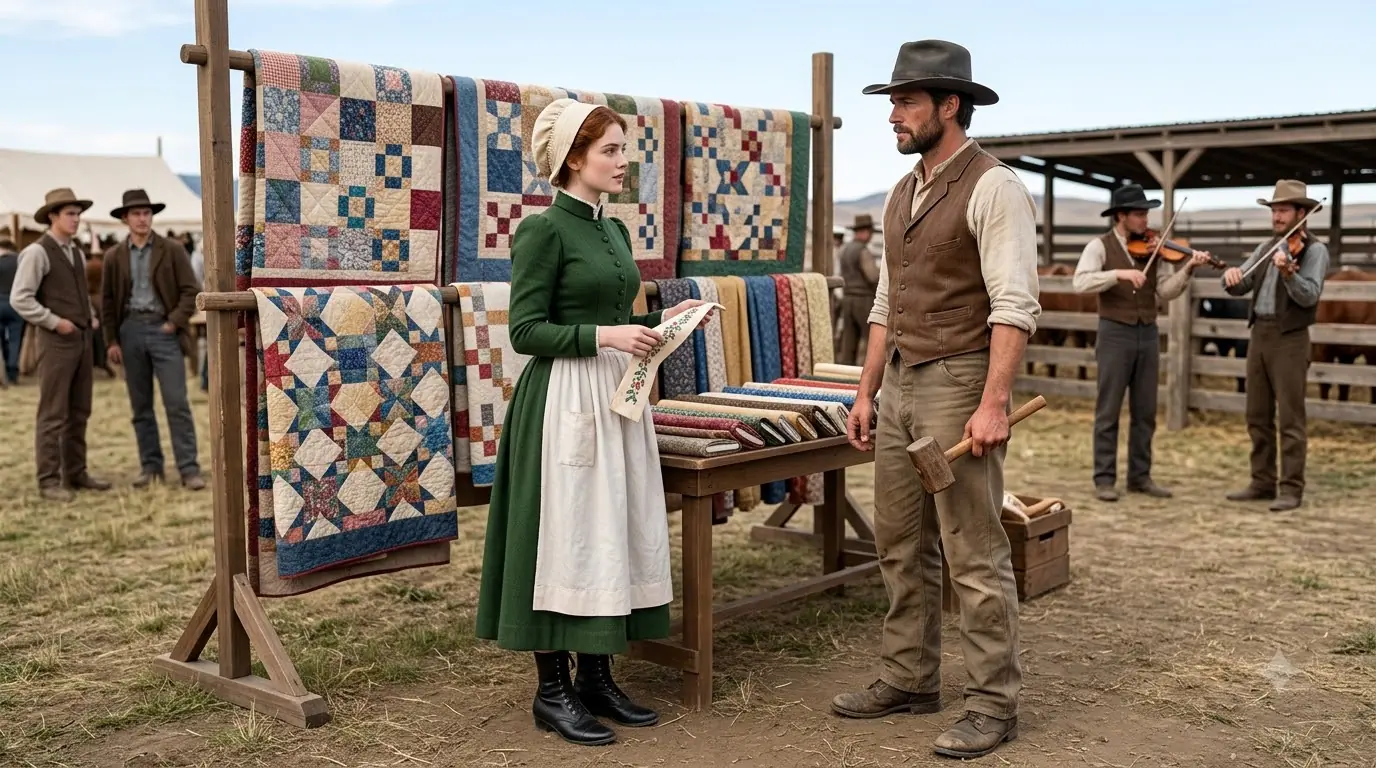
He showed up when he was needed, did the work with the precision of someone who believed that how you built a thing reflected who you were, and went home when it was finished.
He was respected by everyone and known by almost no one.
Five years earlier, he had been a different man, a younger version of himself who laughed easily, made plans, and had a future with a shape to it.
Her name was Clara Whitfield.
She was twenty years old, with light brown hair, a laugh that arrived without warning, and a way of looking at Nathan that made him feel as though the best version of himself was the one standing beside her.
They were supposed to be married in the spring of 1880.
The fever came in February. It moved through Willow Creek the way those fevers moved, fast, indiscriminate, and without any interest in what it was interrupting.
Clara became sick on a Tuesday. By Sunday, she was gone.
Nathan had built her a hope chest that winter. It was made of hand-joined oak, with every corner fitted with the precision he put into everything, built to last a hundred years.
It was still standing in the corner of his cabin with a cloth covering it.
He had not opened it since the week she died.
Nathan had kept moving. He had kept building things.
He had become very good at being useful and very deliberate about being alone.
Then Grace Harper arrived in Willow Creek on a September morning with two trunks, a sewing machine, and the particular energy of a nineteen-year-old woman who had decided exactly what she was going to do with her life and was not going to be argued out of it.
Nathan was fixing the hinge on the general store door when her wagon came down the main street. He looked up once, then returned his attention to the hinge.
But something inside him, something that had been very quiet for five years, noticed her.
Then it went quiet again, but differently than before.
The woman Nathan had loved was Clara Whitfield, and she had loved Nathan Reed since they were sixteen years old. It was not the kind of love shared by young people who mistook intensity for permanence. It was the love of two people who had grown up in the same town and had been each other’s person for so long that neither of them could remember a time before it.
Clara was the daughter of the mill owner. Nathan was the carpenter’s apprentice. The match was considered inevitable by everyone who knew them.
They had talked about the house.
That was what Nathan remembered most clearly in the years afterward. He did not remember only the grand moments, but the small ones. He remembered the Tuesday evenings on the porch of her father’s house, when they talked about what he would build for them.
They would have two bedrooms to begin with, a south-facing kitchen for the light, and a porch wide enough for two chairs and a long view.
Clara wanted a garden.
“Not a practical garden,” she had said once, with the precision of someone who had thought carefully about it. “Not vegetables. Flowers. Things that don’t have any use except being beautiful.”
Nathan had told her he would build whatever she wanted.
He had meant it completely.
The winter of 1880 arrived with the fever.
Clara became ill on a Tuesday morning. It began with a headache, followed by a heat that would not break. By Thursday, she could no longer leave her bed.
Nathan pulled his chair beside her and did not leave.
By Sunday, she was gone.
She was twenty years old.
Nathan sat beside her for a long time afterward. The room was very quiet, and the Montana winter waited outside.
He looked at her face, the face he had been looking at since he was sixteen, and understood, with the finality of something that arrived all at once, that the future he had been building toward in his mind had just become a past.
He went home and did not come outside for four days.
When he finally emerged, he returned to work.
That spring, he built a barn for the Henderson family. Every joint was precise, every board was level, and the whole structure was solid and true.
He built it the way a man built something when he had nowhere else to put what he was carrying.
Then he went home, looked at the hope chest in the corner, and thought about a garden filled with flowers that had no practical use.
He lay awake until the Montana sky changed from black to gray, then to the pale gold of another day that Clara was not in.
Five years was a long time to grieve and a short time to stop.
Nathan had not stopped. He had only learned to carry the grief differently, the way a person carried something heavy, not by putting it down, but by adjusting the way he held it so that he could keep moving.
He became the kind of craftsman who understood that what he built would outlast him and who placed that understanding into every joint and beam.
People came from three counties to hire him.
Nathan lived in a small cabin on the edge of Willow Creek. It was nothing remarkable from the outside, but the interior was the work of someone who understood what well-made things looked like.
Every shelf was level. Every door hung true. The kitchen table was solid enough to last a hundred years.
The hope chest remained in the corner.
Nathan had covered it with a cloth during the second year, not to forget it, but to keep the dust away.
He was not certain there was a difference.
Nathan did not attend social gatherings. He was not unkind. He was consistently generous with his time and his skill, but there was a quality to his presence that people recognized and respected.
He was like a door that remained open for business and closed for everything else.
Eventually, Willow Creek stopped trying to introduce him to unmarried women.
Martha Greer, who ran the general store, had known Nathan since before Clara. She had witnessed the man he had been before Clara’s death and the man he became afterward.
She told people quietly that Nathan Reed was a good man who had something taken from him that a person did not replace.
She said it with the practical accuracy of someone reporting a fact.
People nodded.
They hired Nathan and left him alone.
It seemed like enough.
Nathan had told himself for five years that it was enough. He was not entirely certain he believed it, but the alternative required opening a door he had deliberately closed.
Some doors, once a person understood what closing them had cost, felt impossible to open again.
Nathan had built enough things to know that a joint held together by fear instead of a proper fit would eventually fail. He had never examined whether the same principle applied to doors as well as wood.
Grace Harper arrived in Willow Creek on a Wednesday in September with a plan.
The plan was specific. She would open a seamstress shop in the empty storefront beside the general store, establish herself before winter, and build a regular clientele by spring.
Grace had been completing alterations and private commissions since she was fourteen, learning from her mother and grandmother.
She was nineteen years old and entirely certain that Willow Creek was the right place and that this was the right time.
She had auburn hair that turned heads without effort and the directness of someone who had long since decided that other people’s attention was not her problem.
She had been in town for three days when she first needed Nathan Reed.
A shelf bracket had pulled away from the wall in her shop. It had been poorly installed by the previous tenant, and Grace needed it repaired before she could place her bolts of fabric on the shelf.
Martha Greer told her to ask Nathan.
Grace found him at his workshop on the edge of town. He was standing at his bench, shaping a piece of oak into a door panel.
He looked up with the expression he used for new people, polite and professionally attentive.
“Miss,” he said.
“Grace Harper,” she replied. “I’ve opened the seamstress shop beside the general store. I have a shelf bracket that needs attention.”
Nathan looked at her for a moment.
Grace looked back with direct green eyes that had been examining things honestly since she was old enough to have opinions.
“I can come by Thursday,” he said.
“Thursday works.”
She looked around the workshop, noticing the tools arranged in order on the wall and the workbench with its clean surface.
“You built this yourself?”
“Yes.”
“It’s very well made,” she said, offering the words as an observation without decoration.
Nathan glanced at the bench.
“Thursday,” he repeated.
Grace nodded and left.
Nathan looked at the piece of oak for a long time after she was gone.
Then he picked up his plane and returned to work.
He did not think about the way she had examined his workshop with the attention of someone who understood what well-made things looked like.
He did not think about it at all.
He thought about it for the rest of the afternoon.
The shelf bracket took twenty minutes to repair.
Grace had coffee ready when Nathan arrived and watched him work with the quiet attention of someone who paid attention to things generally.
He fixed the damaged bracket, then inspected the other shelves while he was there. He found two more that needed attention and repaired them without being asked.
Grace examined the shelves.
“You fixed the others?”
“They needed it,” he said. “They would have come down eventually.”
She paid him less than the work was worth, thanked him, and watched him leave.
The following Tuesday, Grace came to the workshop. The door to her shop would not latch properly. Could Nathan look at it when he had time?
He came by on Wednesday.
The door latch took ten minutes. Nathan adjusted the strike plate, tested the door, and discovered that the frame itself was slightly out of alignment.
It was not severe enough to cause an immediate problem, but it would create trouble later.
He repaired that too.
The following week, Grace had a window that would not close completely. After that came a creaking floorboard, then a shelf in the back room.
Nathan repaired all of them.
He began to notice that the problems requiring his attention appeared at consistent intervals, one each week. They were always small, and they were always things that theoretically could have waited.
Nathan noticed this with the precision of a man who had been building things for fifteen years and could tell the difference between a problem that needed immediate attention and one that had been deliberately saved.
He said nothing about it.
He came whenever Grace asked. He fixed whatever needed repairing, drank the coffee that was always ready, and participated in the conversations that accompanied the work.
They talked about the town, her shop, the books she was reading, and the quality of the Montana autumn light, about which Grace had many opinions.
Nathan had never discussed the Montana autumn light with anyone.
After each visit, he returned home, looked at the hope chest in the corner, and thought, “This is not what it looks like.”
Then he thought, “I need to stop going whenever she asks.”
After that, he thought, “The window frame on the east side of her shop is going to cause trouble by February if it isn’t reinforced.”
He should mention it on Thursday.
Nathan did not examine the order of those thoughts too closely.
He had not dreamed about Clara in two years.
During the first year after her death, he dreamed about her almost every night. The dreams were not about the fever or her final days. They were about everything that came before.
He dreamed about evenings on the porch, conversations about the house, and the way she laughed.
He woke from those dreams with the weight of someone who had been somewhere good and had been returned against his will.
Gradually, the dreams came less often.
On a Thursday in October, the week after Nathan repaired the east window frame in Grace’s shop, Clara came to him in a dream.
She did not appear the way grief often brought people back, anxious and unresolved.
She came as she had always come, easily, with laughter waiting behind her eyes. She was sitting on the porch of the house they had planned but never built.
Clara looked exactly as she had at twenty.
“Nathan,” she said.
“Clara.”
She looked at him with the expression she used when she was about to say something he needed to hear.
“You’re being very careful,” she said.
“I’m always careful.”
“With wood?”
“Yes.”
“With yourself?”
Nathan said nothing.
“You’re being careful the way you are when you’re afraid something won’t hold.”
Nathan looked at the porch, the south-facing kitchen, and the wide view.
“She looks at you,” Clara said. “The way I used to look at you.”
Nathan remained silent.
“Nathan.”
Her voice was as it had always been, direct, warm, and entirely without pretense.
“The garden,” Clara continued. “The flowers with no practical use. I always wanted you to have that.”
“What do you mean?”
Clara smiled, the smile that had always arrived without warning and changed everything.
“Not flowers exactly. Something with no practical use. Something simply because it’s good.”
She paused.
“You’ve been building things for other people for five years. Build something for yourself.”
“I don’t know how anymore.”
“Yes, you do,” she said. “You’ve always known how. You just stopped believing you were allowed.”
Nathan woke at four in the morning with the Montana darkness around him.
The hope chest stood in the corner beneath the cloth.
He looked at it for a long time.
Then he rose, put the kettle on, and sat at the kitchen table, thinking about a garden filled with flowers that had no practical use.
For the first time in five years, the thought did not hurt.
It felt like something else.
It felt like permission.
October brought the Willow Creek Harvest Fair, the kind of gathering small towns had been holding since before anyone could remember.
It was a combination of commerce, community, and the energy of people who had survived another difficult season and decided to celebrate it. There were booths, competitions, music, and more food than was strictly necessary.
Grace had a booth.
She had spent two weeks preparing it. Samples of her work hung from a small wooden display rack that Nathan had built the previous Tuesday.
She had not asked him to build it. He had seen her struggling with the display and simply arrived the following morning carrying the finished rack.
Grace had looked at the rack and then at Nathan. She said nothing, which was its own kind of sentence.
Her booth was popular.
Grace had lived in Willow Creek for only six weeks, but she had already built a clientele. Part of it was because she was good at her work, and part of it was because she was Grace.
People were drawn to her the way they were drawn to warmth.
Nathan came to the fair to help repair the livestock pens before the animals arrived. It was a practical reason for attending.
He finished repairing the pens at noon.
He should have gone home.
Nathan was standing at the edge of the fairground when he saw Grace surrounded by four young men who were competing for her attention with all the determination of youth.
She handled the situation the way she handled everything, warmly, directly, and completely in control.
Grace laughed at something one of them said.
It was her real laugh.
Nathan looked down at his hands.
Then he walked toward her booth.
He did not know why. He was standing there before he had consciously decided to approach.
Grace noticed him immediately. Her green eyes found him in the crowd.
Nathan looked at her, then at the young men.
He felt something he recognized but had not experienced in five years and had never expected to feel again.
He smiled, using the half smile that appeared whenever he felt something he did not intend to say aloud.
“You’re going to break a lot of hearts,” he said.
He meant it as an observation, a way of saying something that was not the thing he was actually thinking.
Grace looked at him.
The young men were still standing nearby, but she was looking only at Nathan.
She became quiet for a moment, the quiet of someone choosing her words carefully.
Then she smiled.
It was not her laugh, but another kind of smile, quieter and carrying more meaning.
“I only wanted to mend yours,” she said, looking directly at him.
Then she turned, returned to her booth, and helped a woman examine a piece of lace.
Nathan remained at the edge of the fairground with the four young men, all of them thinking about the same moment.
Only Nathan understood what Grace had actually said.
He stood there for a long time.
Then he went home.
He did not sleep.
A woman who had been paying attention for six weeks had said the most honest thing she had ever said to anyone.
The man she said it to stood as though he had just been handed something he believed no longer existed and did not know whether he was allowed to hold it.
Nathan went home after the fair and sat at the kitchen table for a long time.
The hope chest remained in the corner.
He had not opened it in five years.
He looked at the cloth, the shape beneath it, and the thing he had built for a future that had never happened.
He thought about what Grace had said.
“I only wanted to mend yours.”
He thought about what it would cost to allow those words to mean what they meant.
He thought about what happened when a person allowed something to matter and then lost it.
Nathan had paid that cost once.
He knew exactly what it felt like.
The knowledge was not merely a memory. It was a physical thing, a weight in his chest that he had learned to walk around but had never truly put down.
He thought about Clara and the dream.
“You just stopped believing you were allowed.”
He thought about Grace at the fair and the green eyes that had found him in a crowd.
Nathan thought, “I know what a sound foundation looks like, and I know what this is.”
Then he thought, “That is exactly why I cannot do this.”
He sat at the kitchen table for three hours.
Then he stood and began quietly and systematically packing.
Nathan had been offered work in Billings in August, a hotel commission that would pay him more money than two years of work in Willow Creek. He had declined because he had not wanted to leave.
He would write to the hotel owner that night.
He would be gone before winter.
Nathan would leave because Grace Harper was nineteen years old and deserved a man who could give her everything without the weight of his uncertainty.
He would leave because staying required him to open a door that he was not certain he could survive opening again.
He packed carefully and methodically, the way he did everything.
He left the hope chest behind.
Nathan sat at his desk and began writing the letter to Billings.
He wrote three sentences, then stopped.
He looked at the hope chest.
He remembered the dream and Clara’s voice.
“You’ve always known how. You just stopped believing you were allowed.”
Nathan put down the pen.
Then he picked it up again.
He finished the letter, sealed it, and placed it on the desk to be sent in the morning.
Afterward, he went to bed, lay in the darkness, listened to the Montana wind, and told himself he was doing the right thing.
He repeated it often enough that it almost felt true.
It felt like the right thing in the way closing a door always felt right until a person discovered that he was standing on the wrong side of it.
Nathan left on a Tuesday morning before most of Willow Creek was awake.
He told no one except Martha Greer, whom he paid for supplies.
Martha looked at him with the expression of a woman who had watched a situation develop and found the resolution entirely inadequate.
“Billings?” she asked.
“Work,” Nathan answered.
Martha made a quiet sound that conveyed everything she thought about the decision.
Grace discovered he had left on Wednesday when she came to the workshop and found it closed.
She asked Martha what had happened.
Martha told her.
Grace went home.
She did not tell anyone what she felt. She sat at her worktable, continued an alteration that needed to be completed, and became very precise about her stitching.
On Thursday, Grace returned to Nathan’s workshop because Martha had a key and believed there was something Grace should see.
A small wooden box had been placed carefully on the workbench. It was joined at the corners with Nathan’s signature precision.
Inside the box was a small, carved flower.
It had no practical use.
It was simply beautiful.
There was no note.
Grace held the carved flower for a long time.
The workshop smelled of oak and sawdust, the smell she had spent six weeks finding reasons to be near.
She turned the flower over in her hands.
Nathan had carved it carefully, with the same attention he gave everything. Every petal was precise.
He had left it without a note and gone to Billings.
Grace did not know whether the flower was a farewell or the beginning of something Nathan did not yet know how to finish.
She placed the flower in the pocket of her dress.
Then she returned to work.
Grace was nineteen years old. She had said the truest thing she had ever said to another person, and he had left anyway.
The uncertainty was the hardest part.
It was almost harder than the leaving.
Billings was larger than Willow Creek.
The hotel commission was real, the work was good, and Nathan threw himself into it with the focus of a man who needed not to think about one particular thing.
He worked twelve hours each day.
The hotel began taking shape, solid and well-made, with every joint precise.
Nathan was fine.
He was not fine.
At three in the morning during his second week in Billings, Nathan woke with the unfamiliar darkness surrounding him.
He lay in the strange bed and thought about a carved flower with no note. He wondered whether Grace had found it and what she had thought.
He remembered the hope chest he had left in his cabin.
He thought about Clara’s dream.
“You just stopped believing you were allowed.”
Nathan considered what it meant that he had carved a flower, an object with no practical purpose, something simply beautiful, exactly what Clara had always wanted him to have.
Then he had left it without the words that should have accompanied it.
He had acted like a man who almost said something, lost his courage at the final moment, and ran.
Nathan sat upright in the darkness.
He thought about everything he had built during his life, every barn, bridge, cabinet, and door.
He had built all of it for other people because he had stopped believing he was allowed to build anything for himself.
He thought about Grace at her worktable, precise and quiet, not displaying her feelings for anyone.
He wondered what kind of man left a woman a flower and a silence, then called it enough.
Nathan got out of bed.
He lit the lantern, sat at the small desk, and wrote to the hotel owner. He explained that a personal matter required him to return to Willow Creek and that he would recommend another carpenter to finish the commission.
He wrote the letter carefully and honestly.
Then he packed his bag, paid for the room, and saddled his horse in the gray Billings morning.
He rode for two days.
During the entire journey, he thought about what he would say.
He thought about Clara, permission, and flowers that had no practical use.
He thought about a woman who had spoken the truest words she knew and deserved more than a carved flower and a silence.
Nathan rode faster.
The Montana Valley opened ahead of him, revealing the mountains, the sky, and the particular light upon the grass that Grace had so many opinions about.
Nathan felt something inside his chest that he recognized.
It was the same thing he had felt when he was twenty-five and riding toward a life he was building with someone.
He had not felt it since.
He rode toward it.
Nathan arrived in Willow Creek on a Thursday afternoon.
He rode down the main street, tied his horse outside the general store, and entered.
Martha Greer looked up.
She stared at him for a long moment.
“You came back,” she said.
“Yes.”
Martha made another quiet sound.
This time, it meant something different, something closer to, “About time.”
“She’s at the shop,” Martha said before Nathan could ask.
He nodded.
Nathan walked to the seamstress shop and opened the door. The latch he had repaired in October still worked.
The bell above the door rang.
Grace sat at her worktable with her back toward him, working on a piece of fabric with the focused precision of someone who had been very deliberate about remaining focused.
“Just a moment,” she said.
Then she heard the silence.
It had a specific quality, different from the usual silence of an waiting customer.
Grace turned.
Nathan stood in the doorway with his hat in his hands and three weeks of riding and thinking visible upon his face.
The Montana afternoon light entered through the windows he had repaired.
Neither of them spoke for a long moment.
Then Grace stood.
She was not pretending to be composed. She was actually composed, with the stillness of someone who had spent three weeks deciding how she would feel if this happened and had arrived at an answer.
“Nathan,” she said.
“I left a flower,” he replied.
It was not what he had planned to say first.
“I found it.”
“I should have left a note. I should have…”
Nathan stopped and began again.
“I left because I was afraid. Not of you. I was afraid of what it meant. I was afraid of what happens when you allow something to matter and then lose it.”
He looked down at the hat in his hands.
“I lost someone five years ago. Her name was Clara. I loved her, and she died. Afterward, I built a door, closed it, and told myself that was the right thing.”
“I know,” Grace said quietly. “Martha told me part of it. I figured out the rest.”
“I carved you a flower,” Nathan said. “A flower with no practical use. Then I left without a note because I became frightened at the final moment and ran.”
He looked at her.
“I’m not afraid anymore. Or I am, but I’m finished letting fear decide for me.”
Grace crossed the room with the deliberate certainty of someone who had made a decision and was living inside it.
She stopped in front of him.
“I’m not trying to replace her,” Grace said. “I’m not trying to make you forget her. Clara was real. She mattered, and she always will.”
Her voice was steady, but her eyes were bright.
“I only want to be here, if you’ll let me.”
Nathan looked at the nineteen-year-old woman standing before him with the truth in her eyes.
He felt something inside himself, something that had remained closed for a very long time, begin to open.
It did not open entirely or all at once.
But it opened.
Nathan reached out and took Grace’s hand.
She looked down at his hand holding hers. Then she looked into his eyes and began to cry quietly and completely, the way a person cried when something she had given up on turned out to still be true.
Nathan held her hand and said nothing.
There was nothing he could say that was better than what was already happening.
Nathan took Grace to see the hope chest on a Sunday afternoon.
He had not opened it in five years.
He had covered it and lived around it in the way a person lived around something he was not yet ready to face.
Grace sat beside him on the cabin floor in front of the chest.
Nathan removed the cloth.
The chest was exactly what it had always been, a hope chest built by a young man for the woman he intended to marry. Its joints remained tight, the wood was still smooth, and it had been made to last.
Nathan opened it.
Inside was a quilt that Clara’s mother had started for the wedding. There was also a small Bible with Clara’s name written inside in her own handwriting.
Beside it rested a pressed wildflower, now dry and fragile, which Clara had placed there herself during the autumn before she died.
At the bottom lay a folded piece of paper covered in Clara’s handwriting.
Nathan had never been able to open it.
His hands were not entirely steady.
Grace placed her hand over his.
Nathan unfolded the paper.
It was a list of things Clara wanted for the house they had planned.
There was the south-facing kitchen, the wide porch, and, at the bottom, underlined twice, a garden.
Not practical.
Only flowers.
Only beautiful things.
Nathan looked at the list for a long time. Then he folded it carefully and held it.
Grace sat beside him on the cabin floor, saying nothing because she did not need to.
After a while, Nathan spoke.
“She would have liked you.”
Grace looked at him.
“I think I would have liked her.”
Nathan nodded.
He returned the list to the chest, not as something he needed to hide from, but as something worth keeping, a record of something that had been real.
“I’m going to build a garden,” he said. “Not practical. Only flowers.”
He looked at Grace.
“If you’ll help me decide which ones.”
Grace looked at him with the green eyes that had been paying attention since September.
“Yes,” she said.
She said it simply and completely, the same way she said everything that mattered.
They were married in the spring.
It was not a large wedding. Nathan was not a man who enjoyed large gatherings, and Grace had decided that the most important part was the moment when they said the words.
They spoke their vows in the Willow Creek church on a Saturday in April.
The entire town attended because the entire town had become invested in the outcome during the previous months.
Martha Greer cried in the front row with the satisfaction of a woman whose conclusions had been correct all along.
Nathan built their house that summer.
It was not the house he had once planned with Clara. It was something new, something that belonged to Nathan and Grace.
It had a south-facing kitchen for the light, a wide porch with room for two chairs and a long view, and a garden along the eastern side.
It was not practical.
It contained only flowers.
Grace planted them in May and tended them throughout the summer with the care she gave to everything.
The hope chest stood in the corner of their bedroom.
It was not covered.
It was present, the way things that had been real and had mattered should be present.
Their first child arrived the following spring.
She was a girl, and they named her Clara Rose.
Grace suggested the name, and Nathan received it with the expression of a man being given a gift he did not know how to deserve.
Their second child arrived two years later, a boy named William after Nathan’s father.
The years passed in the way good years often did, steadily, through work, seasons, and the accumulation of a life built deliberately.
Nathan built things.
Grace sewed things.
The garden grew each spring and returned every year, more established than it had been the year before.
During the twenty-third year of their marriage, Nathan was fifty-three and Grace was forty-two.
Clara Rose was grown and had moved to Helena. William had become an apprentice to a carpenter whom Nathan had personally recommended.
One evening, Nathan and Grace sat on the porch in the two chairs facing the long view and watched the Montana evening do what Montana evenings did.
Nathan looked at the garden, at the flowers that had no practical use and were simply beautiful.
He looked at Grace beside him, her auburn hair turning silver at the temples and her hands marked by the work she had been doing since before he knew her.
She felt him watching and turned toward him.
“What?” she asked.
“Nothing,” he said. “I’m just looking.”
Grace returned her attention to the evening.
Nathan continued looking.
He thought about a Wednesday in September when a woman with green eyes arrived in Willow Creek with two trunks and a sewing machine.
He remembered a carved flower left without a note.
He thought about a twenty-year-old woman who had loved him, died, and later came to him in a dream to give him the only permission he had ever needed.
He thought about what it meant to have built something that lasted.
Not a barn.
Not a bridge.
This.
“Grace,” he said.
She looked at him.
Nathan did not say anything else.
He did not need to.
Grace took his hand.
The Montana evening held them both.
Nathan Reed had built a hope chest for a woman he intended to marry. She died before they could fill it.
He covered the chest with a cloth and lived around it for five years. He did not forget her. He never forgot her. He only learned to move through a world in which Clara existed in the past and nothing seemed to exist in the future.
Then a nineteen-year-old woman arrived with a sewing machine and a plan. She began finding reasons to visit a carpenter’s workshop and, while standing at a fairground in October, said the truest thing she had ever said to anyone.
“I only wanted to mend yours.”
Nathan left a carved flower on a workbench and ran.
During those three weeks in Billings, he discovered what it cost to have loved someone completely, lost her, and then found himself standing in front of someone who made the world feel different again.
He was so afraid of losing again that he almost chose the loss himself.
The bravest thing Nathan Reed ever built was not a barn or a bridge.
It was the decision to ride back to Willow Creek, walk into a seamstress shop, stand in the doorway with his hat in his hands, and tell the truth.
“I was afraid. I’m done letting fear decide for me.”
Clara, who had loved him at sixteen, died at twenty, and came to him in a dream to remind him that he was allowed to live again, had been right.
Nathan had always known how.
He had only needed permission.
Everyone carries something they have covered with a cloth. Everyone has a hope chest standing somewhere in the corner.
Sometimes, not always, but sometimes, someone arrives who is worth uncovering it for.
Do not run to Billings.
Ride back.
May God bless everyone listening today.