The steam from the Kansas Pacific locomotive hissed against the wooden platform of Abilene Station.
It was June of 1875. The air smelled of coal smoke, hot dust, and cattle.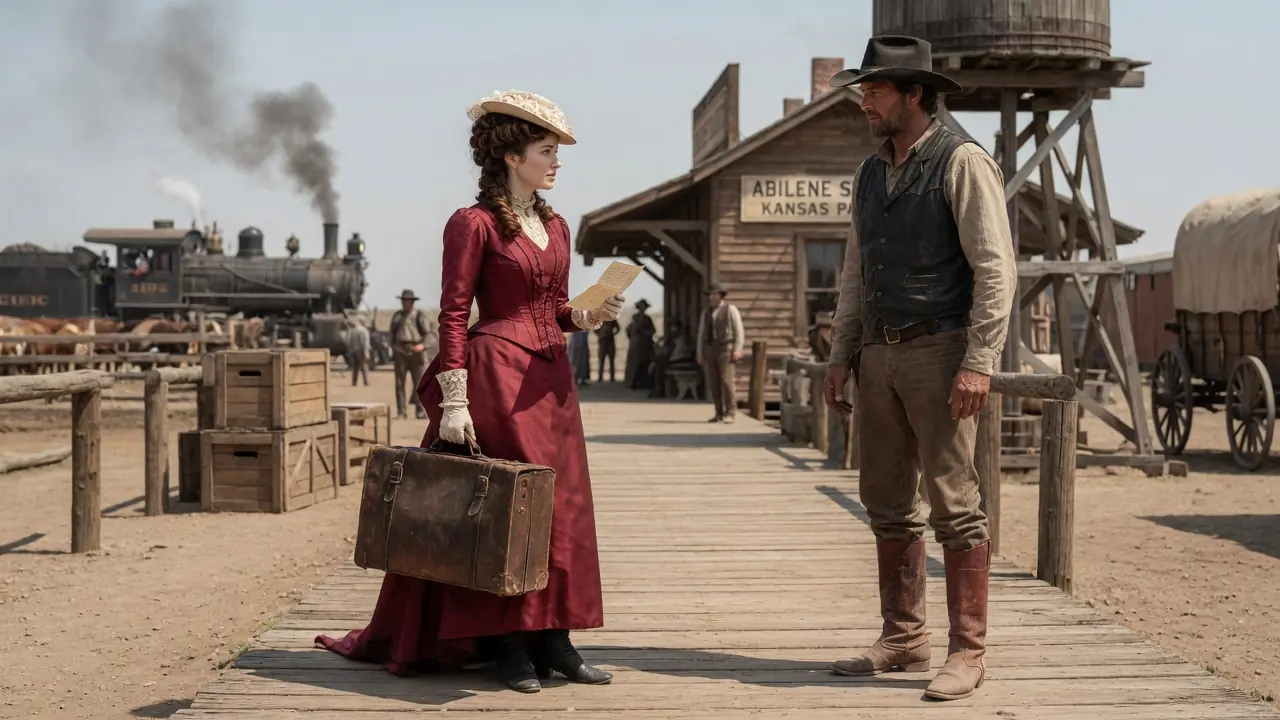
Eliza Bennett stood on the platform clutching a leather valise and a crumpled letter. She wore a dress of deep crimson silk, a color far too fine for the dusty, unforgiving plains of Kansas.
Her hair was pinned in an intricate arrangement of curls, a style that had been the height of fashion in Philadelphia just two weeks ago. Now, it felt like a heavy crown of vanity.
She looked painfully out of place.
Eliza was twenty-eight years old. In the polite society of the East, many people already considered her late for marriage.
She had once taught music to the daughters of wealthy bankers. Then the Panic of 1873 took everything.
Her father’s business collapsed. Her dowry vanished. The men who had praised her beauty disappeared with her money.
So Eliza did the one thing no proper Philadelphia woman was supposed to do. She answered an advertisement in a matrimonial circular.
By letter, she had married an idea. Now, at the train station, she was about to meet the man.
She had entrusted her future to a stranger because hope was the only thing she had left.
The advertisement had been brief and oddly poetic.
“I have a thousand acres of grass and a house that is too quiet for a man’s soul. I seek a woman who values a sunset more than a ballroom. I seek a conversation more than a gossip column.”
The man who signed it was Silas Thorne.
For six months, they had exchanged letters across the heart of a broken nation.
In those letters, Silas was a philosopher of the plains. He wrote about the way the wind sounded in the tall grass, like a whispered prayer.
He quoted Henry David Thoreau with the ease of a scholar. He described a life of dignity, hard work, and mutual respect.
Eliza had fallen in love with the ink on the page.
She had imagined a tall, refined gentleman. She pictured silvering temples and soft, caring hands.
She expected a man who would hand her a bouquet of wildflowers and speak in hushed, romantic tones.
The train gave a final, mournful whistle. The crowd of passengers dispersed, leaving Eliza alone on the sun-baked platform.
He did not wear a suit.
He wore a black cowboy vest over a clean, sun-faded shirt. His trousers were dusty, and his boots carried the red mud of the Smoky Hill River.
A Colt revolver rested at his hip, plain and well-used. His beard was short, dark, and neatly trimmed.
He looked wild enough to belong to the prairie, but not dirty, not careless, just hardened by a life that had never been gentle.
His skin was burned to the color of an old saddle by the unrelenting Kansas sun.
He approached her with a heavy, deliberate gait. He smelled of horses, wood smoke, and something sharp, like pine resin.
He stopped three feet away from her. His eyes were the color of a gathering storm cloud.
“You’re Eliza,” he said.
His voice was not soft or poetic. It was a low growl, like stones grinding together in a creek bed.
Eliza felt her heart drop into the cold pit of her stomach. She looked at the man, then down at her beautiful, useless red dress.
She looked at his rough hands and the way he stood with a guarded slouch.
“I am,” she whispered, her voice barely audible over the wind.
“I’m Silas,” he said.
He did not offer her a flower. He did not bow or kiss her hand.
He simply reached out and took her heavy valise as if it weighed no more than a feather.
“The wagon’s over here,” he added, turning his back on her.
Eliza followed him, her silk skirt dragging in the filth of the street. She felt a wave of nausea wash over her.
She had traveled fifteen hundred miles for a brute. She had sold her mother’s jewelry to marry a man who looked like a common outlaw.
In that moment, standing in the middle of a dusty cow town, Eliza Bennett regretted every word she had ever written.
She regretted the hope she had allowed to bloom in her chest. Most of all, she regretted that she had no money left to buy a ticket back home.
The ride to the Thorne Ranch took four agonizing hours. They traveled in a heavy buckboard wagon pulled by two sturdy, stubborn mules.
The landscape was a vast, flat sea of green and gold. There were no trees to break the terrifying horizon.
The sun beat down on Eliza’s head until her scalp burned under her stylish hat.
Silas did not speak a single word for miles. He kept his eyes on the trail, his hands relaxed but firm on the reins.
Eliza stared at his profile against the blue sky. He looked hard, like the land itself. He looked like a man who had long ago forgotten how to smile.
“Is it always this hot?” she asked, her voice cracking with suppressed tears.
“It’s Kansas,” Silas replied without looking at her. “It’s hot enough to melt your soul in the summer. It’ll freeze your blood solid in the winter.”
Eliza bit her lip to keep from crying out loud. She thought of the shaded cobblestone streets of Philadelphia. She thought of the tea parties and the cool marble floors of the grand library.
“Why did you lie to me in your letters?” she finally burst out.
Silas pulled on the reins, bringing the mules to a sudden halt. The silence of the prairie rushed in to fill the space.
He turned to look at her, his gaze piercing and raw.
“I didn’t lie about a single thing,” he said quietly.
“You wrote like a scholar,” Eliza said, gesturing wildly at his rough clothes. “You wrote about poetry and the intricate needs of the soul, but you look like a laborer. You look like a man who belongs in the dirt.”
Silas looked down at his scarred hands, then back at her.
“I am a laborer, Eliza. Out here, a man who doesn’t work doesn’t eat. Books don’t plow fields, and clean hands don’t keep a roof standing.”
His voice remained steady, but something in it had hardened.
“If you came looking for a gentleman in a parlor, you came to the wrong place.”
He flicked the reins, and the wagon moved forward again.
The silence that followed was heavier than the Kansas heat.
When they finally reached the ranch, Eliza’s heart sank even further.
It was not a grand manor or even a modest farmhouse. It was a small house built of limestone and cedar, standing alone and defiant against the vastness of the prairie.
There were no neighbors for miles in any direction. There was only the wind, the grass, and the endless, indifferent sky.
Silas led her inside.
The house was sparse, almost monastic, but perfectly clean. There was a heavy oak table, two chairs, and a cast-iron stove that looked like an altar.
In the corner, there was a shelf filled with books.
Eliza walked over to the shelf, her fingers trembling.
There was Virgil, Milton, and the very Emerson essays they had discussed. The books were well-worn, their spines creased from a thousand readings by lamplight.
“This is your room,” Silas said, pointing to a small door. “It has a latch on the inside for your privacy. I’ll sleep in the barn until we’ve had a proper ceremony next Sunday.”
Eliza looked at him in genuine surprise. She had feared he might treat the marriage as a claim instead of a promise.
“Thank you,” she said softly.
Silas nodded and turned to leave.
“Eliza,” he said, stopping at the threshold, “I know I’m not the refined ghost you pictured in your head. But this land is honest, and I try my best to be the same.”
He left, closing the heavy wooden door behind him.
Eliza sat on the edge of the small rope bed. She put her face in her hands and finally let the tears fall.
The silk of her red dress felt like a funeral shroud.
The first week was a brutal trial of endurance.
Eliza woke at dawn to the rhythmic sound of Silas chopping wood. She tried to cook, but she had never even touched a wood-burning stove.
She burned the biscuits into black stones and scorched the salt pork.
Silas ate the charred food without a single word of complaint.
The next morning, Eliza tried again. The biscuits were still hard, but they were no longer black.
Silas broke one open, ate half of it, and gave a small nod.
It was not praise, but somehow it felt like the first kind thing the prairie had given her.
He spent his days in the fields, fighting the weeds and the encroaching drought.
In 1875, the frontier was a place of constant, grinding struggle. The great grasshopper plague of the previous year had left the soil depleted and spirits broken.
Every farmer was praying for a miracle to survive the coming winter.
One evening, as the sun set in a blaze of orange and violet, Eliza sat on the porch. She was physically and emotionally exhausted.
Her hands were blistered and raw from hauling heavy buckets of water.
That night, she cried quietly over the washbasin. Then she wrapped her palms in strips of old linen and rose before dawn anyway.
For the first time, she did not ask herself how to escape.
She asked herself how to last one more day.
Her face was peeling and red from the unforgiving sun.
Silas walked up from the barn, wiping his brow with a sweat-soaked bandana. He sat on the top step, a few feet away from her.
He pulled a small carved wooden flute from his vest pocket.
He began with a rough, simple tune. The notes were not perfect. Some were cracked by the wind.
But then the melody turned familiar.
Eliza froze.
Buried beneath the roughness was a Mozart sonata she had once played on a grand piano in Philadelphia.
“You know music?” she asked, her voice trembling with emotion.
“My mother was a teacher in Virginia,” Silas said, staring at the horizon. “She brought that flute through the wilderness. It’s the only thing of hers I have left in this world.”
He looked at her, and for the first time, Eliza saw the man from the letters.
She saw the profound loneliness in his eyes. She saw the depth of the soul he had tried to describe with his pen.
He was not a brute or an outlaw.
He was a man who had been stripped down to the bone by the elements. He was a man who chose dignity over comfort.
“I’m sorry for what I said at the station,” Eliza whispered. “I was shallow and afraid.”
Silas did not answer right away. He just watched a lone hawk circling high above the golden grass.
“The prairie doesn’t care about silk dresses or family names, Eliza,” he said. “It only cares about what stays when the silk is gone. It only cares about the heart that refuses to break.”
That night, Eliza could not find sleep.
She thought about his words and the calluses on his hands. She thought about the Mozart melody echoing across the empty, silent plains.
Perhaps her regret had been a premature judgment. Perhaps she had been looking at the cover of the book and ignoring the sacred text.
The wedding took place on a Sunday morning in Abilene. It was a simple, quiet affair in a small frame church.
Eliza wore her red dress, but she had covered it with a plain white apron. She had braided her hair simply, like the other hardened farm women.
Silas had trimmed his beard and wore a clean white shirt that smelled of lye.
As they stood before the preacher, Eliza felt a strange, solid sense of peace. When Silas took her hand, his palm was like sandpaper, but his grip was the steadiest thing she had ever felt.
“I do,” she said.
And for the first time in years, she felt she was telling the truth.
They were now husband and wife in the eyes of God and the law. But the true test of their covenant was about to begin.
The summer of 1875 turned from hot to truly brutal.
The rains failed to come, and the clouds were mere teases in the sky. The heat became a physical weight that pressed down on the scorched land.
The wheat began to wither and turn to dust in the fields.
Silas worked eighteen hours a day trying to dig a deeper well with his bare hands. He was losing weight rapidly, his face becoming gaunt and hollow.
Eliza stepped up to help in ways she never thought possible.
She stopped worrying about her complexion or her soft skin. She learned how to milk the stubborn cow. She learned how to preserve the few vegetables they managed to pull from the dirt.
She learned that survival is the highest form of poetry.
One afternoon, while Silas was out in the far pasture, a dark cloud appeared.
It was not a rain cloud, though the land screamed for water. It was a strange, shimmering wall of brown and black moving with terrifying speed.
The air grew deathly still. The birds suddenly silenced.
Then Eliza heard a sound like a thousand dry leaves rattling in a hurricane. It grew louder, a deafening, metallic roar that shook the windows.
She ran to the porch and looked out in horror.
The sky was being blotted out by millions upon millions of wings. The great locust plague had returned to finish what it started.
They descended like a plague from the book of Exodus. They covered the ground, the walls of the house, and every living thing.
They clung to her sleeves. They tangled in her hair. They rattled against the windows like dry bones.
Eliza stumbled back, fighting the panic rising in her throat.
Then they began to eat with a ravenous, mindless hunger.
They ate the wheat down to the roots. They ate the leaves off the few stunted trees until they were skeletal.
They stripped every green thing they touched.
Silas came riding back, his horse lathered in foam and wild with fear.
“Inside!” he shouted over the roar of the insects. “Get inside now, Eliza!”
They huddled together in the small house as darkness fell at midday. They listened to the horrific sound of millions of insects devouring their livelihood.
The sound was hope being chewed away by tiny jaws.
Through the dusty window, Eliza watched her small garden vanish in minutes.
She saw Silas sitting at the oak table, his head buried in his scarred hands. Everything he had sweated for was being destroyed before his eyes.
“This is the end,” he whispered, his voice broken. “We’ll have nothing left to eat when the snow falls. We have failed.”
Eliza walked over to him, her heart swelling with a new kind of love. She put her hand on his trembling shoulder.
“We have the house, Silas,” she said with iron in her voice. “We have the well, and we have the air in our lungs. And most importantly, we have each other.”
Silas looked up at her, tears tracking through the soot on his face.
He saw the determination in her eyes, a fire that no plague could extinguish.
He saw that the fragile city girl was gone forever. In her place stood a woman of the American frontier.
The locusts stayed for three days of absolute darkness.
When they finally rose and flew away, the landscape was a burnt wasteland. Not a single blade of green was left for miles.
The wheat was gone. The corn was gone. The dreams were gone.
The Thorne Ranch was a skeleton of its former self.
The silence that followed the plague was more terrifying than the roar.
Silas walked out into the barren field and fell to his knees in the dirt. He wept with a dry, racking sound that broke Eliza’s heart into pieces.
She went to him and knelt in the gray dust. She pulled his heavy head to her chest and held him with all her strength.
She did not offer empty words or false promises. She just held him while the sun beat down on their broken backs.
“We’ll find a way, Silas,” she whispered into his hair. “I’ll sell the red silk dress. I’ll sell the lace and the books if I have to. We’ll buy seed for a winter crop, and we will survive.”
Silas pulled back and looked at her with pure reverence.
“You’d do that for this dirt?” he asked.
“I’d do anything for my husband,” she replied.
In that moment, the regret she had felt at the train station was a ghost.
She realized she had not married beneath herself. She had married a man whose worth could not be measured by polish, money, or clean fingernails.
And for the first time, she felt proud to stand beside him.
They survived the winter of 1875 by the narrowest of margins.
It was a winter of thin soup and thick blankets. Eliza sold her fine clothes to the wives of the cattle barons in Abilene.
She taught music lessons to local children for bags of flour and sides of bacon. She played her mother’s Mozart on a borrowed, out-of-tune upright piano.
Silas took a dangerous job as a freight hauler. He drove heavy wagons through blinding blizzards to the northern camps.
They saw each other only a few days a month, and the parting was always a wound.
But they wrote to each other constantly, their letters becoming their lifeline.
The letters were different now. They were not about philosophy or abstract poetry. They were about how much they missed the warmth of each other’s breath.
They were about the plans they were making for the first green shoot of spring. They were about a love that had been forged in the white-hot fire of hardship.
One cold February night, Silas returned home unexpectedly.
He was covered in a thick layer of frost, his eyelashes white with ice. Eliza ran to him, wrapping him in a heavy wool blanket by the stove.
He reached into his heavy coat and pulled out a small wrapped package.
“Merry Christmas, Eliza,” he said, his voice trembling with the cold. “I know I’m months late, but the mountain passes were closed.”
Eliza opened the package with shaking fingers.
Inside was a small, delicate gold locket.
She opened it and gasped, the tears springing to her eyes immediately.
Inside the locket was a tiny, vibrant piece of red silk.
“I saved a scrap from your wedding dress before you sold it,” Silas whispered. “I wanted you to remember that you were a queen, even in an apron. I wanted you to know I saw your beauty when you thought it was gone.”
Eliza burst into tears and threw her arms around his frozen neck.
“I don’t need the silk to be a queen, Silas,” she sobbed against his chest. “I only need to be your wife.”
The years passed, and the Thorne Ranch slowly began to prosper.
The rains returned, and the Kansas soil gave up its hidden riches. They built a larger house, a beautiful stone structure with a wraparound porch.
They had three children, two boys with their father’s eyes and a girl with her mother’s spirit.
Eliza made sure they all knew how to play the flute and read the classics. Silas made sure they knew how to respect the land and handle a horse with grace.
The story of the woman in the red dress became a legend in the county.
People talked about how she arrived looking like a doll and became a woman of iron and grace. They talked about the man who had seen her soul through the ink of a letter.
Eliza never forgot that transformative day at the train station.
She kept Silas’s original crumpled letter in a wooden box on her nightstand. Every year on their anniversary, she would take it out and read it by candlelight.
She would remember the smell of coal smoke and the wild-looking man in the black vest. She would laugh at the memory of her own youthful arrogance.
Years later, when a neighbor’s estate was sold, Eliza found her old red dress folded inside a cedar trunk.
The silk had faded with time, but her hands still trembled when she brought it home.
She realized that life rarely gives you what you want in the moment. It gives you exactly what you need to become who you are meant to be.
She had wanted a gentleman, but she had desperately needed a hero. She had wanted a comfortable life, but she had needed a meaningful one.
Silas Thorne died in the spring of 1910, sitting in his favorite chair on the porch. He was seventy years old, his work finally done.
Eliza was by his side, holding his hand until the very end.
His last words were not a quote from a book or a line of poetry.
They were simply, “You were the best thing I ever found in the dirt, Eliza.”
Eliza lived for another ten years, witnessing the world change at a dizzying pace.
She saw the first automobiles rattle down the streets of Abilene. She saw the telegraph replaced by the magical ringing of the telephone.
But to her, the world was always the thousand acres of grass Silas had promised.
On her deathbed, her eldest daughter asked if she had any final regrets.
Eliza smiled, her eyes clouded with age but bright with the memory of the sun.
“Only one,” she whispered, her voice a soft rustle like the wind in the wheat. “I regret that I wasted even one hour being disappointed at that station. I should have known the moment I saw his eyes that I was finally home.”
She died with a smile of absolute peace on her face.
She went to join the man who had taught her how to truly live and how to truly love.
Her children buried her in that red silk dress. They laid her next to Silas on a high hill overlooking the golden prairie.
The wind still blows through the tall grass there, singing an eternal song. The hawks still circle in the infinite blue sky.
And if you listen closely, you might hear the faint melody of a flute.
It is the sound of a Mozart sonata playing for an audience of one.
It is a song of a love that did not care about the difference between dirt and silk.
A love that was as deep, as harsh, and as enduring as the Kansas soil itself.