Karen Whitmore believed a title could settle any argument, even in a supermarket she did not own. When two customers asked her to stop her children from wrecking an aisle, she threatened to have them banned and demanded that the manager remove them. She expected him to recognize her authority and apologize. Instead, he arrived carrying a tablet—and something security had noticed was about to make her wish she had remained unnoticed.
The first cereal box hit the floor at 3:17 p.m.
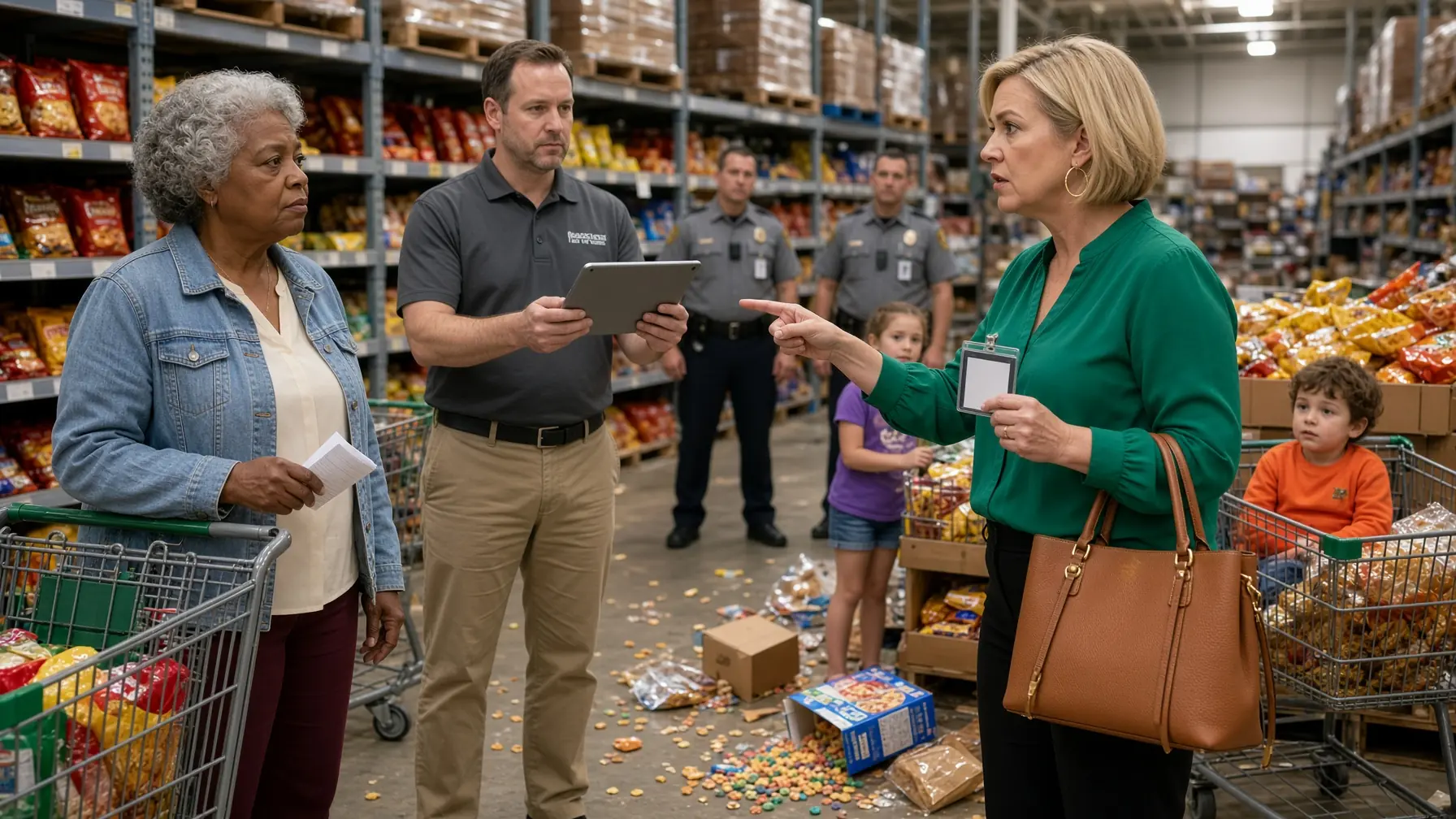
The second struck an elderly woman’s shopping cart. The third split when it landed, scattering cereal across the polished floor of Aisle Seven.
Madison Whitmore laughed and swept another row of boxes from the shelf with both arms.
Ten feet away, her younger brother kicked the front of their cart. Each impact rang through the aisle, accompanied by a shriek that made a woman pushing a stroller stop and turn around.
Their older brother ran past carrying an open bag of cheese puffs upside down.
Orange snacks bounced behind him. A man holding a basket flattened himself against a freezer door, and an employee at the far end of the aisle stared at the growing mess.
In the middle of it stood Karen Whitmore.
She was forty-two, with a stiff blonde bob, carefully arched eyebrows, and sunglasses pushed onto her head. Her pastel-pink blouse stretched across her shoulders, and gold bracelets clicked together whenever she moved a hand.
A laminated badge hung from her expensive handbag.
HOA PRESIDENT.
Karen looked irritated.
Not with the children.
With the shoppers who kept stopping to stare.
“Tyler.” She snapped her fingers at the nine-year-old. “Stay where I can see you.”
He glanced back, then disappeared around the end of the aisle.
Karen returned her attention to the shelf.
Her youngest son kicked again.
The cart rolled backward.
Eleanor Price caught it just before it struck her a second time.
For nearly two minutes, she had been trying to maneuver around the family without saying anything. At sixty-eight, she had learned that an ordinary shopping trip could become an unpleasant afternoon if she challenged the wrong person.
But the first impact hurt her hip.
The second would have hurt more.
“Excuse me.”
Karen turned slowly.
Eleanor kept her voice polite. Her folded grocery list rested between two fingers, its paper soft from being carried through the store.
“Would you mind asking your children to settle down?”
Karen stared as though Eleanor had requested something unreasonable.
“Excuse me?”
“The little boy nearly hit me with the cart.”
“He’s five.”
“I understand.”
“And?”
Eleanor looked down at the cereal, the crushed crackers, and the orange snacks scattered between them.
“They’re destroying the aisle.”
Karen’s eyebrows rose.
“They’re children.”
Eleanor waited for something to follow that explanation.
Nothing did.
Instead, Karen lifted her chin.
“If you can’t handle noise, stay home.”
A nearby shopper looked over.
Eleanor felt the familiar temptation to step aside and let someone else deal with it. She had a short list, a carton of milk already in her cart, and no desire to spend her Saturday arguing with a stranger.
But the cart had struck her.
There was broken packaging beneath the wheels.
And the little girl had already reached for another box.
“It isn’t the noise,” Eleanor said. “They’re destroying the aisle and frightening people.”
Karen stepped toward her.
Too close.
Her finger rose until it hovered inches from Eleanor’s face.
“You should be very careful how you speak to me.”
Eleanor looked at the finger, then at Karen.
“Why?”
The question appeared to offend Karen more than the original complaint.
She seized the badge hanging from her handbag and turned it outward.
“I run the homeowners association in Brookfield Estates.”
Eleanor glanced at it.
Then she looked around the aisle.
“This is a supermarket.”
Someone laughed quietly behind them.
Karen heard.
She turned sharply toward a man in a gray quarter-zip sweater standing beside his cart.
James Walker had been waiting almost three minutes to pass. At forty-five, he knew enough about difficult people to recognize that Karen’s badge was being offered as an answer to a question nobody had asked.
“She’s right,” he said.
Karen’s eyes widened.
James indicated the floor.
“Your children have opened food, thrown boxes, and knocked over that display.”
“They’re having fun.”
“They’re making everybody else miserable.”
Madison lifted another cereal box.
James held up one hand.
“Hey, please don’t—”
She threw it.
The box struck the edge of his cart and fell beside his shoe.
Karen laughed.
Not nervously.
Not apologetically.
She laughed as if Madison had supplied the right response to an irritating man.
James stared at her.