For forty minutes, Willa Foster’s boarding pass mattered less than a flight attendant’s suspicion. Thirty passengers watched a seventy-two-year-old woman explain, again and again, why she was sitting in a seat she had purchased six weeks earlier. Most looked away when she was finally told to gather her belongings. None of them knew where the three words she sent from row twenty-eight would lead—or what would happen before the aircraft door closed.
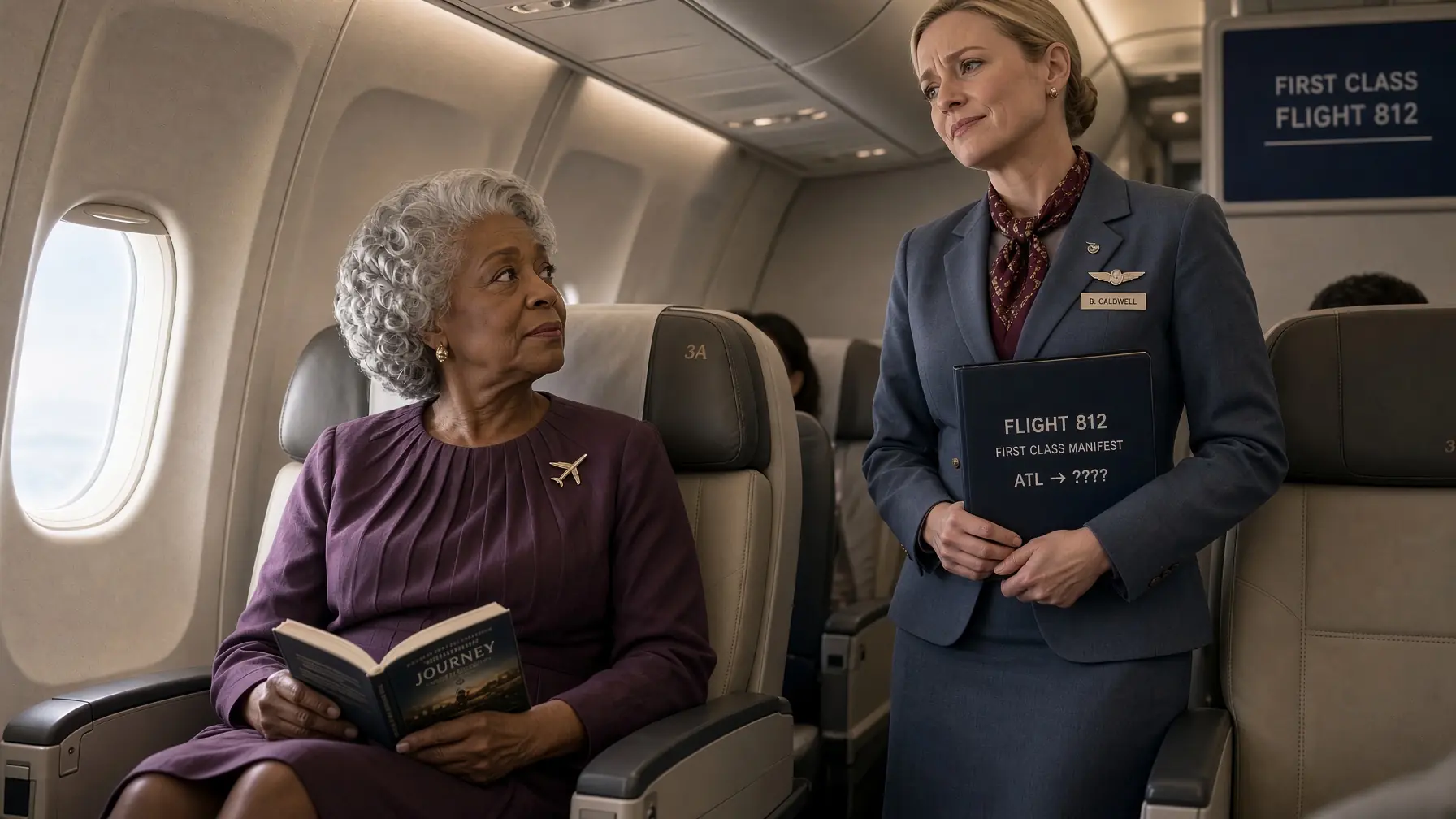
At 6:15 on Tuesday morning, Willa walked through Terminal B carrying a paperback, a handbag, and a small suitcase with one wheel that occasionally complained.
The wheel had made the same sound on three previous trips.
Her son had offered to replace the bag.
She had declined because the bag still closed, the handle still worked, and she did not believe a person needed a new possession every time an old one developed an opinion.
Besides, she knew where everything was.
Her medication rested in the inside pocket. Her boarding pass was tucked beside the paperback. The book contained a folded shopping receipt marking the page where she had stopped reading the night before.
She wore a modest navy dress, comfortable black shoes, and a gold airplane brooch near her collar.
The brooch was twenty-three years old.
Her husband had given it to her when their son, Nathan, came home wearing his first CrestView Airlines employee badge. Nathan had been twenty-two then, proud of a job loading luggage and slightly embarrassed that his parents had made an occasion of it.
Willa remembered him standing in their kitchen, tugging at the edge of the badge.
“It’s not a big job, Mama.”
“It’s your job.”
“I’m loading bags.”
“Then load them carefully.”
Her husband had laughed, handed her the little box, and told her to open it.
Inside was the airplane.
She pinned it to her dress while Nathan watched.
“Everybody has to start somewhere, baby.”
He smiled at that, though he tried not to.
Her husband had been gone several years now. Willa still touched the brooch before leaving for a flight, not because she believed it brought luck, but because it brought him into the morning.
She did so again near the gate.
Around her, travelers hurried with the anxious energy of people who believed arriving faster might change what the departure board said. Coffee smelled burnt, the floors smelled freshly cleaned, and a child nearby was objecting to the existence of shoes.
Willa understood him.
Her knees were less cooperative than they had once been.
She had purchased first class because the extra space helped, and because she had reached an age at which spending her own money on comfort did not require an apology. She had taught in Atlanta public schools for four decades, including thirty-eight years with fifth graders, and had retired with enough experience of discomfort to recognize a reasonable alternative.
Seat 3A.
Six weeks earlier, she had chosen it herself.
A window seat.
Room to settle her knees.
A place to read.
At the boarding podium, she handed over the pass.
The agent scanned it.
WILLA FOSTER.
3A.
FIRST CLASS.
The young employee looked from the screen to her face. Something like recognition passed across her expression, followed by a smile.
“Welcome aboard, Mrs. Foster.”
“Thank you, sweetheart.”
Willa stepped into the jet bridge.
She did not know whether the agent recognized the name, remembered her from another trip, or simply possessed good manners. Whatever the reason, the welcome made the morning feel easy.
She intended to keep it that way.
On Flight 812, she found 3A, placed her suitcase in the overhead bin, and settled beside the window. She put the handbag at her feet, adjusted the belt, and rested the book on her lap.
Outside, a baggage vehicle moved beneath the terminal windows.
For a moment, she thought of Nathan at twenty-two.
Then she opened the paperback.
She had saved it for the trip because she liked beginning a book somewhere she could not interrupt herself with laundry, dishes, or a neighbor asking whether she had seen the package left at the wrong door.
Three pages later, Brenda Caldwell reached the front cabin.
Brenda had worked for CrestView for twelve years.
She knew the service routine, the frequent travelers, the language used to make inconvenience sound effortless. Her uniform was immaculate, her movements practiced, and her smile appeared promptly whenever she recognized someone she considered worth remembering.
“Welcome back, Mr. Pennington.”
The businessman in 2C looked up.
“Good morning, Brenda.”
“Champagne?”
“You know me too well.”
She laughed.
Willa glanced up briefly, then returned to her book.
Brenda offered water to 1A, coffee to 2A, and a hot towel to 4C. When she reached row three, her eyes moved over Willa’s dress, the paperback, and the small bag beneath the seat.
She looked at the brooch.
Then she continued.
Willa watched her pass.
She had spent too much of her life in classrooms to miss the difference between an oversight and a choice. Teachers learned to recognize exclusion before children admitted practicing it.
The person whose hand never got called on.
The chair nobody invited someone to take.
The greeting distributed to everyone except one.
Still, a single missed offer could be a mistake.
Willa turned another page.
She did not want to begin the day by interpreting someone at her worst.
More passengers boarded.
A woman across the aisle struggled with a jacket while holding a phone. Willa offered to hold the jacket for a moment, and the woman thanked her without looking away from the screen.
An older man farther ahead asked for another cup.
Brenda supplied it.
Willa’s throat was dry.
She considered asking for water, then decided to wait until the attendant came back.
When Brenda returned ten minutes later, she carried no tray.
“Boarding pass.”
Willa looked up.