Legacy is not inherited.
Claire Moss learned that standing in a muddy field with a shovel in her hands while four grown men leaned against a fence and laughed at her.
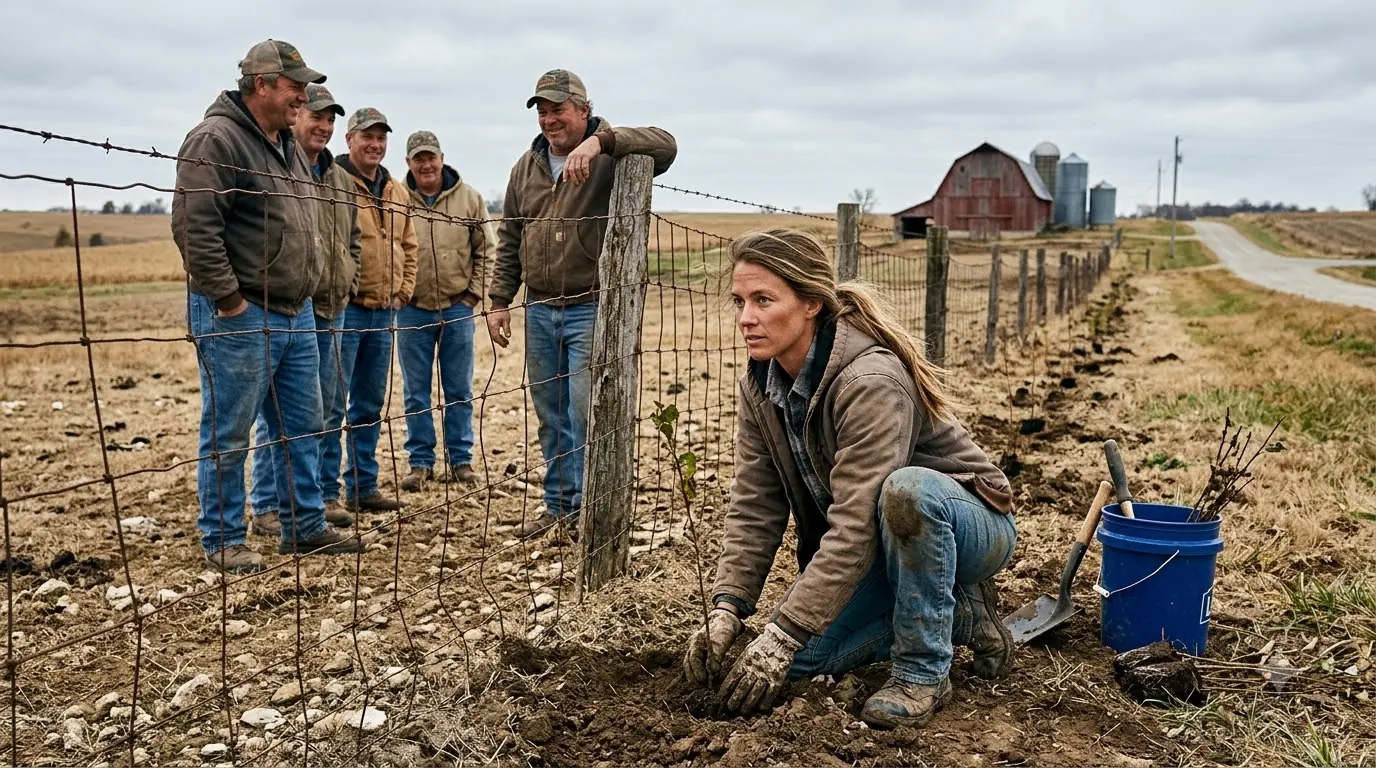
It was March of 2022, two weeks before Claire’s twenty-ninth birthday, and the wind coming across the eastern edge of Moss Farm was strong enough to pull loose strands of dark brown hair from beneath her cap.
At her feet lay the first of 340 saplings.
Most were barely taller than she was when kneeling.
Hawthorn.
Wild plum.
Serviceberry.
A few additional native shrubs selected with help from the county extension office to fill lower gaps and provide density close to the ground.
To Brad Cole, the whole thing looked ridiculous.
Brad farmed the neighboring property and had known Claire since she was a child. At fifty-three, he had spent nearly his entire life growing soybeans, corn, sweet corn, pumpkins, and vegetables on the same rolling ground outside Fulton, Missouri.
He was not stupid.
That was important.
Brad was experienced.
Successful enough.
Practical.
And completely certain Claire was making a mistake.
He stood on his side of the fence with three other farmers, Curtis Wade, Hal Mercer, and Gene Talbot, while Claire drove her shovel into the earth.
Brad pointed toward the young tree.
“You know what I see?”
Claire did not look up.
“A man avoiding his own work?”
Curtis laughed.
Brad ignored him.
“I see your best edge soil getting taken up by sticks.”
Claire pushed dirt around the roots.
“It isn't my best edge soil.”
“It could be.”
“No.”
“If you worked it.”
Claire straightened.
The eastern edge of Moss Farm stretched nearly half a mile from the county road to a shallow creek.
On paper, Brad had a point.
Every acre mattered.
Every row mattered.
Farm margins were thin, and the traditional advice in the area had always been simple.
Plant to the fence.
If equipment could reach it, use it.
If sunlight hit it, grow something that could be sold.
Trees belonged in woods.
Crops belonged in fields.
Claire looked toward the edge.
Thirty years earlier, topsoil along that boundary had been several inches deeper.
Her mother still had photographs.
Dark soil.
Thick.
Productive.
Then shelter trees farther east had been cleared from neighboring ground.
Open fields replaced pasture.
Wind gained an unobstructed path across nearly a mile of exposed land.
Spring winds moved soil.
Summer winds dried it.
Winter winds stripped anything left uncovered.
Slowly, the eastern edge of Moss Farm became lighter, thinner, harder.
By 2022, some sections had lost enough topsoil that pale subsoil showed through after cultivation.
Brad pointed again.
“Girl, you're wasting your best edge on sticks.”
Claire returned to the shovel.
“No.”
“What do you call it?”
“Protection.”
Brad laughed.
“Soil doesn't pay rent for protection.”
Claire pressed one boot against the shovel blade.
“You might want to remember saying that.”
Curtis grinned.
“Brad remembers nothing inconvenient.”
“I'm serious.”
Brad walked closer to the fence.
“You came home from college with all this theory.”
“Graduate school.”
“Whatever.”
“Agroforestry.”
“Trees in crop fields.”
“Trees beside crop fields.”
“Same difference.”
“No.”
Brad shook his head.
“You want advice?”
“No.”
“I'll give it anyway.”
“I assumed.”
“Rip that line back out before those roots get established.”
Claire glanced at him.
“Anything else?”
“Plant vegetables to the boundary.”
“The land is there.”
“Use it.”
Claire looked toward the next sapling.
Then another.
Three hundred thirty-eight still waiting.
“I am.”
Brad stared.
She went back to work.
That was the first morning.
He returned the second.
So did Curtis.
The men drank coffee beside Brad’s pickup while Claire planted.
By the third morning, Hal Mercer had brought a folding chair.
Claire looked over.
“Are tickets being sold?”
Hal raised his cup.
“Free entertainment.”
Claire smiled.
Then planted another tree.
Sapling by sapling.
Hole.
Roots.
Soil.
Water.
Stake.
Label.
Again.
Three days.
Three hundred forty trees and shrubs.
When Claire finished the last one, her palms were blistered beneath her gloves and every muscle in her lower back hurt.
Brad looked down the line.
The saplings appeared absurdly small against the open field.
Thin brown stems.
Tiny branches.
Protective tubes around some trunks.
Mulch circles.
Flags marking irrigation points.
Nothing about them looked capable of stopping anything.
Brad whistled.
“That’s your big plan?”
Claire leaned against the shovel.
“Part of it.”
“How long before it works?”
“Depends what you mean by works.”
“How long before those sticks make you money?”
Claire looked at the wind moving across the field.
“That isn't the first job.”
Brad shook his head.
“College.”
Then he climbed into his truck and drove away.
Claire watched him go.
She was not angry.
Mostly because she understood him.
Four years later, Brad Cole would drive past Moss Farm three times on the same harvest morning before finally pulling into the gravel lane.
By then, he would no longer be laughing.
But in March 2022, nobody knew that.
Not Brad.
Not Claire.
Not even James Reed, the extension agent who had helped her design the windbreak.
At that point, all they had was a theory, a plan, and 340 small trees bending in a hard Missouri wind.
Claire Moss had grown up on those 128 acres.
Her mother, Ruth, liked to say Claire learned to walk between vegetable rows because the farmhouse had too many sharp corners.
Her father, Daniel Moss, had been the farmer then.
At least that was how Claire remembered childhood.
Dad drove the tractor.
Dad handled planting.
Dad negotiated with buyers.
Dad repaired irrigation.
Dad decided when rain mattered and when everyone was worrying for nothing.
Ruth managed books, packing, payroll, and half the labor while somehow receiving a quarter of the credit.
Claire did not understand that until later.
Their farm was unusual for Callaway County.
Instead of depending entirely on row crops, Daniel and Ruth had gradually built a diversified operation.
Sweet corn.
Green beans.
Pumpkins.
Squash.
Tomatoes.
Peppers.
A smaller soybean rotation.
Several acres of cover crops every year.
Produce went to regional wholesalers, farmers markets, and eventually organic buyers.
Daniel liked the diversification when it worked.
He hated it when it didn't.
By 2012, several difficult seasons had stacked together.
Drought.
Equipment debt.
A bad wholesale contract.
Then a hailstorm damaged nearly an entire vegetable planting.
Daniel started changing.
He became impatient.
Angry.
He talked constantly about selling.
Ruth refused.
“This land isn't the problem.”
Daniel answered:
“The land is always the problem when the numbers don't work.”
Claire was nineteen then.
Home from college for the summer.
She remembered those arguments from the kitchen.
Low voices at first.
Then louder.
Daniel wanted to sell eighty acres to a developer from Columbia.
Ruth wanted to restructure debt and keep farming.
The marriage began cracking around the same time the business did.
In 2014, Daniel left.
Not died.
Not disappeared.
Left.
He took a job managing equipment for a large agricultural operation in Kansas.
Within a year, he and Ruth divorced.
Daniel continued speaking to Claire.
Birthday calls.
Christmas.
Occasional visits.
But he stopped being part of Moss Farm.
Ruth did not.
She was fifty at the time.
Most people assumed she would sell.
Brad Cole came over two weeks after Daniel moved out.
“You don't have to prove anything.”
Ruth looked at him from the porch.
“Who said I was proving something?”
“This place is too much for one person.”
“Then I suppose I should hire help.”
Brad laughed awkwardly.
“I mean financially.”
“So do I.”
Ruth kept the farm.
She renegotiated debt.
Sold an unused combine.
Dropped several low-margin crops.
Shifted more acreage toward organic vegetable production.
Hired carefully.
Worked brutally hard.
For eight years, she kept Moss Farm alive.
Claire watched from a distance.
She had left Missouri for school.
Agronomy first.
Then soil science.
Eventually agroforestry and sustainable land management.
At twenty-one, she thought leaving the farm meant escaping a narrow future.
By twenty-six, she realized almost every question that interested her led back to the same place.
Soil.
Water.
Wind.
Trees.
Field edges.
The relationship between land that produced immediately and land that protected production indirectly.