No one understood why the little girl walked toward the burned boy when every adult stepped away from him.
The summer afternoon at Hartley Estate should have been gentle.
The lawns of the great house in upstate New York shimmered beneath the soft light of late afternoon, trimmed so carefully they looked more like green velvet than grass.
White tents stood across the garden like elegant clouds lowered to earth. Silver trays flashed in the hands of servants.
Crystal glasses caught the sun. Ladies in pale dresses moved through the gathering with soft laughter, their parasols open above their heads, while gentlemen in dark coats spoke of railroads, banks, steel, and politics as if the future were a room to which only they had keys.
Everything was arranged.
Everything was observed.
Everything had rules.
Children were meant to play in neat little groups near the rose garden, watched by governesses and corrected by mothers whenever their voices rose too loudly.
Boys were told not to dirty their collars. Girls were told not to run. Every child was reminded, directly or indirectly, of who they were, what family they came from, and which friendships were suitable.
Eliza Hartwell had never been good at being suitable.
At six years old, she was small, bright-eyed, and restless, with a mind that moved faster than the adults around her preferred. She asked why guests were seated according to money instead of kindness. She wondered why servants had to stand while everyone else sat. She had once brought a plate of sugared cakes to the stable boy because she thought his birthday should matter just as much as hers.
Her mother had not been pleased.
“Curiosity brings trouble,” Mrs. Hartwell often told her.
But Eliza had already decided that most trouble came from people who were frightened of honest questions.
That afternoon, her white dress itched at the collar, and her shoes pinched her toes. A pale ribbon had been tied around her waist, another around her hair, both chosen by her mother and both much too perfect for a child who would rather be kneeling near the pond looking for frogs.
She tried to play with the other children for as long as she could.
They tossed hoops.
They chased butterflies.
They practiced the polite little games adults liked to watch.
But Eliza felt the old pull toward the edge of things, toward the places where people forgot to pretend.
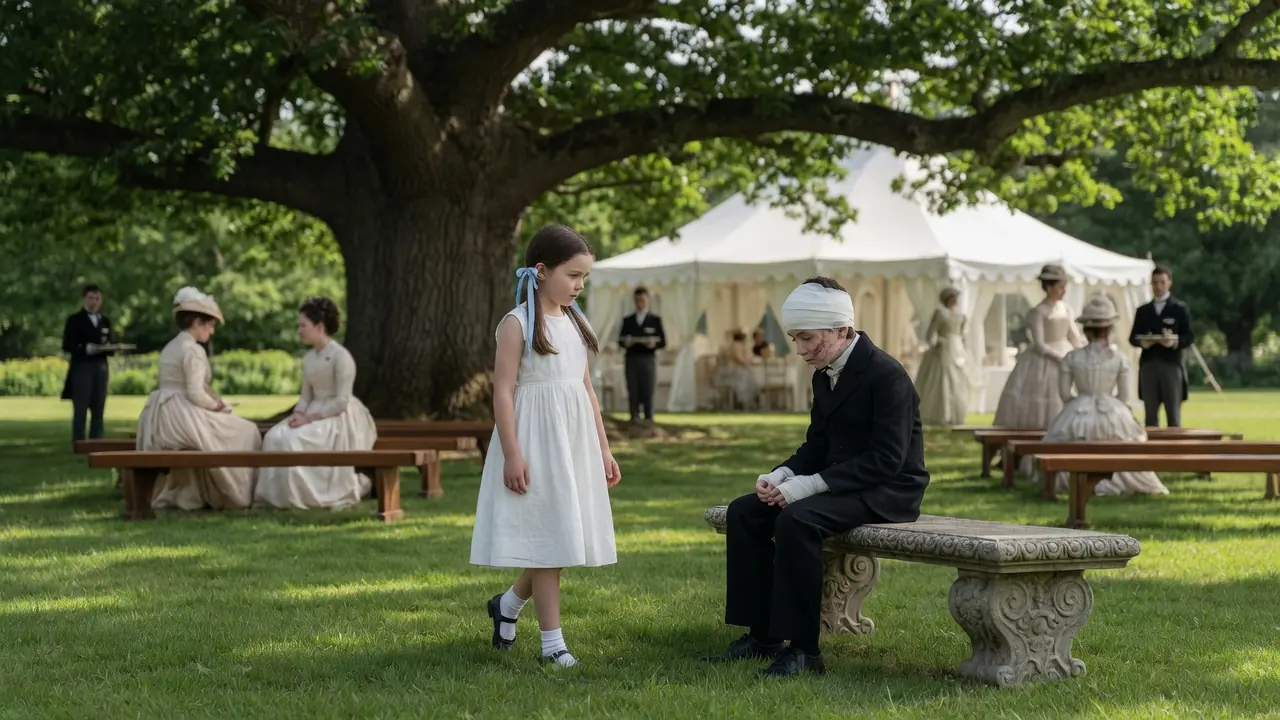
So when no one was looking closely, she slipped away from the lawn games and wandered toward the old oak tree at the far side of the garden.
The oak was enormous, older than the house itself, with thick branches that spread over the stone bench beneath it. The air was quieter there. The conversations from the tents became distant murmurs. The smell of roses faded into the scent of bark, grass, and warm earth.
That was where she saw him.
A boy sat alone on the stone bench beneath the tree.
He could not have been much older than ten, but he sat like someone who had already lived through something old and terrible. His body folded inward, shoulders curved, head lowered. Thick bandages wrapped one side of his head and neck, disappearing beneath the high collar of his coat. More bandages covered his hands, though burned skin showed through in places where the wrappings had shifted.
Red and white patches marked his face where the fire had touched him. The skin looked raw in some places, tight and shiny in others. One eye was partly hidden by the bandage, but the other stared at the ground with a stillness that did not belong to a child.
Eliza stopped.
Not because she was afraid.
Because she understood, even at six, that she had come upon someone who had been left alone on purpose.
Earlier, she had heard whispers near the lemonade table.
A fire.
A terrible accident.
His parents dead.
The boy survived, poor thing.
Scarred for life.
Never the same.
People used soft voices when they spoke of him, as though softness could make cruelty gentle. But they had not sat with him. They had not spoken to him. The other children had stared until their nurses pulled them away. The adults had looked quickly, then looked elsewhere.
Eliza heard no kindness in their words.
Only distance.
The boy knew it too.
She could tell by the way he sat, as if he were trying to make himself smaller than his pain.
Eliza took one step toward him.
Then another.
Behind her, someone called for a child to come back to the croquet lawn, but no one called her name yet. No one noticed that she had crossed the invisible line between proper and improper.
She approached the bench slowly, the way she approached injured birds near the barn at home. Not too fast. Not too loud. No sudden movements. Just enough presence to let the frightened creature know it was not alone.
The boy did not look up when she sat beside him.
He stiffened slightly, but he did not move away.
For several moments, Eliza said nothing. She swung her feet lightly above the grass and watched a line of ants moving along the edge of the stone bench. She did not stare at his face. She did not gasp. She did not ask what happened.
Then, in the plain, steady voice of a child who had not yet learned to hide honest concern behind manners, she asked, “Does it hurt?”
The boy flinched.
His visible eye shifted toward her, then quickly away.
He said nothing.
Eliza waited.
The silence did not frighten her. Adults were always filling silence with meaningless words. Eliza often thought silence was better when something important was happening.
“My knee hurt terribly once,” she continued after a while. “I fell from the orchard wall because I wanted to see if I could climb like the boys. Mama said I was foolish. Papa said I was brave. I think I was both.”
The boy’s fingers moved slightly in his lap.
They were stiff, damaged, wrapped in linen, but the small movement told Eliza he was listening.
She reached into the pocket of her dress and pulled out a pale blue ribbon.
It was not the ribbon from her hair. That one was white and tied too tightly. The blue ribbon was one she had hidden away earlier after finding it among the decorations. It was silk, smooth and soft, the color of morning sky before clouds gathered.
She had taken it because it felt important.
Now she understood why.
“My mama says pretty things help when you are sad,” Eliza said.
The boy turned his head slowly.
For the first time, he looked directly at her.
His face was wounded and frightening only because adults had taught everyone to see it that way. But Eliza saw his eye first. It was gray, dark at the edges, watchful and exhausted. There was fear in it, but not the fear of the weak. It was the fear of someone who had already learned that people could hurt without touching.
Eliza held out the ribbon.
The boy looked at the ribbon as if she were offering him something impossible.
His scarred fingers reached for it slowly. The movement seemed painful. He took the ribbon with extreme care, as if it might vanish if handled too roughly.
“What is your name?” Eliza asked.
For a moment, she thought he would not answer.
Then he said, “Sebastian.”
His voice was low, roughened by disuse or pain.
“Sebastian,” she repeated, testing the name and deciding she liked it. “I am Eliza.”
He nodded once.
“Everyone keeps looking at me,” he said.
It was not a complaint.
It was a fact.
Eliza glanced toward the lawn, where a woman was pretending not to stare while speaking to another lady behind a fan.
“Yes,” Eliza said. “Adults are very rude when they are pretending to be polite.”
Something moved across Sebastian’s face.
Not quite a smile.
But almost.
Eliza felt encouraged.
“When I grow up,” she said with absolute certainty, “I will marry you.”
Sebastian stared at her.
The gray eye widened.
“That is a foolish thing to say,” he whispered.
“No, it is not,” Eliza replied. “I like you.”
“You do not know me.”
“I know you are sad. I know everyone left you alone. I know you did not laugh when I said my knee hurt. That is enough for today.”
He looked down at the ribbon again.
Eliza leaned closer, lowering her voice as if making a sacred vow.
“Take this ribbon. It is a promise.”
For one brief moment, Sebastian Winterborne forgot the fire.
He forgot the night of smoke and screaming.
He forgot the searing heat, the doctors holding him down, the smell of medicine, the way servants had cried when they thought he was sleeping.
He forgot the way mirrors had been covered after he came home.
He forgot the way people now spoke over him, around him, about him, but rarely to him.
For one brief moment, he was simply a boy on a summer afternoon, sitting beneath an oak tree while a fearless little girl handed him a ribbon and promised him a future.
Then a sharp voice cut across the garden.
“Eliza.”
The sound cracked through the air like a whip.
Eliza turned.
Her mother was coming toward them fast, her face tight with fear and anger mixed so thoroughly that even a child could feel the danger in it. Her pale skirts brushed the grass. Her gloved hands clenched at her sides.
“Eliza Hartwell, come away from there this instant.”
Eliza frowned. “Mama, this is Sebastian.”
“I said come away.”
Mrs. Hartwell reached them and grabbed Eliza by the arm.
The grip was hard enough to hurt.
Eliza cried out, not from the pain alone, but from confusion.
“I was only talking to him.”
“You do not touch him,” her mother said through clenched teeth. “You do not sit alone with strange boys. You do not make spectacles of yourself.”
“He is lonely,” Eliza protested, trying to twist back toward him.
Mrs. Hartwell pulled harder.
“Get away from him.”
Sebastian sat perfectly still.
He had gone pale beneath the scarred patches of skin.
The ribbon remained clenched in his damaged hand.
Eliza reached back toward him as her mother dragged her away.
“Sebastian,” she called, tears spilling now. “Keep it. Do not lose it.”
But her mother turned her sharply, blocking her view.
The whispers began before they had even crossed the lawn.
Poor Mrs. Hartwell.
The child has no sense.
That burned boy must be kept apart.
What a terrible thing.
Sebastian heard them all.
Children hear more than adults believe.
He watched Eliza disappear into the brightness of the garden, watched her mother bend low and speak harshly into her ear, watched Eliza shake her head and cry.
Then he looked down at the blue ribbon in his hand.
Something inside him, something still soft from childhood, tried to reach toward the memory of her kindness.
But around it, something else began to form.
A shell.
A wall.
A lesson.
Kindness was rare.
Fear was common.
And fear, he would one day learn, could be shaped into power.
He tucked the ribbon into the inner pocket of his coat, pressing it close to his heart where no one could see.
No one would take it from him.
No one would know what it meant.
Eighteen years passed.
By the autumn of 1893, Sebastian Winterborne was no longer the burned child beneath the oak tree.
He was the Duke of Winterborne, master of one of the largest private estates in the Hudson Valley. Winterborne Hall stood on a rise above the river, built of gray stone and black iron, its towers rising like a warning against the sky. The estate covered thousands of acres of woodland, pasture, orchards, and formal gardens. But the land was only a visible fraction of his power.
Sebastian owned rail interests that moved freight across the eastern states. He held shares in mines, banks, shipping companies, textile mills, and newspapers. Men in New York, Boston, Philadelphia, and London spoke his name with caution.
Some called him brilliant.
Some called him merciless.
Many called him a monster, though never where he could hear.
He did not attend society events.
He did not host parties.
He did not sit for portraits, smile for newspapers, or open his house to curious guests. The world had stared at him enough when he was a child. He saw no reason to invite more eyes.
His scars had not faded. They had changed, settled, hardened. They ran from his left temple to his jaw, down the side of his neck, across his hands. The skin pulled slightly when he turned his head. One side of his mouth did not soften easily. His left hand, though strong, never moved with the ease of the right.
People tried not to stare.
They failed.
Sebastian had learned to use that failure.
In business meetings, he remained silent and allowed men to grow uncomfortable beneath the weight of his gaze. They spoke too quickly. They overexplained. They revealed weaknesses he could later exploit. He negotiated with the patience of a man who had outlived pity and found no use for charm.
He destroyed rivals without raising his voice.
He rewarded loyalty with equal precision.
At Winterborne Hall, the servants did not fear him the way society did. They respected him. He paid well. He listened to practical concerns. He never tolerated cruelty among his staff. A footman who struck a kitchen maid was dismissed before sunset and never found respectable employment again. A housekeeper who quietly supported a widowed sister received a pension without explanation. Stable boys with clever hands were apprenticed properly.
Sebastian protected those under his roof.
He simply did not ask to be loved.
Love, he had decided, was for people whose faces did not make rooms fall silent.
Late at night, when Winterborne Hall slept and the lamps burned low in his study, Sebastian sometimes opened a small wooden box he kept locked in the bottom drawer of his desk.
Inside lay a pale blue ribbon.
It had faded over the years, the silk no longer as bright as morning sky. But it remained soft beneath his scarred fingertips. He touched it rarely, and only when he was certain he was alone.
He told himself it was a relic of foolishness.
A reminder of a time when he had believed kindness could mean something lasting.
A warning against weakness.
He told himself the girl had forgotten him.
Of course she had.
Children made promises the way birds scattered seed, without knowing what might take root.
Eliza Hartwell had likely become a proper woman by now, married to some polished gentleman approved by her mother, living behind fine curtains, remembering nothing of the burned boy beneath the oak.
That belief protected him.
Until an October morning shattered it.
Sebastian was in his study reviewing rail contracts when Harrison, his estate manager, entered with unusual hesitation.
Harrison was not a hesitant man. He had served the Winterborne family for twenty-two years and knew better than to interrupt unless the matter required attention.
Sebastian did not look up at first.
“What is it?”
“There is an artist on the grounds, Your Grace.”
Sebastian’s pen stopped.
“An artist.”
“Yes, Your Grace. From New York City. Commissioned by the Historical Estates Society.”
“I approved no such thing.”
Harrison’s jaw tightened slightly.
“It appears a junior clerk responded to the society in error. The appointment was confirmed under the assumption that Your Grace had agreed to contribute a portrait to their archive of notable estates and families.”
Sebastian looked up slowly.
“And no one thought to confirm this with me?”
Harrison lowered his eyes.
“The clerk has already been dismissed from administrative duty and reassigned to accounts review.”
Sebastian leaned back in his chair.
He hated portraits.
He hated sitting still while someone studied his face under the excuse of art. He hated the pretense that paint could turn discomfort into dignity.
“Send the artist away.”
Harrison hesitated again.
“She has traveled from New York, Your Grace. She is already set up in the east gallery. The society has announced the commission.”
Sebastian’s expression cooled further.
Refusal would create attention.
Attention would lead to letters, gossip, public speculation, perhaps even newspaper mention. The Historical Estates Society was full of old women with money and younger men seeking it. They would not let the matter die quietly.
“One portrait,” Sebastian said. “No more. She may paint the house, the grounds, whatever stone and furniture satisfy the society. I will not sit for hours like an exhibit.”
“Yes, Your Grace.”
“What is her name?”
Harrison checked the card in his hand.
“Eliza Hartwell.”
Sebastian went still.
The name moved through the study like a ghost.
Harrison, who missed very little, noticed the change but wisely said nothing.
Sebastian lowered his gaze back to the papers before him.
“Leave me.”
When the door closed, he remained motionless for a long time.
Eliza Hartwell.
It was not an uncommon enough name to prove anything.
Still, the past had risen too quickly.
The oak tree.
The blue ribbon.
The small voice saying, When I grow up, I will marry you.
Impossible.
He returned to his contracts, but the numbers blurred.
Several hours passed before curiosity overcame discipline.
Sebastian left his study and moved through the quiet corridors of Winterborne Hall. His footsteps made almost no sound on the long carpets. He passed portraits of severe ancestors, suits of armor, marble busts, and windows looking out over lawns scattered with copper leaves.
The east gallery had been opened for morning light.
He stopped at the doorway.
A woman stood inside with her back to him.
She was not dressed like the society artists he had occasionally seen in New York. There was nothing theatrical about her. She wore a simple gray dress marked with faint smears of paint at the cuffs. Her dark hair was pinned at the nape of her neck, though a few strands had escaped near her cheek. She stood before a large canvas, studying not the grandest portrait in the room, but the light falling across a cracked marble column.
Her posture was focused.
Self-possessed.
She turned when he cleared his throat.
For one suspended second, Sebastian forgot how to breathe.
She was no longer the child from Hartley Estate.
Of course she was not.
But the eyes were the same.
Clear.
Unflinching.
Kind without softness.
She dipped into a neat curtsy.
“Your Grace,” she said calmly. “I am Eliza Hartwell. I will be painting your portrait.”
Sebastian studied her face, waiting for the usual reaction.
There was always a reaction.
A small widening of the eyes.
A tightening of the mouth.
A forced politeness that arrived half a second too late.
Eliza did not flinch.
She looked at him as she might look at a landscape, a structure, a person who existed fully before her. She did not look away from his scars, but neither did she stare at them as though they were all he was.
“I approved no portrait,” he said.
“So I was informed after arriving,” she replied.
Her tone held no apology for being there, only acknowledgment of inconvenience.
“The society commission requires a likeness. I understand Your Grace dislikes such work. I require three sittings. Morning light works best. I work quickly.”
Sebastian almost laughed.
No one gave him instructions in his own house.
Yet she did.
Quietly.
Practically.
Without fear.
“Three sittings,” he said.
“If you remain still.”
This time, he did laugh, but only once, a sound so unused that it startled even him.
Eliza’s mouth curved slightly.
“Tomorrow morning, then?” she asked.
Sebastian felt something shift beneath his ribs.
“Very well. Tomorrow.”
That night, he slept poorly.
The blue ribbon lay in its wooden box inside his locked desk, but he felt its presence like a living thing.
The next morning came gray and cool.
Sebastian dressed with more care than usual, then was irritated with himself for noticing. He chose a black coat, dark waistcoat, white shirt, and gloves, though he removed the gloves before entering the gallery. Let her paint what she had agreed to paint. Let her see the scars on his hands as well as his face.
Eliza was already there.
She had arranged her easel near the tall windows. Charcoal sticks, brushes, rags, and pigments lay in careful order. A chair had been placed where the light would strike him from the right, leaving the scarred side of his face partially shadowed.
Sebastian noticed immediately.
“You intend to hide it.”
Eliza looked up.
“No. I intend to let the light tell the truth gradually.”
“There is no need for delicacy.”
“I do not paint delicately, Your Grace. I paint accurately.”
He held her gaze.
Then he sat.
For the first half hour, the only sounds were charcoal over canvas, the faint crackle of the hearth, and rain tapping lightly against the gallery windows.
Eliza worked with intense concentration. She looked at him often, but never in the manner of the curious or the cruel. She studied structure, light, expression. The angle of his jaw. The tension in his hands. The weight behind his eyes.
At last, Sebastian said, “People usually ask.”
“Ask what?”
“How it happened.”
“I know how fire happens,” she said.
“That is not the same thing.”
“No,” she agreed. “But I assumed you would tell me if you wished to be known that way.”
No one had ever phrased it like that.
Known that way.
As if his pain were not public property.
Sebastian looked toward the window.
“My parents died in the fire,” he said after a long silence. “I survived because a footman carried me through a collapsed corridor. He died three days later from the smoke.”
Eliza’s hand stilled only for a moment before she resumed drawing.
“I am sorry.”
“So everyone said.”
“I imagine most of them said it badly.”
He looked at her then.
Her eyes remained on the canvas, but her expression had softened.
“Yes,” he said. “Most did.”
Over the next sittings, Sebastian spoke more than he intended.
He told her fragments first. Then longer pieces.
The fire had started in the west wing of his family’s old house. No one ever proved whether it had been a lamp, a servant’s negligence, or faulty wiring installed too quickly because his father liked modern things. Sebastian remembered heat. Smoke. His mother’s voice. His father shouting for someone to open a door that had already warped shut. He remembered pain only in pieces, the mind merciful in its violence.
He remembered waking weeks later and learning he was heir to everything.
He remembered a mirror being removed from his room.
He remembered the first visitor who looked at him and cried.
After that, he preferred fear.
Fear was cleaner than pity.
Eliza listened.
Sometimes she asked a question, but never too many. Sometimes she said nothing at all, and her silence became a place where truth could rest.
Days passed.
Then weeks.
The portrait grew on the canvas.
The man who emerged there was not handsome in the ordinary way society admired. He was not softened or disguised. The scars remained. The tension remained. But Eliza had painted him with command, sorrow, intelligence, and a kind of contained force that made the viewer unable to dismiss him.
He looked wounded and powerful.
Human and untouchable.
Alive.
One afternoon, as autumn leaves fell slowly beyond the gallery windows, Sebastian mentioned Hartley Estate.
He had not meant to.
The name appeared between them as if spoken by the past.
Eliza went still.
Her brush lowered.
“What did you say?” she asked.
“Hartley Estate,” Sebastian said carefully. “I attended a garden party there once as a child. After the fire.”
Eliza turned fully toward him.
All the color had left her face.
“I was there,” she said.
Sebastian’s breath caught.
The room seemed to shift around him.
“Yes,” he said. “I know.”
Her voice trembled, but only slightly.
“I never forgot you.”
The words struck him harder than any insult ever had.
He stood from the chair.
Eliza set down her brush and stepped away from the canvas.
“I searched for you for years,” she continued. “At first, I did not know enough. Only your first name. Only that there had been a fire. Only that my mother dragged me away before I could ask more.”
Sebastian stared at her.
“You were six.”
“I was old enough to know cruelty when I saw it.”
He looked down at his hands.
“You made a childish promise.”
“I made a true one.”
The silence that followed was not empty.
It was filled with eighteen years.
Eliza pressed her hands together at her waist.
“When I was older, I asked questions. My mother forbade it. My father avoided the subject. Servants remembered more than they were supposed to. Eventually, I learned your surname. Then your title. Then I learned you had withdrawn from society.”
“You should have let the matter die.”
“I tried.”
Her eyes shone now.
“I could not.”
Sebastian turned away sharply and walked to the window.
His reflection appeared in the glass, distorted by rain, scars and shadow merging into something almost unrecognizable.
“I kept it,” he said.
Eliza took one careful step toward him.
“What?”
“The ribbon.”
Behind him, he heard her breath catch.
He crossed the gallery, opened the door to the adjoining study, and returned with the small wooden box. He had not planned to bring it. He had not planned for any of this.
But there it was in his hand, the old wood smooth from years of touch.
He opened it.
The faded blue ribbon lay inside.
Eliza lifted one hand to her mouth.
For the first time since he had known her as a woman, she looked like the child beneath the oak tree.
Wounded by memory.
Brave anyway.
Sebastian lifted the ribbon and placed it in her palm.
Her fingers closed around it.
Tears slid down her face without sound.
“I meant it,” she whispered. “I meant every word.”
Sebastian’s voice was rough.
“So did I.”
The distance between them closed slowly, as if neither trusted the world not to interrupt again.
Eliza touched his scarred hand first.
Not his sleeve.
Not his shoulder.
His hand.
She lifted it and pressed her lips to the damaged knuckles.
Sebastian shut his eyes.
No one had ever touched him that way.
Without hesitation.
Without pity.
Without fear.
His other hand rose to her face, uncertain at first, then steadier when she leaned into him. When he kissed her, it was careful, almost reverent, as if afraid that the moment might vanish if held too tightly.
Eliza answered with all the certainty of the child who had once handed him a ribbon and promised him a future.
For a while afterward, they did not speak.
Words would have made the moment smaller.
The days that followed changed Winterborne Hall.
Not outwardly.
The house remained grand and severe. Servants continued their work. Business letters arrived. Carriages came and went. But inside the east gallery, something long frozen began to thaw.
Sebastian stayed longer than the sittings required.
Eliza painted and spoke. He watched her mix colors, sharpen charcoal, scrape away mistakes, begin again. She spoke of New York, of studying art despite her mother’s disapproval, of painting portraits to support herself after her father’s death left the family fortunes thinner than appearances suggested.
“My mother wanted me to marry well,” Eliza said one morning.
“And did you disappoint her?”
“Constantly.”
He smiled faintly.
“Good.”
Eliza looked up from the canvas.
“She still believes life is a room where women must wait to be chosen. I never liked waiting.”
“No,” Sebastian said. “I imagine you walked straight toward whatever everyone told you to avoid.”
She smiled.
“Only when it mattered.”
Their happiness was quiet because both understood how fragile it felt.
Sebastian had lived too long without hope to trust it easily. He sometimes withdrew without warning, retreating behind formality when emotion came too close. Eliza did not chase him with demands. She waited, then reached for him in simple ways.
A hand on his sleeve.
Tea left beside his papers.
A question asked without pressure.
He learned, slowly, that being loved did not mean being invaded.
Eliza learned, slowly, that loving Sebastian meant accepting his silences as part of him, not proof of rejection.
But the world rarely lets private happiness remain untouched.
Lord Ashford arrived in November.
He came for business, or so the letter claimed, though Sebastian suspected the man never did anything for one reason only. Ashford was a minor noble with a large appetite for advancement and the sort of beauty that made society forgive his emptiness. Tall, golden-haired, charming, graceful, he looked like the hero of a painting and spoke like a man who expected admiration before earning it.
He noticed Eliza immediately.
Of course he did.
She was working in the gallery when Ashford entered beside Sebastian. She wore a dark blue dress that day, paint on one cuff, her hair pinned loosely. Sunlight touched her face through the tall windows.
Ashford stopped mid-sentence.
“And who is this?”
Sebastian’s voice cooled.
“Miss Hartwell. The artist commissioned by the Historical Estates Society.”
Ashford bowed over her hand a fraction too long.
“An artist? How fortunate for Winterborne Hall. Beauty creating beauty.”
Eliza withdrew her hand politely.
“How fortunate for beauty that it does not depend on flattery, my lord.”
Sebastian nearly smiled.
Ashford’s interest sharpened.
Over the next several days, Ashford lingered wherever Eliza worked. He offered compliments too smooth to be innocent. He asked about her training, her ambitions, whether she intended to exhibit in London. He spoke of galleries, patrons, introductions he might provide.
Eliza remained polite.
Distant.
But Sebastian watched from the shadows, feeling something unfamiliar tighten in his chest.
Jealousy was new to him.
He had desired power, revenge, silence, solitude.
He had never desired a person before Eliza.
He had never known the primitive fear of seeing another man stand too close to the only person who had ever looked at him without fear.
One afternoon, he found Ashford walking with Eliza in the garden.
The trees were nearly bare. The air smelled of frost and damp leaves. Ashford’s hand rested lightly on Eliza’s arm as he bent toward her, smiling.
Sebastian crossed the lawn with cold purpose.
Eliza saw him first.
There was no guilt in her face.
Only surprise, then understanding.
Ashford turned.
“Your Grace.”
Sebastian did not look at Eliza. He looked only at Ashford.
“You are dismissed.”
Ashford’s smile faltered.
“I beg your pardon?”
“You have concluded your business here.”
“I was under the impression our discussion would continue through Friday.”
“You were mistaken.”
Ashford’s gaze flicked to Eliza, then back to Sebastian.
The calculation in his eyes was quick and ugly.
“Of course, Your Grace.”
He bowed.
When he left, Eliza turned to Sebastian.
“You are angry.”
“I am protective.”
“You are jealous.”
He said nothing.
Eliza stepped closer.
“You do not need to be.”
Sebastian’s jaw tightened.
“He is everything society would prefer for you.”
“That may be the least persuasive sentence you have ever spoken.”
“He is handsome.”
“So are statues. I do not wish to marry one.”
Sebastian looked at her sharply.
The word hung there.
Marry.
Eliza did not take it back.
That night, in the quiet of Winterborne Hall, Sebastian came to her in the gallery.
She had stayed late, working by lamplight. The portrait was nearly finished. His painted likeness stared from the canvas with a calm, commanding expression that unsettled him.
Eliza turned when he entered.
He stood in the doorway, scarred hands bare, face half-shadowed.
“I have little gentleness to offer,” he said.
She set down her brush.
“That is not true.”
“I am not easy.”
“I know.”
“I will frighten people who stand near you.”
“Let them be frightened.”
“I will ruin anyone who harms you.”
Eliza’s mouth softened.
“That, I believe.”
Sebastian crossed the room.
“When I was a boy, I thought your promise was the only kind thing the world had left to give me. Then I spent years telling myself I was a fool for believing in it.”
Eliza’s eyes glistened.
“You were not a fool.”
“I do not know how to ask gently.”
“Then ask honestly.”
He took her hands.
“Marry me.”
Eliza smiled through sudden tears.
“Yes.”
His breath left him as if he had been struck.
“I have been waiting,” she said.
Their engagement was not announced with grand spectacle. Sebastian disliked public declarations, and Eliza had no need for society’s approval. But word spread because word always spread when power and romance crossed paths.
New York society became fascinated.
The scarred Duke of Winterborne was to marry an artist.
A Hartwell girl.
The same Eliza Hartwell who had once refused three proposals and scandalized her mother by earning her own living.
Invitations arrived immediately. Letters. Requests. Congratulations written in elegant ink and poisoned with curiosity.
Sebastian wanted to ignore them all.
Eliza read them with amusement.
“They want to see if I am desperate or mad,” she said.
“They will see neither.”
“What will they see?”
“My future wife.”
The first public appearance came at a grand ballroom in New York City, hosted by one of the old banking families who feared Sebastian too much not to invite him and loved gossip too much not to hope he would attend.
Sebastian entered with Eliza on his arm.
The room changed instantly.
Conversations thinned.
Fans lifted.
Eyes turned.
Sebastian felt the old familiar pressure of being seen.
But Eliza’s hand rested firmly on his sleeve.
She did not shrink.
She did not look apologetic.
She walked beside him as if there were no safer place in the world.
That steadied him more than he expected.
Then Eliza’s mother appeared.
Mrs. Hartwell had aged without softening. Her hair was silver now, her posture rigid, her mouth still shaped for disapproval. She stopped across the ballroom when she saw them, shock flashing across her face before hardening into anger.
She approached as if drawn by outrage.
“Eliza.”
Eliza turned.
“Mother.”
Mrs. Hartwell’s gaze slid over Sebastian and away, as if refusing to acknowledge him properly.
“You are making a grave mistake.”
Sebastian felt Eliza’s hand tighten slightly.
“Am I?”
“You cannot possibly intend to go through with this.”
Eliza’s voice remained calm.
“I do.”
“You are throwing yourself away.”
That was when Sebastian moved.
Not dramatically.
Only half a step forward.
But the air around them changed.
Mrs. Hartwell finally looked at him.
Really looked.
Sebastian’s voice was quiet.
“Madam, you will leave us.”
Her face flushed.
“I am speaking to my daughter.”
“You are insulting my future wife.”
“She is blinded by foolish sentiment.”
“No,” Sebastian said. “She sees with unusual clarity. That has always been your problem with her.”
The surrounding guests had gone silent.
Mrs. Hartwell’s lips parted.
Sebastian continued, each word precise.
“Eighteen years ago, you dragged a child away from me because my face offended your sense of comfort. I was ten years old. Your daughter was the only person in that garden with courage enough to be kind. You did not protect her from me. You tried to protect her from becoming someone better than you.”
Mrs. Hartwell went pale.
Eliza whispered, “Sebastian.”
But he did not stop.
“You will not speak to her that way again. You will not approach her without invitation. You will not poison what you failed to understand.”
Mrs. Hartwell looked around and saw everyone watching.
For once, judgment did not favor her.
She turned sharply and left the ballroom.
Eliza stood very still.
Sebastian looked down at her.
“I apologize if I overstepped.”
She shook her head.
“No one has ever defended that child before.”
His expression softened.
“I should have done it eighteen years ago.”
“You were the child too.”
A few weeks later, they married at Winterborne Hall.
There were no crowds.
No spectacle.
No society columns invited to record the flowers, the gown, or the guest list. Only those who truly mattered were present. Harrison stood as witness for Sebastian. Eliza’s old art instructor came from New York and cried quietly into a handkerchief. Several servants watched from the back of the chapel, pretending they were there for practical reasons.
Eliza wore ivory silk with no jewels except a small blue ribbon sewn inside the bodice where only she and Sebastian knew it rested.
Sebastian wore black.
When he saw her walking toward him, something in his face changed so completely that the old chapel seemed to warm.
Their vows were simple.
Absolute.
When Sebastian promised to honor and protect her, his voice did not tremble. But when Eliza promised to love him in all seasons, scar and shadow, power and silence, the hand holding hers tightened.
After the ceremony, they returned to the east gallery alone.
The finished portrait stood covered by a cloth.
Eliza removed the covering.
Sebastian stared.
The man on the canvas looked scarred, yes.
But not ruined.
He looked like someone who had survived the fire and then survived the world after it. Someone powerful not because he inspired fear, but because he had endured what fear tried to make of him.
Eliza came to stand beside him.
“You see me?” he asked quietly.
“I always did.”
Marriage did not soften Sebastian Winterborne.
It sharpened him.
The world expected Eliza to disappear into his shadow, to become the silent Duchess of Winterborne, beautiful and decorative beside a frightening husband. Instead, she became a force.
Winterborne Hall changed under her presence.
Not all at once.
Gradually.
Rooms that had remained closed for years were opened. Curtains were drawn back. Music returned to the drawing room. Artists visited. Writers came. Young women with talent but no family support were invited to study, paint, and work under Eliza’s patronage.
Sebastian funded every endeavor without hesitation.
When a critic in New York mocked Eliza’s first major exhibition after marriage, suggesting the Duchess had mistaken sympathy for talent, Sebastian asked only one question.
“Does he depend on any paper I own?”
The critic’s editor received new instructions by morning.
Eliza scolded him lightly when she learned.
“You cannot destroy every man who dislikes my work.”
“I did not destroy him. I educated his employer.”
“Sebastian.”
“He was imprecise.”
Despite herself, she laughed.
That laugh became one of Sebastian’s favorite sounds.
Their marriage was not effortless. No true marriage is.
Sebastian still withdrew at times. There were mornings when old memories returned with the smell of smoke from a distant chimney. There were nights when he woke with his hand clenched around nothing, his body ready to run from a fire long extinguished.
Eliza learned not to startle him awake.
She learned to place her hand gently near his and wait until he found the present again.
He learned to speak before silence became a wall.
He learned that Eliza was not frightened by grief, not bored by pain, not fragile before truth.
Slowly, the rooms inside him he had locked after childhood began to open.
One year after their wedding, Eliza found him in his study holding the wooden box.
The blue ribbon lay across his palm.
Beside it, now, was a white ribbon from their wedding day.
She came to sit beside him.
“You were thinking again,” she said.
“I was remembering.”
“Do you regret anything?”
He considered the question carefully.
There were many things he could regret.
The years of loneliness.
The hardness he had mistaken for safety.
The people he had punished too severely because mercy had once seemed dangerous.
But at last he said, “I regret believing kindness was weakness.”
Eliza leaned her head against his shoulder.
“Sometimes kindness is the bravest thing a person can offer.”
He looked at the ribbons.
“A child taught me that once.”
“She was very wise.”
“She was very stubborn.”
“That too.”
Sebastian kissed her hair.
In time, the story of the Duke and Duchess of Winterborne spread beyond society gossip.
People liked to speak of it as romance, and it was. They liked to speak of it as fate, and perhaps it was that too.
But those who knew them understood something deeper.
Their love had begun not with beauty, wealth, or ambition.
It had begun with a child refusing to look away.
A six-year-old girl had walked toward a burned boy when every adult stepped back.
She had offered him a ribbon.
A promise.
A moment of dignity in a world determined to make him feel monstrous.
That moment had not healed him. Not then.
But it had remained.
Through pain.
Through silence.
Through eighteen years of becoming harder than the world that hurt him.
And when the girl returned as a woman, she did not rescue him from his scars. She did something far more powerful.
She saw the man who had survived them.
Years later, on quiet autumn afternoons, Sebastian and Eliza would sometimes walk beneath the old oak tree at Hartley Estate, which Sebastian eventually purchased not for revenge, but for memory.
The estate no longer belonged to people who whispered behind fans and measured worth by comfort. Eliza transformed the grounds into a retreat for young artists, injured veterans, orphaned children, and anyone society had taught to stand at the edge of the garden.
Beneath the oak, she placed a stone bench.
On its back were carved the words:
Kindness is not weakness.
Sebastian stood beside her the day it was unveiled.
He touched the carved letters with his scarred fingers.
“You have made a monument of my softest memory,” he said.
“No,” Eliza replied. “I have made a doorway.”
Children played across the lawn that afternoon.
Not in neat groups.
Not watched too closely.
They ran, laughed, argued, shared sweets, stained their clothes, and asked improper questions.
At one point, Sebastian saw a little boy with a twisted leg sitting alone beneath the oak. Before he could move, a little girl ran toward him with a handful of wildflowers.
Sebastian watched her sit beside him.
Watched her speak.
Watched the boy slowly smile.
Eliza slipped her hand into his.
He looked down at her.
No one spoke for a while.
They did not need to.
The world had once tried to teach them fear.
They chose love instead.
And love, once chosen bravely, became the one thing no fire could destroy.