The tiny silver-plated band struck a stone, spun once in the morning light, and settled between two wagon tracks. Behind her stood the town of Briar Glen, where Peter Vale had promised to make her his wife. Ahead of her stretched three empty roads across the Wyoming prairie, none offering shelter, certainty, or a reason to choose it.
Peter had disappeared before dawn.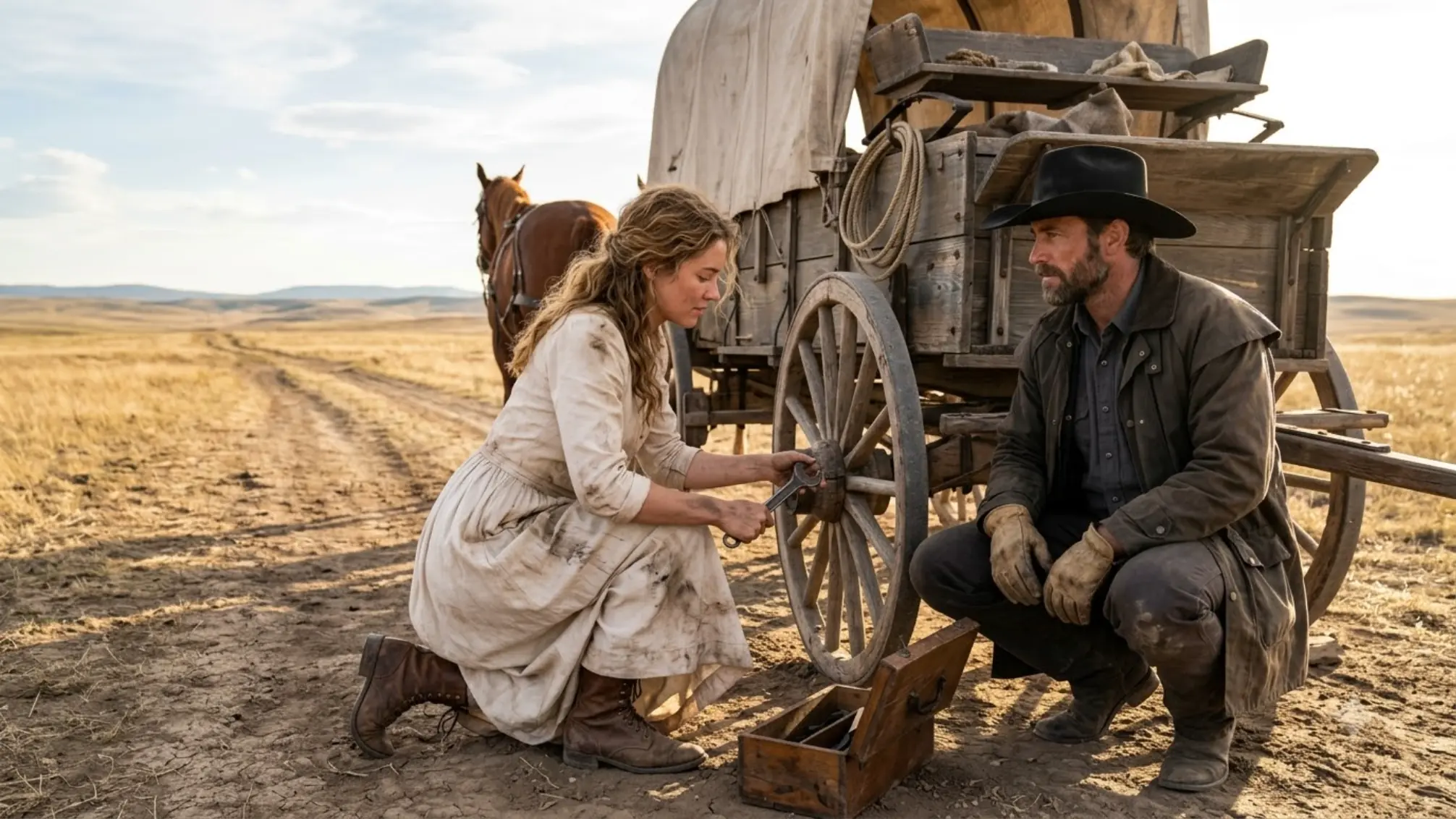
He left an unpaid bill at the boarding house, an untouched wedding breakfast, and a brief note informing Sarah that he had discovered they were not suited for one another. She had stood inside the church for nearly an hour while the guests whispered and the flowers wilted beside the altar. Peter’s mother watched from the front pew with satisfaction rather than surprise.
“A blacksmith’s daughter can wash the soot from her hands,” Mrs. Vale had once told Sarah, “but she cannot scrub it from her blood.”
Peter had been sitting beside his mother when she said it.
He had not defended Sarah.
That silence should have warned her.
By noon, Sarah had changed out of her wedding gown and put on the only practical dress she still owned—a white work dress that had once belonged to her mother. It was already stained around the hem from the muddy road. She carried a worn carpetbag containing nineteen cents, a leather apron, a tin of buttons, her father’s pocket watch, and the few tools she had refused to sell after his death.
The prairie wind pulled strands of brown hair loose from her braid as she reached the crossroads. One road curved south toward the railway. Another disappeared east through miles of grass. The northern road climbed gradually toward distant mountains.
Sarah sat in the shallow ditch beneath a leaning signpost.
Hours passed.
Her last swallow of water became hot inside the tin flask. Grasshoppers clicked in the weeds, and dust gathered over the white fabric of her dress. She wondered whether Peter had already boarded a train or whether he remained close enough to hear how the town laughed about the woman he had abandoned.
Then came the slow creak of wood.
A dark bay horse appeared over the eastern rise, pulling a large buckboard wagon. The man holding the reins wore a wide black hat, a long trail coat, and boots that looked expensive despite the dust. He sat straight-backed, with the quiet confidence of someone accustomed to land, responsibility, and being obeyed.
Sarah almost lowered her eyes.
Then she heard the damaged wheel.
A sharp wooden knock repeated with every rotation. The left rear hub tilted outward, and the kingpin shifted farther from its housing each time the wagon rolled forward.
Sarah jumped to her feet.
“Stop!”
The stranger pulled the reins hard.
The horse snorted and stamped as the wagon shuddered to a halt. Sarah hurried from the ditch, lifting her muddy skirt away from her boots.
The man studied her from beneath the brim of his hat. He appeared to be about thirty-five, with broad shoulders, dark hair, a short beard, and serious blue eyes. His expression was cautious rather than hostile.
“If you keep moving,” Sarah said, “your axle will split before the next bend.”
He looked toward the rear wheel. “You can tell that from here?”
“I heard it from the ditch.”
The stranger climbed down and walked around the wagon. Sarah followed, placing her carpetbag near the road. He crouched beside the wheel, but she was already kneeling across from him.
Her white dress sank into the dust.
She pressed her thumb against a narrow crack near the iron collar.
“The kingpin has split,” she said. “Another mile and the wheel comes free.”
“I have tools.”
He pointed toward a polished wooden chest in the wagon bed. Sarah opened it and found new hammers, clean wrenches, coiled wire, nails, a file, and a heavy iron tent stake. Every tool was high quality, but the handles were smooth and nearly untouched.
Sarah glanced at him.
“You bought these recently.”
“Is that a problem?”
“Only if you expected them to know how to use themselves.”
For the first time, the stranger smiled.
It transformed his face more than Sarah expected.
She took the iron stake and tested its thickness against the damaged kingpin. Then she pulled a small hammer from the chest and began shaping one end.
The stranger removed his gloves.
“What do you need me to do?”
“Hold the wheel upright and do exactly what I tell you.”
“Yes, ma’am.”
He braced both hands against the spokes. Sarah drove the iron stake against the cracked wood, creating a temporary splint. She then reached for the leather belt around his waist.
His eyebrows lifted.
“I need that.”
He removed it without argument.
Sarah threaded the belt through the wheel assembly and wrapped it around the weakened hub. When she pulled, the leather slipped against the polished wood.
“It needs more tension,” she said.
The stranger planted one boot against the axle and pulled the belt.
“Harder.”
The leather groaned.
Sarah tore a strip from the lower edge of her petticoat, wrapped it beneath the belt, and tightened the knot. Mud smeared across her sleeve, and axle grease darkened both palms.
“My father used wet hide for repairs like this,” she explained. “The cloth will prevent slipping until the leather settles.”
“How long will it hold?”
“Long enough to reach your ranch, provided you avoid stones and stop pretending the wagon is a racing carriage.”
The stranger gave a quiet laugh.
Together they rolled the wagon several feet. The repaired wheel remained upright.
Sarah sat back on her heels and wiped one cheek with her wrist, leaving a streak of grease near her jaw. The stranger continued looking at the repair as if she had done something impossible.
Rancher (softly, holding the wheel steady): “You saved my wagon, ma’am—where did you learn to work iron and wood like that?”
Frontier Woman (gently, keeping her eyes on the repair): “My father taught me before he died, and sometimes his lessons are all I have left to live on.”
Rancher (carefully, watching her muddy dress and tired face): “A woman dressed for a wedding should not be alone at a crossroads with grease on her hands.”
Frontier Woman (sadly, lifting her eyes to him): “Then perhaps it is a mercy you found me after the wedding never did.”
The rancher’s expression softened, but he did not ask who had abandoned her or why.
Instead, he offered his hand and helped her stand.
“My name is Silas Cain,” he said. “I own Iron Creek Ranch.”
Sarah recognized the name. Nearly everyone in southern Wyoming had heard of Iron Creek. Its cattle grazed across thousands of acres north of the Green River, and its owner was said to be wealthy, private, and impossible to intimidate.
“Sarah Hawthorne,” she replied.
Silas became completely still.
The change lasted only a moment, but Sarah saw it.
“Have we met?” she asked.
“No.”
“Then why do you know my name?”
“I did not say I knew it.”
“Your face did.”
Silas looked toward the road behind her. Dust moved in the distance, though no rider was yet visible.
“We should leave before the light changes,” he said. “My ranch is twelve miles north. You can eat, rest, and decide where you want to go tomorrow.”
Sarah folded her arms. “That did not answer my question.”
“No.”
“Do you always avoid questions this badly?”
“Only when the answer should not be given beside an empty road.”
Sarah looked toward the distant dust. She had no horse, little water, and no money for lodging. Yet accepting shelter from a stranger required trust she no longer possessed.
Silas seemed to understand.
“My daughter is at the ranch,” he said. “Her name is Clara. She is eight years old, suspicious of vegetables, and believes every injured animal belongs in her bedroom. My housekeeper, Mrs. Bell, will be there as well.”
“You are married?”
“Widowed.”
The word carried an old heaviness.
Silas lifted Sarah’s carpetbag and placed it in the wagon without assuming she had agreed to follow. Then he waited beside the passenger step.
“If you say no, I will leave food, water, and enough money for the next stagecoach,” he said. “But I would rather not abandon you here.”
Sarah studied him.
Peter had spoken beautifully about love while refusing to defend her from his mother. Silas spoke plainly and offered help without asking gratitude in return.
She climbed into the wagon.
The repaired wheel held.
They traveled north at a careful pace while the afternoon faded across the grass. Silas asked no questions about the wedding. Sarah asked none about his wife. Their silence was not uncomfortable, though she remained aware that he had reacted to her name.
Iron Creek Ranch appeared near sunset.
The main house stood on a low rise surrounded by cottonwood trees, barns, corrals, bunkhouses, and fields bordered by sturdy fencing. It was not a mansion, but it was larger and better maintained than any home Sarah had known. Smoke rose from two chimneys, and lanterns glowed behind the windows.
A little girl ran from the porch before the wagon stopped.
She had dark brown braids, bright blue eyes, and one missing front tooth. A small black dog followed at her heels.
“Papa!”
Silas climbed down and caught her as she threw both arms around his waist.
“You were supposed to stay inside,” he said.
“You were supposed to be home before supper.”
“Then we have both behaved poorly.”
Clara noticed Sarah sitting in the wagon.
Her eyes widened. “Did you bring me a mother?”
Sarah almost choked.
Silas closed his eyes briefly. “Clara.”
“What? Mrs. Bell said you cannot buy one from the mercantile.”
A gray-haired woman appeared on the porch, wiping her hands on an apron.
“I said no such thing,” she called.
“You said he would have to find one somewhere else.”
Mrs. Bell looked horrified.
Sarah covered a smile with her hand.
Silas helped her down from the wagon. “Miss Hawthorne repaired the wheel and needs a safe place for the night.”
Clara looked at Sarah’s mud-covered white dress.
“Were you fighting the wagon?”
“The wagon nearly won,” Sarah replied.
Clara accepted that explanation immediately.
Inside the house, Mrs. Bell prepared hot water and found Sarah a clean blue dress that had belonged to Silas’s late wife. Sarah refused it at first, uncomfortable wearing a dead woman’s clothes, but Mrs. Bell explained that the dress had never been worn. It had been ordered shortly before Rebecca Cain’s illness and delivered after her funeral.
“She would rather see it used than forgotten,” Mrs. Bell said.
Sarah washed the mud from her face and arms, but the grease remained beneath her fingernails. She considered hiding her hands during supper. Then Clara entered the kitchen with black ink covering three fingers and proudly announced that matching stains made them nearly related.
Silas had changed into a clean charcoal shirt. He sat at the head of the long table but spent most of the meal cutting Clara’s meat and reminding her not to feed potatoes to the dog.
Sarah watched him quietly.
He was wealthy enough to employ servants, yet only Mrs. Bell and six ranch hands lived near the main house. There was no performance of importance, no polished speech meant to impress her. Silas listened when Clara described a bird’s nest she had found and asked questions as though the matter deserved his full attention.
After supper, Clara brought Sarah a wooden toy horse with a broken leg.
“Papa tried to fix it,” she whispered.
Silas looked offended. “I fixed it twice.”
“It broke twice.”
Sarah examined the crooked repair. “Your father used too much glue and not enough patience.”
Clara nodded solemnly. “That sounds like him.”
Silas leaned back in his chair. “I am beginning to regret bringing you here.”
Sarah smiled for the first time since the church.
She repaired the toy using a narrow peg carved from a matchstick. Clara watched every movement and asked whether women were allowed to become blacksmiths.
“My father believed hands did not care whether they belonged to a man or a woman,” Sarah said. “If they learned the work, they could do it.”
“Can you teach me?”
“Clara,” Silas began.
Sarah looked at him. “Are you afraid she will become useful?”
“I am afraid she will dismantle the house.”
Clara’s expression suggested she had already considered it.
Later, after the girl had gone to bed, Sarah found Silas waiting in his study. A fire burned low beside shelves filled with ranch ledgers, maps, and legal documents. On the desk rested an envelope bearing Sarah’s name.
Her father’s handwriting covered the front.
Sarah stopped breathing.
“Where did you get that?”
“He mailed it to me nine days before he died.”
Sarah crossed the room and picked it up. The paper was worn, suggesting Silas had handled it many times.
“You knew who I was on the road.”
“I suspected it when you described Hawthorne Forge. I knew after you gave me your name.”
“You should have told me.”
“Yes.”
“Why didn’t you?”
“Because a frightened woman alone at a crossroads had no reason to believe a stranger who claimed her dead father had sent him.”
Sarah looked at the envelope. The seal remained unbroken.
“You never opened it?”
“It is addressed to you.”
“Then how did you know to search for me?”
Silas opened a desk drawer and removed a second letter. This one bore his name. He handed it to her.
The message was brief.
Silas,
If anything happens to me, find Sarah before Peter Vale does. Do not trust the papers Peter carries. The true record is where Sarah has kept my time since childhood.
She will understand when she is ready.
Thomas Hawthorne
Sarah read the final line twice.
Her hand moved to the pocket watch hanging beneath her borrowed dress.
“My father gave me this when I was ten.”
Silas nodded. “Peter Vale came to Iron Creek three months ago. He claimed your father had sold him the patent to a new water pump and transferred ownership of Hawthorne Forge as part of the agreement.”
“My father would never have sold the forge to Peter.”
“I know.”
“How?”
“Because your father designed the pump for Iron Creek.”
Silas unrolled a large drawing across the desk. It showed a system of iron gears, water channels, and pressure valves intended to pull water from a deep spring beneath the ranch’s northern fields.
“Three summers ago, the creek began drying,” Silas explained. “Your father believed this pump could save the ranch during drought. I paid for materials and construction. He retained ownership of the design.”
“Why did he never tell me?”
“He planned to. Then Peter began courting you.”
Sarah’s stomach tightened.
Silas continued. “Your father discovered Peter had copied several pages from his workshop ledger. Shortly afterward, Thomas fell from the forge loft.”
“The ladder broke.”
“The main support had been cut.”
Sarah lowered herself into the chair.
The town doctor had called her father’s death an accident. Peter arrived the next day with food, money, and gentle promises. He helped settle the forge’s debts and told Sarah the building had already been mortgaged beyond recovery.
She had believed him because grief made thinking difficult.
“He did not love me,” she whispered.
Silas did not insult Peter or tell Sarah she should have known better.
“He wanted whatever your father hid,” he said.
Sarah opened the pocket watch.
The familiar white face showed Roman numerals and two narrow hands. It had stopped at fourteen minutes past three on the day her father died. She pressed the release, examined the back plate, and noticed a tiny groove she had always assumed was decorative.
Using Silas’s pocketknife, she lifted the inner casing.
A folded strip of thin paper rested beneath the mechanism.
Sarah opened it carefully.
Her father had written a sequence of numbers, followed by four words.
Under the western anvil stone.
“Hawthorne Forge,” Sarah said.
Silas nodded. “Peter probably learned part of the truth. That may be why he abandoned the wedding. He no longer needed you beside him if he believed he knew where to search.”
“Then he is returning to the forge.”
“Or he has already reached it.”
Sarah stood. “We leave tonight.”
“No.”
“You have been searching for me, yet now you intend to stop me?”
“I intend to keep you from riding thirty miles in darkness with a man willing to cut a ladder beneath your father.”
“My father’s evidence is there.”
“And it will still be there at sunrise if Peter has not found it. If he has, arriving exhausted in the night will not recover it.”
Sarah’s anger rose because his reasoning was sound.
“I will not be ordered about.”
Silas met her gaze. “Then consider it advice from a man who has buried one wife and refuses to carry another innocent woman home from the road.”
The room became quiet.
Sarah saw the fear behind his firmness. It was not the desire to control her. It was the terror of watching another person disappear while he stood helplessly nearby.
She sat again.
Before sunrise, they prepared to leave.
Mrs. Bell packed food while Clara appeared in her nightdress, refusing to return upstairs until someone explained why her father was carrying a rifle. Silas knelt and told her he had business in Briar Glen. Clara looked at Sarah.
“Are you coming back?”
Sarah did not know how to answer.
Silas did.
“Yes,” he said.
Sarah looked at him sharply.
He added, “If she chooses.”
Clara hugged Sarah around the waist. “Choose yes.”
The journey south took four hours. They found Hawthorne Forge locked, its windows boarded and Peter’s rented horse tied behind the building.
Silas dismounted first.
Sarah pointed toward a fresh boot print near the rear entrance. “He is inside.”
They entered through the coal door.
The forge smelled of ash, rust, and old memories. Peter stood beside the western anvil with a pry bar in his hands. Two floor stones had already been removed.
He turned when Sarah stepped inside.
For a moment, his handsome face showed genuine shock.
Then came the smile she once mistook for kindness.
“Sarah, thank heaven. I have been searching everywhere.”
“You left me inside a church.”
“I panicked.”
“You also broke into my father’s forge.”
Peter looked toward Silas. “You have no idea what this man wants from you.”
Silas remained near the door, allowing Sarah to stand in front.
“What do you want?” she asked Peter.
“To protect what your father intended for us.”
“There is no us.”
Peter’s smile faded. “You are upset.”
“I am awake.”
He raised a document bearing Thomas Hawthorne’s signature. According to the paper, Sarah’s father had transferred the pump patent and forge property to Peter in exchange for settling his debts.
Sarah examined the signature.
It looked accurate.
Then she saw the date.
“My father signed this on April seventeenth?”
“Yes.”
“He broke his right hand on April twelfth. I wrote every order and receipt for six weeks because he could not hold a pen.”
Peter’s face tightened.
Silas stepped closer. “The county recorder can compare it with the medical ledger.”
Peter reached beneath his coat.
Silas’s hand moved toward his holster, but Sarah seized the long iron tongs beside the furnace and struck Peter’s wrist before he could draw his pistol. The weapon fell across the floor.
Silas kicked it away.
Peter lunged toward Sarah.
She brought the tongs up again and pressed the iron jaws beneath his chin.
“My father taught me more than wagon repair,” she said.
Peter froze.
They tied his wrists with a leather apron strap and removed the remaining stones beneath the anvil. Inside a narrow iron box, Sarah found her father’s original patent application, his partnership agreement with Silas, the unaltered forge deed, and a ledger documenting payments Peter had made to the town banker.
The final document was a sworn statement.
Thomas wrote that Peter had attempted to pressure him into transferring the pump design. He feared Peter intended to control water access across several ranches, forcing desperate landowners to sell cheaply during the next drought.
The evidence did more than protect Iron Creek.
It exposed a plan to steal half the valley.
Peter was taken before the territorial marshal. The banker tried to destroy his records but was arrested after an employee testified against him. Investigators determined that the support beneath Thomas Hawthorne’s forge ladder had been deliberately weakened, though proving who cut it remained difficult.
Peter eventually confessed in exchange for avoiding the harshest possible sentence.
He had not intended for Thomas to die, he claimed. He only wanted the fall to frighten him.
Sarah listened without expression as the confession was read.
A man who loosened a ladder beneath someone’s feet did not get to decide whether death was intended.
The forge and patent were legally restored to Sarah. Silas offered to purchase the design for a generous amount, but she refused.
“My father wanted a partnership,” she said. “Not a sale.”
Silas agreed.
Sarah returned to Iron Creek to complete the pump.
She told herself she remained because the work belonged to her father. That explanation became less convincing as the weeks passed.
She taught Clara how to hold a hammer without crushing her thumb. Silas built Sarah a forge near the northern field and pretended not to notice when she corrected nearly every measurement. Mrs. Bell began placing Sarah’s preferred tea beside her plate without asking.
The pump required three months of work.
Sarah shaped gears, reinforced pressure chambers, and redesigned the intake valve after discovering that her father’s original model clogged with river grass. Silas worked beside her whenever ranch duties allowed. He never claimed expertise, but he learned quickly and did not become defensive when corrected.
Their affection grew through ordinary things.
Silas brought coffee before dawn. Sarah repaired the hinge on Clara’s bedroom window. They rode together to inspect water channels and sometimes remained on the ridge after finishing, watching cattle move through the valley below.
Neither spoke of marriage.
Sarah had recently escaped a man who used promises as bait. Silas had loved one wife and feared that loving again might betray her memory. They gave each other time rather than demanding certainty.
One evening, a storm trapped them inside the forge.
Rain struck the roof while Sarah cleaned metal filings from the workbench. Silas stood near the doorway, watching water gather between the buildings.
“I lied to Clara,” he said.
Sarah looked up. “About what?”
“I told her you would return from Briar Glen.”
“You said I could choose.”
“I was already hoping you would.”
Sarah set down the cloth.
Silas removed his hat, suddenly appearing less like the owner of Iron Creek and more like a tired single father afraid of asking for too much.
“I do not need someone to replace Rebecca,” he said. “Clara does not need another woman forced into a role because I am lonely. And you do not owe this ranch your life because I helped find a box beneath an anvil.”
Sarah waited.
Silas stepped closer.
“But when you are gone from a room, I look for you. When Clara laughs, I want you to hear it. When I think about the next winter, I picture your tools beside mine.”
Sarah’s eyes filled, but she smiled.
“That is the least graceful proposal I have ever heard.”
“It was not a proposal.”
“No?”
“I am trying to tell you I love you without making it sound like another bargain.”
Sarah crossed the space between them.
She touched the edge of his coat, remembering the first time he had held a broken wagon wheel while trusting her instructions.
“I loved Peter’s promises because they required nothing from me except belief,” she said. “I love you because every day beside you asks me to remain myself.”
Silas lifted one hand to her cheek.
“Is that a yes?”
“You still have not proposed.”
He lowered himself onto one knee on the muddy forge floor.
Sarah laughed through her tears.
Silas Cain, owner of thousands of acres and a man feared by merchants who tried to cheat him, suddenly looked more nervous than he had while confronting an armed criminal.
“Sarah Hawthorne,” he said, “will you marry me, continue correcting everything I build, teach my daughter to dismantle my house, and remind me whenever I begin behaving like a fool?”
Sarah pretended to consider it.
“Will I keep ownership of my forge?”
“Yes.”
“My father’s patent?”
“Yes.”
“Half the pump partnership?”
“Half the pump partnership.”
“And my own name on every design?”
Silas smiled. “Especially your name.”
Sarah knelt in front of him.
“Then yes.”
They married in spring beside the completed water pump.
Sarah wore a simple white dress. This one was clean when the ceremony began, though Clara stepped on the hem before the vows and left a muddy boot print near the back. Sarah saw it and chose not to care.
The pump began operating two weeks later.
Water rose from the underground spring, traveled through iron channels, and poured into the northern fields. Iron Creek survived the drought that struck the territory that summer. Neighboring ranches received water at fair prices under agreements Sarah wrote herself, preventing speculators from using scarcity to seize their land.
Sarah reopened Hawthorne Forge at Iron Creek.
Her name appeared above the door.
Clara became her first apprentice, though she remained prohibited from touching the largest hammer without supervision. By the age of twelve, she could repair a wagon hub more cleanly than most grown men traveling through the valley.
Years later, people told the story of how Sarah Hawthorne repaired a wealthy stranger’s wagon and received a ranch in return.
Sarah always corrected them.
She had not repaired the wagon because Silas was rich. She did not marry him because he rescued her. And Iron Creek had never been a reward given to an abandoned woman.
At the crossroads, they were simply two damaged people facing a wheel that would not carry either of them much farther.
Sarah provided the skill.
Silas provided the strength to hold it steady.
Together, they repaired what was broken—not perfectly and not all at once, but well enough to begin moving forward.