On a cold October morning in 1994, Claire Whittaker drove a brand-new John Deere 8400 into the gravel lot of Brennan John Deere in Marshall County, Iowa, and parked it in front of the service bay like she was delivering bad news. The tractor still looked almost new, with bright green paint, clean yellow rims, and barely more than one harvest on the hour meter. It was the machine her father, Walter Whittaker, had bought eleven months earlier for $180,000, believing it would carry their 480-acre farm into the future. But Walter was dead now, and Claire had spent one harvest inside that expensive cab doing the math her father had refused to face.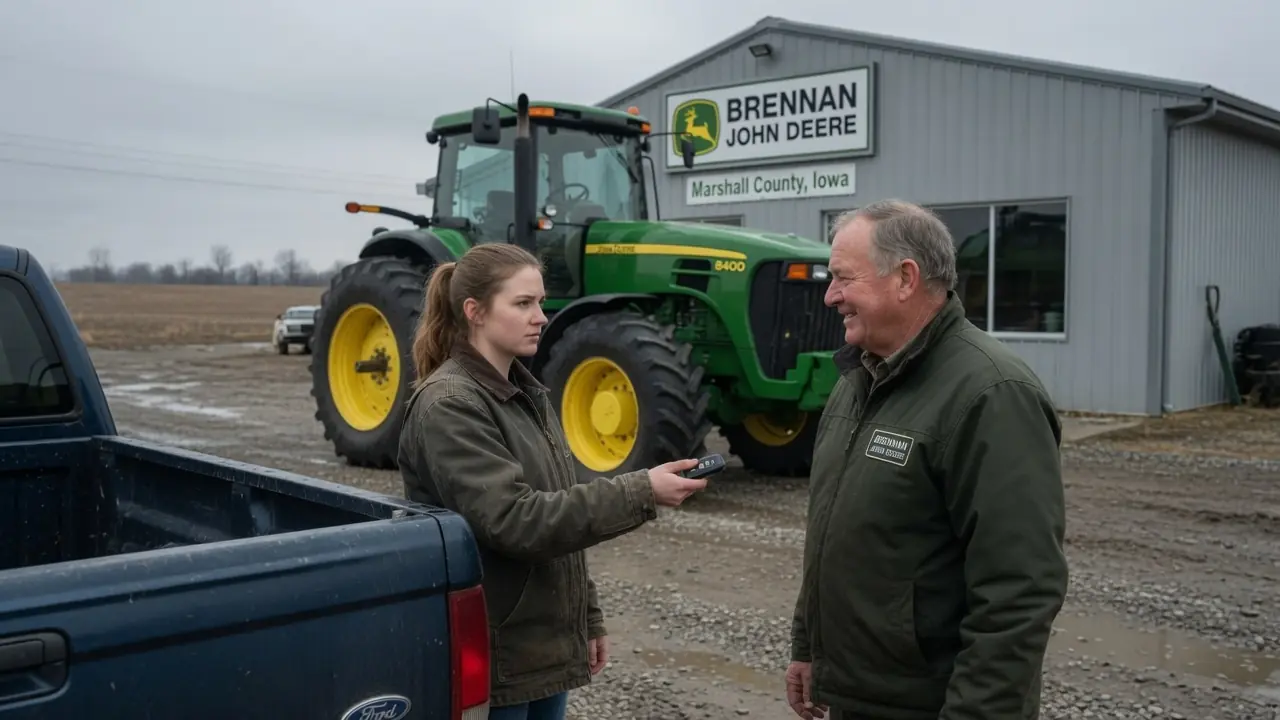
She climbed down slowly, wearing a faded work coat, jeans stiff from cold, and boots still muddy from the last cornfield she had finished. In her hand were the keys, the contract, and the buyback clause her father had insisted on but never expected anyone to use. The clause said the tractor could be returned within one year for eighty percent of the purchase price, no questions asked. Claire had read that sentence twenty times the night before.
Bill Brennan came out of his office when the salesman called him. He was a heavy man in a clean shirt, with a dealership smile that had helped sell more machinery than honest advice ever could. He had known Walter for thirty years and had sold him nearly every tractor the Whittaker farm had owned since the seventies. When he saw Claire standing beside the 8400 with the keys in her hand, his smile flickered.
“Claire,” he said, walking across the gravel like he was trying not to scare a nervous horse, “honey, let’s go inside and talk about this.”
Claire held out the keys. “Nothing to talk about, Mr. Brennan.”
Bill stopped in front of her. “You can’t just bring back a tractor after one harvest.”
“I can.” Claire unfolded the contract and tapped the clause with one cold finger. “My father negotiated this. I’m exercising it.”
Bill stared at the paper, and the practiced warmth drained from his face. “Your daddy bought this machine for you. He wanted you to have the best.”
“My daddy also left me a $140,000 loan attached to it.”
The words struck hard enough to quiet the salesman standing behind Bill. Claire did not raise her voice, but she did not soften it either. For nine months, people had spoken to her like grief made her fragile and debt made her helpless. She had let them talk because she had fields to harvest and numbers to calculate.
Bill took a step closer. “Return this tractor, Claire, and you bury your father’s dream.”
Claire’s eyes hardened. “No, Mr. Brennan. I bury the debt that was killing it.”
Bill’s face tightened. “The whole county will call you a fool.”
Claire placed the keys in his palm. “Good. Let them laugh now - by harvest, they’ll understand.”
For a moment, no one moved. The 8400 sat between them like a monument to everything Walter had believed and everything Claire was refusing to inherit. Bill looked down at the keys as if they had become heavier than metal. Claire turned without another word and walked toward her grandfather’s old 1979 Ford pickup, rusted at the wheel wells and rattling before she even started it.
By noon, half of Marshall County knew what she had done. By evening, every coffee counter, grain office, and feed store had turned Claire Whittaker into a warning story. Walter’s daughter had lost her mind. Walter’s daughter had given back the best tractor in the county. Walter’s daughter would be leasing the land by spring, if the bank did not take it first.
Claire heard the talk because people made sure she heard it. At the elevator, men stopped speaking when she walked in. At the grocery store, two farm wives lowered their voices and then looked at her with pity sharpened by curiosity. Her uncle Ray came by three nights later and stood in her kitchen without taking off his cap, looking older than he had at Walter’s funeral.
“Claire,” he said, “tell me you didn’t do this because you were angry at your father.”
She was washing a coffee mug at the sink. She dried it slowly, set it on the counter, and looked at him. “I did it because I loved the farm more than the tractor.”
Ray sighed and sat at the kitchen table. The chair had been Walter’s, and for a moment Claire almost told him not to sit there. But grief had already taken enough from the room, so she let him stay.
“Your father was proud of that machine,” Ray said.
“I know.”
“He said it would make your life easier.”
Claire gave a quiet, humorless laugh. “A $1,800 payment every month does not make life easier.”
Ray looked down. “That is farming now.”
“No,” Claire said. “That is borrowing now. Farming is something else.”
She went to the drawer and pulled out the yellow legal pad she had filled during harvest. She laid it in front of him and showed him the fuel costs, financing costs, insurance, service contract, depreciation, and repair limits. Every number was written in her precise hand, the same hand that had once done homework at this table while Walter paid bills beside her. Ray read slowly, and his face changed.
Claire sat across from him. “That tractor cost me money when it worked, and it cost me money when it sat still.”
Ray pushed the paper back. “What are you going to use instead?”
She told him.
He closed his eyes.
“Lord help us,” he muttered.
Claire bought a 1972 John Deere 4020 for $7,200 from a retired farmer who had kept maintenance records in a cigar box. She bought a 1965 Farmall 1206 for less than five thousand dollars, a 1978 Massey Ferguson 1085 for slightly more, and spent nine thousand rebuilding the old Farmall 560 Walter had left half-forgotten in the machine shed. Four tractors, all older than she was or close to it, stood where one shiny machine had been. None had a computer, none needed a dealer laptop, and every one of them could be repaired with tools Claire already owned.
She bought used implements too. An eight-row planter, a twenty-foot disc, a five-bottom plow, a field cultivator, a grain cart, and a head for her father’s old combine. Men laughed when they saw her hauling equipment home behind the rusted Ford. They called it a museum fleet, a junk parade, and one old man at the feed store said Walter would roll in his grave.
Claire said nothing. She painted what needed paint, greased what needed grease, replaced belts, changed fluids, and labeled every part shelf in the shed. She put $50,000 of the refund into a working reserve and used another large piece to pay down Walter’s operating loan. For the first time since her father died, the farm’s accounts did not look like a storm cloud.
Spring of 1995 came wet and late. The big operators sat waiting, their heavy tractors too risky to drive across soft ground without compaction. Claire watched the soil, waited for the right window, and started with the 4020 on April 22. It was lighter than the modern machines and moved across the field without sinking.
Neighbors drove past slowly, expecting disaster. They saw Claire sitting upright on an old tractor with no air-conditioned cab, no GPS, and no shine. They did not see the ledger in her truck, where every saved dollar was already changing the future. By the time the heavy machines in the county finally rolled, Claire had corn in the ground and was checking planter depth on her second field.
Bill Brennan drove past one morning in May and slowed near the fence line. Claire saw his truck but did not wave. He watched the 4020 pull steady through the rows and shook his head before driving on. Later that day, at the dealership parts counter, he told the boys, “That girl is farming with her granddaddy’s ghost. She’ll be selling pencils by Christmas.”
The counter laughed.
Claire was too busy to hear it.
July came hot and dry, and then hotter still. The modern tractors across the county began throwing error codes in the heat, shutting down over sensors and electrical faults no farmer could fix without a dealer technician. Brennan’s service trucks ran from farm to farm, but there were too many calls and not enough readers, parts, or hours. Men with expensive machines waited two and three days while weeds grew and tempers burned.
Claire’s tractors kept moving. When the Farmall lost a belt, she replaced it in the shed in under an hour. When the Massey needed a hydraulic hose, she cut one to length and had it running before lunch. When the 4020 ran rough, she cleaned the filter, checked the fuel line, and went back to the field.
By August, the laughter had weakened. Her corn was clean. Her soybeans looked even. Her fields did not look like a young woman failing her father’s farm. They looked like a farm run by someone who understood that uptime mattered more than appearance.
The real test came at harvest.
October turned wet, cold, and unforgiving. Corn came heavy and damp, soybeans ripened early, and every farmer in the county was suddenly racing the same weather. The big modern equipment was supposed to win in a year like that. Instead, sensors failed, hydraulics clogged, and dealer service backed up again.
Claire ran Walter’s old John Deere 7720 combine with the used grain head she had bought. Her old tractors rotated wagons and carts without complaint. Nothing was fast in the glamorous way dealership brochures promised, but everything kept moving. Twelve hours a day, day after day, Claire brought in corn while other farmers waited beside silent machines.
When she delivered her last load to the elevator on November 3, Chuck Lindstrom came out from the scale house and leaned on the railing. He was a quiet man who had watched too many farmers exaggerate and too many ledgers tell the truth. He looked at Claire’s load ticket, then at her. “How’d you do?”
“192 bushel average on corn,” she said. “Sixty-one on beans.”
Chuck whistled. “County average won’t touch that.”
Claire tucked the ticket into her coat pocket.
“You finished early too,” he said.
“Yes, sir.”
Chuck looked out toward the darkening road. “Your daddy would be proud.”
Claire’s throat tightened, but she only nodded once. She climbed back into the old Ford and drove home before anyone could see her cry.
That winter, the numbers became impossible to ignore. Claire cleared more profit than most farms her size because her costs were dramatically lower. While neighbors made payments on equipment that had spent too many days waiting for service, Claire paid down debt, built reserve cash, and bought an additional eighty acres when a widow south of town decided to sell. People still called her lucky, but luck had begun looking suspiciously like discipline.
Year after year, the pattern repeated. Claire fixed what she owned, paid cash when she could, and never bought equipment she could not understand. Her tractors were old, but they were maintained like living members of the family. She kept records on weather, fuel, repairs, yields, rotation, and soil conditions until her notebooks filled an entire shelf.
By 1999, she owned 720 acres. By 2001, she owned more. The men who once predicted foreclosure now slowed down when passing her fields, not to laugh, but to study. Some still said she was stubborn. Some said she had gotten lucky several years in a row. But younger farmers began asking questions.
In 2002, the county farm tour included Claire Whittaker for the first time. Reporters came with cameras, extension agents came with clipboards, and Bill Brennan watched from the back of the crowd with his hands in his pockets. Claire stood beside the 4020, now clean, greased, and still working hard after thirty years. She looked older than twenty-four now, sharper and stronger, with a confidence built from seasons no one could take away.
A reporter asked her what the secret was.
Claire thought for a long moment. “My father thought he bought productivity when he bought that tractor. What he really bought was vulnerability.”
The crowd quieted.
“Every dollar owed to the bank is a dollar of choice you no longer have,” she continued. “Every payment tells you what you must plant, how much risk you must take, and how long you have to keep running even when the numbers say stop. I returned that tractor because I needed choices more than I needed shine.”
Bill Brennan looked down.
The interview ran in Des Moines and changed how people talked about her. Extension economists began asking for records. Young farmers came to see her equipment shed. Some expected a lecture about old tractors and cheap living, but Claire gave them spreadsheets first.
“Do not copy me because you like the story,” she told them. “Do the math. If the math says buy new, buy new. If the math says debt will own you before the machine helps you, walk away.”
That sentence traveled farther than she expected.
In November of 2002, Bill Brennan drove to the Whittaker farm. He parked near the machine shed where the old tractors stood in a clean row, green, red, and faded gray, all of them ready to work. Claire came out wiping grease from her hands. For a moment, neither of them spoke.
“Mr. Brennan,” she said.
“Claire.”
He held his cap in both hands. The salesman’s smile was gone now, replaced by a tired honesty that made him look smaller and more human. He looked at the tractors, the equipment shed, the grain bins, and the land beyond them. Then he looked at her.
“You were right,” he said.
Claire did not answer.
Bill swallowed. “About the debt. About the equipment. About what we were selling men like your father.”
The wind moved across the yard. Claire could hear a loose chain tapping against a wagon. She thought about the morning in the dealership lot, the keys in his hand, the laughter that had spread through the county like spilled oil. She thought about Walter signing papers because he trusted a man who had sold him the idea that newer meant safer.
“I came to apologize,” Bill said. “I should have done it years ago.”
Claire wiped her hands again, though they were already clean enough. “You told people I’d be selling pencils by Christmas.”
His face tightened with shame. “Yes. I did.”
“You sold my father a tractor he did not need with money he did not have.”
Bill looked down. “Yes.”
Claire’s voice stayed calm, but there was iron under it. “He trusted you.”
“I know.”
“He died worried about money.”
Bill closed his eyes for a moment. “I know that too.”
For years, Claire had imagined this conversation. Sometimes, in her imagination, she shouted. Sometimes she handed him a ledger and forced him to read every number out loud. Sometimes she simply closed the door in his face. But now that he stood there, humbled and late, she found that victory was quieter than anger had promised.
“I did not return that tractor to prove you wrong,” she said. “I returned it because keeping it would have buried me.”
Bill nodded. “I understand that now.”
“I appreciate the apology,” Claire said. “But the man who deserved to hear it is buried on Route 14.”
Bill’s eyes reddened. “I’ll go there next.”
He turned as if to leave, then stopped. “Claire, may I ask you something?”
“You can ask.”
“I’ve got a young couple coming in next week. They inherited 120 acres and want to buy new equipment they can’t afford. Would you talk to them?”
Claire studied him.
“Not for me,” Bill said quickly. “For them.”
She looked back at the old tractors, then at the fields her father had loved and she had saved. “Send them out,” she said. “I’ll show them the books.”
That became the beginning of something bigger than vindication. Bill sent more young farmers. Then older farmers came. Then people from counties Claire had never visited appeared at her kitchen table with notebooks, loan statements, and fear in their eyes.
Claire did not promise miracles. She taught them how to count. She taught them that pride could be just as expensive as machinery. She taught them that a farm did not have to look successful from the road to survive on paper.
Years later, when Iowa State honored her for work in farm sustainability, Claire wore clean jeans, a white shirt, and her grandfather’s wristwatch. The auditorium was full of people who now called her practical, visionary, resilient, and ahead of her time. She accepted the award politely, then stepped to the microphone. Her speech lasted less than one minute.
“My father bought a $180,000 tractor because he thought it would carry the farm into the next century,” she said. “What carried the farm into the next century was returning it.”
The room stood and applauded.
Claire thought of Walter, of the cornfield where his heart had failed, of the bills on the kitchen table, and of the keys she had placed in Bill Brennan’s hand on that cold morning in 1994. She did not hate the tractor. She did not hate her father for buying it. She hated only the lie that bigger always meant stronger.
The Whittaker farm endured.
The 1972 John Deere 4020 remained in the machine shed, still starting on cold mornings and still working when asked. The Farmall 560, once forgotten in the back corner, became the tractor Claire’s grandchildren learned to drive. The land grew from 480 acres to more than a thousand, not because Claire chased size, but because she bought only when the numbers allowed freedom to remain.
Every spring, Claire drove her grandfather’s old Ford to the cemetery on Route 14. She stood at Walter’s grave and told him how planting was going, which field needed tile, which grandchild had asked about him, and whether the old 4020 had behaved. She never apologized for returning the tractor. She knew now that love did not always mean preserving what someone gave you.
Sometimes love meant saving what they meant to protect.
And what Walter had meant to protect was never the John Deere 8400.
It was the land.
It was the house.
It was Claire.
So she returned the gift that could have chained her, bought the tools that gave her choices, and proved to an entire county that freedom was not the shine of a new machine under dealership lights. Freedom was waking up on your own farm, owing less, choosing wisely, and knowing that when something broke, you had the tools, the knowledge, and the courage to fix it yourself.