“I think you come to the wrong woman.”
Eleanor Brooks spoke without lifting her eyes.
The dusty main street of Red Hollow, Wyoming, had been noisy only moments earlier. Horses stamped beside hitching rails. Wagon wheels creaked past the mercantile. Men leaned beneath wooden awnings while women whispered behind gloved hands, all waiting to see which bride Michael Hayes would choose.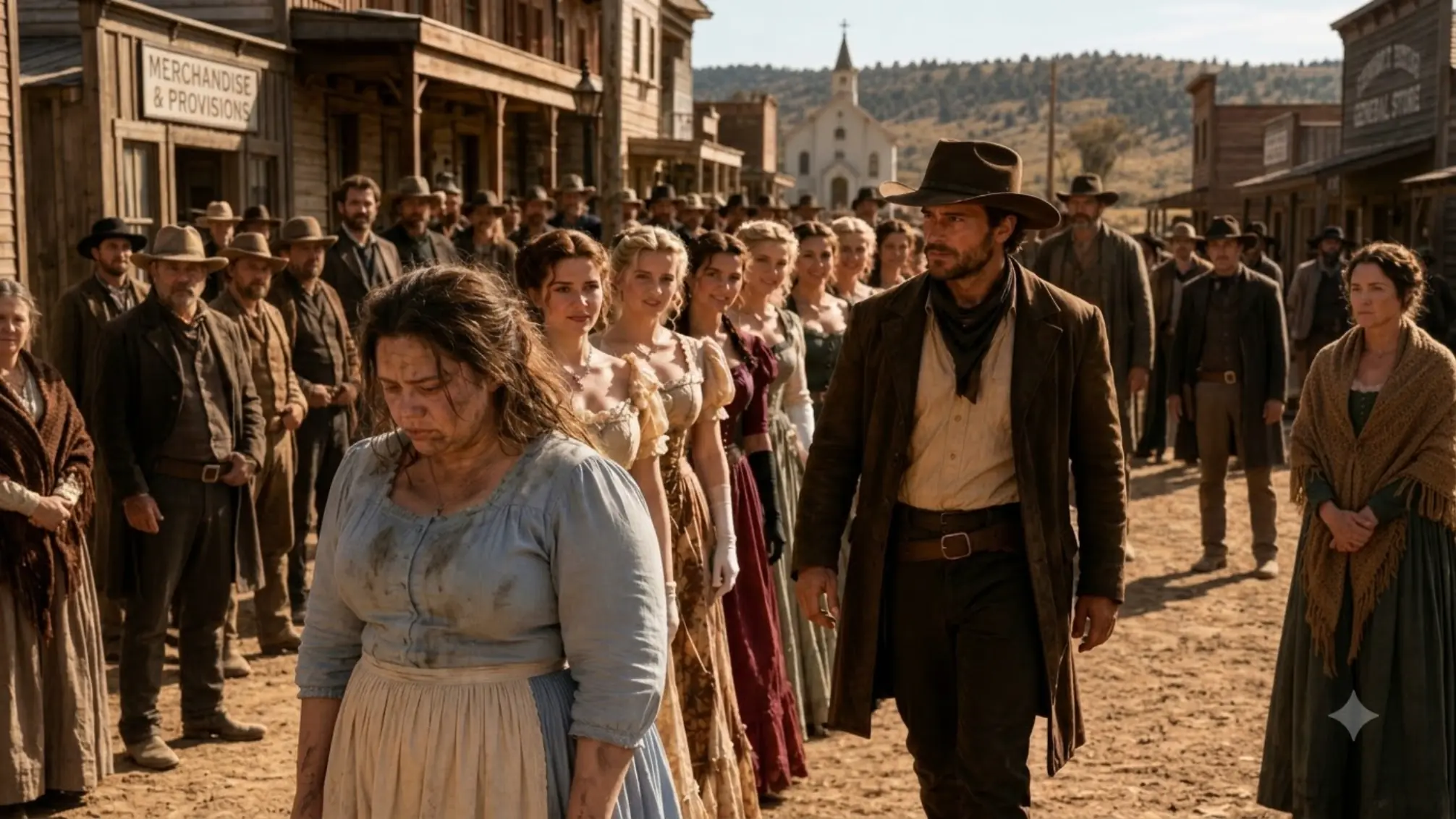
Now the street had gone strangely quiet.
Eleanor stood at the edge of the line in her faded light-blue dress and cream apron, looking less like a hopeful bride than a woman who had accidentally wandered into someone else’s celebration.
Michael Hayes stopped directly in front of her.
Behind Eleanor stood eight women dressed in silk, lace, polished boots, and carefully pinned curls. Several were daughters of prosperous ranchers. One was the niece of the county banker. Another had traveled seventy miles after hearing that Michael Hayes, owner of more than forty thousand acres of Wyoming grassland and cattle, had finally decided he wanted a wife.
Michael had walked past every one of them.
Now he was looking only at Eleanor.
“No, ma’am,” he said gently. “I think I finally came to the only right one.”
A nervous ripple passed through the crowd.
Eleanor finally looked at him.
Michael was thirty-eight, broad-shouldered, weathered by years under the Wyoming sun, with dark hair beneath his brown hat and a trimmed beard that made him appear rougher than his calm eyes suggested. Men in Red Hollow respected him because he owned the largest cattle operation in the county.
Women noticed other things.
His wealth.
His land.
His house.
His name.
Eleanor noticed the way he was standing.
He had not stepped too close.
He had not smiled as though he expected gratitude.
He simply waited.
Eleanor swallowed.
“I know what this is,” she said.
Michael tilted his head slightly.
“What is it?”
“You feel sorry for me.”
A few women behind her exchanged looks.
One covered a smile.
Eleanor heard it anyway.
She always heard them.
She clasped her hands against her apron.
“I'd rather stay alone forever than be someone's charity.”
Michael’s expression did not change.
“Good.”
That single word made Eleanor blink.
Michael slowly removed his hat.
“Because I’m not looking for somebody to rescue.”
He extended his hand.
“I’m looking for somebody who knows what it means to stand when nobody bothers standing beside her.”
The laughter vanished completely.
Eleanor stared at his hand.
For most women in Red Hollow, Michael Hayes reaching toward them would have been the answer to every prayer they had whispered since girlhood.
For Eleanor, it felt dangerous.
Hope always did.
Before she could answer, a voice broke through the silence.
“This has gone far enough.”
Mayor Silas Mercer pushed through the crowd.
He was sixty-two, silver-haired, broad through the waist, and dressed in a polished black coat despite the heat. He had controlled Red Hollow for nearly twenty years, first as the owner of the town bank and later as mayor.
People did not simply respect Silas Mercer.
They avoided disappointing him.
He stopped beside Michael.
“Michael,” Silas said quietly, “you’re making a spectacle of yourself.”
Michael glanced at him.
“I didn’t realize marriage required your approval.”
Silas forced a smile.
“It doesn’t.”
His eyes moved toward Eleanor.
“But surely you understand what people will say.”
Eleanor’s stomach tightened.
There it was.
The phrase she had heard all her life.
What people will say.
Her mother had used it whenever Eleanor wanted to attend a dance.
Her aunt had used it when Eleanor applied for work at the bank.
Shopkeepers had used it when she asked about positions usually given to slimmer, prettier women.
Silas Mercer had used it most of all.
Michael placed his hat beneath one arm.
“I’ve spent half my life hearing what people say.”
He looked at Eleanor again.
“I’m more interested in what she says.”
Eleanor’s throat tightened unexpectedly.
Silas stared at Michael for several seconds.
Then he laughed.
It was not a happy laugh.
“You barely know her.”
“That can be fixed.”
“Some things can’t.”
The way Silas said it changed the air.
Michael noticed.
So did Eleanor.
She looked toward the mayor.
“What is that supposed to mean?”
Silas’s expression softened immediately.
“Nothing, Eleanor.”
“You looked at me when you said it.”
“You’re imagining things.”
Michael took one slow step toward Silas.
“She asked you a question.”
Silas’s smile disappeared.
The two men faced each other in the dusty street while half of Red Hollow watched.
Finally Silas straightened his coat.
“I’m trying to save you from embarrassment, Michael.”
Michael’s voice remained calm.
“I’m not embarrassed.”
Silas looked toward Eleanor.
“You should be.”
A gasp rose from somewhere in the crowd.
Eleanor’s face burned.
For one terrible second, she was fifteen again, standing outside the church while girls laughed about the size of her dress.
She almost walked away.
Then Michael moved.
Not toward Silas.
Toward her.
He placed himself beside Eleanor instead of in front of her.
That small movement changed something.
For once, she was not standing alone while people discussed her as if she were furniture.
Michael looked at Silas.
“If you intend to insult someone,” he said, “you can do it while looking at both of us.”
Silas’s jaw tightened.
Eleanor glanced at Michael.
“Why are you doing this?”
Michael turned toward her.
“Because I meant what I said.”
“No.”
She shook her head.
“Why me?”
The question had haunted everyone on the street.
Now Eleanor asked it herself.
Michael studied her carefully.
“Walk with me.”
Silas immediately stepped forward.
“That would be unwise.”
Michael’s eyes narrowed.
“You seem unusually concerned about where Eleanor walks.”
Silas stopped.
Eleanor noticed it.
For the first time, she noticed something else too.
Fear.
Not embarrassment.
Not anger.
Fear.
The mayor was afraid of Michael talking to her.
That realization was enough.
Eleanor looked at Michael’s outstretched hand again.
Then she placed her fingers into his.
The entire street seemed to inhale.
Michael closed his hand gently around hers.
He did not pull.
He simply waited until Eleanor stepped forward herself.
Together, they walked away from the bridal line.
Behind them, whispers exploded.
Michael led Eleanor past the blacksmith shop, the feed store, and finally toward the quiet end of town where cottonwoods grew beside a narrow creek.
Neither spoke until the crowd was far behind.
Eleanor removed her hand.
Michael released it immediately.
She appreciated that.
“You still haven’t answered me.”
Michael leaned against a wooden fence.
“About why I chose you?”
“Yes.”
“I didn’t choose you today.”
Eleanor frowned.
“What does that mean?”
Michael looked toward the water.
“Do you remember the winter of 1889?”
Eleanor almost laughed.
“I remember freezing.”
Michael smiled faintly.
“So do I.”
He grew serious.
“My father died that winter.”
“I heard.”
“Most people did.”
Michael rubbed his thumb along the edge of his hat.
“What most people don’t know is that I nearly lost the ranch too.”
Eleanor stared at him.
The Hayes ranch had become a symbol of wealth in Wyoming.
It was difficult imagining it ever being close to ruin.
Michael continued.
“My father had borrowed heavily after two bad cattle seasons. When he died, I inherited land, cattle, and debts I didn’t understand.”
“How old were you?”
“Twenty-one.”
Eleanor softened.
“Barely older than I was.”
Michael nodded.
“I spent six months trying to keep creditors from taking the ranch. One afternoon, I came into town looking for work.”
“You?”
“Me.”
She smiled despite herself.
Michael noticed.
“You find that funny?”
“A little.”
“So did the banker.”
His smile disappeared.
“Silas Mercer.”
Eleanor looked back toward town.
Michael continued.
“He told me the ranch would be his before spring.”
“That sounds like him.”
“I walked out of the bank with nothing.”
Michael paused.
“Then somebody left a sack of food beside my horse.”
Eleanor looked at him.
“I thought it was an accident until I found a note inside.”
“What did it say?”
Michael reached into the inner pocket of his coat.
He removed a small folded piece of paper.
Its edges were worn almost smooth.
Eleanor stared.
“You kept it?”
“For seventeen years.”
He handed it to her.
Eleanor unfolded the paper.
The handwriting was young.
Uneven.
Familiar.
She read the words.
You looked hungry. There’s bread, dried meat, and two apples. You don’t owe anyone for kindness.
Her breath caught.
Michael watched her.
“You remember writing it?”
Eleanor touched the paper.
“I was twelve.”
“Thirteen.”
She looked up.
“You knew?”
“I saw you running behind the mercantile.”
Eleanor stared at him.
“You were that ranch boy?”
Michael laughed softly.
“I suppose I was.”
“I thought you were a hired hand.”
“So did everyone.”
She shook her head slowly.
“I gave you food.”
“You gave me more than food.”
Michael stepped closer.
“Everyone else that day looked at me like I was already finished. You were the only person who helped without asking whether I could repay you.”
Eleanor’s eyes filled.
“That was seventeen years ago.”
“I remember.”
“You can’t marry someone because she gave you two apples.”
Michael smiled.
“One of them was bruised.”
Eleanor laughed.
The sound surprised her.
Michael laughed too.
For several seconds, she forgot Red Hollow.
Forgot the women.
Forgot Silas Mercer.
Then Michael became serious again.
“That’s not the only reason.”
Eleanor’s smile faded.
“There’s more?”
“Yes.”
He looked toward town.
“I’ve been watching how people treat you.”
“That sounds unpleasant.”
“It is.”
She folded the old note carefully.
“Why?”
“Because the same people who smile when I enter a room barely acknowledge you.”
Michael’s voice hardened.
“And I’ve spent long enough around wealthy men to know character shows best when there’s nothing to gain.”
Eleanor returned the note.
“So this is some kind of test?”
“No.”
“Then what?”
Michael hesitated.
“I want to know you.”
Eleanor studied him.
“That simple?”
“That difficult.”
She almost smiled again.
Before she could answer, church bells rang from town.
Michael glanced toward the sound.
“Come to the ranch tomorrow.”
Eleanor immediately stiffened.
“For what?”
“Dinner.”
She raised an eyebrow.
“Dinner?”
“My housekeeper will be there.”
“That wasn’t what worried me.”
Michael laughed.
“I thought we could talk without half the county counting how many times you breathe.”
Eleanor looked toward Red Hollow.
She knew what waiting there would be like.
Whispers.
Questions.
Cruel jokes.
“Maybe.”
Michael placed his hat back on.
“I’ll accept maybe.”
She started walking.
Michael called after her.
“Eleanor.”
She turned.
His expression was softer now.
“Keep the note.”
She looked down at the paper still in her fingers.
“You carried this seventeen years.”
“It did its job.”
“What job?”
Michael smiled.
“It reminded me good people existed.”
The next morning, Red Hollow had already decided Eleanor Brooks was either cleverer than anyone thought or foolish beyond saving.
The women who had stood in line with her gathered inside Mabel Finch’s dress shop and discussed the scandal with increasing creativity.
By noon, according to rumor, Eleanor had trapped Michael with witchcraft, blackmail, or pregnancy.
The final theory was particularly impressive considering she had barely spoken to him before the previous morning.
Eleanor ignored all of it.
She had experience.
At three o’clock, she walked toward Hayes Ranch.
Michael sent a wagon.
She refused it.
He had invited her.
He had not purchased her legs.
The ranch stood seven miles outside town across wide grassland framed by distant mountains.
Eleanor arrived just before sunset, dusty and tired.
Michael was waiting beside the gate.
“You walked?”
“Yes.”
“Seven miles?”
“You counted?”
“I own the road.”
She raised an eyebrow.
Michael smiled.
“Bad joke.”
“Terrible.”
He opened the gate.
“That may be the first honest thing anyone has said to me today.”
The ranch house was large but surprisingly plain.
No marble.
No gold.
No servants lined against walls.
A gray-haired housekeeper named Ruth greeted Eleanor warmly and immediately complained that Michael forgot to eat whenever cattle were sick.
Michael protested.
Ruth ignored him.
Dinner consisted of roast beef, potatoes, beans, and fresh bread.
Not champagne.
Not imported delicacies.
Eleanor relaxed.
Michael noticed.
“You expected silver plates?”
“I expected six forks.”
“I own three.”
“In the entire house?”
“Probably.”
She laughed again.
Michael stared at her for half a second too long.
Eleanor caught him.
“What?”
“Nothing.”
“You’re staring.”
“I know.”
“At what?”
Michael smiled.
“You laugh differently here.”
The words struck deeper than he intended.
Eleanor looked down.
“I don’t do it much in town.”
“I noticed.”
Silence settled between them.
Not uncomfortable silence.
The kind that allowed truth room to enter.
After dinner, Michael took Eleanor onto the porch.
A cool Wyoming wind moved across the grass.
He brought two cups of coffee.
Eleanor accepted hers.
“You said there was another reason you remembered me.”
Michael looked toward the horizon.
“Yes.”
“What?”
He hesitated.
“My father knew your father.”
Eleanor froze.
“My father?”
“Samuel Brooks.”
Eleanor had been nine when Samuel Brooks died.
Her memories came in fragments.
A deep laugh.
Saw dust on his coat.
Hands large enough to cover both of hers.
Her mother crying behind a closed bedroom door.
“He worked cattle,” Eleanor said.
“That’s what you were told.”
She looked at Michael.
“What are you saying?”
Michael reached into a drawer beside the porch door.
He removed an old leather ledger.
Eleanor stared at it.
“My father kept this.”
He opened the ledger.
“Hayes Ranch wasn’t always Hayes Ranch.”
Her pulse quickened.
Michael turned several pages.
“Before my father owned the southern acreage, it belonged to a partnership.”
He pointed toward two names.
Thomas Hayes.
Samuel Brooks.
Eleanor stopped breathing.
“My father?”
“Half owner.”
She touched the page.
“That’s impossible.”
“It isn’t.”
“He was poor.”
“After the partnership ended.”
Eleanor looked at Michael sharply.
“How did it end?”
Michael did not answer immediately.
That frightened her more than any answer could.
“Michael.”
“My father told me Samuel sold his share.”
“My mother said he lost it.”
“Neither story appears to be true.”
Eleanor stood.
“What does that mean?”
Michael rose too.
“I found documents while settling old accounts.”
“What documents?”
“Transfer papers.”
“And?”
“The signature attributed to your father doesn’t match the signatures in this ledger.”
Eleanor stared at him.
“You think someone forged it.”
“I think someone wanted forty thousand acres very badly.”
Her hands began trembling.
“Who?”
Michael looked toward the distant lights of Red Hollow.
“Silas Mercer witnessed the transfer.”
Everything inside Eleanor went cold.
She remembered the mayor’s expression in the street.
Fear.
Now she understood.
“How long have you known?”
“Three weeks.”
“And yesterday?”
“I wanted to speak to you before confronting him.”
Eleanor backed away.
“You knew all this when you chose me?”
“Yes.”
Her expression hardened.
“Then I was right.”
“About what?”
“Charity.”
“No.”
“You found out my father may have been cheated, and suddenly you decide the unwanted woman deserves attention?”
Michael stepped toward her.
She raised a hand.
“Don’t.”
He stopped.
“I don’t need you feeling guilty for something your father did.”
“My father may not have done it.”
“I don’t care.”
“You should.”
“I care about you lying by omission.”
Michael’s face tightened.
“That’s fair.”
Eleanor blinked.
She had expected defense.
Excuses.
He gave neither.
Michael nodded slowly.
“I should have told you sooner.”
“Yes.”
“I was afraid if I opened with land records, you’d think that was the only reason I approached you.”
“Wasn’t it?”
“No.”
“How can I know?”
“You can’t.”
His answer stunned her.
Michael met her eyes.
“You don’t know me well enough to trust me.”
Eleanor’s anger wavered.
“So what now?”
“You decide.”
He placed the ledger on the porch table.
“Take it.”
She stared at him.
“What?”
“Take every page concerning your father.”
“That belongs to you.”
“It concerns you.”
He stepped away.
“Tomorrow morning, I’m riding to Cheyenne to speak with an attorney who doesn’t answer to Mercer. You can come or not.”
“And if I don’t?”
“I investigate anyway.”
“Why?”
“Because somebody stole something.”
Michael’s expression hardened.
“And I don’t care whether the victim’s daughter marries me, dislikes me, or never speaks to me again.”
That was the moment Eleanor began believing him.
Not because he promised her something.
Because he gave her the freedom to refuse him.
The following morning, she rode beside Michael toward Cheyenne.
Three weeks later, Silas Mercer stopped smiling.
The attorney Michael hired found discrepancies immediately.
Samuel Brooks’s supposed transfer had been recorded nine days after his death.
The notary signature belonged to a man who had been in Nebraska at the time.
A bank ledger showed that Mercer had issued Thomas Hayes a private loan shortly before the transfer, then erased the debt after the land changed hands.
But the greatest shock came from Ruth.
Michael’s housekeeper had served the Hayes family for forty years.
When shown Samuel’s documents, she went pale.
“I knew your father kept something,” she whispered.
Michael stared at her.
“What?”
Ruth disappeared into the attic.
She returned carrying a narrow wooden box.
Inside were letters written by Thomas Hayes during the final year of his life.
One was addressed to Michael.
Another was addressed to Eleanor.
Michael handed Eleanor hers.
She opened it with shaking hands.
Miss Brooks,
If this letter reaches you, I failed to find the courage to correct something while I was alive.
Eleanor covered her mouth.
Thomas confessed that Silas Mercer had arranged fraudulent documents transferring Samuel Brooks’s land after Samuel died unexpectedly.
Thomas had discovered the fraud later.
He had threatened Mercer.
Mercer responded with records proving Thomas had unknowingly benefited from the transaction.
Fearful of prison and losing the ranch, Thomas remained silent.
But the final paragraph changed everything.
Half the southern property was Samuel’s. Whatever the law says now, it should have passed to his wife and daughter. Michael knows nothing of this. Do not blame my son for the cowardice of his father.
Eleanor lowered the letter.
Michael stood several feet away.
His face had gone pale.
“My father knew.”
“Yes.”
“He kept it.”
“For years.”
Michael turned away.
Eleanor watched anger and shame move across his face.
“Michael.”
“My family built half its fortune on stolen land.”
“You didn’t.”
“I inherited it.”
“You didn’t know.”
“I benefited.”
Eleanor remembered something he had told her beside the creek.
He had spent years learning the difference between someone who wanted him and someone who wanted what belonged to him.
Now she understood why that difference mattered so much.
Michael turned back.
“The land is yours.”
Eleanor stared.
“No.”
“It should have been.”
“You don’t get to decide that alone.”
He blinked.
“Your father owned half.”
“And your father spent decades building the ranch.”
“On land that wasn’t entirely his.”
Eleanor folded the letter.
“So we find out what the law says.”
Michael looked almost offended.
“I’m trying to give it back.”
“I’m not taking charity.”
“It isn’t charity.”
“Then stop offering it like charity.”
That silenced him.
Eleanor stepped closer.
“If the land legally belongs to me, prove it.”
Michael stared at her.
“If it doesn’t, don’t hand me property because you feel guilty.”
His expression softened.
“And if it does?”
“Then we discuss fences.”
Michael laughed.
It escaped unexpectedly.
Eleanor smiled.
“Why is that funny?”
“Because you just discovered you may own twenty thousand acres and your first thought is fencing.”
“Bad fences create bad neighbors.”
Michael shook his head.
“You may be the most terrifying woman in Wyoming.”
“Good.”
The legal case against Silas Mercer moved faster than expected.
Once state investigators examined the documents, they discovered Samuel Brooks had not been Mercer’s only victim.
Widows had lost parcels.
Immigrant ranchers had signed contracts they could not read.
Small landholders had watched debts mysteriously increase until foreclosure became inevitable.
Mercer had built his influence one stolen acre at a time.
Red Hollow turned on him slowly.
Then all at once.
The same people who once laughed at Eleanor now approached her with apologies.
She accepted some.
Ignored others.
Forgiveness, she discovered, did not require pretending nothing happened.
Months passed.
The court eventually recognized Samuel Brooks’s ownership interest and ordered a complicated restitution settlement.
Eleanor did not receive half the Hayes ranch outright.
Instead, after accountants traced decades of changes, she received legal ownership of a substantial southern section, financial compensation, and water rights worth more than anyone in Red Hollow had imagined.
Eleanor Brooks became one of the largest independent landowners in the county.
The town suddenly found her fascinating.
People who had forgotten to invite her to dinners began arriving with pies.
Men who had never noticed her discovered urgent reasons to discuss marriage.
Eleanor found the transformation exhausting.
One afternoon, she sat on her new porch when Michael rode toward the property line.
He dismounted.
She looked up from her ledger.
“State your business.”
Michael removed his hat.
“Neighborly visit.”
“You brought flowers.”
“They grew near my fence.”
“So technically stolen property.”
Michael sighed.
“I can put them back.”
Eleanor laughed.
He stepped onto the porch.
Their courtship had developed slowly after the investigation began.
No declarations.
No rushed wedding.
Michael visited.
Eleanor visited.
They argued about cattle.
They discussed books.
He discovered she hated expensive jewelry.
She discovered he secretly liked poetry and would deny it under oath.
Most importantly, neither owed the other anything.
Michael sat beside her.
“How are the accounts?”
“Better than yours.”
“You’ve owned land six months.”
“And already improved the irrigation.”
Michael frowned.
“I told you I was planning that.”
“You planned it for four years.”
“I was busy.”
“You were procrastinating.”
He leaned back.
“This is why men fear educated women.”
“This is why women avoid lazy ranchers.”
They smiled.
The wind moved through the grass.
After a moment Michael became quiet.
“I have something to ask.”
Eleanor eyed him.
“If it involves merging cattle herds, no.”
“It doesn’t.”
“Water rights?”
“No.”
“Fencing?”
“Eleanor.”
She looked at him.
Michael stood.
He reached into his coat.
Eleanor froze.
“If that is a ring, sit down.”
Michael stopped.
“It is.”
“I knew it.”
“You haven’t heard the question.”
“I know the question.”
“Humor me.”
Eleanor folded her arms.
Michael looked suddenly nervous.
That pleased her enormously.
He held the ring but did not kneel.
He remembered she hated spectacle.
“Eleanor Brooks.”
“Yes?”
“I loved you before either of us knew what your land was worth.”
Her expression softened.
“I know.”
“I loved you when you thought nobody wanted you.”
She swallowed.
“And I love you now that half the county suddenly remembers how charming you are.”
She smiled.
Michael continued.
“But I don’t want your land.”
“I know.”
“I don’t want your money.”
“I know.”
“I want breakfast arguments, bad fencing discussions, your terrible coffee, and the way you laugh when you forget somebody might be listening.”
Tears filled Eleanor’s eyes.
Michael stepped closer.
“I want the woman who gave food to a broke ranch boy seventeen years ago and told him he didn’t owe anyone for kindness.”
He held out his hand.
“Build a life with me.”
Eleanor looked at the ring.
Then at him.
“Separate property?”
Michael blinked.
“What?”
“My acreage remains legally mine.”
He stared.
She waited.
Then his mouth twitched.
“Absolutely.”
“My cattle too.”
“Yes.”
“And if you move one fence without asking me...”
“I’ll sleep in the barn.”
“You’re learning.”
Michael smiled.
“So is that a yes?”
Eleanor reached for his hand.
“The first time you offered me this hand, I thought you were trying to rescue me.”
Michael closed his fingers gently around hers.
“And now?”
Eleanor looked across the land her father had once worked.
The land someone had stolen.
The land she had recovered not through pity but through truth.
Then she looked at the man beside her.
“Now I know you were asking me to walk beside you.”
Michael’s eyes softened.
“Yes.”
Eleanor smiled.
“Then yes.”
They married that autumn.
Not in Michael’s enormous ranch house.
Not in the mayor’s former ballroom.
They married beside the little white church at the end of Red Hollow’s main street.
Eleanor wore blue.
Michael wore the same brown hat he had removed when he first stood before her.
Ruth cried through the entire ceremony.
Half the town attended.
The other half claimed they had always known Eleanor was special.
Eleanor found that particularly amusing.
After the vows, Michael reached for her hand.
She took it.
Years later, people told the story differently.
Some said the richest rancher in Wyoming had shocked Red Hollow by choosing the woman everyone else overlooked.
Others claimed Eleanor had become wealthy overnight and captured Michael afterward.
Both versions missed the point.
Michael had noticed her long before her inheritance existed.
Eleanor had helped him long before his wealth existed.
What brought them together was not land, beauty, pity, or money.
It was the memory of a hungry young man standing beside a horse, and a thirteen-year-old girl quietly leaving him bread and two apples without asking for anything in return.
Michael kept the old note.
Eleanor framed it.
It hung beside the front door of the house they eventually built between their two properties.
Visitors often asked why such a worn scrap of paper deserved a frame.
Eleanor would smile.
Michael usually answered.
“Because it reminds us what something is worth before the world puts a price on it.”
And whenever someone in Red Hollow asked Eleanor whether marrying the richest rancher in Wyoming had changed her life, she corrected them.
Michael had not rescued her.
She had never needed rescuing.
What changed her life was discovering that being overlooked by cruel people had never meant she was worth less.
And what changed Michael’s was finally finding the woman who would take his hand only after she knew she could stand perfectly well without it.