The day Alera Vance carried the dying calf across the Sterling fence, she did not think she was changing her life.
She thought she was carrying something that might stop breathing before she reached home.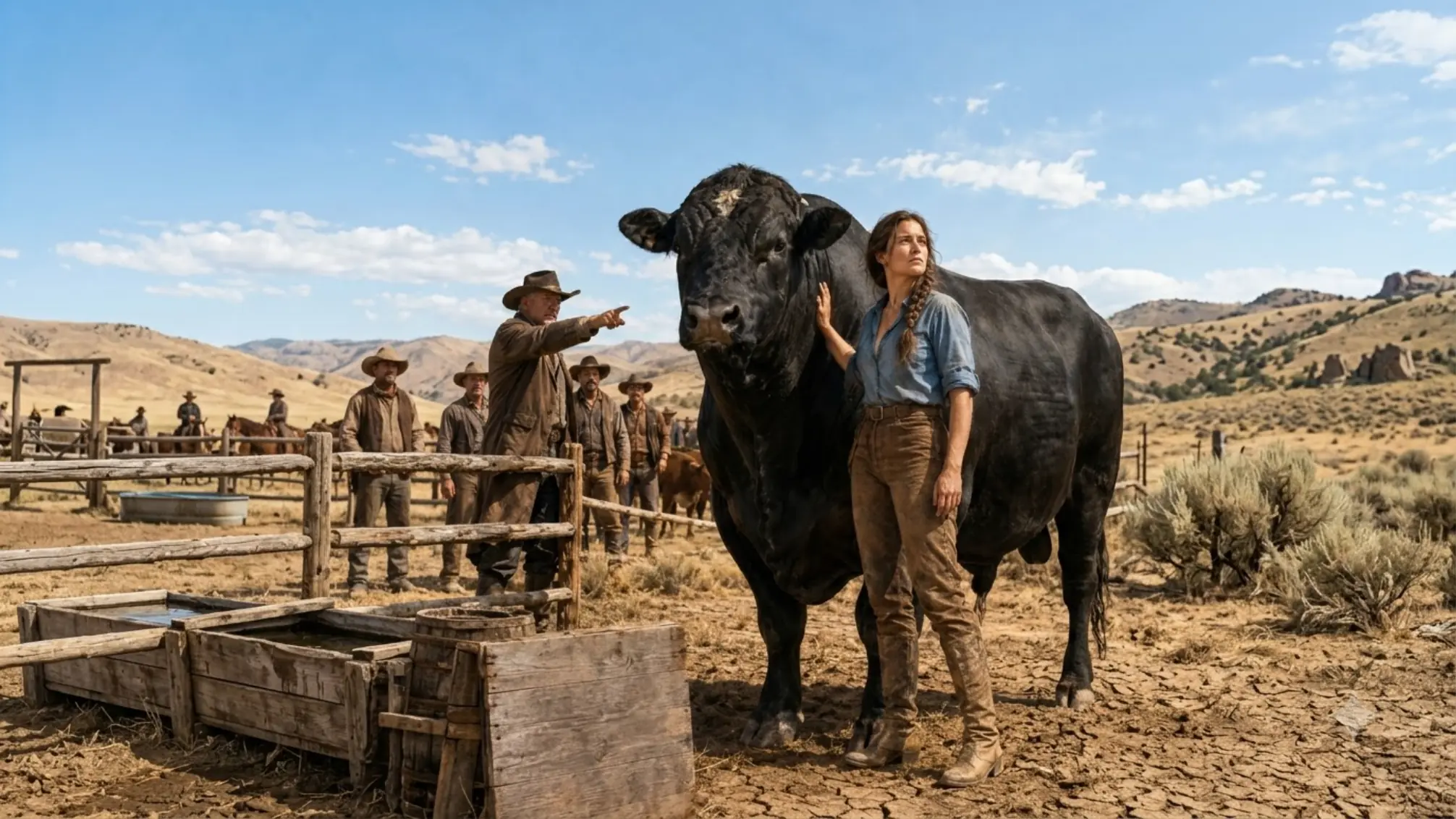
The calf weighed less than any newborn bull she had ever seen. His black hide clung tightly over ribs that moved too quickly beneath the skin, and his legs hung uselessly over her arms as she stumbled through spring grass toward the tiny cabin she had inherited after her husband died. Twice she nearly fell. Once she considered putting the animal down and going for a wagon, but the circling birds above convinced her she did not have that kind of time.
Behind her, Sterling Ranch spread across thousands of acres.
John Sterling had left the calf without hesitation.
Alera had watched him step from his wagon, nudge the tiny animal with his boot, and shake his head.
“Won’t make sunrise,” he had told one of his hands.
The ranch hand had shrugged.
Alera remained hidden beyond the fence until their wagon disappeared.
Then she moved.
By the time she reached her cabin, her arms shook so badly that she almost dropped the calf while lowering him beside the stove.
“Don’t make me regret this,” she whispered.
His eyelids fluttered.
That was enough.
Alera had become a widow at twenty-five. Fever took her husband in less than four days, leaving behind forty acres of poor soil, an unreliable creek, a shallow well, three chickens, and more silence than one human being should have been expected to endure. Neighbors told her to sell. Her husband’s brother suggested she move east and live with relatives.
Alera stayed.
She did not know whether that was courage or stubbornness.
Perhaps there was no difference.
That first night, she warmed watered milk and tried feeding the calf through a cloth.
He rejected it.
By morning he was colder.
Alera sat beside him with her knees drawn against her chest, watching each breath arrive later than the one before it.
That was when Heinrich Hemlock knocked on her door.
He lived down the valley on a small German farm everyone ignored because it produced little enough to inspire envy and enough to survive.
He stepped inside, removed his hat, and looked toward the calf.
“Sterling’s?”
Alera nodded.
“He left him.”
Hemlock knelt.
His old fingers moved carefully across the calf’s ribs and mouth.
Then he looked at the bowl.
“This will kill him.”
Alera stiffened.
“I’m trying.”
“I know.”
His voice carried no mockery.
That surprised her.
He explained that the calf needed more energy, not simply watered milk. He showed her how to mix egg, warm water, molasses, and a small amount of fat into something the calf could tolerate.
“Old-country foolishness,” Hemlock said.
Alera looked at him.
“Does it work?”
“Sometimes.”
“That’s better than nothing.”
For twenty minutes they tried.
Then the calf began sucking weakly from Alera’s fingers.
Hemlock smiled.
“There.”
Alera felt an unreasonable rush of hope.
Before leaving, Hemlock touched the doorframe.
“My grandmother used to say God does not measure anything by how small it begins.”
Alera looked toward the calf.
“That sounds like something grandmothers say so children stop crying.”
“Grandmothers are usually smarter than ranchers.”
She laughed for the first time in months.
The calf survived the day.
Then another.
By the end of the week, he could stand.
News reached town before Alera did.
When she entered Jed’s Mercantile for flour, the men around the stove fell silent.
Jed leaned both hands across the counter.
“Heard you’re raising Sterling’s dead stock.”
“He isn’t dead.”
A rancher near the stove chuckled.
“Yet.”
Alera placed coins beside the flour.
“He’s eating.”
“So do coyotes.”
The men laughed.
She carried the sack away without answering.
One of them called after her.
“Alera, save yourself the milk. That thing won’t ever be worth what you pour into him.”
She did not turn around.
That night, she counted every coin she had.
They were right about one thing.
She could not afford sentiment.
But when she looked toward the calf sleeping near the stove, something inside her refused the arithmetic.
He was the only other heartbeat in the house.
So she continued.
By June, the animal had grown enough to become troublesome.
He followed Alera everywhere.
When she carried water, he nudged her elbow. When she repaired fencing, he leaned his head against her back. When she tried moving him into a small pen, he complained so loudly that Heinrich heard him from half a mile away.
Still, Alera refused to name him.
Names made promises.
She had lost enough things she had promised herself would remain.
A ten-year-old boy solved that problem.
Finn Carter was the blacksmith’s son, quiet and thin, with a habit of appearing at the edge of Alera’s property after school.
One afternoon, he pointed toward the pale circular patch appearing on the calf’s forehead.
“Looks like a button.”
Alera wiped sweat from her face.
“That is a terrible name for a bull.”
Finn shrugged.
“He answers to it.”
“Because you’re holding apples.”
“Still answers.”
The calf became Button.
By autumn, nobody laughed at his size.
Sterling himself rode past one afternoon.
Button stood near the fence, shoulders already heavy for his age.
Sterling slowed his horse.
“Well.”
Alera continued repairing a trough.
Sterling studied the bull.
“That little thing lived.”
“He did.”
“Still won’t amount to much.”
Alera looked toward Button.
“Funny. Everyone keeps saying that while he keeps getting bigger.”
Sterling’s mouth tightened.
“Blood tells eventually.”
“So does care.”
He stared at her.
Then rode away.
Alera watched until the dust settled.
Something about his expression bothered her.
For the first time, he had not looked at Button as trash.
He had looked at him as property Sterling had accidentally allowed to escape.
That winter was mild.
The following spring was not.
Snowmelt came early. Rain came rarely.
By June, the grass across Promise Valley had begun turning pale.
The valley had endured dry years before. Ranchers spoke confidently about weather cycles, old droughts, and seasons that always turned eventually.
Alera listened.
Then she deepened her well.
People laughed again.
Her shallow well still produced water. Digging another six feet required days of painful work.
She did it anyway.
At sunrise she lowered herself into the earth.
By noon her shoulders burned.
By evening she hauled stones until the skin opened across her palms.
Finn helped when his father allowed him.
Heinrich helped too, though age limited him to sharpening tools and complaining that Alera worked like someone arguing with God.
She found a deeper seam of water.
Not much.
Enough.
Then she discovered damp earth near the southern boundary of her property.
Instead of ignoring it, she dug.
A small underground seep fed the soil.
Alera created a basin, packed it with clay, and slowly formed a cistern.
John Sterling heard.
So did everyone else.
At Jed’s store, a rancher laughed when Alera purchased another shovel.
“You planning to dig yourself clear to Mexico?”
“Only until I reach water.”
“Sterling Creek has never failed.”
Alera looked at him.
“Then you’ve got nothing to worry about.”
By August, Sterling Creek failed.
The once-wide ribbon of water became isolated pools.
Then mud.
Then stones.
Cattle began dropping weight.
Grass turned brittle.
Wells shallower than Alera’s disappeared.
Sterling Ranch suffered first because it carried more animals than any other operation in the valley.
Thousands of mouths required water.
Thousands of animals required grass.
Sterling had built wealth on scale.
The drought turned scale against him.
Meanwhile Alera’s small pasture remained green enough to survive.
She guarded every gallon from her well and cistern. She moved grazing carefully, never allowing cattle to destroy the roots beneath the grass.
And Button had become enormous.
At two years old, the runt everyone had expected to die stood taller through the shoulder than any bull Alera had seen in Promise.
His chest was deep.
His hindquarters were powerful.
His black coat reflected sunlight.
He remained gentle with Alera and Finn, though strangers tended to become much more respectful when Button lifted his enormous head toward them.
One afternoon Sterling’s foreman arrived.
Cole Brennan did not dismount.
“Mr. Sterling wants your bull.”
Alera stood beside the gate.
“No.”
Cole blinked.
“I didn’t tell you the offer.”
“You don’t need to.”
“He’ll pay two hundred.”
“No.”
“Three.”
Alera laughed once.
Cole’s face hardened.
“You understand that’s more than this whole patch of dirt is probably worth?”
“Then Mr. Sterling should be happy I said no.”
Cole leaned forward over his saddle.
“What’s a woman alone going to do with an animal like that?”
Alera looked past him toward Button.
“Whatever I decide.”
“You should think carefully.”
“I did.”
Cole spat into the dust.
“Sterling doesn’t like hearing no.”
“That sounds exhausting for him.”
Cole rode away.
The following week, Alera made an arrangement with three small farmers whose cows were struggling.
They could bring one cow each to her surviving pasture.
No money.
In return, Alera would keep every second calf produced through Button.
The farmers agreed immediately.
The cows were unimpressive.
One was swaybacked.
Another had a blind eye.
The third looked more bone than beef.
Sterling would have rejected all three.
Alera saw opportunity.
Button bred them.
The valley became hotter.
By August, even insects seemed quieter.
Dust entered houses through closed windows.
Families began hauling drinking water.
Some ranchers sold cattle at devastating prices simply because selling them was better than watching them die.
Every trip to Promise felt like attending a funeral.
Alera stopped listening to jokes.
There were none.
Then the first calf arrived.
A black heifer.
Strong.
Wide through the chest.
Standing within an hour.
Alera knelt beside her beneath starlight while Finn stared in amazement.
“She looks like Button.”
“She does.”
“You keeping her?”
Alera stroked the calf’s forehead.
“Yes.”
The second cow delivered five days later.
A bull calf.
Healthy.
Then the third.
Another strong calf.
Word spread.
The same men who had called Button coyote meat began riding past Alera’s fence.
They slowed.
They looked.
They said nothing.
Then a cattle buyer arrived from Denver.
His name was Charles Abernathy.
He had been inspecting what remained of the Sterling herd when he heard about Alera.
He walked into her pasture wearing city shoes and nearly ruined them in the mud near her cistern.
Then he saw Button.
“My God.”
Alera crossed her arms.
“That usually means either something very good or something very bad.”
Abernathy circled the bull.
“Where did he come from?”
“Sterling Ranch.”
“He sell him?”
“Abandoned him.”
Abernathy stopped.
“You’re joking.”
“No.”
He examined Button for almost fifteen minutes.
Then he looked at the calves.
The disbelief became excitement.
“These cows are nothing special.”
“Their owners know.”
“No insult intended.”
“Then don’t insult them.”
Abernathy smiled.
“I like you.”
“That makes one cattle buyer.”
He knelt beside the heifer.
“These calves have remarkable structure.”
“How remarkable?”
He stood.
“I’ll give you three hundred dollars for the bull calf.”
Alera’s heart nearly stopped.
Three hundred dollars.
Enough to improve the well.
Enough to buy breeding cows.
Enough to stop calculating flour before every trip into town.
“He isn’t mine.”
Abernathy frowned.
“The heifer?”
“Mine.”
“Three hundred.”
“No.”
“Four.”
“No.”
He laughed.
“You understand business?”
“I understand exactly why you offered four hundred after offering three.”
Abernathy looked at her for a moment.
Then nodded.
“When you decide to sell breeding stock, send word to Denver.”
“I might.”
“You will.”
“How confident.”
“I know cattle.”
Alera glanced at Button.
“So did everyone else.”
Abernathy laughed all the way to his buggy.
John Sterling arrived the next afternoon.
He came without Cole.
Without ranch hands.
Without his usual expensive horse.
His face looked ten years older.
“Alera.”
“John.”
He held his hat before him.
“I owe you an apology.”
Alera almost smiled.
Those were words she had never expected.
“For what?”
“The bull.”
“Which part?”
Sterling ignored the question.
“You saw something the rest of us missed.”
“I saw something still breathing.”
“And you built something from it.”
Alera waited.
Flattery from John Sterling was merely another kind of saddle.
Eventually, he intended to ride.
“I want to propose a partnership.”
There it was.
Sterling explained that she could move Button and her cattle onto Sterling property. He would provide infrastructure, feed connections, and access to his surviving breeding cows.
Together, he said, they could rebuild.
“Whose brand?” Alera asked.
He hesitated.
“Sterling-Vance.”
“Whose ownership?”
“We’d work out percentages.”
“Who controls Button?”
Sterling smiled carefully.
“It wouldn’t make sense to limit an animal like him to this little operation.”
Alera stepped toward the gate.
“My answer is no.”
His smile vanished.
“Alera.”
“No.”
“You don’t understand the opportunity.”
“I understand it perfectly.”
Sterling’s face hardened.
“Then you’re foolish.”
“There’s the John Sterling I remember.”
He lowered his voice.
“You have something this valley needs.”
“I know.”
“People are losing everything.”
“I know.”
“And you’re sitting here protecting water and breeding stock while families are desperate.”
Alera stared.
“You abandoned Button because feeding him wasn’t worth the expense.”
Sterling’s eyes narrowed.
“Times change.”
“They do.”
She touched the fence.
“My answer hasn’t.”
Sterling placed his hat back on.
“Desperate people become unpredictable.”
Alera’s jaw tightened.
“That sounds like a threat.”
“Advice.”
“Then here’s mine.”
She stepped closer.
“Don’t confuse what you need with what belongs to you.”
Sterling left.
Alera did not sleep that night.
Two days later, she saw the riders.
Twenty men approached her property.
Some were on horseback.
Others walked.
John Sterling led them.
Alera’s stomach tightened.
She had sent Finn home earlier.
Button stood behind her near the gate.
The huge bull seemed perfectly calm.
Sterling stopped beyond the fence.
“Alera.”
She remained inside her property.
“John.”
“These men have families.”
“I know most of them.”
Peters stood near the front.
His ranch had lost more than half its cattle.
Garvey stood beside him.
The blacksmith was there too.
Sterling pointed toward Alera’s pasture.
“They want to know why one woman has water while their children and livestock suffer.”
A murmur spread.
Peters shouted.
“You’ve got enough!”
Alera looked directly at him.
“Enough for what?”
“For all of us!”
“No.”
“You’re hoarding it.”
That word landed exactly where Sterling intended.
Alera looked toward John.
He stood slightly behind the angry men now.
Safe.
Guiding without appearing responsible.
She understood.
Sterling had not come to take Button himself.
He had come hoping the valley would take him.
Alera rested her hand against the bull’s massive neck.
John pointed.
“You’re one widow sitting on water and a bull that should’ve died. Hand them over before this whole valley tears your fence down.”
Alera looked at him.
“Funny.”
The crowd quieted.
“You called him worthless when I carried him home, but now your dying empire suddenly needs him.”
Sterling’s jaw clenched.
“Open the gate.”
“No.”
“Twenty desperate ranchers behind me can make this decision for you.”
Alera looked beyond him at the men.
Then back at Sterling.
“Then let them step forward, because before anyone crosses that fence, I’m going to tell them exactly who caused their herds to fail.”
The men shifted uneasily.
Sterling stepped closer.
“Careful.”
Alera ignored him.
“Mr. Peters.”
The farmer looked up.
“Last spring, when I deepened my well, what did you call me?”
He stared at the ground.
Alera waited.
Finally:
“A fool.”
“And when I built the cistern?”
Nobody answered.
Garvey cleared his throat.
“We laughed.”
“Yes.”
She looked around.
“You laughed because Sterling Creek had never failed.”
Sterling interrupted.
“This isn’t about the past.”
“It is exactly about the past.”
Alera’s voice remained calm.
“You laughed when I saved Button.”
She rested her palm against him.
“You laughed when I spent money keeping him alive.”
Several men looked at the bull.
“You laughed when I deepened my well.”
Silence.
“When I dug the cistern.”
More silence.
“When I refused to overgraze.”
She looked at Peters.
“You told me land existed to be used.”
Peters nodded reluctantly.
“I did.”
Alera pointed toward the cracked ground beyond her property.
“You used yours.”
Then toward her pasture.
“I managed mine.”
Sterling stepped forward.
“People are starving, Alera.”
“I know.”
“Then stop lecturing.”
She finally looked at him.
“You want them angry because anger keeps them from asking why the richest ranch in Promise had no drought plan.”
Sterling’s face reddened.
“You had thousands of cattle and enough money to build ten wells.”
The men looked toward him.
“You trusted one creek because improving anything would reduce your profits.”
“Alera.”
“You told everyone bigger herds meant stronger ranches.”
She pointed toward his starving cattle in the distance.
“How strong are they now?”
Sterling stepped toward the gate.
Button lifted his head.
The bull did not charge.
He simply moved one step closer to Alera.
Sterling stopped.
The blacksmith noticed.
So did everyone else.
Alera looked toward the crowd.
“I will not give you Button.”
A murmur rose.
“I will not let you take my breeding stock.”
The murmur became louder.
“And I will not let anyone seize this land.”
Peters shouted.
“So what are we supposed to do?”
Alera raised one hand.
“Listen.”
Something in her voice quieted them.
“I have water.”
Men stared.
“Not enough to save all your herds.”
Faces fell.
“But enough for families.”
Silence.
“Bring drinking barrels.”
Peters blinked.
“What?”
“Every household in Promise can take water for people.”
She looked around.
“No charge.”
The blacksmith removed his hat.
Alera continued.
“If you still own a milk cow, bring enough water to keep her alive.”
Garvey stared.
“You’d do that?”
“Yes.”
“After what we said?”
Alera held his gaze.
“I remember what you said.”
He looked ashamed.
“I’m helping because I know what losing everything feels like.”
Sterling stepped forward.
“And livestock?”
Alera looked at him.
“You’re worried about livestock now?”
His face hardened.
She turned back toward the others.
“I cannot rebuild thousands of head.”
Nobody argued.
“But Button can help rebuild breeding lines.”
The ranchers looked toward the enormous bull.
“When the first calves from my cows become available, local ranchers get first choice.”
Peters frowned.
“At Denver prices?”
“No.”
She shook her head.
“Neighbor prices.”
The blacksmith stared at her.
“You’d sell us Button calves?”
“Yes.”
“After we came here threatening your fence?”
“No.”
Alera looked toward Sterling.
“I’m offering despite the man who brought you here threatening my fence.”
Several heads turned.
Sterling’s face changed.
The difference mattered.
Alera was not surrendering.
She was choosing.
The blacksmith stepped forward.
He removed his hat completely.
“Alera.”
“Yes?”
“We were wrong.”
Nobody moved.
Then Peters removed his hat too.
“So was I.”
Garvey followed.
One by one, men who had arrived ready to intimidate a widow stood with hats in their hands.
Sterling remained mounted.
“You’re all fools.”
Nobody answered him.
“You think her little bull is going to save this valley?”
The blacksmith turned.
“No, John.”
He looked toward Alera.
“She is.”
Sterling stared at him.
Something broke in his expression.
Not sorrow.
Power.
He felt it leaving.
For decades, Promise had measured ranching wisdom by acreage.
By cattle numbers.
By money.
By how confidently John Sterling spoke.
Now twenty men stood outside Alera Vance’s fence and understood that the person they had dismissed had prepared while they boasted.
Sterling pulled hard on his reins.
“You’ll regret this.”
Alera stepped toward the fence.
“No.”
Her voice was quiet.
“You will.”
Sterling rode away.
Nobody followed.
That evening, people arrived with barrels.
Alera controlled the well carefully.
No waste.
No livestock herds.
Families first.
Milk cows second.
She wrote down every gallon.
Peters helped pump.
Garvey repaired the trough without being asked.
The blacksmith brought iron fittings for the cistern.
At sunset, Heinrich Hemlock arrived.
He stood beside Alera watching the line.
“You became popular.”
She laughed tiredly.
“I preferred being ignored.”
“Too late.”
He looked toward Button.
The bull stood beneath the cottonwood while Finn brushed dust from his enormous shoulder.
Hemlock smiled.
“God does not measure a thing by the size it starts.”
Alera looked at him.
“You’ve been waiting two years to say that again.”
“Yes.”
“Annoying old man.”
“Correct old man.”
She smiled.
Three weeks later, rain came.
It began quietly.
A few drops against the cabin roof.
Then more.
Alera walked outside.
Across the valley, people emerged from houses.
Nobody spoke.
Rain fell harder.
Children screamed with joy.
Men stood bareheaded.
Women placed pots beneath roof edges as if they feared heaven might change its mind.
Alera walked toward Button.
Water darkened his black hide.
He shook himself, sending droplets everywhere.
Finn laughed.
Alera tilted her head toward the sky.
For the first time in months, the earth smelled alive.
The drought ended.
The consequences did not.
Sterling Ranch had lost almost seventy percent of its herd.
The bank called loans.
Sections of land were sold.
John Sterling remained wealthy by ordinary standards, but his influence was finished.
People stopped assuming his decisions were wisdom simply because he was rich enough to survive mistakes.
Alera’s operation grew slowly.
That mattered.
She refused to repeat Sterling’s mistake.
She purchased two cows the following year.
Four the year after.
She kept Button’s strongest daughters.
She sold bulls locally before accepting offers from Denver.
Abernathy returned every season.
“You’re making this unnecessarily slow,” he complained.
“I’m making it sustainable.”
“You could be rich.”
“I can pay my bills.”
“That isn’t ambition.”
Alera looked across her pasture.
Healthy cows grazed beside calves.
Finn, now thirteen, repaired fencing.
Heinrich slept beneath a tree after claiming he was supervising.
Alera smiled.
“It’s enough ambition for me.”
Within five years, Button’s bloodline spread throughout Promise Valley.
The cattle became known for hardiness, calm temperament, and unusually strong calves.
Ranchers simply called them Vance cattle.
John Sterling hated the name.
Everyone knew that too.
One spring morning, a wagon appeared at Alera’s gate.
Sterling climbed down.
He had aged badly.
His coat was still expensive.
His boots were still polished.
But the arrogance that once arrived before him was gone.
Alera approached.
“What do you need?”
Sterling looked toward Button.
The bull was older now.
Gray appeared around his muzzle.
Still enormous.
Still magnificent.
“My remaining breeding bull died last winter.”
Alera waited.
“I need another.”
“Buy one.”
Sterling swallowed.
“I came to.”
She understood.
He wanted Button’s bloodline.
The animal he had abandoned.
Alera crossed her arms.
“I have two yearlings available.”
Sterling nodded.
“How much?”
She gave him the standard local price.
He blinked.
“That’s all?”
“That’s the price.”
“You could charge me anything.”
“I could.”
Sterling looked at her.
“Why don’t you?”
Alera glanced toward Button.
“Because then I’d become you.”
Sterling lowered his eyes.
The sentence hurt.
She could see it.
But he nodded.
“I suppose I earned that.”
“Yes.”
Alera expected argument.
None came.
Sterling looked across the pasture.
“I was wrong about you.”
She almost laughed.
“About Button?”
“You too.”
Alera said nothing.
He continued.
“I thought being alone made you small.”
Alera looked toward the ranch she had built.
“Being alone gave me room.”
Sterling nodded.
He purchased the bull.
Paid full price.
No discount.
No punishment.
Fair dealing.
As he prepared to leave, he stopped.
“Why did you save him?”
Alera looked toward Button.
The answer had changed over the years.
At first, she thought she saved him because she could not tolerate watching something die alone.
Later she believed she saved him because she recognized herself in him.
Now she understood something deeper.
“Because everyone else had already decided what he was worth.”
Sterling waited.
“And?”
Alera smiled.
“I wanted to see for myself.”
Sterling looked toward the bull once more.
Then left.
That evening, Alera sat on her porch beside Heinrich.
Finn, now nearly grown, worked near the barn.
Button stood among cows and calves carrying his blood.
The valley was green.
Not untouched.
Never untouched.
But alive.
Heinrich leaned back.
“You understand what you built?”
“A lot of fencing.”
He frowned.
“Do not ruin my wisdom.”
She laughed.
He pointed toward the herd.
“You changed how these people ranch.”
Alera considered that.
After the drought, neighbors began deepening wells.
They built cisterns.
They reduced herd sizes.
They shared breeding stock instead of competing themselves into ruin.
The water agreement Alera organized during the crisis eventually became permanent.
Nobody called it charity.
It was simply what neighbors did when survival became more important than pride.
“I didn’t change them,” Alera said.
“The drought did.”
Hemlock shook his head.
“The drought broke them.”
He looked at her.
“You showed them how to rebuild.”
Alera watched Button.
He had been born too small.
Left behind.
Dismissed by people who understood cattle.
She had been a widow with poor land.
Dismissed by people who understood ranching.
Perhaps experts sometimes confused familiarity with certainty.
Perhaps people became most dangerous when they believed something unworthy before giving it the opportunity to become otherwise.
Finn walked toward the porch.
“Button broke the west gate again.”
Alera closed her eyes.
“Of course he did.”
“He leaned on it.”
“That bull weighs more than the gate.”
“I told him.”
“Did he apologize?”
“No.”
Heinrich laughed.
Alera stood.
She looked toward the huge black shape waiting beside the broken fence.
“You know,” Finn said, “if Sterling had kept him, he’d probably have become his best bull.”
Alera picked up her gloves.
“Maybe.”
Finn frowned.
“You don’t think so?”
She looked at Button.
“I think surviving and becoming are different things.”
Finn waited.
“Sterling might have kept him alive once he became useful.”
Alera walked toward the pasture.
“But he would never have believed in him while he was still worthless.”
Finn followed.
Button saw Alera and approached.
His massive forehead lowered toward her.
She placed both hands against him.
The little white mark Finn had once called a button remained visible beneath years of black hair.
Alera smiled.
“You ridiculous animal.”
Button exhaled heavily.
Finn laughed.
Across the valley, cattle grazed on land that had once cracked beneath drought.
The Vance line moved among them.
Strong.
Patient.
Alive.
And Alera Vance, once called foolish for spending precious milk on a calf nobody wanted, stood at the center of everything that decision had created.
The valley remembered John Sterling as the man who built the largest herd Promise had ever seen.
But it remembered Alera differently.
She was the woman who understood something size and money had made everyone else forget.
What survives is not always what begins strongest.
Sometimes it is what someone decides is still worth saving.