At twenty-four, Emily Harper had learned that kindness usually arrived before answers did. It appeared in the seconds before a person had enough information to decide whether helping was sensible, safe, or convenient. By the time every fact was known, the moment to act had often already passed. That was why Emily noticed the elderly woman outside Willow Creek Florist when everyone else kept walking.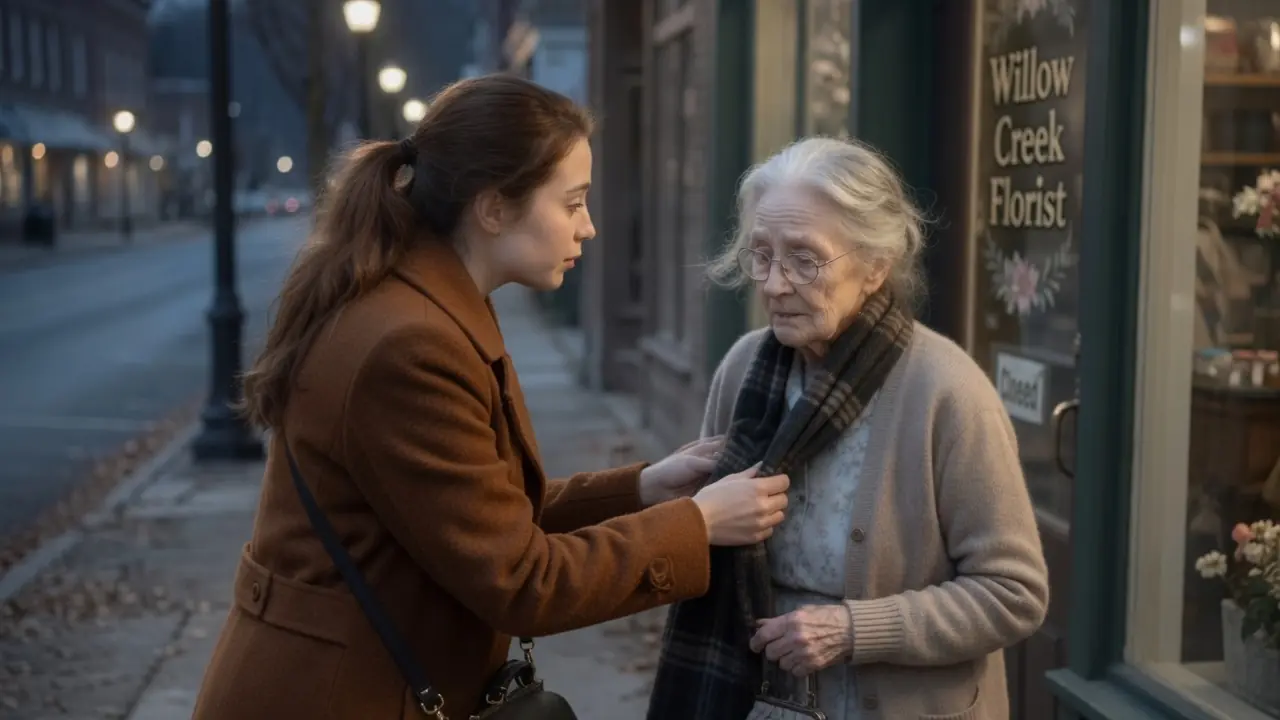
The November evening had turned colder much faster than expected. Wind moved along Main Street, pushing dead leaves against brick storefronts and carrying the smell of wood smoke from the houses beyond the hill. Most businesses had already closed, and the streetlamps cast pale circles across the wet sidewalk. Snow had not begun, but the air held the heavy stillness that came just before it.
Emily stood inside the florist shop, counting the day’s disappointing earnings. Three wedding deposits had been delayed, two regular customers had moved away, and the landlord had placed another rent notice beneath the door that morning. The register contained sixty-eight dollars, most of which would disappear into the electricity bill before the week ended. She closed the drawer and tried not to look toward the envelope marked Final Notice beside the telephone.
Willow Creek Florist had belonged to Emily’s grandmother, Rose Harper, before passing to Emily’s mother, Sarah. Emily grew up sweeping leaves from the entrance, trimming stems, and listening to customers explain the meaning behind every bouquet. After Sarah died from cancer two years earlier, Emily inherited the shop along with its debts, failing refrigerator, and reputation for never turning away someone who needed flowers for a funeral but could not pay immediately.
Emily kept the business alive because surrendering it felt like losing both women again. Yet love did not repair leaking roofs or increase foot traffic. The national grocery store outside town sold flowers for half her prices, and younger couples ordered wedding arrangements online. Every month, Emily promised herself she would survive one more.
She turned the sign to Closed and reached for the light switch.
Then she saw the old woman.
The woman stood close to the shop window wearing a thin beige cardigan over a faded floral dress. A dark plaid scarf hung loosely around her neck, offering little protection against the cold. Her silver hair had partly escaped its bun, and a small purse dangled from one trembling hand. She stared at the gold lettering on the glass as though the words meant something she could not quite remember.
Emily opened the door.
The wind immediately entered the shop, shaking the hanging ribbons near the counter. The old woman turned, startled, and stepped backward.
“Ma’am, are you all right?”
“Yes,” she answered too quickly.
Her voice was gentle but uncertain. Emily noticed that her shoes were soft indoor slippers rather than outdoor footwear. Moisture had darkened the fabric around the toes, and the woman’s fingers were nearly colorless from cold.
“Are you waiting for someone?”
“My son.”
“Is he coming here?”
The woman looked down the empty street. “He always finds me.”
Emily stepped outside and pulled the door partly closed behind her. “How long have you been standing here?”
“I only just arrived.”
The woman’s lips trembled so badly that the sentence became difficult to understand. Emily removed her own black scarf and wrapped it carefully around the stranger’s shoulders. The old woman did not resist, but she looked at Emily with sudden tears in her pale blue eyes.
“Why are you standing out here alone in this cold?” Emily asked.
“I can’t remember the road home.” The woman gripped her purse with both hands. “My son will think I’ve become a burden.”
Emily’s heart tightened.
“You are not a burden.”
“You do not know me.”
“I know you are freezing.”
The old woman looked through the florist window. “Is this still the Harper shop?”
“Yes.”
“Rose Harper?”
“My grandmother.”
The woman closed her eyes.
For several seconds, she appeared to stop breathing. Emily reached toward her but hesitated before touching her arm.
“Did you know my grandmother?”
“I knew someone,” the woman whispered. “Someone with kind hands.”
Emily unlocked the shop again and guided her inside. The woman moved slowly, one hand trailing along the wall for balance. Once the door closed, Emily turned up the small space heater and brought a chair from the consultation table.
“My name is Emily Harper.”
The elderly woman stared at her.
“Emily,” she repeated.
“What is your name?”
The answer took longer.
“Evelyn.”
“Evelyn what?”
Her confusion returned. She opened the small purse and searched through it, but the bag contained only a handkerchief, an old lipstick, and a silver locket. There was no wallet, identification, phone, or written address.
Evelyn opened the locket.
Inside was a tiny photograph of a young woman standing beside the florist shop many years earlier. The photograph had faded almost completely, but Emily recognized the old striped awning visible behind her. On the opposite side was a picture of a newborn baby wrapped in a white blanket.
“Who is she?” Emily asked.
Evelyn touched the first photograph. “Rose.”
Emily leaned closer.
The woman in the picture was younger than any photograph Emily had ever seen of her grandmother. Rose wore a simple blue dress and stood with one hand resting protectively on Evelyn’s shoulder. Evelyn could not have been more than twenty.
Emily looked toward her.
“This is you?”
Evelyn nodded.
Before Emily could ask another question, the old woman swayed in the chair. Emily caught her shoulders and lowered her gently against the backrest. Evelyn’s skin felt dangerously cold.
“I need to call someone.”
“No police.”
“I can call an ambulance.”
Evelyn’s fear became immediate. “Please, no hospital.”
“You need to be checked.”
“My son will find me.”
“Then help me contact him.”
Evelyn pressed one hand against her forehead. “Daniel.”
“Daniel is your son?”
“Yes.”
“What is his last name?”
She stared at the floor.
The answer would not come.
Emily considered calling emergency services anyway. Leaving an elderly woman confused and exposed to the cold was not safe, and Emily knew she was not trained to evaluate memory loss. Yet Evelyn’s panic increased every time the hospital was mentioned.
“Do you live in Willow Creek?” Emily asked.
“I used to.”
“When?”
“Before Daniel learned to walk.”
Emily knelt beside her. “Come home with me tonight. You can eat something, warm up, and rest while I find your family.”
Evelyn studied her face. “Why would you trust me?”
“I don’t know whether I do.”
The honesty seemed to calm her.
Emily continued. “But I trust what my grandmother would have done.”
Tears filled Evelyn’s eyes again.
“She would have opened the door,” she whispered.
Emily lived above the florist in a narrow apartment her grandmother had built after purchasing the building. The stairs were steep, so Emily brought Evelyn through the rear entrance and used the old service lift once designed for flower deliveries. It groaned during the climb, but Evelyn smiled faintly when they reached the second floor.
The apartment contained one bedroom, a small sitting room, and a kitchen overlooking Main Street. Emily offered Evelyn the bedroom and prepared tomato soup with grilled cheese at the stove. The old woman sat at the table wrapped in two blankets, watching Emily with an expression that alternated between confusion and recognition.
“You look like Sarah,” Evelyn said.
Emily stopped stirring the soup. “My mother?”
“I think so.”
“You knew her too?”
Evelyn frowned. “Little girl with red boots.”
“My mother had red rain boots as a child.”
“Rose complained she jumped into every puddle.”
Emily sat across from her. “When did you know my family?”
“A long time ago.”
“What happened?”
Evelyn stared toward the dark window.
“A door opened.”
That was all she could say.
Emily served the food, and Evelyn ate slowly. After half the sandwich, she placed it down and touched the locket again.
“Daniel was so small,” she said.
“The baby in the picture?”
“My boy.”
“Where was his father?”
Evelyn’s fingers tightened around the necklace. “Behind us.”
Emily did not understand, but she noticed fear returning to the woman’s face. She changed the subject and asked whether Evelyn preferred tea or coffee.
“Tea.”
“With milk?”
“Rose remembered.”
Emily prepared it the way her grandmother had prepared tea for every visitor, with milk added first and one small spoonful of honey. Evelyn took one sip and began crying quietly.
Neither woman spoke for several minutes.
After Evelyn fell asleep, Emily searched online for missing-person notices. She typed Evelyn Daniel Pennsylvania elderly woman missing, but the results were too broad. She checked local police pages, community groups, and news reports without finding a useful match.
At eleven-thirty, snow began falling.
Emily sat near the bedroom door and listened to Evelyn breathe. Every few minutes, the old woman murmured names in her sleep.
Rose.
Daniel.
Arthur.
Once, she said, “Do not let him take the baby.”
Emily remained awake most of the night.
At six the next morning, pounding shook the florist’s front door.
Emily hurried downstairs wearing yesterday’s black trousers and a sweater pulled over her nightshirt. Through the glass, she saw two police officers, a woman in medical clothing, and a tall man in a dark coat. Three black vehicles were parked along the curb, their roofs covered in fresh snow.
The man stepped closer to the window.
He was around thirty-eight, with dark hair, tired blue eyes, and the expression of someone who had spent the night imagining the worst. When Emily unlocked the door, he entered before the officers could stop him.
“Where is she?”
“Who?”
“My mother.”
Emily moved between him and the stairs. “Tell me her name.”
“Evelyn Mercer.”
The surname landed with immediate recognition.
The Mercer family owned hospitals, assisted-living centers, construction companies, and large sections of commercial property across Pennsylvania. Mercer House, the restored mansion outside Willow Creek, had remained empty for years but still appeared in local history books. Daniel Mercer’s photograph occasionally appeared in newspapers beside stories about healthcare expansion and charitable donations.
Emily looked at the exhausted man standing inside her shop.
“You’re Daniel Mercer.”
“Yes.”
One officer stepped forward. “Miss Harper, Mr. Mercer’s mother was reported missing yesterday afternoon from a memory-care residence outside Harrisburg.”
“She said she didn’t want a hospital.”
“She becomes frightened when she is confused,” the medical woman explained. “I’m Dr. Nina Patel, her geriatric specialist.”
Emily’s defensiveness softened slightly. “She is upstairs. She was cold but ate dinner, drank tea, and slept.”
Daniel closed his eyes.
For one second, the wealthy executive disappeared, leaving only a frightened son hearing that his mother had survived the night. He gripped the back of a chair until his breathing steadied.
“May I see her?”
Emily nodded.
They rode the service lift upstairs because Daniel refused to wait for the narrow staircase. When the bedroom door opened, Evelyn was already awake. She sat beneath the quilt holding Rose’s photograph.
“Daniel,” she said.
He crossed the room and knelt beside the bed.
“Mom.”
Evelyn touched his face. “I found her.”
Daniel’s eyes moved toward Emily.
“Found whom?”
“Rose’s girl.”
Emily stood near the doorway, uncertain whether she belonged inside the moment. Daniel looked from the locket to the old photograph.
“You came here on purpose?” he asked.
Evelyn smiled through tears. “I remembered the flowers.”
Dr. Patel examined Evelyn while Daniel remained beside her. Her temperature had returned to normal, and there was no sign of serious injury. The doctor explained that Evelyn had recently entered a memory-care program because vascular dementia sometimes caused confusion, particularly during the late afternoon.
“She left through a service entrance during a fire alarm,” Daniel said. “A taxi driver remembered dropping her near Willow Creek, but she could not tell him the street.”
Emily looked toward Evelyn. “You remembered the florist.”
“She has spoken about this place for years,” Daniel replied.
“Why?”
He glanced at his mother.
Evelyn rested against the pillow, exhausted but peaceful. “Tell her.”
Daniel asked Emily to join him downstairs.
The police left after confirming Evelyn’s safety, while Dr. Patel remained upstairs. Daniel stood beside the florist counter and examined the photographs along the wall. Rose Harper appeared in several, arranging wedding bouquets, standing beside community fundraisers, and holding Sarah as a child.
“My mother grew up near Pittsburgh,” Daniel began. “Her father died when she was sixteen, and her mother remarried a man named Arthur Mercer.”
Emily waited.
“Arthur was wealthy, controlling, and violent. When my mother became pregnant at nineteen, he believed the child would embarrass the family.”
“Your father?”
“Arthur’s son from his first marriage.”
Emily stared at him.
Daniel continued carefully. “My parents were not related by blood, but Arthur still considered the relationship a betrayal. He wanted my mother sent away and me surrendered for adoption.”
“What did your father do?”
“He died in a car accident before I was born.”
Evelyn had been left pregnant, isolated, and completely dependent on Arthur. He kept her inside the Mercer estate and told everyone she had experienced a nervous breakdown. When she tried to leave, he threatened to have her declared unfit and take the baby immediately after birth.
One November night, she escaped.
“She had no money,” Daniel said. “No coat. No idea where she was going.”
Emily looked toward the ceiling, imagining the elderly woman as the frightened girl in Rose’s photograph.
“She reached Willow Creek during a storm,” Daniel continued. “Your grandmother found her outside this shop.”
Exactly as Emily had found her nearly fifty years later.
Rose brought Evelyn upstairs, hid her from men Arthur sent to search the town, and contacted a lawyer who helped protect her rights. When labor began unexpectedly, Rose drove her to a hospital under another name and remained beside her through Daniel’s birth.
“She saved both of you,” Emily said.
“Yes.”
“Why didn’t anyone in my family tell me?”
“My mother promised not to expose the circumstances. Arthur Mercer remained powerful for years, and she feared he would still try to take me.”
Rose kept the secret.
She helped Evelyn find safe housing and employment through a women’s organization in Philadelphia. Evelyn eventually married a kind man named Henry Whitfield, though she retained the Mercer surname to preserve Daniel’s legal inheritance. After Arthur died, hidden trust documents revealed that Daniel’s father had left shares in the family company to his unborn child.
Daniel inherited controlling ownership at twenty-five.
“My mother spent years trying to repay your grandmother,” he said. “Rose refused every offer.”
“That sounds like her.”
“She said opening a door was not an investment.”
Emily smiled faintly. “That also sounds like her.”
Daniel removed an envelope from inside his coat.
“My mother began searching for you after Sarah died.”
Emily’s smile vanished.
“How did she know?”
“The funeral notice reached her foundation. She wrote several letters, but she never sent them.”
“Why?”
“She wanted to come herself. Then her memory began failing.”
Daniel placed the envelope on the counter. Rose Harper’s name was written across it in Evelyn’s careful handwriting.
“What is this?”
“A promise.”
Emily opened it.
Inside was a copy of a handwritten letter from Rose dated November 1976. The original remained in Evelyn’s private papers.
Evelyn,
You owe me nothing. Raise your boy where fear cannot reach him. If he grows into a man who keeps a door open for someone else, that will be repayment enough.
Keep your money for the life ahead of you. But if one day my family stands where you stood tonight, help them without turning their need into ownership.
Rose
Emily read the final sentence twice.
Daniel looked around the struggling shop. “My mother learned three months ago that your landlord intends to sell this building.”
Emily stiffened. “How?”
“Public property records.”
“This is why she came?”
“She believed your family had reached the same kind of doorway.”
“I am not running from an abusive man.”
“No. But you are about to lose the place Rose used to save her.”
Emily folded the letter. “And your mother wanted to buy it for me.”
Daniel did not deny it.
“I cannot accept that.”
“I expected you to say so.”
“Then why tell me?”
“Because refusal should come after understanding, not before.”
Emily moved behind the counter, needing distance. “Your mother does not owe my family a building.”
“I agree.”
“Then this ends here.”
Daniel remained calm. “The property was purchased yesterday.”
Emily stared at him.
“What?”
“The landlord accepted an offer from the Mercer Community Trust.”
Anger rose immediately. “You bought my workplace without asking me?”
“We purchased the building to prevent another buyer from removing you next month.”
“That is still control.”
“Yes.”
The answer surprised her.
Daniel continued. “Which is why the trust will not give you the property.”
Emily folded her arms.
“The building will be placed inside a community preservation program,” he explained. “You may sign a thirty-year commercial lease at the same monthly rate Rose paid when she opened the shop.”
“That would be almost nothing.”
“It covers taxes and basic maintenance.”
“And what does Mercer receive?”
“No ownership of your business. No percentage of profits. No naming rights.”
“There must be a condition.”
“There is.”
Emily waited.
“You preserve the upstairs emergency room.”
“My apartment?”
“Rose’s safe room.”
Daniel explained that Evelyn’s foundation wanted to renovate part of the second floor into temporary accommodation for women, elderly people, or stranded families needing one safe night while local services arranged proper help. Willow Creek Florist would remain independent, but the building would continue opening its door as Rose once had.
Emily looked around the shop.
The proposal was not charity disguised as possession. It was a way of protecting the building’s history while giving its kindness a future. Still, accepting frightened her.
“What happens if the florist fails?”
“The space remains available to another local business willing to maintain the safe room.”
“So the building is not mine.”
“No.”
Emily looked at the letter again.
That mattered.
Daniel was not offering wealth in exchange for gratitude, loyalty, or access. He was offering time, stability, and a responsibility larger than either family.
“Your mother planned all of this?”
“She planned most of it during her clearer days.”
“Why didn’t you contact me?”
“She asked me to wait until she could come.”
Emily glanced toward the stairs.
“And then she escaped?”
Daniel smiled sadly. “She remembered Rose more clearly than she remembered the address of her own residence.”
Dr. Patel brought Evelyn downstairs an hour later.
The old woman wore Emily’s scarf and held Daniel’s arm. She stopped when she saw the letter in Emily’s hand.
“You read it?”
“Yes.”
Evelyn’s expression became anxious. “Are you angry?”
“A little.”
Daniel looked away to hide a smile.
Emily crossed the shop and stood before her. “You should not have come alone.”
“I had to see whether the flowers were still here.”
“They are.”
“And Rose?”
Emily swallowed. “She died twelve years ago.”
“I know.”
For one painful moment, Evelyn looked completely clear.
“She was the first person who looked at me and saw someone worth saving,” she said.
Emily took her hands.
“My grandmother would say you saved yourself. She only opened the door.”
Evelyn smiled. “You sound like her.”
Outside, morning light touched the snow along Main Street. Several residents had gathered near the black vehicles, whispering about why Daniel Mercer was inside the failing florist shop. Emily understood that by afternoon, everyone in Willow Creek would have a different version of the story.
The truth was quieter.
One frightened young woman had been welcomed into the florist nearly fifty years earlier. She became an old woman, lost part of her memory, and still remembered the door.
Emily agreed to review the preservation lease with an independent attorney. Daniel insisted on paying for the attorney but allowed Emily to choose one with no connection to the Mercer family. She changed several clauses, added stronger protections for the florist, and required the community trust to maintain accessibility upgrades without increasing rent.
Daniel accepted every revision.
Three months later, the upstairs apartment was renovated.
Emily moved into a small unit at the rear of the building while the larger bedroom became Rose’s Room. It contained a bed, clean clothes, food, a working telephone, and a lock that could be secured from inside. A plaque near the door carried only one sentence.
Kindness opens the door. Choice decides what happens next.
The florist slowly recovered.
News of the preservation project brought customers from surrounding towns, but Emily refused to turn her grandmother’s story into a marketing trick. She never placed Evelyn’s photograph in advertisements or described the safe room as part of a heroic family legacy. People who stayed there deserved privacy, just as Evelyn once had.
Daniel returned often to visit his mother.
Sometimes Evelyn remembered Emily immediately. Other times she called her Rose or Sarah and needed Daniel to explain where they were. Emily stopped correcting every name and learned to listen for the emotion beneath the confusion.
One spring afternoon, Evelyn sat beside the florist window arranging yellow tulips. Her hands moved slowly but retained the memory of Rose teaching her how to trim stems. Daniel watched from across the room.
“She is happier here,” he said.
“Then bring her whenever Dr. Patel approves.”
“You make that sound simple.”
“It should be.”
Daniel looked toward Emily. “Nothing involving my family has ever been simple.”
“That may be because your family employs too many lawyers.”
He laughed.
Over the following year, their friendship grew without promises. Daniel helped with the preservation program but never interfered with the flower shop. Emily attended Mercer Foundation meetings only when the safe room required funding or policy decisions, and she challenged Daniel whenever wealthy board members spoke about vulnerable people as though they were numbers.
He began trusting her because she did not need anything from his name.
She began trusting him because he never used generosity to demand access.
One evening, nearly a year after Evelyn appeared in the cold, Emily locked the shop and found Daniel waiting outside beneath the streetlamp. Snow had begun falling in the same quiet way it had on the night his mother disappeared.
“Is Evelyn all right?” Emily asked.
“She is sleeping.”
“Then why are you here?”
Daniel looked toward the gold lettering on the window.
“To ask whether kindness is allowed to arrive after answers.”
Emily smiled. “Sometimes.”
He stepped closer. “Would you have dinner with me?”
“As Daniel Mercer?”
“I have not found another name that works.”
“No assistants?”
“No.”
“No board members?”
“Absolutely not.”
Emily pretended to consider the offer.
Then she wrapped her black scarf around her neck. It was the same scarf she had given Evelyn, carefully cleaned and returned with a handwritten note.
“Dinner,” Emily said. “Nothing more promised.”
Daniel offered his hand but waited.
Emily chose to take it.
They walked down Main Street while snow gathered across the rooftops. Behind them, Willow Creek Florist remained illuminated, and the light from Rose’s Room shone through the upstairs window.
The building had survived because two women, separated by nearly fifty years, made the same decision before knowing where it would lead.
Rose opened the door for Evelyn.
Emily opened it again.
And when Evelyn’s memory could no longer hold every name, road, or year, it still held the one truth that mattered.
Some doors remembered kindness even when people could not.