The slap sounded louder than it should have.
Perhaps it was because every other sound inside the first-class cabin seemed to vanish immediately afterward.
One second, Diana Washington was bending toward the polished aisle to retrieve a sheet that had slipped from her leather portfolio. The next, senior flight attendant Madison Wright’s open hand struck the left side of Diana’s face hard enough to turn her head and make one pearl earring brush her jaw.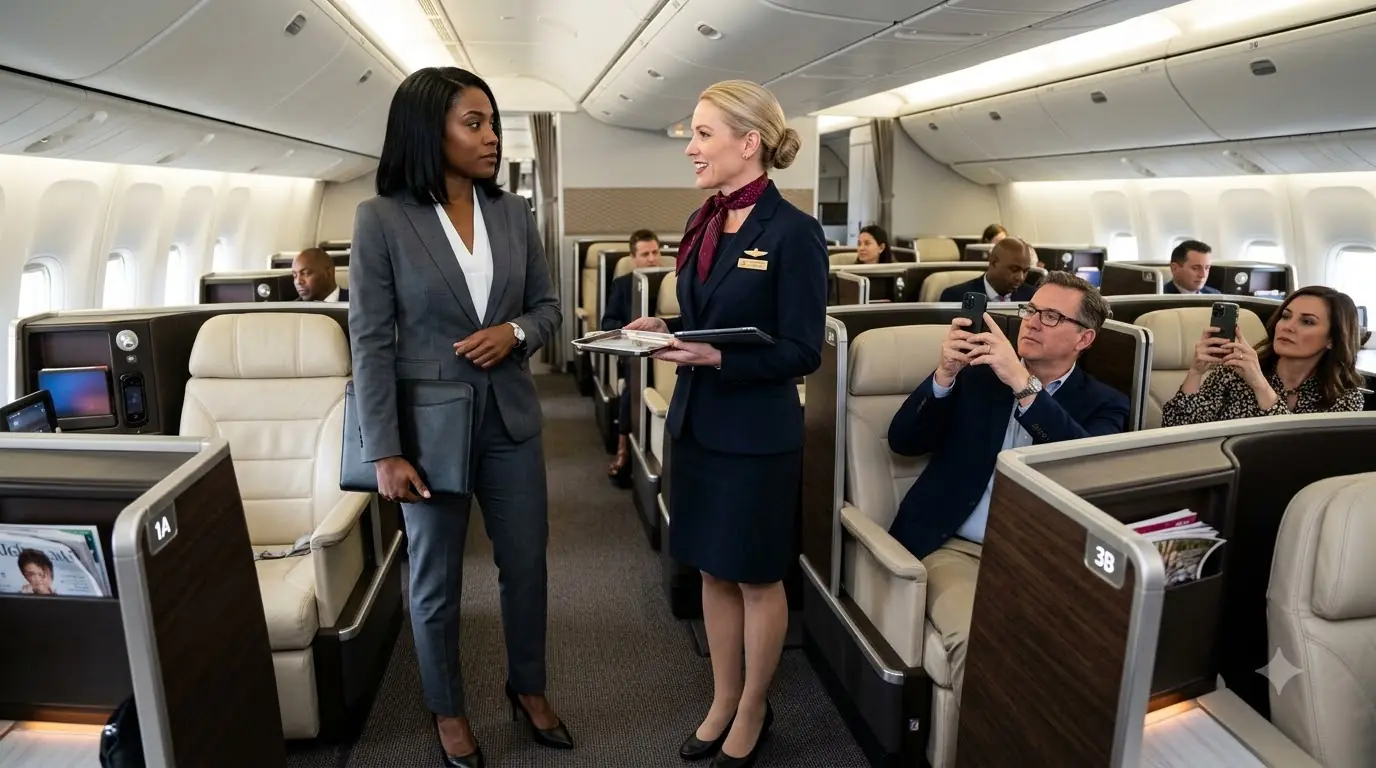
A champagne glass stopped halfway to a passenger’s mouth.
Someone gasped.
Another passenger whispered, “Jesus.”
The low continuous hum of the aircraft suddenly seemed enormous.
Diana remained still for perhaps two seconds.
Her cheek burned.
Not badly.
What stunned her was not pain.
It was the sheer impossibility of what had just happened.
Madison stood less than two feet away in her fitted navy uniform, blonde hair pulled tightly into a professional bun, burgundy silk scarf immaculate at her throat. Her breathing was rapid. Color had risen across her face.
And she looked angry.
Not horrified.
Not ashamed.
Angry.
“I don’t care who you think you are,” Madison snapped. “You have been difficult since boarding, and I’m finished tolerating it.”
Diana slowly raised her fingertips to her cheek.
Around them, phones began appearing.
The elderly man in seat 2A leaned into the aisle.
“Miss, you just hit her.”
Madison turned sharply.
“Sir, stay out of this.”
“I watched it happen.”
“I said stay out of it.”
Diana lowered her hand.
Her voice came quietly.
“Did you really just strike a passenger?”
Madison laughed once.
“Yes.”
The word shocked the cabin almost as much as the slap.
Madison continued.
“And maybe now you’ll stop behaving like you own the place.”
Diana looked at her.
For one strange second, she almost smiled.
Not from amusement.
From disbelief at the accidental accuracy of the statement.
Instead, she glanced toward the documents scattered near her shoes.
One page contained a route-performance summary.
Another carried notes from the company’s labor-relations office.
The third had fallen beneath the edge of a cream leather seat.
Diana bent to retrieve it.
Madison stepped forward.
“I told you to sit down.”
Diana picked up the paper.
Then straightened.
“Who is the senior cabin supervisor on this flight?”
Madison rolled her eyes.
“Oh, please.”
“I asked you a question.”
“You can file whatever complaint you want when we land.”
The elderly man across the aisle shook his head.
“I wouldn’t wait.”
Madison turned toward him.
“You have been warned once.”
He laughed.
“Warned?”
Another passenger, a young woman near the window, raised her phone higher.
Madison saw it.
“Stop recording.”
The woman answered immediately.
“No.”
“You’re interfering with cabin operations.”
“I’m sitting in my seat.”
Madison’s jaw tightened.
Diana looked around.
Nearly half the cabin was watching through phone screens now.
That meant evidence existed beyond the aircraft’s internal systems.
Good.
Diana had spent too much of her career around investigations to depend on one source.
She reached toward her portfolio.
Madison scoffed.
“Whatever paper you think is going to impress me, save it.”
Diana opened a slim black credential wallet.
She did not wave it.
Did not shove it into Madison’s face.
She simply held it between them.
Madison glanced down.
A company seal.
A photograph.
Then the name.
DIANA E. WASHINGTON
EXECUTIVE CHAIR
WASHINGTON AVIATION GROUP
Madison stared.
Her expression did not collapse all at once.
First came confusion.
Then recognition.
Then denial.
Then something much closer to fear.
“You…”
Before she could finish, footsteps came from the forward galley.
Robert Lang, the flight’s cabin manager, entered holding a service tablet.
He had just received an urgent message from operations.
His eyes found Diana.
Then the reddening mark on her face.
Then Madison.
He stopped dead.
“Ms. Washington?”
Madison turned slowly toward him.
Robert’s mouth opened.
Nothing came out.
The first-class passengers watched.
Finally Robert asked, almost in a whisper:
“What happened?”
The elderly passenger answered before anyone else could.
“She slapped her.”
Robert looked at Madison.
Madison said quickly:
“There was a passenger-compliance issue.”
Robert stared.
“You struck her?”
“She was refusing instructions.”
“What instructions?”
“She was blocking the aisle.”
Diana spoke.
“I was collecting papers that fell from my portfolio.”
Robert looked at the scattered sheet still visible beneath one seat.
Madison continued.
“She was deliberately disrupting service.”
Diana looked toward her.
“Was I?”
Madison’s confidence weakened.
Robert’s voice dropped.
“Madison, step into the galley.”
“No.”
The answer surprised everyone.
Madison realized it immediately.
Robert stared.
“What?”
She corrected herself.
“I mean, I think we need to deal with the passenger issue first.”
Robert’s expression changed.
“There is no passenger issue right now.”
Madison looked at Diana.
Then back.
Robert repeated:
“Forward galley. Now.”
Madison finally moved.
Diana remained standing.
Robert turned toward her.
“Ms. Washington, I am extremely sorry.”
Diana interrupted.
“Don’t apologize for something you didn’t do.”
“Yes, ma’am.”
“Also, don’t call me ma’am because you now know who I am.”
Robert looked embarrassed.
Diana lowered her voice.
“Handle this exactly as you would if she had struck any passenger.”
Robert paused.
The sentence mattered.
Diana knew it.
He knew it.
The entire situation had become complicated the second her identity was exposed.
If he reacted too aggressively because she owned the company, any investigation could become contaminated by hierarchy.
If he reacted too softly because Madison was a colleague, passengers would see that too.
Diana continued.
“Separate her from passenger service if policy requires it.”
Robert nodded.
“Preserve all cabin reports.”
“Yes.”
“Do not delete or overwrite any crew communications.”
“Yes.”
“And ask passengers who recorded the incident if they’re willing to preserve their videos.”
Robert nodded again.
Diana finally sat.
The elderly man across the aisle looked at her.
“You really own the airline?”
Diana glanced toward him.
“The parent company.”
He smiled.
“Close enough.”
She almost laughed.
Then touched her cheek again.
It was beginning to swell slightly.
The laughter disappeared.
Two hours earlier, none of this seemed possible.
Diana had arrived at the airport in an ordinary black town car with no executive entourage and no announcement to station management.
That was intentional.
Washington Aviation Group controlled three carriers, several maintenance companies, and a growing airport-services division. More than thirty thousand people worked somewhere inside the organization.
Diana received beautiful reports.
Customer satisfaction.
Employee engagement.
Operational reliability.
Cabin-service consistency.
Incident rates.
Charts with green arrows.
Charts with red arrows.
Charts explaining why one month should not be compared directly with another month.
She respected data.
But she had learned early that senior executives saw whatever an organization prepared for senior executives to see.
So Diana traveled anonymously whenever possible.
No corporate greeting.
No special manifest notation beyond security requirements.
No station manager waiting at the jet bridge.
She wanted ordinary treatment.
Not because she enjoyed testing employees.
She disliked the word test.
A test implied tricking people.
What Diana wanted was observation.
How did check-in agents behave when nobody important seemed to be watching?
Were cleaning contractors rushed?
Did gate teams speak respectfully to passengers who needed extra time?
Were flight attendants warm only toward people they assumed could reward them?
Did rules remain rules when nobody with a title was nearby?
Most trips reassured her.
Some produced uncomfortable notes.
Occasionally, one changed policy.
That morning, Diana had been walking through the terminal when a notification appeared on her phone.
Employee Family Education Assistance — payment completed: $2,500.
She stopped near a window overlooking the ramp.
The payment belonged to a program almost nobody associated with her.
Years earlier, a baggage agent’s son had been accepted into university and nearly withdrawn because his father’s medical bills destroyed the family’s savings.
Diana learned about it by accident.
She covered the tuition herself.
Then realized a company employing tens of thousands of people should not depend on executives randomly hearing personal stories.
So she created a confidential assistance fund.
Employees could apply through an independent committee.
Medical emergencies.
Rent crises.
Childcare.
Education.
Funeral expenses.
No publicity.
No photographs of grateful families.
No executive names.
Diana personally contributed millions over the years, but the assistance was administered separately enough that recipients usually believed the money came from a corporate foundation.
That was exactly how she wanted it.
The notification on her phone concerned a university payment for Emily Wright.
Diana knew the name only because she had reviewed the fund’s monthly summary that morning.
Emily was nineteen.
A first-year nursing student.
Her mother was a senior flight attendant.
Her father had left the family years earlier.
The household had faced large medical bills after Emily required surgery in high school.
The assistance committee approved educational support.
Diana added personal funding to expand the award.
She typed one response:
Perfect. Keep it confidential.
Then continued toward security.
She did not notice the surname.
Not really.
Not then.
Madison Wright had started that same morning exhausted.
Her alarm rang at 3:45.
She had slept perhaps four hours.
The electricity bill was overdue.
Her car needed repairs.
Emily had called the previous night crying because a required nursing textbook package cost nearly six hundred dollars.
Madison had told her daughter not to worry.
Then stayed awake worrying.
The anonymous education grant had kept Emily enrolled.
Madison was profoundly grateful for it.
But gratitude did not erase exhaustion.
It also did not erase a bitterness that had been growing quietly for years.
Madison had worked for the airline for fifteen years.
She began in economy cabins, moved into premium international service, earned excellent reviews, and eventually became one of the senior attendants frequently assigned to first class.
At first, she loved the work.
Travel.
Precision.
Helping nervous passengers.
Remembering anniversaries.
Finding solutions.
Then years accumulated.
Passengers became more demanding.
Staffing became tighter on certain routes.
Performance standards increased.
Social-media complaints could turn one imperfect interaction into public humiliation.
Madison began building a private theory.
Passengers were divided into two categories.
Those who respected crew authority.
And those who did not.
The theory made work easier.
Too easy.
Because once Madison placed someone into the second category, everything they did became evidence.
Questions became attitude.
Requests became entitlement.
Silence became arrogance.
Calm disagreement became deliberate challenge.
That morning, Diana entered the cabin quietly.
Charcoal pantsuit.
White blouse.
Black leather portfolio.
No designer luggage on display.
No conversation about status.
No demand for special attention.
Madison checked her boarding pass twice.
“Seat 3A?”
“Yes.”
Madison looked from Diana to the seat.
“May I see that again?”
Diana handed it over.
Madison scanned it.
“Fine.”
Diana noticed the word.
Not welcome aboard.
Not thank you.
Fine.
She wrote nothing yet.
One interaction was not a pattern.
Later, Madison offered pre-departure champagne to the passenger in 2A.
Sparkling water to 2B.