At seven-thirteen on a bright Wednesday morning, Barbara Whitmore stood halfway up an aluminum ladder in the side yard of Marcus Reed’s house and swung a claw hammer at his security camera like she was settling a blood feud.
The first blow cracked the white housing.
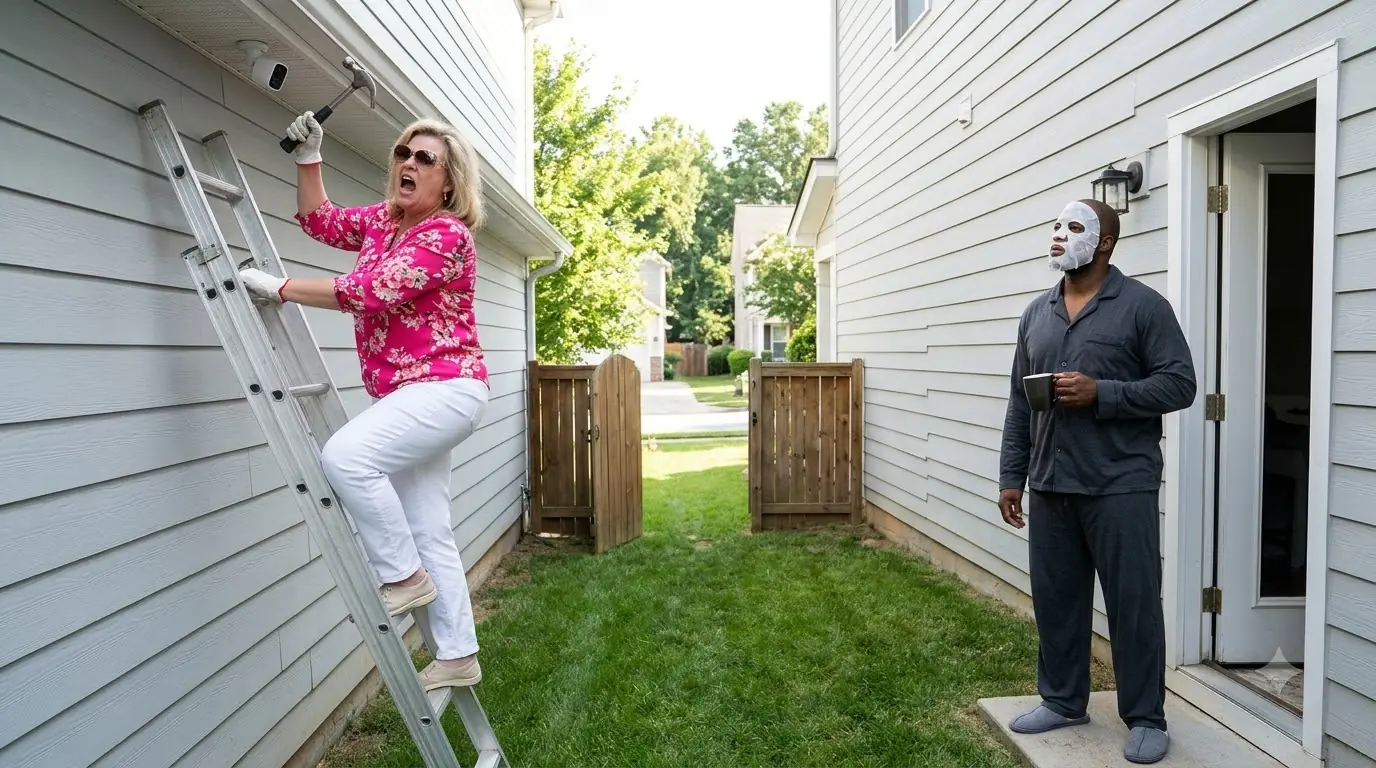
The second knocked the lens sideways.
The third sent a spray of plastic shards into the trimmed grass.
Marcus opened the back door just in time to see the fourth strike.
For a moment his brain refused to accept what his eyes were telling it. He had gone to bed a few hours earlier after a long overnight systems review, slept badly, woken later than usual, pulled on charcoal pajama pants and a T-shirt, slapped a white skincare sheet mask over his face because his sister swore it helped with stress, and carried a coffee mug toward the kitchen’s glass door in search of quiet. Instead he stepped into a scene so ridiculous it looked like it belonged on somebody else’s phone video.
Barbara Whitmore, president of the Maple Brook Estates Homeowners Association, fifty-eight years old, rigidly blond, always wrapped in a floral blouse loud enough to qualify as public aggression, was beating his camera with a hammer.
“Barbara,” Marcus said, lowering the mug slightly, “what the hell are you doing?”
She looked over her shoulder but did not climb down. Her sunglasses covered half her face, yet somehow he could still feel the force of her indignation. “Destroying an illegal surveillance device.”
“It’s a doorbell extension camera on my house.”
“It points at the side gate.”
“Because that is where the side gate is.”
Barbara hit the camera again. The mounting bracket bent.
Marcus held very still. He was six foot two, broad through the shoulders, and knew from long experience that if he moved too quickly toward an agitated white woman in an affluent neighborhood, the facts of a situation could become secondary before he even finished explaining himself. So he stayed near the back door, ceramic mug still in one hand, hardware-store bag in the other from the supplies he had set down by the jamb the night before. A screwdriver set, painter’s tape, batteries—ordinary purchases from a late stop after work. The bag looked absurdly domestic against the scene in front of him.
“You need to get off that ladder,” he said evenly. “Right now.”
Barbara laughed once, short and sharp. “You don’t get to spy on this neighborhood!”
Marcus stared at her. The skincare mask on his face suddenly felt even more ridiculous, but he left it there. “You really should’ve asked who owned it.”
That finally made her pause.
He saw the hesitation—small but real—as she processed the possibility that there might be some detail she had overlooked. For Barbara, overlooking details was intolerable. She preferred to define them before anyone else got a chance.
The hesitation lasted less than a second. Then she ripped the damaged camera from the bracket with one hard twist, held the dangling shell up like a trophy, and smiled.
Marcus heard tires scream from the street.
Barbara heard them too.
Three black SUVs stopped almost simultaneously at the curb beyond the side gate.
Doors opened.
Men and women in dark suits moved fast.