The first blow sounded like a gunshot fired inside a glasshouse.
Marcus Reed had been working at the dining room table when the sharp crack carried through the ceiling. He looked up from his laptop, expecting to hear a falling branch or the dull thud of something hitting the roof. Instead came a second blow, followed by a rattling spray of tiny hard fragments striking shingles.
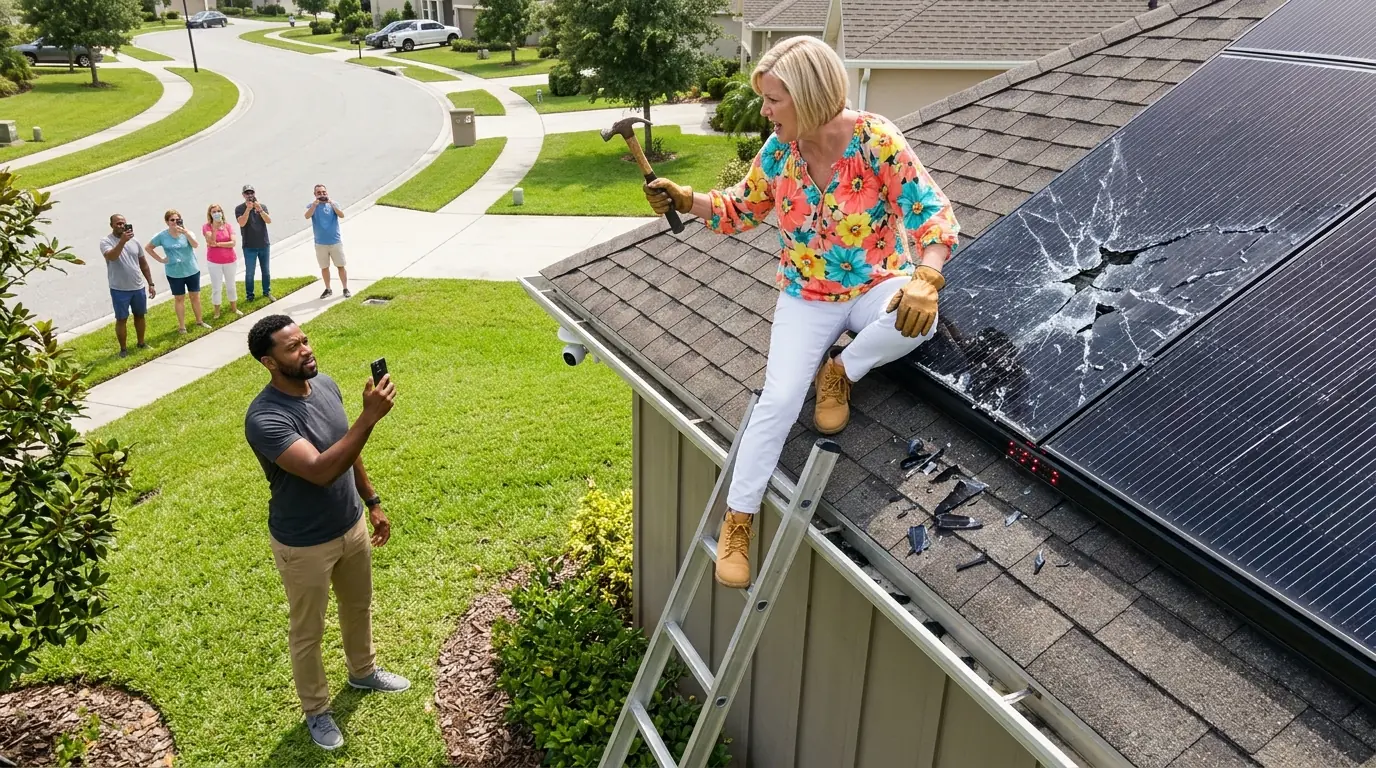
A woman's voice shouted from above him.
“These illegal panels come down today!”
Marcus knew that voice.
He knew it before the hammer struck a third time. He knew it before his security camera sent an alert to his phone. He knew it because for six months Barbara Whitmore had made her dislike of his rooftop solar array the central activity of her presidency of the Oakridge Glen Homeowners Association.
He pushed his chair back so quickly it skidded against the hardwood floor.
On the phone screen, the roof camera feed showed a blonde woman in a gaudy floral blouse, standing on the slope beside an aluminum extension ladder with a claw hammer raised over her head. The camera caught the bright coral, yellow, and turquoise flowers of the blouse, the white trousers tucked above tan work boots, and the black sunglasses that had become nearly as familiar to Marcus as her laminated HOA identification card.
Barbara brought the hammer down again.
The solar panel beneath it burst into a web of dark cracks. Glass fragments scattered across the roof, some lodging under the aluminum frame, others skittering downslope in the sunlight. Barbara struck once more, not with the hesitant rhythm of a person removing faulty equipment, but with the deliberate rage of someone who wanted an audience to understand that she could destroy what she disliked.
Marcus was already dialing for emergency help as he moved toward the front door.
His voice remained controlled, though he could feel a heavy pulse in his throat. He gave his address, identified a person vandalizing electrical equipment on his occupied home's roof, said she was holding a hammer, and explained that broken solar modules might present an electrical hazard even if ordinary household breakers were off. He did not try to diagnose the system over the phone. He asked that responders keep people clear of the house and notify the appropriate utility-response channel if necessary.
Then he stepped onto the front lawn.
Bright afternoon sunshine washed across the landscaped yard. The roof rose above the garage, covered in neat rows of modern black solar modules that had been part of the house for almost two years. From the sidewalk, the array looked smooth and discreet, the panels fitted flush along the slope, their dark surfaces reflecting thin patches of blue sky. From where Marcus stood now, two panels were shattered, their patterned cells splintered into irregular silver-black lines.
Barbara stood beside them with the hammer in her gloved right hand.
“Barbara!” he shouted. “Get off my roof and put down the hammer.”
She turned toward him. Her blonde bob was windblown beneath the sunglasses, and her face was so flushed that the bright flowers on her blouse almost looked restrained by comparison.
“These illegal panels come down today!” she shouted again.