Brad Duncan had been married to Vicky for twenty years, and until that evening, he believed he understood the woman sitting across from him on the back patio.
The Florida night was quiet and heavy with warmth. The pool lights shimmered across the water, breaking into silver lines whenever the breeze touched the surface.
Beyond the screened patio, palm leaves moved gently against the dark, and somewhere in the neighborhood, a dog barked once before the silence swallowed it again.
Two wine glasses sat untouched on the glass table between them.
Brad had opened the bottle because Vicky asked if they could sit outside and talk.
That should have meant something ordinary.
A vacation idea.
A family issue.
A renovation plan.
Maybe a complaint about the neighbors or an argument about whether they should finally replace the old patio furniture.
After twenty years, most conversations in marriage began quietly. They did not always announce themselves as dangerous. Sometimes danger came wearing a satin robe, sitting with folded hands, speaking in a voice too calm to trust.
Vicky looked at him across the table and said, “What if I wanted to see someone else?”
Brad stared at her.
For a moment, he truly believed he had misheard.
The pool pump hummed.
A bead of condensation slid down the side of his wine glass.
He waited for the laugh that would make it a terrible joke. Vicky had always had a strange sense of humor when she was nervous. Sometimes she would say something outrageous just to watch his face change, then grin and say, “Relax, Brad. I’m kidding.”
But she did not laugh.
She sat there in her pale satin robe, blonde hair loose over one shoulder, face serious in a way that made his chest tighten. Her hands were folded in her lap, but one thumb kept rubbing the knuckle of the other. Brad knew that gesture. She did it when she was trying to keep control of herself.
After twenty years, he knew when his wife was testing words.
He knew when she was hiding a truth behind them.
This was not curiosity.
This was a confession trying to dress itself as a question.
“What did you just say?” he asked.
Vicky looked toward the pool, then back at him.
“I said what if I wanted to see someone else?”
Brad leaned back slowly.
The patio chair creaked beneath him.
“Have you found someone else?”
Vicky’s eyes lowered for half a second.
That was enough.
“It’s not like that,” she said.
Her voice did not carry enough conviction to save the sentence.
Brad felt the first cold crack open inside him.
He had always believed their marriage had rules that did not need repeating. He had never thought he needed to sit across from his wife after two decades and explain that loyalty mattered. He thought some promises lived beneath the floorboards of a marriage, holding the whole structure upright whether people spoke of them or not.
Apparently, he had been wrong.
“What is it like, then?” he asked.
Vicky exhaled as if he had already disappointed her.
“It’s complicated.”
“No,” Brad said. “Taxes are complicated. Business contracts are complicated. Wanting another man while you’re married to me is not complicated. It is very simple.”
Her face tightened.
“That’s not fair.”
Brad almost laughed.
The sound never came out.
“Fair?” he repeated.
“Yes, fair,” Vicky said, gaining some courage now that the word was out. “You’re acting like I’ve done something terrible just because I’m being honest about how I feel.”
Brad looked at her carefully.
“How long have you been feeling this honest?”
She pressed her lips together.
“Brad.”
“How long?”
The first hint of irritation flashed across her face.
“Several months.”
“Several months,” he said quietly.
“Yes.”
“And who is he?”
Vicky reached for her wine, then seemed to remember she had not touched it. Her fingers hovered over the stem, then withdrew.
“Nathan.”
The name entered the patio like an unwanted guest.
Brad searched his memory.
“Nathan Trumble?”
Vicky did not answer.
He remembered him then.
A real estate consultant from Sarasota. Divorced. Smiled too often. Wore expensive linen shirts. He had attended one of their fundraising dinners the previous year and laughed too loudly at Vicky’s stories. Brad had noticed him only because Vicky had laughed back in a way she rarely laughed with strangers.
“You met him through the Whitfield gala,” Brad said.
“Yes.”
“And you’ve been seeing him.”
“Not seeing him,” she said quickly. “Talking to him.”
“Talking.”
“Yes.”
Brad nodded slowly.
“That’s always where people begin when they are trying to make betrayal sound harmless.”
Vicky’s eyes sharpened.
“You’re being cruel.”
“No,” he said. “I’m being accurate.”
She sat back and folded her arms, no longer pretending this was simply a thoughtful discussion.
“Times have changed, Brad. People have changed. Maybe marriage does not have to mean ownership.”
That did make him laugh once.
Not joyfully.
Not loudly.
Just one bitter sound escaping before he could stop it.
“Ownership?”
“You know what I mean.”
“I really don’t.”
“You think because we signed papers twenty years ago, I’m not allowed to want anything else ever again.”
Brad stared at the woman he had trusted with his entire life.
He had given her his name, his loyalty, his best years, his money, his protection, his patience, and his children. He had stood beside her through her mother’s illness, through the hard early years of his business, through Mark’s surgery at fourteen, through Jennifer’s anxiety in high school, through every season he thought had shaped them into something unbreakable.
Now she was sitting in front of him, using the language of freedom to ask permission to betray him.
“Marriage is not ownership,” he said. “It is a vow. You were free before you married me, Vicky. You chose me. I chose you. We built a life on that choice.”
She looked away.
“And now I am asking if that choice can grow.”
“No,” Brad said. “You are asking if it can rot while I pretend it is still alive.”
Her face paled.
“That’s dramatic.”
“No. Dramatic would be me throwing this table into the pool. I am speaking very calmly.”
Vicky shifted in her chair.
His calm was beginning to unsettle her.
Brad had always been steady. That was one of the reasons she had loved him in the beginning. He did not panic. He did not raise his voice often. He did not make decisions from emotion. But tonight, the steadiness felt different. Not gentle. Not safe.
Cold.
He looked at her hands again.
“Has anything physical happened?”
She took too long to answer.
“No.”
Brad held her gaze.
“Do not lie to me now.”
“I said no.”
“You also said this was not like that.”
“Then answer plainly.”
She closed her eyes briefly.
“We kissed.”
The pool water rippled.
Brad felt his jaw tighten.
“When?”
“Brad.”
“When?”
“Two months ago.”
“Once?”
She looked down.
His throat went dry.
“How many times?”
“I don’t know.”
“You don’t know how many times you kissed another man?”
“It wasn’t like I was counting.”
He leaned forward slightly.
“That is not helping you.”
Vicky’s eyes filled, but Brad could not tell if the tears were guilt, fear, or frustration that the conversation was not bending the way she had imagined.
“It started as flirting,” she said. “Then lunches. Long talks. He listens to me, Brad. He makes me feel seen.”
Brad stared at her.
Seen.
How many marriages had died under that word?
“How unfortunate for you,” he said quietly, “to have been invisible in a house I paid for, beside a husband who never touched another woman, with two children raised and educated, with vacations, comfort, security, and freedom most people dream of.”
“That is exactly what I mean,” she snapped. “You turn everything into a ledger. I am not talking about money.”
“Neither am I.”
“You just listed everything you provide.”
“And you listed feelings as if they cancel vows.”
She looked away again.
Brad felt something inside him shift from pain toward clarity.
Vicky had rehearsed this.
Not once.
Many times.
She had planned the phrases. Times have changed. People have changed. Freedom. Being seen. Marriage evolving. She had not come outside to ask him what he thought. She had come to see how much of himself he would surrender before calling it love.
“How far does this go?” he asked.
She shook her head.
“I told you.”
“No. You told me the version you thought I might survive. Tell me the real version.”
“Brad, please.”
“The real version, Vicky.”
Her lips parted.
For a moment, he saw the exact point where she considered lying.
Then she sighed.
“We’ve been talking about taking some time.”
“What does that mean?”
“A trip.”
The words struck strangely.
Not as loudly as he expected.
A trip required planning.
Time.
Money.
Tickets.
Hotels.
Bags.
Lies.
“What trip?” he asked.
Vicky’s eyes moved toward the lounge chair near the pool.
Brad followed her gaze.
A suitcase sat beside it.
Small.
Expensive.
Cream-colored leather.
He had seen it earlier and thought nothing of it. Vicky was always half-packed for something: charity retreats, weekend spa trips with friends, quick visits to Jennifer’s campus. Now the suitcase looked like evidence waiting for him to become smart enough to see it.
“Where?” he asked.
“Aruba.”
The patio seemed to go still around them.
“Aruba,” he repeated.
She swallowed.
“Yes.”
“With Nathan.”
“Yes.”
“When?”
“Saturday.”
Brad slowly stood.
His chair scraped hard against the patio tile.
Vicky flinched as if she expected him to yell.
He did not yell at first.
He looked at the suitcase.
Then at the pool.
Then at his wife.
“How long?”
Her voice became small.
“Two weeks.”
For a few seconds, he could only hear his own breathing.
Two weeks.
Not a stolen lunch.
Not an emotional confusion.
Not a conversation gone too far.
Two weeks in Aruba with another man.
She had not only imagined the betrayal.
She had scheduled it.
Paid for it.
Made room in her life for it.
“Two weeks,” he said.
“It’s just two weeks, Brad.”
The sentence was so absurd that he almost could not process it.
Just two weeks.
As if she had borrowed a jacket.
As if she were trying a new exercise class.
As if the marriage they built over twenty years could be paused, set neatly aside, then resumed when she returned with a tan and a satisfied curiosity.
“What did you expect me to do?” he asked.
“I hoped you would understand.”
“Understand what?”
“That I need this.”
He stared at her.
“You need to betray me?”
“I need to know who I am outside this marriage.”
“You are a woman who booked a vacation with another man while married. There. Now you know.”
Her face twisted.
“That is not fair.”
“Stop saying fair.”
His voice rose then, not into shouting, but into something harder.
“Do not sit there with a packed suitcase and tell me about fairness.”
Vicky’s eyes filled again.
“We have been married for twenty years.”
“Yes,” Brad said. “That is why this is disgusting.”
She stood too.
“People go through things after twenty years. They change. They question. They explore.”
“You can explore divorce. You cannot explore another man and expect me to pack your sunscreen.”
“I was going to tell you.”
“When? After I paid the credit card bill?”
Her face changed.
Small.
Barely visible.
But Brad saw it.
Something about money had landed.
His mind sharpened.
“What does that mean?” he asked.
“What?”
“That look.”
“What look?”
“Vicky.”
She looked toward the pool again.
He knew then that there was more.
“What about the kids?” he asked suddenly.
Her head turned back.
“What?”
“What were you planning to tell Mark and Jennifer?”
Vicky’s fingers tightened around the back of her chair.
“They’re adults.”
“I asked what you were planning to tell them.”
She did not answer.
A different cold opened in Brad.
“They know.”
Vicky’s silence confirmed it.
Brad took one step back.
“No.”
“Brad, listen.”
“They know?”
“I needed someone to talk to.”
“You told our children?”
“They’re not children anymore.”
“They are my children.”
“They are mine too.”
“And you involved them in hiding your affair from their father?”
Her face hardened defensively.
“I did not call it an affair.”
“What did you call it? Personal growth?”
Vicky flinched.
“I was trying to figure out how to tell you.”
“So you told Mark and Jennifer first.”
“I needed support.”
Brad looked at her like he had never seen her before.
“You needed support to betray me.”
“Stop twisting everything.”
“Everything is already twisted. I’m just naming it.”
He pulled out his phone with shaking hands.
Vicky stepped forward.
“Brad, don’t.”
That was all the confirmation he needed.
He called Mark first.
His son answered on the fourth ring.
“Hey, Dad.”
His voice was guarded.
Not surprised.
Guarded.
“Add your sister to the call,” Brad said.
“Dad, what’s going on?”
“Add Jennifer.”
There was a pause.
Then Mark said quietly, “Okay.”
A minute later, Jennifer joined.
“Dad?”
Brad stood beside the pool while Vicky watched him with fear tightening her face.
“Did you both know your mother planned to go to Aruba with Nathan Trumble?”
Silence.
It lasted longer than any answer.
Jennifer spoke first.
“Dad, Mom said she was going to talk to you.”
Brad closed his eyes.
Mark exhaled.
“It wasn’t supposed to happen like this.”
Brad opened his eyes.
“No. It was supposed to happen after I calmly accepted being humiliated?”
“Dad,” Mark said, trying to sound reasonable, “it’s not that simple.”
Brad laughed once, softer this time.
His son too.
His own son.
“What did she tell you?” Brad asked.
Jennifer’s voice was trembling.
“She said she felt trapped.”
Vicky whispered, “Brad, please.”
He ignored her.
“Trapped,” he repeated.
“She said she loved you,” Jennifer rushed on. “But she needed space to figure herself out.”
“And you believed this required two weeks in Aruba with another man?”
Mark said, “Dad, couples who have been together a long time sometimes go through things. It doesn’t mean she doesn’t love you.”
Brad’s hand tightened around the phone.
“How long have you known?”
Neither answered.
“How long?”
Jennifer began to cry softly.
“Months.”
Brad felt the word enter him like a blade.
Months.
His wife had built a secret life.
His children had been placed inside it.
And all of them had allowed him to continue living as the only person in the family who did not know his marriage was being discussed behind his back.
“Why didn’t you tell me?” he asked.
Mark’s voice grew defensive.
“Because Mom asked us not to. She said she needed to tell you herself.”
“And you thought that was acceptable?”
“We didn’t want to choose sides.”
Brad looked at Vicky.
His voice became very quiet.
“You did choose.”
Jennifer sobbed.
“Dad, I’m sorry.”
“No,” Brad said. “You’re frightened. That is not the same thing.”
Mark said, “That’s not fair.”
Brad almost smiled.
There it was again.
Fair.
“You and your mother should retire that word for a while.”
He ended the call.
Vicky took a step toward him.
“Brad.”
He held up one hand.
She stopped.
For the first time that night, Vicky looked truly afraid.
Not afraid of losing Nathan.
Not afraid of embarrassment.
Afraid because she was beginning to understand that Brad was not reacting the way she had counted on. He was not begging, bargaining, promising to change, or asking how to win her back.
He was going silent.
And silence from Brad Duncan had always meant decisions were being made.
“You made our children accomplices,” he said.
“I didn’t mean to.”
“But you did.”
“I was confused.”
“No. You were selfish.”
Her tears spilled over.
“I didn’t want to hurt you.”
“You wanted to hurt me after you came back from Aruba.”
“That’s not true.”
“You wanted two weeks with him, and then you wanted to return to this house and decide whether I was still useful.”
She shook her head.
“That is not what I wanted.”
“But it is what you planned.”
Vicky hugged herself.
“If you love me, you will at least try to understand.”
Brad looked at her for a long moment.
“I have loved you for twenty years. Do not ask me to prove it by accepting my own humiliation.”
Then he walked inside.
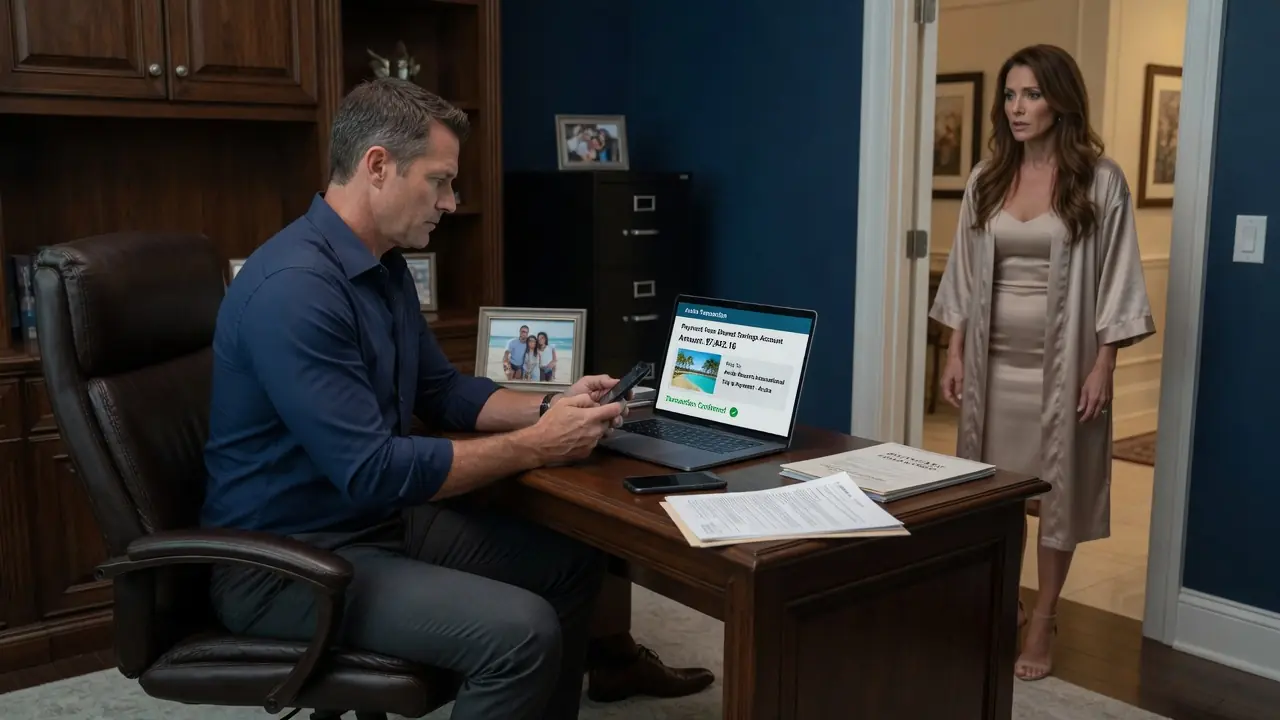
He went straight to his office, closed the door, and sat at the family computer. At first, he meant only to check the accounts because something about her face when he mentioned money had unsettled him.
Brad was a businessman.
Not by inheritance.
By discipline.
He had built Duncan Logistics from three delivery trucks and an office rented behind a tire shop into a regional freight and supply company worth more than anyone in his old neighborhood would have believed. His success came from noticing small inconsistencies before they became disasters. A missed invoice. A fuel bill too high. A client who delayed payment by three days more than usual.
Small changes spoke.
You only had to listen before pride made you deaf.
He logged into the joint savings account.
The numbers appeared.
Then the second betrayal hit him with such force that his hands went numb.
A travel agency charge.
A resort deposit.
Airline tickets.
A string of expenses coded through accounts he recognized as theirs.
Not Vicky’s private spending.
Not her personal allowance.
Their shared savings.
The money they had built together.
The money meant for family emergencies, home repairs, investment opportunities, future grandchildren, and the quiet security Brad believed marriage deserved.
She had planned to betray him and expected him to help finance it.
Brad stared at the transaction details until the letters blurred.
Then he leaned back and laughed once.
Bitterly.
Without joy.
That laugh changed something in him.
The wounded husband moved aside, not because the wound healed, but because the businessman inside him recognized an active threat.
He opened another tab.
Then another.
Accounts.
Credit cards.
Investment portals.
Insurance policies.
Education trusts.
Phone plans.
Travel rewards.
Passwords.
Beneficiaries.
The map of a family’s shared financial life spread across the screen.
And Brad began closing doors.
First, he paid off the shared credit cards and canceled them. He did not do it recklessly. He did what he had every legal right to do. He saved confirmations, downloaded statements, and sent copies to an encrypted folder.
Then he moved his legal share of liquid funds into accounts only he controlled. He froze what required freezing. He changed passwords on every account connected to his name. He removed Vicky’s access from business-related platforms where she had no legitimate reason to remain.
He opened his life insurance policy.
Primary beneficiary: Vicky Duncan.
He stared at her name for a long time.
Then he replaced it with his parents.
Aaron and Grace Duncan.
People who had never needed to be reminded what loyalty meant.
He moved to the phone plan next.
Vicky.
Mark.
Jennifer.
All paid by him.
All still functioning under his account.
He canceled the lines scheduled at the next legal cutoff and locked the devices from account privileges. If they wanted to stand with her, they could stand without his wallet beneath them.
Then he opened the education trust.
Six hundred thousand dollars.
A fund he had built quietly for Mark and Jennifer. Graduate school. First homes. Emergencies. Weddings. Business starts. The kind of money a father sets aside not because children deserve luxury, but because he wants to soften the hard edges of their future.
Brad stared at the balance.
He remembered Mark at five years old, asleep in a dinosaur blanket.
Jennifer losing her first tooth and demanding he inspect the gap.
College tours.
Move-in days.
Proud phone calls.
Birthday checks.
Late-night advice.
Every moment he had believed he was not only providing, but building trust.
Then he thought of months.
Months of them knowing.
Months of them listening to Vicky explain her desire to run away with Nathan while their father cooked holiday dinners, paid tuition, sent care packages, and believed his family was intact.
His hand hovered over the keyboard.
He did not empty the trust into chaos.
He did something colder.
He moved the funds into a structure solely under his control, pending legal review. No more automatic access. No more quiet assumption that betrayal carried no cost. Mark and Jennifer were adults now.
Adults could learn consequences.
Vicky knocked once on the office door.
“Brad?”
He did not answer.
“Are you all right?”
The question was almost funny.
After a while, she walked away, probably assuming he needed time to cool off.
She still did not understand.
Cooling off was not what was happening.
He was no longer waiting for his temper to pass.
He was making sure none of them could use his love as an open account.
At 11:20 p.m., he called his father.
Aaron Duncan answered in the rough voice of a man who had been asleep.
“Brad?”
“Dad.”
Something in Brad’s voice changed Aaron immediately.
“What happened?”
“Is the old house empty?”
There was a pause.
“Your mother and I haven’t rented it since the last tenants left. Why?”
“I need somewhere to stay.”
Another pause.
Longer this time.
“Vicky?”
“She’s been involved with another man. She planned a trip to Aruba with him. The kids knew for months.”
Silence.
Then Aaron said, “Come home.”
Not come to the house.
Not take a few days.
Come home.
Brad’s throat tightened for the first time since the phone call with his children.
“I’ll be there in a few hours.”
“We’re coming too,” Aaron said.
“You don’t have to.”
“Yes, son. We do.”
Brad packed carefully.
He took clothes, documents, passports, his laptop, business files, personal records, his father’s old watch, and a framed photo of himself with his parents from a fishing trip when he was fifteen. He did not take wedding photos. He did not destroy anything. He did not wake the house with shouting.
He simply removed what mattered.
Vicky appeared at the bedroom door when he was zipping the suitcase.
Her face was pale.
“What are you doing?”
“Leaving.”
“For how long?”
He did not answer.
“Brad, don’t be dramatic.”
He turned toward her then.
The word had cost her more than she knew.
“Dramatic would have been throwing your suitcase into the pool. This is organized.”
Her eyes flickered toward the closet.
“I was going to unpack it.”
“No, you weren’t.”
“I would have canceled if you needed me to.”
“If I needed you to,” he repeated. “You still think this is about me needing to persuade you not to betray me.”
She began crying again.
“You’re scaring me.”
“Good.”
That word came out before he could soften it.
Vicky recoiled.
Brad picked up his suitcase.
“Do not contact me except through an attorney.”
“Attorney?” she whispered.
He walked past her.
At the garage door, she grabbed his arm.
“Brad, please. This is twenty years.”
He looked down at her hand on his sleeve.
Then at her face.
“So was what you risked.”
She released him.
Brad loaded the car, took an old bottle of Scotch his parents had once given him, and drove away with the garage door closing behind him.
Vicky stood barefoot in the driveway until the taillights disappeared.
For the first hour after he left, she was angry.
By the second, frightened.
By the third, she told herself he would return.
Brad had always loved his family too much to stay away. He was stubborn, yes, but never permanently cruel. He would spend a few days at his parents’ old house, maybe call a lawyer to scare her, maybe demand counseling. He would miss the bed, the pool, the routines, the children, the life they built.
After six days alone, he would understand that her trip was not the end of them.
That was what Vicky told herself.
She did not yet understand that Brad had not left to be missed.
He had left to survive.
The old Duncan house sat two hours north, outside a small inland town surrounded by oaks and quiet roads. It was a large, old place with wide porches, dark wood floors, high ceilings, and windows that opened to fields instead of neighbors. Vicky had always disliked it because it felt strange and old-fashioned to her.
Brad loved it because he had grown up there.
For the first time in hours, stepping inside felt less like running away and more like returning to something that had never betrayed him.
He placed his suitcase in his childhood bedroom and sat on the edge of the bed.
The room still had the built-in shelves his father had made when Brad was twelve. The walls had been repainted, but the old window seat remained. Brad remembered sitting there as a teenager, promising himself he would build something big enough that his parents never had to worry again.
He had done that.
Then somehow, the people he built for had mistaken his effort for something they could depend on while disregarding him entirely.
His parents arrived just after dawn.
Grace Duncan came through the front door carrying a covered dish, a thermos of coffee, and the expression of a woman ready to go to war. Aaron followed with a duffel bag and the slower, heavier sadness of a father watching his son’s life collapse.
Grace hugged Brad first.
She held him with a strength that surprised him.
“My boy,” she whispered.
He had not been called that in decades.
Something inside him almost broke.
Aaron embraced him next, one hand gripping the back of Brad’s head the way he had when Brad was younger.
“You did right coming here,” he said.
They sat in the kitchen while morning light spread across the old table.
Brad told them everything.
The patio.
The question.
Nathan.
Aruba.
The suitcase.
Mark and Jennifer.
The shared savings.
Every part.
Grace’s face hardened more with each detail. When Brad reached the part about the children knowing for months, her anger became cold enough to silence the room.
“My grandchildren knew their mother was planning this and said nothing to you?” she asked.
“Yes.”
Grace looked toward the window.
“I need a minute before I speak to anyone.”
Aaron sat very still, hands clasped on the table.
“You moved the money?”
“What I legally could. I secured everything else through counsel this morning.”
“You called a lawyer already?”
“I will formally retain one today.”
Aaron nodded.
“Good.”
Brad looked at his father, expecting hesitation.
There was none.
“You don’t think I went too far?”
Aaron’s eyes lifted to his.
“Son, when people plan harm behind your back and expect continued access to your protection, removing that access is not cruelty. It is sense.”
Grace returned to the table.
“You are not punishing them,” she said. “You are refusing to finance your own disrespect.”
The sentence settled something in him.
That night, Mark and Jennifer began trying to reach him repeatedly.
Their calls went unanswered.
Jennifer called her grandmother next.
Grace answered.
Brad could hear only one side of the conversation from the living room.
“No, Jennifer, he is not coming to the phone.”
A pause.
“No, sweetheart, you do not get to cry now and call it confusion.”
Another pause.
“You knew for months.”
Grace’s voice sharpened.
“You let your father sit at family dinners while you knew your mother was planning to run off with another man. You let him pay your bills. You let him send money. You let him think he was loved honestly.”
A longer pause.
“I do not care what your mother told you. You are twenty-two years old, not twelve. Right and wrong did not become complicated because your mother used soft words.”
Brad closed his eyes.
Mark tried next.
Aaron took that call.
His voice was quieter than Grace’s.
More dangerous.
“No, Mark. You listen. Your father has spent your entire life standing between you and hardship. If the first time he needed loyalty, you decided neutrality was easier, then you have learned nothing from him.”
Mark must have tried to joke.
Aaron cut him off.
“This is not a business inconvenience. This is your father’s life.”
Then he ended the call.
By morning, the consequences had reached Vicky’s house.
Her phone calls to Brad failed.
The joint credit cards declined.
Her access to several accounts vanished.
The children called in panic after their phone lines stopped working and tuition support was frozen pending legal review. Mark was angry. Jennifer was terrified. Both of them were suddenly less philosophical about freedom and complicated marriages.
Vicky told them Brad was overreacting.
She said he had always been controlling with money.
She said he needed time.
But even as she spoke, she could hear how weak the words sounded.
Jennifer came home first.
She arrived the next afternoon, crying before she reached the door.
“Cancel the trip,” she said.
Vicky stood in the foyer.
“Jennifer.”
“Cancel it, Mom. Please. This is not what you said would happen.”
“What did you think would happen?”
Jennifer wiped her face.
“You said Dad would be hurt, but he loved us. You said he would be angry and then listen. You said he might even understand.”
Vicky looked away.
Jennifer’s voice broke.
“You said we weren’t betraying him by letting you explain.”
Vicky had no answer.
Mark called that evening.
He was angrier than Jennifer, but fear sat underneath it.
“If you go to Aruba,” he said, “you could lose all of us.”
“I am still your mother.”
“And he is still our father.”
“That did not bother you for months.”
Mark went silent.
Vicky knew she had wounded him, but she was too defensive to stop.
“This is my life,” she said. “I have given twenty years to this family.”
“And Dad didn’t?”
She hung up.
Then she packed the rest of her suitcase.
By Saturday morning, Vicky boarded the flight to Aruba with Nathan Trumble.
She told herself it was courage.
It was not.
It was momentum.
Some people continue walking toward a cliff because turning around would require admitting they saw the edge.
Nathan met her at the airport wearing a white linen shirt, sunglasses, and a smile that looked practiced in vacation light. He kissed her cheek and took her bag.
“Ready?” he asked.
Vicky wanted to say yes.
Instead, she looked around the airport as if Brad might appear from behind a column.
Nathan noticed.
“He’s not here.”
“I know.”
“Are you sure you’re okay?”
She smiled tightly.
“I just need to get away.”
But the trip was not the romantic escape she had imagined.
Fear traveled with them.
It sat in the taxi from the airport.
It unpacked itself in the hotel room.
It followed them to the balcony overlooking turquoise water.
Nathan, who had seemed bold when their affair existed in lunches and messages, became nervous when consequences became real. He checked the hallway before leaving the room. He avoided crowded places where Americans gathered. He jumped when someone knocked on the door with room service.
“You think Brad would come here?” Vicky asked on the third night.
Nathan laughed too quickly.
“I don’t know. Men do crazy things when embarrassed.”
Embarrassed.
That word turned something in her stomach.
“He is not embarrassed,” she said.
Nathan shrugged.
“Betrayed, humiliated, whatever.”
She stared at him.
For the first time, she heard how lightly he carried what had destroyed her family.
The clubs felt loud.
The beach felt exposed.
The dinners felt forced.
Nathan drank too much by the fifth night and complained that she was distracted.
“You said you wanted this,” he said.
“I did.”
“Then be here.”
She looked across the candlelit table at the man she had risked twenty years for and saw, with a slow sinking clarity, that he was only exciting when he was hidden.
In daylight, he was smaller.
By the end of the two weeks, she was ready to go home.
Not to Brad exactly.
Not yet.
But to the house.
To familiar rooms.
To the illusion that damage could be contained if everyone simply returned to their assigned places.
Brad was nowhere near Aruba.
By then, he was in Tokyo.
He had flown there three days after Vicky left, not because he needed distance for drama, but because business required action and distance made action easier. For months, he had been in quiet discussions with a Japanese logistics group interested in acquiring Duncan Logistics. He had resisted selling because the company was his pride, the monument of his adult life.
Now even the company felt tied to a life he no longer recognized.
He wanted liquidity.
Control.
Freedom.
A place where nobody called him Vicky’s husband, Mark’s father, Jennifer’s dad, or the man everyone expected to keep paying.
In Tokyo, Brad moved through meetings with a precision that impressed the buyers. He negotiated hard, slept little, and signed terms faster than his board expected. The sale would make him wealthier than he had ever been, but when he returned to his hotel room overlooking the city, he felt nothing like victory.
He walked through Tokyo alone at night.
Neon reflected in wet streets.
Crowds moved around him with purpose.
Tiny restaurants glowed behind paper curtains.
He took photos of temples, narrow alleys, train stations, food markets, and quiet gardens surrounded by glass towers.
Every beautiful sight hurt because some part of him still wanted to share it.
He imagined Jennifer asking questions about the food.
Mark making jokes about how he would never understand the train system.
Vicky leaning against him, smiling for a photo.
Then he remembered the patio.
The suitcase.
Months.
The ache returned.
But each time, it returned with less power.
From Japan, Brad kept moving.
Singapore.
Vietnam.
Thailand.
He told his parents he was traveling after the sale to clear his head. That was partly true. The other truth was darker and simpler. He was searching for a reason to care about tomorrow.
Money could move him across the world.
It could not tell him why to wake up.
He found the answer in a market in northern Thailand, though at first it looked like trouble.
The market was narrow and bright, filled with fruit stalls, smoke from grilled meat, scooters squeezing through impossible spaces, and voices rising in a language Brad understood only in fragments. He had gone there because his hotel guide recommended the mango rice and because wandering was easier than sitting in another room alone.
Near a fruit stand, a seller gripped a young boy by the arm.
The boy was maybe seven, thin, dark-haired, barefoot in worn sandals, eyes wide with fear. Beside him stood a little girl, perhaps nine, crying while trying to pull the seller’s hand away.
Brad stopped.
He did not understand every word, but hunger and fear did not need translation.
The boy had tried to steal fruit.
A mango.
Maybe two.
The seller was furious.
People gathered.
The girl spoke quickly, pleading. The boy kept his head down. When two local officers approached, the girl’s panic became sharper.
Brad stepped forward.
He held up both hands gently and spoke in slow English, then in the few Thai phrases he had learned badly.
“I pay. I pay.”
The seller turned on him, still angry.
Brad took out cash.
More than the fruit was worth.
Far more.
The seller hesitated.
The officers looked at Brad, then at the children, then at the money. One officer asked Brad something he did not understand. A woman from a nearby stall translated in broken English.
“He ask if children with you.”
Brad looked at the children.
The girl stared at him, terrified and hopeful.
“No,” Brad said. “But I help.”
He paid the seller.
Then paid again, enough to make the problem disappear.
The seller released the boy’s arm.
The boy stumbled back, and the girl immediately stepped in front of him like a small shield.
Brad knelt, keeping distance so he would not frighten them.
“You hungry?” he asked, touching his own stomach.
The boy stared.
The girl understood.
She nodded once, then looked ashamed of nodding.
Brad pointed to a small restaurant at the edge of the market.
“Food?”
The girl looked around, as if expecting someone to stop them.
No one did.
So she took her brother’s hand and followed him.
Brad bought them rice, chicken, soup, fruit, and bottled water. The girl began eating with restraint at first, then faster when she realized the food was truly theirs. The boy ate silently, eyes fixed on the plate, as if someone might take it if he looked away.
Brad sat across from them.
For the first time in months, someone’s need was simple.
Food.
Water.
Safety.
No manipulation.
No hidden conditions.
The little girl eventually pointed to herself.
“Mali.”
Then to the boy.
“Arun.”
Brad touched his chest.
“Brad.”
Mali repeated it carefully.
“Brat.”
He smiled.
“Close enough.”
After they ate, the children led him, through gestures and a mix of broken English and Thai, to a small church tucked behind a row of shops. It was quiet inside, cooler than the street, with wooden benches, candles, and a statue near the front.
The children knelt.
Brad stood awkwardly at the back until a priest approached.
The priest was older, with kind eyes and English shaped by years of careful use.
“You help them?” he asked.
“I fed them,” Brad said.
The priest nodded.
“Their father died last year. Their mother works late. They come here after school. Sometimes hungry.”
Brad watched Mali bow her head.
Arun copied her.
“What are they doing?” he asked.
“They pray for their father.”
Brad looked at the children.
Something moved through him so sharply he had to grip the back of a bench.
Their father was dead.
Gone.
Unable to provide anything.
And still they came every day to honor him.
Brad had given his children everything, and when he needed honesty, they had protected the person betraying him.
The comparison was not fair.
He knew that.
Pain is rarely fair.
But it broke something open anyway.
Later that evening, the children’s mother arrived at the church.
Her name was Tam Thong.
She was in her early thirties, slight and exhausted, wearing a faded work shirt and carrying a cloth bag over one shoulder. When she saw Brad sitting near her sleeping children, fear crossed her face so quickly it made him stand and step back.
The priest spoke to her in Thai.
Her eyes moved from Brad to the children to the containers of leftover food he had bought for them. She listened, tense at first, then slowly lowered her guard.
She bowed slightly.
“Thank you,” she said in careful English.
Brad nodded.
“They were hungry.”
Her face tightened with shame.
“Yes.”
She woke the children gently. Arun leaned into her immediately. Mali began telling the story in rapid Thai, gesturing toward Brad, the market, the fruit, the police, the food.
Tam Thong listened without interrupting.
Then she looked at Brad again.
Her eyes were tired, but clear.
Not begging.
Not performing.
Not calculating.
Just honest.
That stayed with him.
The next day, Brad returned to the market.
He told himself it was to make sure the children were all right.
Then he returned the next day too.
And the next.
Soon, a pattern formed.
He found Mali and Arun near the church after school, bought them food, helped with simple English words, waited until Tam Thong came from work, and walked with them to the narrow room they rented behind a mechanic’s shop.
The room was small, bare, and painfully clean.
A mat on the floor.
A small fan.
Two school bags.
A hot plate.
A plastic tub for washing clothes.
Tam Thong worked long hours washing dishes in a restaurant that paid almost nothing. Her husband had died after an illness consumed their small savings. She did not ask Brad for help. That was what made him want to help more.
Over time, Brad saw the place where she worked.
He saw the manager speak harshly to her.
He saw her hands red from hot water and soap.
He saw Mali pretend not to be hungry so Arun could eat more.
He saw Arun save small pieces of fruit in his pocket for his mother.
He rented a modest house outside the crowded market district.
Not a mansion.
Not a hotel suite.
A small house with three bedrooms, a clean kitchen, a shaded porch, and enough space for children to laugh without disturbing neighbors through thin walls.
Then he made Tam Thong an offer.
She misunderstood at first.
Her face went cold.
“No,” she said sharply. “I am not that.”
Brad realized too late how it sounded.
A foreign man offering housing to a poor young widow.
He stepped back immediately.
“No. No. I am sorry. Not like that.”
She gathered the children close.
The next day, Brad brought the priest.
He explained everything slowly through translation. He needed help keeping the house, cooking, cleaning, learning local language and customs. He would pay a fair salary. The children would live there with her. They would have their own rooms. There would be written terms. She could leave whenever she wished.
No hidden demand.
No dishonor.
Just work.
Safety.
School.
A chance.
Tam Thong did not accept that day.
Or the next.
It took weeks.
She visited the house with the priest. She spoke to neighbors. She checked every lock, every room, every corner where danger might hide. Brad respected every question because he understood caution. A person who had survived enough did not owe the world quick trust.
When she finally accepted, the house changed immediately.
Mali filled it with questions.
Arun filled it with toy cars Brad bought from a market stall.
Tam Thong cooked meals that made the house smell alive.
Brad learned Thai slowly and badly, while teaching the children English with flashcards, cartoons, and patience.
He arranged tutors.
He set up bank accounts in Tam Thong’s name.
He paid school fees.
He found doctors.
He did not call it family at first.
He was afraid to.
But one night, after dinner, Arun fell asleep against him on the couch. Mali sat nearby drawing a picture of five people: herself, Arun, Tam Thong, Brad, and a figure she said was her father “watching from God.”
Brad looked at the drawing and felt the hollow place inside him shift.
Not fill completely.
Nothing fills completely.
But shift.
Back in Florida, Vicky returned from Aruba to an empty house and a life that had changed locks without asking her permission.
Brad’s clothes were gone.
His office was empty.
The accounts were restricted.
The cards failed.
The phone plan had ended.
The house still stood, large and beautiful, but it felt suddenly fragile because the man who maintained its invisible foundations was no longer there.
Nathan lasted a few months.
At first, his presence helped Vicky avoid silence. He came over with wine, ordered takeout, lounged by the pool, and told her Brad was being vindictive. She wanted to believe him because believing Nathan meant she had not destroyed everything for nothing.
But Nathan was charming only when life required nothing of him.
When bills arrived, he became vague.
When Mark called angry, Nathan went outside.
When Jennifer cried, Nathan said she was being manipulative.
One night, after too much wine, he laughed and said, “Honestly, Brad sounds like a pathetic control freak.”
Vicky slapped him.
The room went still.
Nathan touched his cheek, stunned.
“You don’t talk about him like that,” she said.
Nathan stared at her.
“You left him for me.”
“No,” she whispered, the truth arriving too late. “I left myself for you.”
She made him leave that night.
It did not bring Brad back.
Months passed.
Lawyers spoke where family once had.
Brad filed for divorce from abroad. He offered Vicky the Florida house if she signed without dragging the proceedings into war. He wanted none of the furniture, none of the memories, none of the rooms where he had been lied to.
The money from the company sale remained beyond her reach.
The children’s trust stayed under his control.
Mark raged.
Jennifer unraveled quietly.
Then Brad agreed to a video call because his attorney advised that direct conversation might help settle remaining matters.
Vicky, Mark, and Jennifer appeared together on the screen.
They looked thinner.
Older.
Frightened.
Brad looked different too.
Tanned from months in Asia.
Leaner.
Calmer.
Not healed exactly, but no longer bleeding in front of them.
Behind him, the house in Thailand glowed with afternoon light. Mali and Arun could be heard arguing in the background about a schoolbook. Tam Thong moved briefly through the frame carrying laundry, then stopped when she realized the call had begun.
Vicky stared.
“Who is that?”
Brad looked over his shoulder.
“My household.”
Mark frowned.
“What does that mean?”
Brad told them.
Not defensively.
Not to wound them.
Simply.
He told them about the market, the mango, the fruit seller, the two hungry children, the church, their dead father, and their mother who worked until her hands hurt. He told them how those children prayed every day for a father who had left them nothing but love, and how that had changed something in him.
Jennifer cried before he finished.
Vicky covered her mouth.
Brad’s voice remained steady.
“I crossed the world trying to get away from a family that had forgotten what loyalty meant. Then I found two children who had nothing and still honored a dead father with more devotion than my living children showed me when I needed truth.”
Mark looked down.
Jennifer whispered, “Dad.”
Tam Thong stepped forward then.
Her English was careful but clear.
“Brad is good man,” she said. “He was hurt. Very hurt. But he help my children. He help me. Your family hurt him badly.”
Vicky began crying.
“Brad, please come home.”
“No.”
The word was immediate.
Her face crumpled.
“The affair was a mistake. Nathan was a mistake. I love you.”
Brad looked at her through the screen.
“Did you keep seeing him after Aruba?”
Vicky froze.
That was answer enough.
Brad nodded once, as if confirming a number in a report.
“You loved me when it was comfortable to say so. You betrayed me when desire felt stronger. You wanted me back when consequences arrived. That is not love I can trust.”
Jennifer sobbed.
“I’m sorry, Dad.”
Brad’s face changed slightly.
Pain moved through it.
“I believe you are sorry.”
“Can you forgive me?”
“Not today.”
She nodded, crying harder.
“That is honest,” he said. “More honest than what I was given before.”
Mark finally spoke.
“So that’s it? You just replace us?”
Brad’s eyes hardened.
“No. You cannot be replaced. That is why your betrayal hurt. But being irreplaceable does not mean being untouchable.”
Mark looked like he had been struck.
Brad continued.
“I am still your father. But I am no longer your bank, your safety net, or your fool.”
The call ended with Vicky pleading, Mark silent, and Jennifer crying so hard she could barely breathe.
Afterward, Mark said the man on the screen did not feel like their father anymore.
Jennifer looked at him through tears.
“He is our father,” she said. “We made him look at us like strangers.”
That truth stayed with her.
Years later, Jennifer wrote her mother a letter.
It was not cruel.
That made it harder.
She said she loved Vicky, but she could no longer stay near someone who refused to fully see what she had destroyed. She admitted she had helped hurt Brad and would regret it for the rest of her life. Then she left.
She found him in Thailand after weeks of searching through relatives, lawyers, and finally a message sent through his attorney.
When Jennifer arrived at the house, she carried one suitcase and more fear than hope.
Tam Thong opened the door.
She was visibly pregnant, one hand resting on her belly, her eyes cautious but not unkind.
Jennifer’s voice shook.
“Is my father here?”
Brad appeared behind Tam Thong.
For several seconds, neither father nor daughter moved.
Then Jennifer dropped to her knees.
Not dramatically.
Not as performance.
As if her legs had simply given up under the weight of years.
“I’m sorry,” she sobbed. “Dad, I’m so sorry.”
Brad stood frozen.
Mali and Arun watched from the hallway.
Tam Thong turned and quietly guided them back, giving Brad and Jennifer space.
Jennifer cried into her hands.
“I didn’t come for money. I didn’t come because Mom sent me. I left her. I found work. I can stay anywhere. I just needed to tell you I know what I did. I know I betrayed you. I know I let Mom make your pain sound like something you should manage for us.”
Brad’s face tightened.
“You were young.”
“I was old enough.”
He looked away.
That answer mattered.
Jennifer continued.
“I don’t expect you to forgive me today. Or ever. But I want to earn one small piece of trust if you will let me try.”
Brad looked at his daughter.
She was twenty-six now, but in that moment, he saw the little girl who used to run to him after nightmares. He also saw the adult who had failed him. Both were true. Love did not erase betrayal, but betrayal did not erase love either.
Finally, he stepped forward.
He did not hug her immediately.
He crouched in front of her.
“You have a brother and sister to meet,” he said.
Jennifer covered her mouth and cried harder.
Tam Thong smiled from the doorway.
She understood what had just happened.
Not forgiveness.
Not yet.
A door.
Five years later, Vicky woke up beside Nathan in a life that felt like punishment.
They had drifted back together after months apart, not from love, but from loneliness and habit. Nathan was no longer charming. His health had declined. His money problems were constant. His bitterness filled every room. Vicky cared for him partly because she believed suffering beside him was the price she deserved to pay.
She still thought of Brad every day.
She thought of Jennifer, now part of Brad’s new family and happy in rare photographs passed quietly through relatives. She thought of Mark, who called less and less, his own marriage tense from habits he pretended not to see in himself. She thought of the patio, the question, the suitcase, the children’s silence, and the arrogance with which she had believed Brad’s love would survive any insult.
One afternoon, Vicky saw Mark across the street outside a restaurant.
He was with a woman who was not his wife.
He leaned in and kissed her.
Vicky felt the world tilt.
For a moment, she was back on the patio, watching herself from the outside.
She crossed the street so quickly Mark barely had time to step away.
“Mom?”
She slapped him hard.
The woman gasped and hurried off.
Mark held his cheek, stunned.
“What the hell?”
“No excuses,” Vicky said.
Her voice shook with fury and terror.
“No stories about being confused. No speeches about needing to feel seen. No lies about how marriage changes. I invented all those cowardly sentences, and they cost me your father, your sister, my parents, my home, and every peaceful morning I might have had.”
Mark stared at her.
For once, he had no joke.
Vicky pointed at him.
“You go home. You tell your wife the truth before she has to discover it like your father did. You fix what you can before you become me.”
Mark’s face changed.
“Mom.”
“No,” she said. “Listen to me now, because I did not listen when I should have. Betrayal does not only destroy the person being cheated on. It hollows out the betrayer too. You will think you are choosing excitement, but what you are really choosing is a life where every mirror remembers.”
She walked away before he could answer.
That night, Vicky sat alone by the same pool where she had once asked Brad for permission to betray him.
The patio furniture had aged.
The pool light flickered.
The palm leaves moved gently beyond the screen.
She thought of the man she had called controlling because he refused to finance his own humiliation. She thought of how patiently he had built their life, and how carelessly she had assumed he would remain inside it no matter what she broke.
Brad, far away, no longer waited for apology, explanation, or repair.
He had taken back his money.
His name.
His future.
His sense of self.
More importantly, he had taken back the part of himself Vicky had believed she could wound and still control.
In Thailand, Brad sat at a long dinner table surrounded by noise.
Tam Thong placed food before him. Mali argued with Arun over pronunciation homework. Jennifer laughed while holding her baby brother, little Aaron, named after Brad’s father. Rain tapped gently against the roof. The house was not grand, not like the Florida home had been, but it was full in a way that house had never been after trust died.
Brad looked around the table.
For years, he had believed family was something built once and kept forever.
Now he knew better.
Family was built every day.
By truth.
By loyalty.
By showing up when it cost something.
By refusing to make someone’s love a place to hide your selfishness.
Vicky had stolen from their savings to fund her affair.
But in the end, what she lost was worth far more than money.
She lost the man who would have stayed.
The children lost the father who had once believed they would always stand with him.
And Brad, though broken for a time, learned something none of them had expected.
A betrayed man does not have to spend the rest of his life standing in the ruins.
He can walk away.
He can cross oceans.
He can feed hungry children in a market.
He can become necessary to people who know how to value love.
He can build again.
And sometimes, the life waiting on the other side of betrayal is not the life he planned.
Sometimes it is better.
Not because the pain was deserved.
Not because the betrayal was a blessing.
But because a man who finally stops begging to be chosen by people who betrayed him becomes free to choose himself.
Brad Duncan chose himself.
Then he chose kindness.
Then, slowly, he found a family that chose him back.