December 31st arrived wrapped in cold light, the last pale hours of the year slipping slowly across the Evans household.
Margot stood near the tall mirror in the front sitting room while the maid fastened the final hooks of her gown, the faint rustle of fabric the only sound breaking the quiet.
Outside, carriages passed along the road toward Hawthorne Hall, their wheels already crunching over frost.
The dress was well-made.
She knew that it fit her properly, hid what it needed to hide, and would draw no criticism.
Still, Margot doubted anyone would truly look at it tonight.
Clothing only mattered when a woman was meant to be noticed.
At twenty-six, she had learned the rhythm of evenings like this.
She would attend, she would stand where she was placed, and she would leave without having altered the course of anything at all.
Balls were no longer invitations.
They were obligations endured rather than anticipated.
Her fingers closed around the folded fan she held at her waist, the pressure grounding her as it always did.
The injury in her leg had long since healed as much as it ever would.
But its presence shaped every step, every pause, every decision about where she could safely stand without drawing attention.
What unsettled her more was not the limp itself, but how easily it had been folded into the story people already told about her.
The scandal had come first.
The injury had simply made the judgment permanent.
The door opened abruptly, and voices spilled into the room along with warmth and motion.
Her cousin Clara entered in a swirl of pale silk and excitement, cheeks flushed, eyes bright with the kind of expectation Margot remembered only dimly.
Someone important had arrived early at the ball.
Someone worth positioning oneself near.
Someone whose attention mattered.
Margot listened, smiled at the right moments, and offered advice she would never use herself.
She adjusted a glove for Clara, smoothed a sleeve, and ignored the familiar tightening in her chest.
It was easier to be generous when one no longer competed.
When she was finally alone again, Margot faced her reflection.
She did not search for flaws.
She did not rehearse hope.
She simply adjusted her grip on the fan, lifted her chin, and accepted what the night would ask of her.
She would go.
She would be seen.
And she would endure.
Moments later, the carriage drew up outside.
Laughter and music drifted faintly through the cold air from Hawthorne Hall, already alive with celebration.
As Margot stepped forward, she felt the familiar resolve settle into place.
The year was ending.
She doubted it would make room for her.
The year was ending the way it always did, with expectations Margot Evans had long stopped trying to meet.
She stood motionless in the sitting room while the maid worked at the back of her gown, fingers quick and practiced against the row of small hooks.
The fabric settled against her shoulders with a whisper.
Expensive and well-tailored, chosen not by Margot, but by her mother weeks earlier.
It was a deep midnight blue, appropriate for winter, appropriate for evening, appropriate for a woman who needed to blend into the background of a ballroom rather than command its center.
Appropriate.
That word had governed her life for three years now.
The maid stepped back, surveying her work with the detached efficiency of someone who had dressed dozens of young women for dozens of similar occasions.
“It suits you, miss.”
Margot met her eyes in the mirror and offered a small practiced smile.
“Thank you, Hannah.”
It did suit her.
She could admit that much.
The color complemented her dark hair, and the cut flattered her figure in all the ways a gown was supposed to.
But Margot had learned that beauty without permission to be seen was little more than decoration on a shelf.
Pretty enough to notice in passing, easy enough to ignore when something more interesting appeared.
Hannah left quietly, and Margot remained where she was, alone with her reflection and the distant sounds of the household preparing for the evening.
Somewhere downstairs, her mother was likely directing the servants through final preparations.
Her father would be in his study, content to avoid the chaos until the last possible moment.
And Clara, her younger cousin, just nineteen and glowing with the kind of optimism Margot barely remembered, would be in her room agonizing over jewelry and slippers and all the small decisions that felt monumental when the world still cared what you chose.
Margot turned slightly, testing her weight on her left leg.
The injury had healed years ago, as much as it ever would.
The bone had set, the bruising had faded, and the pain had dulled into something manageable.
What remained was the hesitation in her gait, the careful redistribution of weight before each step, the awareness that her body no longer moved with the fluid grace society expected from women of her standing.
It wasn’t the limp itself that had ruined her.
It was what the limp represented.
Proof that the scandal had consequences.
Proof that Margot Evans had been somewhere she shouldn’t have been, doing something she shouldn’t have done, with someone whose name was still whispered in drawing rooms three years later.
The truth, of course, was far simpler and far less scandalous.
But truth had never mattered as much as narrative, and the narrative had been written without her input.
She had been twenty-three when it happened, young enough to still believe that honesty would protect her, old enough to know better now.
The carriage accident had been exactly that.
An accident.
She had been traveling to visit her aunt in the countryside, chaperoned by a maid and accompanied by a family friend who had offered his carriage when hers had broken an axle two hours into the journey.
The horses had startled.
The carriage had overturned, and Margot had been thrown against the door frame with enough force to fracture her leg and leave her unconscious for nearly an hour.
When she woke, she was in an inn, her leg badly injured, her chaperone hysterical, and the family friend, a married man, respectable, kind, and entirely innocent, doing everything in his power to summon a doctor and notify her family.
But they had been alone in that inn for six hours before her father arrived.
Six hours in which Margot had been unconscious, fevered, and utterly unaware of the damage being done to her reputation by the very fact of her presence.
The whispers had started immediately.
A young woman unchaperoned in the company of a married man.
It didn’t matter that the maid had been there.
It didn’t matter that Margot had been barely conscious.
It didn’t matter that the man in question had acted with nothing but decency and concern.
What mattered was that people had seen them together, and people had decided what that meant.
The injury had simply made it worse.
Margot’s recovery had taken months, during which time she had been confined to the house, unable to attend events, unable to defend herself, unable to do anything but listen as her name became synonymous with poor judgment and ruined prospects.
By the time she could walk again, the story had solidified into fact.
She was the girl who had thrown herself at a married man.
The girl who had been reckless.
The girl who limped now as a reminder of her own folly.
And the limp made it impossible to forget.
Every time she entered a room, every time she crossed a dance floor, every time she hesitated before a staircase, people were reminded.
Margot Evans.
The one who had that accident.
You remember.
She did not bother correcting them anymore.
Correction required an audience willing to listen.
The door opened again, this time without a knock, and her mother swept into the room with the brisk energy of someone managing a crisis that only she could see.
“Margot, you’re not ready.”
Margot gestured vaguely at her gown.
“I’m dressed.”
“Your hair needs pinning, and you haven’t put on your gloves.”
Her mother’s gaze swept over her with the practiced assessment of a general inspecting troops.
“We leave in twenty minutes. The Hawthorns expect us before eight.”
“I’ll be ready.”
Her mother’s expression softened just slightly, the way it always did when she remembered that Margot was not simply an inconvenience, but also her daughter.
“It’s important that we attend tonight. You understand that, don’t you?”
Margot understood perfectly.
Appearances had to be maintained.
The family could not afford to look as though they were hiding Margot away, as though they were ashamed.
And so Margot was trotted out at regular intervals, dressed appropriately, positioned carefully, and left to endure whatever the evening required.
“I understand,” Margot said quietly.
Her mother hesitated as though she wanted to say something more, something reassuring or kind.
But reassurance required hope.
And hope required the belief that things might improve.
Neither of them believed that anymore.
“Clara is beside herself with excitement,” her mother said instead, her tone brightening with false cheer. “Lord Peyton’s son will be there tonight. She’s convinced he’ll ask her to dance.”
“He probably will,” Margot said, and meant it.
Clara was lovely, unscandalized, and entirely without the baggage that made men avoid Margot as though she carried a contagion.
Her mother smiled, pleased.
“Yes. I think he will.”
She left as quickly as she had arrived, and Margot returned to the mirror.
She pinned her hair herself, hands steady, movement sufficient.
She pulled on her gloves, smoothed the fabric over her fingers, and picked up the fan she had chosen earlier.
It was small, understated, and served no real purpose except to give her hands something to do when she stood alone.
She would stand alone tonight.
She always did.
But she would go.
She would be seen.
And she would not hide.
The resolve settled into her chest, familiar and cold.
It was not hope.
It was not defiance in any grand sense.
It was simply the quiet refusal to disappear entirely.
If society wanted to judge her, it would have to do so while she stood in plain sight.
Downstairs, she could hear Clara’s laughter, bright and untroubled.
Margot listened for a moment, letting the sound wash over her, and then turned toward the door.
The carriage was waiting.
Hawthorne Hall loomed against the winter sky, every window blazing with light, the sound of music and laughter spilling out into the cold night air.
Carriages lined the drive, footmen moving efficiently to help guests alight, and the great doors stood open in welcome.
Margot sat in the carriage beside Clara, who was practically vibrating with excitement, and her mother, who was adjusting her shawl for the third time.
Her father had ridden ahead separately, preferring to arrive early and position himself near the card room where he could avoid the dancing entirely.
“Do I look all right?” Clara asked for the fourth time, her hands fluttering over her hair.
“You look beautiful,” Margot said, and it was true.
Clara’s dress was a soft rose pink, her cheeks flushed with anticipation, her eyes bright.
She looked like someone the evening had been designed for.
The carriage rolled to a stop, and Margot’s stomach tightened reflexively.
She took a slow breath, her fingers closing around her fan, and reminded herself that she had done this before.
She would do it again.
And she would survive it.
The footman opened the door, and Clara stepped out first, barely waiting for assistance, her eagerness propelling her forward.
Margot’s mother followed.
Then it was Margot’s turn.
She took the footman’s hand, placed her weight carefully on her good leg first, and stepped down onto the gravel drive.
The movement was slower than it should have been, more deliberate, and she felt the familiar flicker of self-consciousness as she steadied herself.
But no one was watching.
Not yet.
The three of them moved toward the entrance together, joining the stream of guests ascending the wide stone steps.
Music swelled from inside.
Violins and laughter and the hum of conversation layered into a single overwhelming sound.
Margot lifted her chin, adjusted her grip on her fan, and stepped through the doors into Hawthorne Hall.
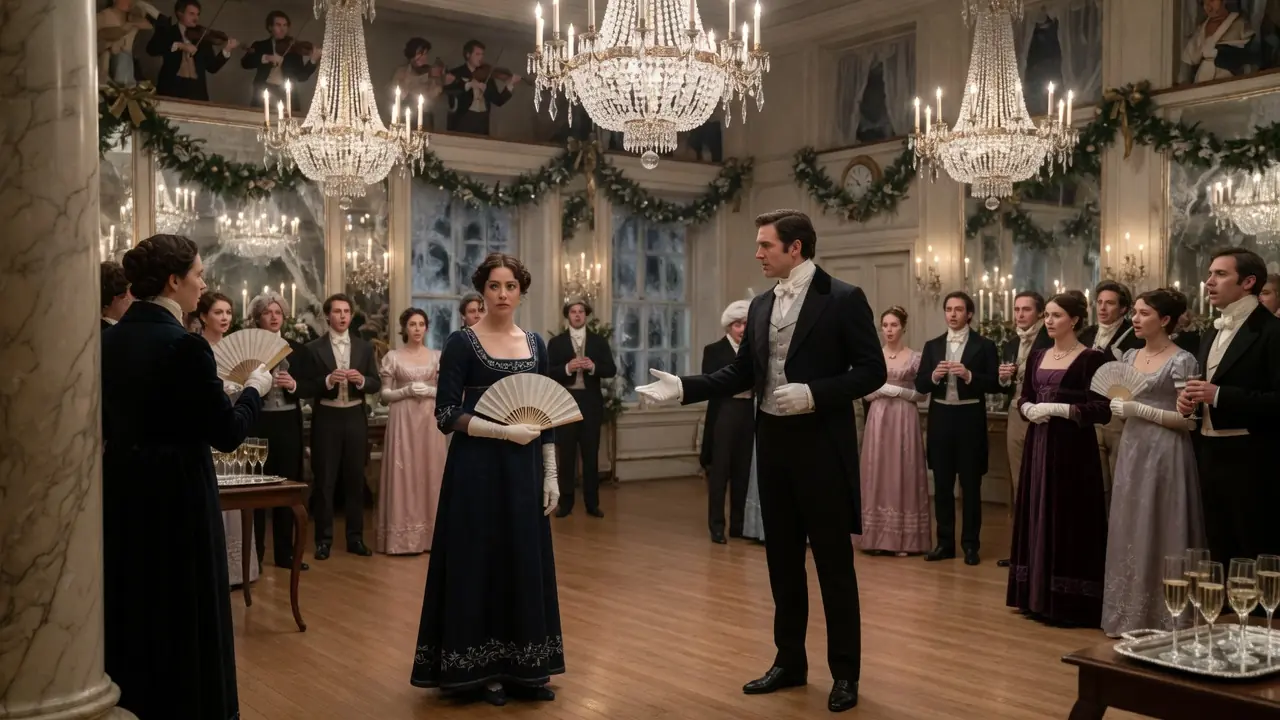
The ballroom stretched before her, chandeliers glittering overhead, the walls lined with evergreen garlands and gold ribbon.
Couples moved across the floor in elegant patterns, skirts swirling, faces bright with champagne and anticipation.
Midnight was still hours away, but the energy of the evening already hummed with the promise of new beginnings.
Margot found a place near the edge of the room, close enough to be seen, far enough to be forgotten.
Clara disappeared almost immediately, swept into a group of young women near the refreshment table.
Her mother drifted toward a cluster of matrons already deep in conversation.
Margot stood alone exactly as she had known she would.
She did not wait to be asked to dance.
She did not scan the room for friendly faces.
She simply stood, fan in hand, and prepared to endure.
The year was ending, and Margot Evans was exactly where she had been when it began.
The ballroom at Hawthorne Hall had been designed for spectacle.
And tonight, it delivered precisely that.
Three massive chandeliers hung from the vaulted ceiling, each dripping with hundreds of crystals that caught the candlelight and scattered it across the polished floor in fragments of gold and white.
The walls were lined with mirrors that doubled the crowd, doubled the movement, doubled the impression that the entire world had gathered here to celebrate.
Evergreen garlands wound along the balustrades, their scent mixing with perfume and beeswax and the faint sweetness of champagne.
The orchestra played from the gallery above, violins soaring over the steady pulse of the bass, and the music seemed to live inside the room itself, vibrating through the floorboards, humming in the air.
Couples swept past in precise formations, their movements practiced and effortless.
Skirts billowed like waves, coattails flicked in rhythm.
Laughter punctuated the music at irregular intervals, bright and unrestrained.
The kind of laughter that came easily when one had nothing to fear from being heard.
Midnight was still two hours away, but the energy of anticipation already filled every corner.
Voices rose and fell in excited speculation about the coming year.
Young women clustered near the refreshment tables, whispering behind fans and glancing toward clusters of young men who pretended not to notice.
Matrons observed from the sidelines with the shrewd eyes of generals planning campaigns.
At the center of it all, the dance floor spun and shifted like something alive.
Margot stood at the very edge of the room near a marble column that divided the ballroom from the adjoining parlor.
It was a good position, close enough to the activity that she could not be accused of hiding, far enough that she did not obstruct anyone’s view or movement.
She had learned over the years to find these in-between spaces, places where her presence could be tolerated because it did not demand acknowledgment.
Her back was straight, her hands folded over the fan at her waist, her expression carefully neutral.
She had long since perfected the art of looking as though she were merely resting between dances, as though she had just stepped away from the floor for a moment and would return any second.
It was a performance no one believed, but it allowed both parties to maintain the fiction that everything was normal.
The first hour passed slowly.
Margot watched Clara being led onto the floor by Lord Peyton’s son, her cousin’s face flushed with delight.
She watched her mother deep in conversation with Lady Ashford, both women nodding approvingly at something said.
She watched the room move around her in patterns she no longer tried to join.
And she felt the familiar weight of being watched in return.
It was never direct.
No one stared openly.
That would have been rude, and cruelty in society was always conducted with impeccable manners.
But she could feel it nonetheless.
The quick glances that slid past her and then returned.
The eyes that assessed and dismissed in the same breath.
The conversations that paused when she shifted her weight and resumed the moment she stilled again.
She had become a reference point, a landmark, the woman standing alone near the column.
You know the one.
A group of young women passed nearby, their voices low but not low enough.
Margot caught fragments of their conversation, each word landing with the precision of a blade.
“Still comes.”
“Can you imagine?”
“No shame, really.”
“Mother insists, I suppose, but honestly.”
Laughter followed, light and careless, and the group moved on without a backward glance.
Margot’s fingers tightened imperceptibly around her fan.
She did not turn her head.
She did not react.
She had learned that reactions were what they wanted.
Proof that the words had landed.
Proof that she could still be hurt.
She would not give them that satisfaction.
Another dance began, and the floor filled again.
Margot shifted her weight slightly, easing the pressure on her left leg.
The movement was small, automatic, but she saw the woman nearest her notice it.
Saw her gaze drop to Margot’s skirt, linger there for a beat too long, and then rise again with a faint curl of a knowing smile.
The limp.
Always the limp.
The visible proof that something had gone wrong, that Margot had made mistakes, that she was not like the other women who moved effortlessly across the ballroom as though gravity itself had made an exception for them.
Margot looked away first.
It was easier than holding the woman’s gaze and pretending she did not understand exactly what was being communicated.
The music swelled, and couples spun past in a blur of color and motion.
Margot stood perfectly still, a stone in the current, and told herself the same thing she told herself at every event.
You only have to survive until it is acceptable to leave.
You do not have to enjoy it.
You do not have to be chosen.
You only have to endure.
She could endure.
She had proven that already.
But tonight felt heavier than usual.
Perhaps it was the particular cruelty of New Year’s Eve, the way the entire room seemed designed to celebrate fresh starts and new possibilities while she remained locked in the same narrative that had defined her for three years.
Perhaps it was the way Clara had looked at her earlier with something close to pity, as though Margot were already a cautionary tale rather than a living person.
Or perhaps it was simply exhaustion, the weight of pretending that standing alone in a crowded room did not hurt.
The clock on the far wall showed half past ten.
Ninety minutes until midnight.
Ninety minutes until she could leave without causing comment.
She could last ninety minutes.
The ballroom doors opened with a sudden flourish, and a ripple of attention moved through the crowd like wind across water.
Conversations paused mid-sentence.
Heads turned.
The music did not stop, but somehow the room’s focus shifted entirely, pulled toward the entrance by a force Margot could not immediately identify.
And then she saw him.
The Duke of Westmore.
Margot knew the title before she knew the man.
Everyone did.
The Duke of Westmore was one of those names that carried weight simply by existing.
The kind of title that made hostesses rearrange seating charts and mothers recalculate their daughters’ prospects.
He had been abroad for years.
Italy, she thought, or perhaps France, and his absence had only amplified his reputation.
Wealthy, influential, unmarried.
The crowd parted slightly as he entered, not out of fear, but out of instinctive deference.
He was tall, broad-shouldered, dressed in black evening clothes that fit him with the kind of precision that suggested both expense and indifference to it.
His hair was dark, his expression unreadable, and he moved through the room with the ease of someone who had never questioned his right to occupy space.
Margot watched the reaction more than the man himself.
She saw young women straighten, saw mothers lean toward each other with urgent whispers, saw men shift their postures as though preparing for either alliance or competition.
The Duke’s arrival had changed the room’s atmosphere entirely, turning what had been a predictable evening into something unpredictable.
He paused near the center of the ballroom, acknowledged Lord Hawthorne with a slight nod, and allowed himself to be drawn into conversation with a cluster of men near the refreshment table.
The music continued.
The dancing resumed.
But the energy had shifted, sharpened, become more deliberate.
Margot turned her attention away.
The Duke’s arrival was not her concern.
Men like that did not notice women like her, and she had no interest in joining the chorus of hopeful glances being directed his way.
She had learned long ago that hope was more dangerous than resignation.
She shifted her weight again, adjusted her fan, and prepared to endure the next hour and a half exactly as she had endured the first.
But then she felt it.
The weight of being watched, but different this time.
Heavier, more focused.
She glanced up almost involuntarily, her gaze sweeping across the room, and found herself looking directly at the Duke of Westmore.
He was standing near the far side of the ballroom, half turned away from the men he had been speaking with.
And he was looking at her.
Not past her.
Not through her.
At her.
Their eyes met.
Margot’s breath caught, surprise flickering through her before she could suppress it.
She had expected him to be watching the dancers or surveying the room in the way powerful men often did, cataloging assets and opportunities.
She had not expected his attention to land on her.
The woman standing alone near the column.
The woman everyone else had already dismissed.
For a moment, neither of them looked away.
His expression was unreadable, but his gaze was steady, deliberate, as though he were studying something that required careful attention.
Margot felt the familiar prickle of self-consciousness rise in her chest.
He was seeing her limp, she thought.
He was seeing her isolation.
He was seeing exactly what everyone else saw and drawing the same conclusions.
She looked away first, breaking the connection with the practiced ease of someone who had learned not to hold eye contact for too long.
She focused on the far wall, on the clock, on anything that was not the Duke of Westmore’s unreadable expression.
It meant nothing.
A moment of idle curiosity.
He would look away, turn back to his conversation, and forget her entirely within seconds.
She had been noticed before.
It never changed anything.
The music shifted into a new piece, something faster, brighter.
The dancers moved with renewed energy, and the noise in the room rose to match.
Margot remained where she was, fan in hand, and told herself firmly that she had imagined the weight of the Duke’s gaze.
But she could still feel it.
And when she risked a glance back toward where he had been standing, he was no longer there.
Relief flooded through her, followed immediately by a strange, unwelcome sense of disappointment she refused to examine.
She straightened her shoulders, adjusted her posture, and reminded herself that she had not come here to be noticed.
She had come here to survive.
Then the crowd shifted.
Not dramatically, not all at once, but gradually, a space began to open near her.
A widening gap in the press of people that suggested someone was moving through them with purpose.
Margot’s stomach tightened.
She kept her gaze forward, her expression neutral, and told herself it was coincidence.
Someone heading toward the parlor.
Someone leaving the ballroom.
Someone passing by.
But the space continued to widen, and the conversations nearest her began to falter and stop, replaced by a humming silence that felt louder than the music.
And then she saw him.
The Duke of Westmore, moving through the crowd with steady, unhurried steps, his gaze fixed directly on her.
He was coming toward her.
Not past her.
Toward her.
Margot’s pulse stuttered.
She gripped her fan tighter, her mind racing through possibilities, each one worse than the last.
He was going to speak to her.
He was going to ask her something.
He was going to humiliate her in some new and creative way she had not yet anticipated.
She braced herself, lifting her chin slightly, and prepared for whatever was about to happen.
The Duke of Westmore stopped directly in front of her.
Close enough that Margot could see the fine details of his evening clothes, the way his cravat had been tied with precision, the faint shadow along his jaw that suggested he had been traveling.
Close enough that there could be no mistaking his destination.
He inclined his head slightly, a gesture of acknowledgment that was neither effusive nor dismissive.
“Miss Evans.”
He knew her name.
Margot’s mind stuttered over that fact, even as she managed a small curtsy, her weight shifting carefully to accommodate the movement.
“Your grace.”
His voice was lower than she had expected, calm and steady, with none of the affected charm she had heard from other men of his rank.
He spoke as though they were having a private conversation rather than one conducted in full view of a ballroom that had gone unnaturally quiet around them.
“I hope you are enjoying the evening.”
It was a standard pleasantry, the kind of thing said at every social gathering, but Margot heard the faint question beneath it.
He was not simply making conversation.
He was observing her, assessing something she did not yet understand.
“It is a lovely ball,” she said carefully, giving him the answer that was expected, the one that revealed nothing.
“But you are not dancing.”
It was not quite a question, but it demanded a response nonetheless.
Margot felt the attention of the room pressing in on them.
Felt the weight of all those eyes watching to see what she would say, how she would explain herself, whether she would crack under the sudden scrutiny.
“I am content to observe, your grace.”
“Are you?”
The question was quiet, but it landed with unexpected force.
Margot looked up at him fully for the first time, searching his expression for mockery or pity or any of the other reactions she had learned to recognize.
She found neither.
His gaze was direct, serious, and strangely intent, as though he were genuinely interested in her answer.
“Yes,” she said, and heard the lie in her own voice.
The Duke tilted his head slightly, studying her with the same careful attention he had shown from across the room.
“I do not think that is true.”
Margot’s breath caught.
No one spoke to her like this.
No one addressed her directly, honestly, without the careful cushion of polite fiction.
She did not know how to respond to directness.
It felt like standing too close to a fire.
“Your grace,” she said quietly, her voice dropping low enough that only he could hear, “I do not know what you think you are doing, but I would ask you to reconsider. You do not want to be seen speaking with me for long. It will not reflect well on you.”
Something shifted in his expression.
A flicker of what might have been anger, or perhaps understanding.
“And why is that?”
“You know why.”
“I know what people say. I am asking what you say.”
Margot swallowed against the tightness in her throat.
This was a trap.
It had to be.
No man of his position would genuinely care about her perspective, about the truth buried beneath three years of rumor and dismissal.
And yet, he stood there waiting as though her answer actually mattered.
“It does not matter what I say,” she said finally. “It has not mattered for a long time.”
The Duke was silent for a moment, and Margot braced herself for him to agree, to nod politely and retreat, to confirm what she already knew.
Instead, he did something entirely unexpected.
He extended his hand.
“Dance with me.”
The words fell into the space between them like stones into still water.
Margot stared at his outstretched hand, her mind blank with shock.
Around them, the ballroom seemed to hold its breath.
She could feel the stares now, no longer furtive, but open, curious, waiting to see what she would do.
“No,” she said.
The Duke did not lower his hand.
“No, I cannot.”
Margot forced herself to meet his eyes, to hold his gaze even though every instinct told her to look away.
“I will not be made into a spectacle, your grace. Not by you, not by anyone.”
“A spectacle,” he repeated, as though testing the word.
“Yes.”
Her voice was steadier now, anger giving her strength.
“You may think you are being kind. You may think you are doing something generous. But if I dance with you, I will become a story. Tomorrow, people will not talk about how gracious you were. They will talk about how desperate I must have been to accept. They will dissect every step, every misstep, and they will confirm everything they already believe about me. So no, I will not dance with you.”
She had never spoken so plainly to anyone of his rank.
She had never dared.
But something about the way he looked at her, the way he had asked rather than assumed, made her feel as though honesty might be possible, even if it cost her.
The Duke did not flinch.
He did not look offended or embarrassed.
Instead, he nodded slowly as though she had just confirmed something he had suspected.
“You are right,” he said quietly.
Margot blinked.
“I what?”
“You are right. If we dance here now, it will be exactly as you described. They will watch you. They will judge you. And you will be reduced to a performance for their entertainment.”
Relief flooded through her, followed immediately by a sharp, unexpected disappointment.
He understood.
Of course, he understood.
And now he would leave, and she would return to standing alone, and nothing would have changed except that she would have this strange, brief conversation to remember.
But the Duke did not leave.
Instead, he turned away from her, his gaze sweeping across the ballroom, across the faces watching them with barely concealed fascination.
Then, in a voice that carried effortlessly over the music, he spoke.
“Stop the music.”
The orchestra faltered one instrument at a time until silence fell across Hawthorne Hall like a blanket.
The dancers slowed, stumbled, stopped.
Conversations died mid-sentence.
Every head turned toward the Duke, confusion and curiosity written across every face.
Margot’s heart hammered against her ribs.
What was he doing?
The Duke walked forward, not toward the orchestra, but toward the center of the ballroom, his movements deliberate and unhurried.
When he reached the middle of the floor, he stopped and turned to face the crowd.
“Clear the floor,” he said.
The command was not loud, but it was absolute.
For a moment, no one moved.
The guests stared at him, at each other, trying to understand what was happening, what was being asked of them.
Lord Hawthorne stepped forward slightly, his expression caught between confusion and concern.
“Your grace…”
“Clear the floor,” the Duke repeated, and this time his voice carried the full weight of his authority. “Now.”
It was not a request.
It was not a suggestion.
It was an order delivered by a man who had never been denied anything in his life and did not expect to be denied now.
The crowd hesitated for one more heartbeat.
Then slowly, they began to move.
Couples stepped off the dance floor, retreating toward the edges of the room.
Guests shifted backward, creating space where moments before there had been none.
The ballroom, which had been full and alive with motion, emptied until only the Duke remained standing at its center.
The silence was absolute.
Margot could hear her own breathing, could hear the rustle of fabric as people adjusted their positions, could hear the faint creak of the floorboards beneath her feet.
And beneath it all, she could feel the weight of hundreds of eyes, no longer watching her with judgment, but with something closer to shock.
The Duke turned back to her, and for the first time since he had approached her, he smiled.
It was a small smile, barely there, but it transformed his face entirely.
He extended his hand again.
“Dance with me,” he said, “without an audience.”
Margot stared at him, her mind struggling to process what had just happened.
He had not simply asked her to dance.
He had removed the audience.
He had taken away the very thing she feared most, the watching, the judging, the performance of her humiliation.
He had created a space where she could move without being a spectacle.
Her hands trembled.
She pressed them together, trying to still the shaking, trying to find words for what she was feeling and failing completely.
“Why?” she whispered.
The Duke’s expression softened.
“Because you deserve to dance without being a story.”
The words broke something inside her.
Some wall she had been maintaining for three years.
Some carefully constructed barrier between what she felt and what she allowed herself to feel.
Tears pricked at the corners of her eyes, and she blinked them back furiously, refusing to let them fall.
She looked at his hand, still extended, still waiting.
Then slowly, she reached out and placed her gloved fingers in his palm.
His hand closed around hers, warm and steady, and he led her forward onto the empty floor.
The Duke gestured to the orchestra, and after a moment’s hesitation, they began to play again.
The music was softer this time, slower, a waltz that seemed to belong to the space the Duke had created rather than the ballroom itself.
He placed his other hand at her waist, his touch light and respectful, and Margot lifted her free hand to his shoulder.
They stood like that for a moment, positioned but not yet moving, and Margot felt the full weight of what was about to happen settle over her.
She had not danced in three years.
Not since the accident.
Not since her leg had betrayed her and made her afraid of her own body.
“I may stumble,” she said quietly.
“Then I will adjust,” he replied, as though it were the simplest thing in the world.
They began to move.
The Duke led with the kind of certainty that made following easy, his steps clear and deliberate.
Margot matched him as best she could, her weight shifting carefully, her left leg protesting but holding.
When she hesitated, he slowed.
When she faltered, he steadied her without drawing attention to it.
He did not treat her injury as something to be overcome or hidden.
He simply danced with her as she was.
And slowly, painfully, beautifully, Margot remembered what it felt like to move without shame.
The ballroom remained silent around them, the guests watching from the edges.
But Margot found she no longer cared.
They were not watching her stumble.
They were not cataloging her mistakes.
They were witnessing something else entirely.
A woman being treated with dignity.
The music swelled, and the Duke guided her through a turn.
Margot’s skirt flared slightly, and for one breathless moment, she felt graceful.
Not perfect.
Not healed.
But graceful nonetheless.
“You dance beautifully,” the Duke said quietly.
Margot almost laughed.
“I dance adequately.”
“No,” he said, his voice firm. “You dance beautifully, and anyone who has told you otherwise is a liar.”
The tears threatened again, but this time, Margot let them come.
One slipped free, sliding down her cheek before she could stop it.
The Duke saw but said nothing, simply continued to lead her across the floor as though crying while dancing was the most natural thing in the world.
The clock began to chime.
Midnight.
The first strike echoed through the ballroom, deep and resonant, and Margot felt the weight of it in her chest.
Around them, the guests stirred, the traditional countdown forgotten in the strangeness of the moment.
But the Duke did not stop.
He kept dancing.
Kept moving.
Kept holding her as though the world outside their small circle did not exist.
The clock struck twelve, and the year turned.
The old year, with all its pain and judgment and isolation, ended.
The new year, with all its terrible, fragile possibility, began.
And Margot Evans stood in the center of a silent ballroom, held by a man she barely knew, and understood that this moment, this impossible, improbable moment, could not be undone.
The music ended.
The Duke stepped back, releasing her hand with the same careful respect he had shown throughout.
He did not bow dramatically.
He did not make a show of what had just happened.
He simply looked at her, and in his eyes, Margot saw something she had not seen directed at her in years.
Genuine respect.
“Thank you,” he said quietly.
Before Margot could respond, the room began to move again.
Guests stepped forward uncertainly, conversations resuming in murmurs, the spell of silence breaking.
But nothing was the same.
The people who had whispered about her now looked uncertain.
The women who had laughed now watched her with something that might have been wariness or perhaps grudging respect.
The Duke inclined his head to her once more, then turned and walked toward Lord Hawthorne, resuming his place in the world as though nothing extraordinary had occurred.
But everything had changed.
And Margot, standing alone again in the ballroom, felt it settle into her bones.
She was no longer the woman who could be dismissed.
The carriage ride home was silent.
Margot sat across from her mother and Clara, the three of them suspended in the darkness between Hawthorne Hall and home, and no one spoke.
Clara kept glancing at her with wide, uncertain eyes, as though Margot had transformed into someone she no longer recognized.
Her mother stared out the window, her expression unreadable, her hands folded tightly in her lap.
Margot felt the silence like a physical weight pressing down on her shoulders, filling her lungs.
She did not know what to say.
She did not know what had just happened.
Not really.
The dance felt both impossibly real and entirely surreal, as though she had dreamed it while standing fully awake.
The Duke of Westmore had cleared a ballroom for her.
He had stopped the music, dismissed the crowd, and danced with her as though she were someone worth protecting.
Then he had walked away, leaving her standing in the center of a room that no longer knew how to look at her.
She did not know if that was mercy or cruelty.
She would not know until tomorrow, when the whispers started again and she learned what story had been written in place of the old one.
When they finally arrived home, Margot climbed the stairs to her room without waiting for conversation.
She closed the door behind her, leaned against it, and allowed herself to breathe.
Her reflection stared back at her from the mirror across the room.
Same dark hair.
Same careful posture.
Same dress she had worn hours earlier.
But something in her expression had shifted.
She looked less guarded, more fragile, as though the armor she had been wearing for three years had cracked just enough to let light through.
Margot crossed to the window and looked out at the dark street below.
Somewhere in the city, the Duke of Westmore was doing whatever dukes did after midnight.
Sleeping perhaps, or drinking with friends, or thinking nothing at all about the woman he had danced with.
She told herself it did not matter.
One dance, however extraordinary, did not change the reality of her position.
Tomorrow, she would still be Margot Evans.
Still marked by scandal.
Still limping.
Still alone.
But for tonight, just for tonight, she allowed herself to remember what it had felt like to be seen.
Morning arrived with pale winter light and a knock at her door.
Margot had not slept well.
She had spent most of the night replaying the ball in her mind, examining every moment, every word, searching for the trap she was certain existed.
Men like the Duke did not act without reason.
There had to be an explanation, something she was missing.
Some larger game being played that she did not yet understand.
“Come in,” she called, expecting Hannah or perhaps her mother with more questions she would not know how to answer.
Instead, Clara slipped through the door, still in her nightgown, her expression urgent.
“He’s here,” she whispered.
Margot sat up slowly, confusion replacing the fog of sleeplessness.
“Who?”
“The Duke. The Duke of Westmore. He’s downstairs. He’s asking to speak with you.”
The room tilted slightly.
Margot gripped the edge of her bed, trying to steady herself, trying to make sense of what Clara was saying.
“That’s not possible.”
“He arrived ten minutes ago. Father is with him in the drawing room. Mother sent me to fetch you.”
Clara stepped closer, her voice dropping even lower.
“Margot, what is happening?”
“I don’t know,” Margot said honestly.
But she rose anyway, her heart hammering against her ribs, and allowed Clara to help her dress.
Her hands shook as she fastened her hair, as she pulled on a simple morning gown, as she prepared to face whatever was waiting for her downstairs.
When she finally descended, she found her father standing outside the drawing room.
His expression was caught somewhere between bewilderment and caution.
He looked at Margot as though she had suddenly become a puzzle he could not solve.
“He asked to speak with you privately,” her father said slowly. “I told him it was irregular, but he insisted. Your mother will be just outside.”
Margot nodded, not trusting her voice, and stepped past him into the drawing room.
The Duke stood near the window, his back to her, his hands clasped behind him.
He was dressed more casually than he had been at the ball, though casual for a man of his rank still meant impeccable tailoring and quiet wealth.
When he heard her enter, he turned, and his expression softened in a way that made Margot’s breath catch.
“Miss Evans. Thank you for seeing me.”
“Your grace.”
Margot closed the door behind her, leaving it slightly ajar as propriety demanded.
“I confess I am surprised to see you.”
“I imagine you are.”
He gestured toward the chairs near the fireplace.
“Will you sit?”
Margot hesitated, then lowered herself into one of the chairs, her posture careful, her hands folded in her lap.
The Duke took the chair across from her, and for a moment, they simply looked at each other in the morning light.
“I owe you an explanation,” he said finally.
“You owe me nothing, your grace. You were kind last night, more than kind. But you do not owe me anything beyond that.”
“I disagree.”
He leaned forward slightly, his gaze serious.
“I came to that ball last night because I had been away from England for three years. I returned because I received a letter from a friend asking me to look into a matter that had troubled him. That matter concerned you.”
Margot went very still.
“I don’t understand.”
“The scandal that ruined your reputation. The carriage accident. The man you were supposedly involved with.”
The Duke’s voice was steady, factual, but Margot heard the anger beneath it.
“My friend was the younger brother of that man. He never believed the story, and when he heard what had become of you, he asked me to investigate.”
“Investigate,” Margot repeated, the word hollow in her mouth.
“I spent the better part of two months tracing what actually happened that day, speaking to witnesses, finding records, collecting testimony.”
The Duke reached into his coat and withdrew a folded letter.
“The innkeeper remembered you. He remembered that you were unconscious when you arrived, that your maid was frantic, that the man with you did everything he could to help. He also remembered three other guests who arrived later that evening. Guests who saw you in that vulnerable state and decided to turn it into gossip.”
Margot stared at the letter in his hands, unable to move, unable to breathe.
“One of those guests,” the Duke continued, “was a woman who had been courting the attention of the man traveling with you. When he showed you kindness instead of her, she decided to punish you both. She started the rumor deliberately, Miss Evans. She crafted it carefully, and she made certain it spread before you were conscious enough to defend yourself.”
The room swam.
Margot gripped the arms of her chair, her knuckles white.
“Who?”
The Duke told her.
The name meant nothing to Margot at first.
Then everything.
A woman she had met only twice.
A woman she had barely noticed.
A woman who had destroyed her life out of petty jealousy and wounded pride.
“I have written testimony,” the Duke said quietly. “From the innkeeper, from your maid, from two travelers who witnessed your arrival. I have a letter from the man himself, written three years ago but never sent, in which he explains what actually happened and condemns those who twisted it. And I have a confession of sorts from the woman who started the rumor. She did not mean to confess, but when pressed, she revealed enough.”
Margot could not speak.
The words caught in her throat, tangled with three years of grief and rage and exhausted resignation.
She had been innocent.
She had always been innocent.
And someone had decided that did not matter.
“Why?” she whispered finally. “Why would you do this? Why would you spend months investigating something that happened to a woman you did not know?”
The Duke set the letter on the table between them.
“Because my friend asked me to. Because I have seen too many lives destroyed by lies. And because when I walked into that ballroom last night and saw you standing alone, I knew exactly what had been done to you, and I could not allow it to continue.”
Tears slid down Margot’s cheeks, hot and unchecked.
She did not wipe them away.
She simply sat there, crying silently while the Duke watched her with patience and something that looked almost like grief.
“You were never the problem, Miss Evans,” he said softly. “You were never broken. You were never deserving of what they did to you. And anyone who told you otherwise was a liar.”
The words broke her completely.
Margot bent forward, her hands covering her face, and sobbed.
She cried for the girl she had been at twenty-three, who had believed honesty would protect her.
She cried for the three years she had spent believing she deserved her isolation.
She cried for every dance she had missed, every friendship she had lost, every moment she had stood alone and convinced herself it was her fault.
And she cried because someone had finally, finally told her the truth.
When the tears finally subsided, Margot lowered her hands and found the Duke still sitting across from her, waiting.
He had not moved.
He had not looked away.
He had simply let her break in front of him without judgment.
“What happens now?” she asked, her voice raw.
“That depends on you.”
The Duke leaned back slightly, giving her space.
“I can make this information public. I can ensure that the truth is known, that your name is cleared, that the people who wronged you face consequences. Or I can do nothing, if that is what you prefer. This is your choice, Miss Evans, not mine.”
Margot looked at the letter on the table, at the proof of her innocence folded into cream-colored paper.
For three years, she had wanted nothing more than vindication.
She had dreamed of the moment when everyone would know they had been wrong, when she would be restored to the place she had occupied before the scandal.
But now, faced with that possibility, she found she did not want revenge.
She did not want to watch people grovel or apologize or pretend they had always believed in her.
She simply wanted her life back.
Her dignity.
Her right to exist without constantly justifying her presence.
“I want the truth known,” she said slowly. “But I do not want spectacle. I do not want drama. I want people to know I was innocent, and then I want to be left alone to live my life as I see fit.”
The Duke nodded.
“That can be arranged.”
“And you?”
Margot met his eyes.
“What do you want from this?”
“Nothing,” he said simply.
“I do not believe that.”
A faint smile crossed his face.
“All right. I want permission to call on you. Not to rescue you. Not to claim credit for clearing your name, but because I would like to know you better, if you will allow it.”
Margot studied him, searching for deception, for ulterior motive, for any of the thousand warning signs she had learned to recognize.
She found only sincerity.
“Why?” she asked again.
“Because you refused to dance with me when you believed it would harm you,” he said quietly. “Because you stood in that ballroom for three years and never hid. Because you are stronger than anyone I have ever met, and I would very much like the chance to understand how.”
Margot felt something shift in her chest, something that might have been hope or perhaps simply possibility.
She did not know yet if she could trust him.
She did not know if she could trust anyone after what had been done to her.
But she wanted to try.
“You may call on me,” she said, “but I make no promises beyond that.”
“I would not ask for any.”
The Duke rose, and Margot stood as well, her movements careful, but no longer apologetic.
They faced each other in the morning light, two people who had been strangers twelve hours earlier and were something else now, something undefined.
“Thank you,” Margot said. “For the truth. For believing it mattered.”
“It always mattered,” the Duke said, “even when no one else saw it.”
He left quietly, and Margot returned to her room.
She stood before the mirror again, the same mirror that had reflected her resignation the night before, and looked at herself with new eyes.
Same body.
Same injury.
Same history.
But something fundamental had changed.
She was no longer waiting for the night to end.
She was no longer bracing herself to survive.
She was simply standing whole and certain in her own life.
The Duke had not given her worth.
He had exposed the lie that said she had none.
And Margot Evans, at twenty-six, finally understood that she had always been enough.
Three weeks later, the truth circulated through London society with the swift efficiency of all good gossip.
The woman who had started the rumor retreated to the countryside in disgrace.
The man who had been accused sent Margot a letter of apology that she read once and then burned.
And slowly, carefully, the invitations began to arrive again.
Margot accepted some, declined others, and discovered that choice itself was a kind of freedom.
The Duke called on her twice a week, always respectful, always patient, never assuming more than she was willing to give.
They talked about books and travel and the small, quiet things that made up a life.
And gradually, Margot learned what it meant to be known rather than judged.
She did not know yet if she would marry him.
She did not know if she would marry anyone.
But she knew she would never again stand silent at the edge of a room and accept that she deserved to be there.
The new year had begun, and so had Margot’s life.