Maya Brooks thought the worst thing a customer could do was get her fired over a cinnamon roll. Then a stranger looked at her name badge and mentioned something that should have belonged only to home. By the end of her shift, Maya would have to decide which frightened her more: finding out how the woman knew, or discovering why her mother refused to answer.
“Keep the box, please. You still need to pay for that.”
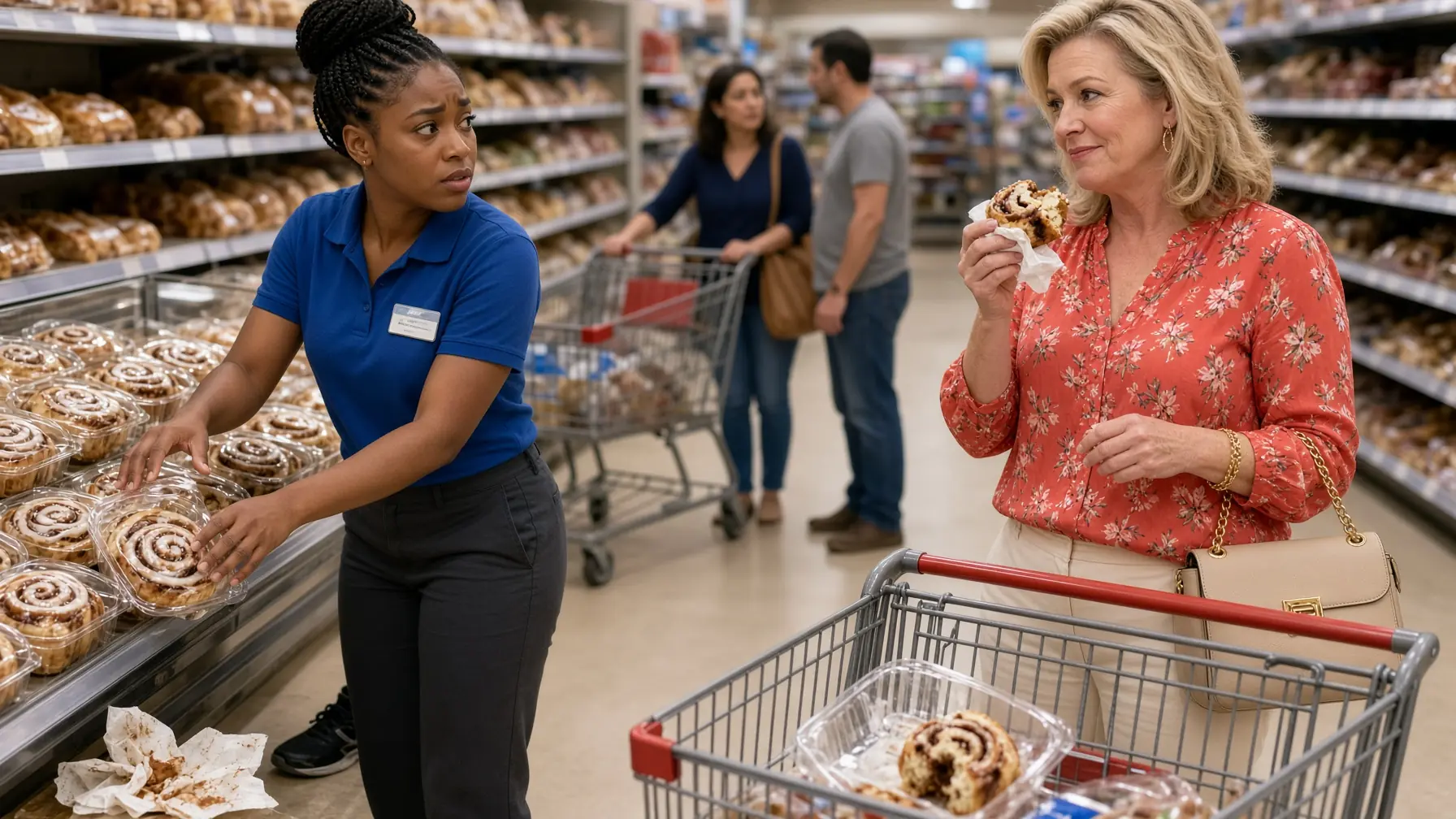
Maya said it in the voice she used for spilled milk, misplaced coupons, and people who opened a bag of grapes before reaching the register. Pleasant, clear, nothing sharp enough to become a complaint.
The woman beside the cinnamon roll display stopped chewing.
She was in her early fifties, with carefully styled blonde hair and a vivid coral floral blouse tucked into cream trousers. A gold bracelet rested against the handle of her cart, and her designer handbag occupied the child seat as though it had been given a reservation.
An opened pastry package lay beside it.
The woman looked at Maya’s blue store polo, then her charcoal trousers, then the black sneakers she had bought because twelve-dollar shoes had started making her knees hurt.
“I spend more here than you make in a week,” she said. “Go stock something.”
A man examining sandwich bread lowered the loaf an inch. Farther down the aisle, a woman with a shopping basket glanced toward them and immediately looked away.
Maya felt heat climb into her cheeks.
She had been working since six that morning. She had unloaded a delivery, covered a cashier’s break, cleaned juice from beneath the refrigerated fruit display, and listened to a customer explain that the arrangement of muffins was somehow a personal insult.
She did not have enough energy left to pretend this woman had said something clever.
“You can eat it while you shop,” Maya said. “We just need the package at checkout.”
The woman gave a small laugh and reached for another sealed pastry.
Maya placed an open hand in front of the package without touching the woman or her cart.
“Then paying for it shouldn’t be a problem.”
The laugh disappeared.
For a moment, they stood beneath the bright bakery lights with Maya’s palm hovering between a clear plastic lid and a bracelet worth more than her rent.
The woman pulled her hand back. Then she took the greasy wrapper from her cart and dropped it beside Maya’s shoes.
It landed icing-side down.
Maya looked at it, then back at her.
She knew what was expected. Bend down. Clean it up. Restore the comfortable order in which one person could make a mess and another person had to be grateful for the opportunity to remove it.
Maya left it there.
The woman’s eyes narrowed. Then her gaze lowered to the badge pinned above Maya’s chest.
Something changed.
It was slight enough that Maya might have missed it if she had been looking at the wrapper. The woman’s mouth relaxed, and her attention settled on the badge with a stillness more unsettling than her anger.
“Brooks,” she said.
Maya waited.
The woman slowly raised her eyes.
“Does your mother still keep that purple planter by the front door?”
Maya’s hand stopped against the edge of the display.
For a second, the store seemed to continue at a distance. A cart wheel clicked against a floor seam. Someone laughed near the deli. The bakery oven gave its ordinary electronic beep.
The planter was tall, with a chipped rim and one pale streak where her mother had repaired a crack. In summer it held flowers. In winter her mother moved it beneath the porch roof and insisted it looked perfectly fine empty.
It was not something Maya discussed with customers.
She had never mentioned it at work.
The woman took another deliberate bite of the cinnamon roll.
Behind her, the shopper holding the sandwich bread stopped pretending to read the label.
Maya lowered her hand.
“My mother?”
The woman swallowed.
“It’s a distinctive color.”
Her small smile remained.
Maya wanted to ask who she was. She wanted to ask where she had seen the planter, when she had seen it, and why she had said still.
Instead, she heard herself say, “You need to keep the package.”
The woman studied her a moment longer.
Then she turned the cart.
Its front wheel squealed as she rolled toward the end of the aisle, leaving the wrapper on the floor and Maya standing beneath the bright lights with a question she could no longer fit inside an ordinary workday.
Maya watched until the coral blouse disappeared behind a display of crackers.
Only then did she bend down.
She picked up the wrapper with a paper towel, carried it to the bakery trash, and washed her hands even though the towel had kept the grease from touching her skin.
Her fingers were trembling.
She pressed both palms against the sink and looked at the stainless steel basin until she could remember what she was supposed to do next.
There were labels to replace. A tray of discounted rolls needed moving. She had fifteen minutes before she was expected at the front registers.
Normal things.
She held on to them.
When she returned to the aisle, the man with the sandwich bread was still there.
He wore a gray zippered jacket and had put the loaf into his cart.
“You okay?” he asked.
“Yes.”
The answer came too quickly.
He looked toward the aisle where the woman had gone.
“That was unnecessary.”
Maya straightened a stack of pastry boxes that did not need straightening.
“Some people have a bad day.”
The man’s face tightened slightly.
“She looked like she was enjoying hers.”
Maya almost smiled.