“I told you to stay out of it!”
My daughter-in-law’s voice cracked across the dining room before anyone had even taken a seat.
She stood near the end of the long oak table, one hand braced against the back of a chair, the other pointed directly at me.
Not toward me.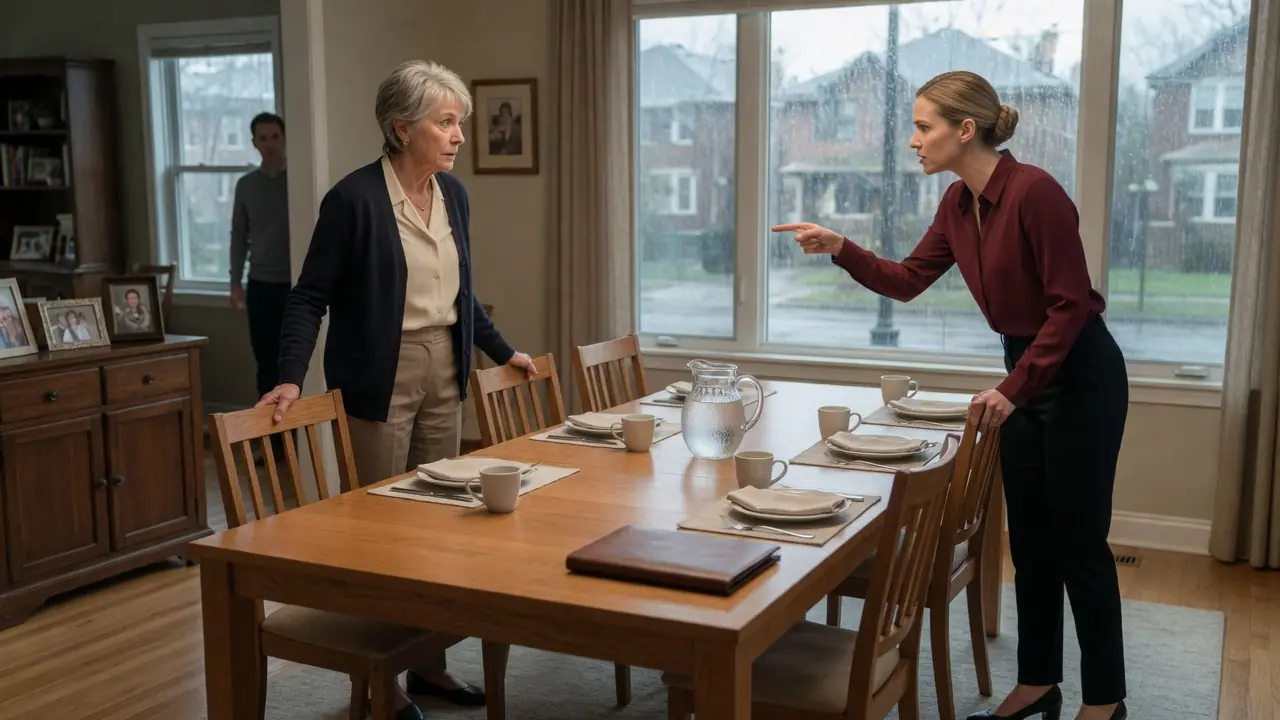
At me.
Like I was a stranger who had wandered into the wrong house. Like I had no right to stand beneath the roof where my son had celebrated birthdays, where my husband had carved the Thanksgiving turkey for twenty-six years, where my granddaughter had taken her first steps across the living room rug.
For one suspended second, no one moved.
The glass chandelier above us kept glowing warmly. A pot of coffee sat untouched near the counter. Rain slid down the windows in thin, silver lines. My son, Daniel, stood beside the window with his shoulders drawn tight, staring at the glass as though the weather outside had suddenly become the most important thing in the room.
My husband’s old framed photograph watched from the sideboard.
Robert had been gone for six years, but in moments like that, I still looked for him. I still expected to hear his low voice from the hallway, calm and firm, telling everyone to sit down before they said something they could not take back.
But Robert was not there.
And somehow, in the middle of my own family meeting, I was the only person who looked like I did not belong.
I kept my voice calm.
“You’re talking to your husband’s mother.”
Sophie shook her head once, sharply.
“No,” she said. “I’m talking to someone who refuses to listen.”
The words landed harder than they should have.
Maybe because she had practiced them.
Maybe because Daniel did not say a word.
I looked at him.
He still would not meet my eyes.
“Sophie,” I said quietly, “I came because Daniel called and said the family needed to talk.”
“And now you’re making it about yourself.”
Her lips pressed into a thin, bitter line. She had always known how to make an accusation sound reasonable. That was her talent. She did not scream often. She did not throw things. She simply chose her words carefully enough that everyone else began to wonder whether they had misunderstood what happened.
Around the table, the silence thickened.
Daniel’s sister, Hannah, sat with both hands wrapped around a glass of water. My younger brother, Mark, had stopped pretending to check his phone. Even my granddaughter, Lily, who had been coloring quietly near the living-room doorway, looked up from the floor.
No one said anything.
That hurt more than Sophie’s voice.
I had spent years telling myself that silence did not always mean agreement.
Sometimes people froze.
Sometimes they did not know what to say.
Sometimes they waited because they were afraid that choosing words too early would make a bad moment worse.
But that afternoon, with Sophie standing across from me and my son looking everywhere except at my face, silence felt like a decision.
“What exactly am I refusing to listen to?” I asked.
Sophie laughed, but there was no humor in it.
“Everything. Every boundary. Every conversation Daniel and I have tried to have with you.”
Daniel flinched at his name.
It was small. Barely visible.
But I saw it.
I had raised him. I knew the difference between the way he looked when he agreed with someone and the way he looked when he was afraid of what would happen if he did not.
My chest tightened.
“Daniel,” I said, still watching him, “is that how you feel?”
His fingers curled at his sides.
Sophie turned toward him immediately.
“Don’t,” she said.
The room changed.
It was not loud. It was not dramatic. No one gasped.
But every face at that table shifted.
Daniel finally looked at me.
His eyes were tired. Not angry. Not certain.
Tired.
And for the first time, I wondered how long this had been building behind closed doors. How many conversations had happened without me. How many times my name had been said in rooms I had never entered. How many times my son had swallowed his own answer because answering would cost too much.
“I didn’t say that,” Daniel murmured.
Sophie’s head snapped toward him.
“You didn’t have to.”
He looked down again.
That was when I understood this meeting had never been about solving anything.
Making me the problem before I had the chance to ask any questions.
Sophie pulled out the chair beside her but did not sit. Her fingers trembled against the polished wood, though her voice stayed controlled.
“You always act like you’re protecting him,” she said. “Like he needs you to step in and fix everything.”
“I have never believed he needed saving.”
“Then why are you here?”
The question hung in the room.
Why was I here?
Because my son had called me the night before after midnight and sounded like he had not slept.
Because he said, “Mom, can you come over tomorrow?” and then went quiet for so long I thought the call had dropped.
Because when I asked if he was all right, he whispered, “Just come.”
Because I had heard something in his voice that I had not heard since he was eight years old and broke his arm falling out of the maple tree in our backyard. Not pain exactly. Not fear exactly.
The sound of someone trying very hard not to need his mother and failing.
But I did not say that.
Not yet.
Instead, I reached for the empty chair at the table and pulled it back slowly.
The sound of its legs against the hardwood floor made Sophie’s jaw tighten.
“I am here,” I said, “because this is my family too.”
Her eyes hardened.
“No,” she said. “That’s exactly what you don’t understand.”
Daniel finally moved away from the window.
“Enough,” he said.
But it came out too softly.
Sophie turned toward him, stunned.
For a moment, I saw something flicker across her face.
Not anger.
Fear.
Then she reached into the leather folder on the table and pulled out a single sheet of paper.
She placed it in front of Daniel.
His face went pale.
Hannah leaned forward.
Mark stopped breathing.
And Sophie looked directly at me.
“Go ahead,” she said. “Tell your mother why you called this meeting.”
Daniel did not touch the paper.
The rain kept sliding down the window behind him. Lily’s crayon rested still in her little hand. My own heart beat so loudly that I could hear it in my ears.
I looked at the sheet.
At the top, in bold letters, it said:
Family Contact Agreement.
Below that were paragraphs of neatly typed rules.
No unscheduled visits.
No direct calls to Daniel after 8:00 p.m.
No gifts for Lily without approval.
No private conversations between Evelyn Harper and Daniel Harper regarding marital, financial, or parenting decisions.
No negative comments about Sophie Harper to any family member, including implied criticism through concern.
Any violation would result in a ninety-day suspension of contact.
My name was there.
Evelyn Harper.
Daniel’s name was there.
Sophie’s name was there.
At the bottom, two signature lines waited like traps.
One for Daniel.
One for me.
I stared at the paper for a long moment.
Then I looked at my son.
“Did you write this?”
Daniel’s mouth opened, but no sound came out.
Sophie answered for him.
“We wrote it together.”
“No,” Hannah said suddenly.
Everyone turned.
Hannah’s face had gone pale, but her voice was steady.
“No, you wrote it. Daniel texted me last week asking if I thought Mom would hate him if he needed help. That is not the message of a man writing family contact agreements.”
Sophie’s eyes flashed.
“This is exactly what I mean. Everyone in this family thinks they have a vote in our marriage.”
Hannah stood.
“Because you keep turning your marriage into a courtroom and inviting witnesses when you think they will support you.”
“Hannah,” Daniel said quietly.
His sister looked at him.
“No, Daniel. I’m tired of pretending I don’t see it.”
Sophie laughed again, sharp and controlled.
“Oh, this is wonderful. Now your sister is here to rescue you too.”
Mark finally set his phone face down on the table.
“Sophie, sit down.”
She looked at him as if he were a chair that had spoken.
“Excuse me?”
“I said sit down,” Mark repeated. “You called this a family meeting. Then let the family speak.”
Mark was my younger brother by nine years. He had always been quiet, steady, the kind of man who measured every word before spending it. He had been close to Robert, and after Robert died, he became the person who fixed my gutters, checked my furnace, and sat beside me in silence on the bad days when grief made conversation impossible.
Sophie did not like Mark.
That alone told me he had seen more than she wanted him to see.
She did not sit.
Daniel looked at the paper again.
His hands were shaking now.
Sophie moved closer to him.
“Daniel,” she said, her tone suddenly softer, almost sweet. “We discussed this. Remember? We agreed that your mother’s interference is damaging our household.”
I watched him.
The word we had never sounded so lonely.
Daniel swallowed.
“I didn’t agree.”
Sophie froze.
“What did you say?”
He looked at her, then at me.
“I didn’t agree.”
The room was so still I could hear Lily breathing near the doorway.
Daniel reached for the paper.
For one terrifying second, I thought he was going to sign it.
Instead, he picked it up, folded it once, then set it aside.
“I called this meeting,” he said, “because I needed witnesses.”
Sophie’s face went white.
“Daniel.”
He did not look at her.
“I needed to say the truth in a room where it couldn’t be twisted by tomorrow morning.”
My chest tightened.
Hannah sat back down slowly.
Mark leaned forward, elbows on the table.
“What truth?” I asked.
Daniel looked older than thirty-eight in that moment. There were shadows under his eyes, gray at his temples I had not noticed before, and a tiredness in his face that no amount of sleep would fix.
He took a folder from the sideboard.
Not Sophie’s leather folder.
A plain blue folder I had not noticed sitting beneath Robert’s photograph.
He placed it on the table.
Sophie made a small sound.
“Do not do this.”
Daniel opened the folder.
Inside were bank statements, credit card bills, printed emails, screenshots, and a letter from an attorney.
My son’s hands were still shaking, but his voice was clearer now.
“I have been lying to all of you.”
No one moved.
Daniel stared at the papers as if he hated them.
“For almost two years, I have told you I was busy. I told you work was stressful. I told you I forgot birthdays, dinners, calls, and visits because I was overwhelmed.”
His eyes lifted to mine.
“Mom, I told you I couldn’t come to Dad’s memorial breakfast last April because of a client emergency.”
I remembered that morning too well.
Every year on the anniversary of Robert’s death, we met at Bennett’s Diner for breakfast. Robert had loved their blueberry pancakes. It was silly, maybe, but grief needs rituals, even small ones.
Daniel had texted twenty minutes before we were supposed to meet.
Sorry, Mom. Work crisis. Can’t make it.
I had sat in the booth across from Hannah and pretended I understood.
Daniel’s face tightened.
“There was no work crisis.”
Sophie’s voice sliced across the room.
“Daniel, stop.”
He continued.
“Sophie didn’t want me to go. She said I was emotionally dependent on my family. She said if I left her alone with Lily that morning, it would prove I valued dead people more than my living wife.”
My hand went to my mouth.
Sophie shook her head.
“That is completely out of context.”
Daniel turned toward her.
“No. It is not.”
The softness was gone now.
Not replaced by anger, exactly.
By exhaustion that had finally reached the end of silence.
“You told me if I went, you would take Lily to your mother’s and not come back for a week. You said I would have to explain to our daughter why I chose my mother over her.”
Lily looked up from the doorway.
Her small face was confused.
“Mom?”
Sophie spun toward her.
“Lily, go upstairs.”
Daniel stepped forward.
“No.”
Sophie stared at him.
“What?”
“No,” Daniel repeated. “Do not send her away because you don’t like what is being said.”
“She is eight years old.”
“And she has been used in this for two years.”
The words struck the room like a hand against glass.
Sophie inhaled sharply.
Daniel reached into the folder and pulled out a bank statement.
“This is our joint account. My paychecks went here until sixteen months ago. Then Sophie convinced me to move everything into a household account she managed because she said I was bad with money.”
I looked at him.
“You’ve never been bad with money.”
“I know.”
His voice cracked slightly.
“I know that now.”
He placed another sheet on the table.
“This is a credit card opened in my name. I did not open it.”
Sophie’s face hardened.
“We discussed that card.”
“You said it was for household emergencies. I never signed the application.”
“You gave verbal permission.”
“No, I didn’t.”
Hannah reached for the paper, but Daniel held up one hand.
“There are two more.”
Mark swore quietly under his breath.
Sophie pointed at him.
“Do not sit there judging me. You have no idea what it costs to run a household.”
Mark’s jaw tightened.
“I know it doesn’t cost three credit cards opened behind someone’s back.”
“I did what I had to do.”
Daniel looked at her.
“For what?”
She said nothing.
“For the furniture you said we needed to impress people? For the private school deposit you made before we ever discussed it? For the trip to Naples you said was paid for by your parents? For the consultant you hired to build your lifestyle brand?”
Sophie’s eyes flashed.
“You are making me sound insane.”
“No,” Daniel said. “I am making myself stop sounding silent.”
That sentence broke something in me.
I looked at my son and saw not weakness, not failure, not embarrassment.
I saw a man who had been living inside a narrowing hallway, trying to keep the walls from touching his child.
I wanted to go to him.
I did not move.
This was his moment.
If I rushed in too soon, Sophie would turn it into exactly what she had always claimed it was: his mother stepping in to rescue him.
So I sat still.
I let him stand.
Daniel pulled out a printed email.
“This one is from Sophie to a real estate agent.”
Sophie reached for it.
He moved it out of her reach.
“You asked about selling the house.”
Hannah frowned.
“What house?”
Daniel looked at me.
“Mom’s.”
I felt the room tilt slightly.
“My house?”
Sophie’s voice rose.
“That was exploratory. You told us yourself the place is too big for you now.”
I stared at her.
“My husband built that house.”
“You’re one person living in four bedrooms,” Sophie said. “And Daniel is your son. It is reasonable to discuss family assets.”
Family assets.
There it was.
Not home.
Not memory.
Not the place where Daniel learned to ride a bicycle, where Hannah broke her front tooth on the porch step, where Robert planted the maple tree after our first anniversary.
Assets.
Daniel turned the paper toward me.
“She told the agent you would likely be willing to sell within six months and move into a senior living apartment.”
My hand shook against the table.
“I never said that.”
“I know.”
Daniel’s voice softened.
“That was when I called you last month and asked if you were thinking of moving.”
I remembered that call.
He had sounded strange then too. Casual in a forced way.
Mom, do you ever think about downsizing?
I had laughed and said, “Not until your father’s maple tree gets tired of me.”
Then I had heard Sophie’s voice in the background.
What did she say?
Daniel had ended the call quickly.
He looked down.
“When you said no, Sophie told me you were manipulating me with sentiment.”
Sophie threw up her hands.
“This is exactly what I mean. She is sitting here acting wounded, and you are all falling for it. Evelyn, you have always used that house to keep Daniel attached to the past.”
I stood then.
Slowly.
Not because I wanted to tower over anyone. I was sixty-six years old and tired of being made smaller in rooms where I had paid for the furniture, cooked the meals, and held the babies.
But because sitting no longer felt honest.
“That house is not a weapon, Sophie.”
“Everything is a weapon when you use it to make him feel guilty.”
“I have never asked him for that house to matter more than his marriage.”
“No, you just make sure he knows it does.”
Daniel closed his eyes.
“Stop.”
Sophie turned on him.
“No, Daniel. You stop. You are letting them do exactly what they always do. They crowd the room, they make me the villain, and you shrink into the poor little boy who needs Mommy to tell him what to do.”
His eyes opened.
“I called Mom because I was afraid.”
The sentence silenced her.
Daniel looked at me.
“I was afraid that if I tried to talk alone, I would apologize before I finished. I was afraid I would look at Lily and convince myself I could survive a little longer. I was afraid Sophie would tell me I was overreacting and I would believe her because believing her had become easier than fighting every day.”
Tears filled his eyes.
“I was afraid I had become the kind of man Dad would not recognize.”
I could not hold still anymore.
I crossed the room and stood near him, but I did not touch him until he reached for me first.
He did.
His hand found mine like he was a child again crossing a busy street.
And for the first time that afternoon, I saw my son breathe.
Sophie’s face changed.
Not softened.
Changed.
Her control slipped, and something desperate showed beneath it.
“You think they will save you?” she asked. “You think your mother and sister are going to raise your daughter with you? You think a court is going to listen to this little performance?”
Daniel picked up the attorney letter.
“My lawyer already filed for temporary financial separation. The credit accounts are being investigated. My direct deposit has moved. I have copies of everything.”
Sophie stared at him.
Hannah whispered, “Daniel.”
He continued.
“I’m not taking Lily away from you. I am not trying to punish you. But I am not letting her grow up thinking love means fear and silence.”
Lily stood slowly near the living-room doorway.
Her coloring book slid to the floor.
“Daddy?”
Daniel turned.
His face broke.
“Hey, bug.”
Sophie moved toward Lily.
“Sweetheart, go upstairs.”
Lily stepped back from her.
The movement was small.
But everyone saw it.
Sophie stopped.
Lily looked at me, then at Daniel.
“Grandma didn’t stop calling?”
The question was so quiet that it almost disappeared under the rain.
I felt my chest tighten.
Daniel crouched.
“What do you mean?”
Lily twisted the hem of her shirt.
“Mom said Grandma stopped calling because she was mad at us.”
Every adult in the room went still.
My throat closed.
For months, I had called less because Daniel seemed overwhelmed and Sophie kept saying they needed space. I had sent cards. I had left messages. Sometimes days passed before I heard back. I told myself I was respecting boundaries.
Boundaries.
That word had become a locked door with a nice name.
Daniel looked at Sophie.
“You told her that?”
Sophie’s lips parted.
“I was trying to simplify things for a child.”
Lily’s eyes filled.
“You said Grandma didn’t come to my school play because she didn’t want to see Mom.”
My knees nearly gave out.
“I was sick that week,” I whispered. “I sent flowers.”
Lily looked at me.
“You sent flowers?”
“Yes, sweetheart.”
“I never got flowers.”
Daniel stood.
He did not yell.
That made it worse.
“Where did they go, Sophie?”
She looked away.
Daniel took one step toward her.
“Where did my mother’s flowers go?”
“They were inappropriate.”
Hannah put both hands over her mouth.
Mark stood now too.
Sophie’s voice grew defensive.
“You were all making Lily dependent on Evelyn’s approval. I was protecting boundaries.”
“You threw away flowers from her grandmother,” Daniel said.
“They were not just flowers.”
“They were flowers.”
Sophie shook her head, tears rising now, but they were angry tears.
“You don’t understand what it is like to marry into this family. The dead father. The perfect mother. The sister who knows everything. The uncle who watches everything. The house. The stories. The traditions. I was always competing with ghosts.”
My anger softened for one brief, dangerous second.
Because there was truth there.
Not excuse.
But truth.
Sophie had entered a family still grieving Robert. I had tried to welcome her, but maybe there were rooms in our lives where his memory sat too heavily. Maybe Daniel had not known how to build something new without constantly measuring it against what came before.
But pain does not give anyone permission to turn control into love.
“Sophie,” I said quietly, “you could have told us you felt that way.”
She laughed through tears.
“And then what? You would have made me a casserole and told a story about Robert? This family absorbs everything and calls it love.”
Daniel’s face tightened.
“No. You isolated me and called it marriage.”
Sophie stared at him.
For the first time, she seemed to understand that something had truly changed.
She reached for him.
He stepped back.
The movement was small.
But final.
The next hour was the longest of my life.
Daniel called his attorney from the kitchen. Hannah took Lily upstairs to pack a small overnight bag. Mark stood near the front door, quiet and immovable, while Sophie walked from room to room, first furious, then pleading, then furious again.
She said Daniel was destroying the family.
He said the family had already been breaking.
She said he was humiliating her.
He said secrecy had humiliated all of them.
She said I had won.
I said nothing.
Because there are some accusations that do not deserve the dignity of defense.
When Hannah came downstairs with Lily’s backpack, Lily was holding the stuffed rabbit I had given her when she was born.
I had not seen it in years.
“I found it in the top of the closet,” Hannah said, her voice trembling.
Lily held it against her chest.
“Mom said I was too old for it.”
Sophie looked exhausted now.
Not defeated exactly.
Exposed.
Daniel crouched in front of Lily.
“You and I are going to stay with Aunt Hannah tonight. Grandma will come tomorrow if you want.”
Lily looked at me.
“Can she come tonight?”
Daniel’s eyes filled.
He looked at me.
I nodded.
“Of course.”
Sophie whispered, “You can’t just take her.”
Daniel stood slowly.
“I am not taking her from you. I am taking her out of this room tonight. You can call your lawyer. I already called mine. We will do this properly, but I am not letting her sit here while you scream at my mother and rewrite her memories.”
Sophie looked at Lily.
For one moment, I thought she might soften.
Instead, she said, “You’ll understand when you’re older.”
Lily’s face hardened in a way no eight-year-old’s face should harden.
“I understand now.”
That was the last thing she said before Hannah took her outside.
The rain had slowed to a mist by then.
Daniel stood in the doorway, holding the blue folder in one hand and Lily’s backpack in the other. Sophie remained in the dining room beside the long oak table, the unsigned Family Contact Agreement lying near her hand.
She looked at me.
For once, she had no careful words.
I picked up the agreement.
Then I tore it in half.
Not dramatically.
Not with anger.
Just enough to make clear that no one in that room would pretend it had power anymore.
Daniel closed the door behind us.
For the first time in years, my son came home.
He did not sleep much that night.
None of us did.
Hannah made tea at midnight. Mark fixed the loose latch on my back door because he needed something to do with his hands. Lily fell asleep in my guest room with the stuffed rabbit tucked under her chin. Daniel sat at my kitchen table in one of Robert’s old sweaters I had kept folded in the hall closet.
It was too big on him.
That broke my heart too.
At two in the morning, he finally spoke.
“I’m sorry, Mom.”
I sat across from him.
“For what?”
“For believing things about you that I should have questioned. For letting her keep Lily from you. For missing Dad’s breakfast. For making you think I didn’t need you.”
I reached across the table.
“Daniel, needing help is not failure.”
His face crumpled.
“I kept thinking I could fix it if I became easier to love.”
There are sentences a mother never forgets.
That became one of mine.
I moved around the table and held him while he cried into his hands like he had been holding those tears for years.
In the weeks that followed, truth came out slowly.
Not all at once.
Truth rarely arrives neatly.
It comes in receipts, forgotten texts, small confessions, school forms, bank alerts, half-remembered conversations, and children saying things at breakfast that make adults stop breathing.
We learned Sophie had blocked my number on Lily’s tablet.
She had told Daniel I made passive-aggressive comments I never made.
She had told me Daniel needed space when he had been asking why I never came around.
She had returned gifts, discarded cards, hidden flowers, and rerouted family plans through herself until she became the only bridge between Daniel and the rest of us.
Then she charged tolls.
Daniel’s attorney handled the financial mess. Some debts were marital. Some were not. The credit cards opened without clear permission became part of a larger investigation. The house stayed mine, not because I wanted to punish Sophie, but because Robert had put it in a trust years earlier with Mark as co-trustee.
Robert had been a gentle man.
He had also been a careful one.
When Mark told me that, I cried for the first time since the meeting.
“Robert knew?” I asked.
Mark shook his head.
“He didn’t know Sophie. He knew people.”
Daniel began therapy.
So did Lily.
Eventually, through court orders and parenting schedules, she saw Sophie too. I will not pretend Sophie disappeared or became a monster in every memory. She was Lily’s mother. Lily loved her. That made everything harder and more important.
Daniel never spoke badly about Sophie in front of Lily.
When Lily asked questions, he answered carefully.
“Adults can love each other and still hurt each other.”
“Boundaries are supposed to keep people safe, not lonely.”
“You are allowed to love Grandma and Mom at the same time.”
Those became the new rules.
Three months after the dining-room meeting, Daniel came with me to Bennett’s Diner for Robert’s memorial breakfast.
Hannah came.
Mark came.
Lily came with her stuffed rabbit in a backpack, though she claimed it was only there for emotional support emergencies.
Daniel sat in Robert’s old seat.
For a while, no one spoke.
Then he ordered blueberry pancakes.
The waitress brought coffee.
Rain tapped against the window just like it had the day everything broke open, but this rain felt different. Softer. Less like warning and more like weather.
Daniel looked at me.
“I thought coming here would hurt.”
“It does,” I said.
He nodded.
“But not in the same way.”
“No.”
Lily looked up from her hot chocolate.
“Grandpa Robert liked pancakes?”
“Loved them,” I said.
“Did he like whipped cream?”
“He pretended not to.”
Daniel smiled for the first time that morning.
“He said whipped cream was for weak men and then stole half of mine.”
Lily giggled.
And just like that, Robert came back into the room the way memory should return.
Not as a weapon.
Not as a standard no one living could meet.
As love.
As story.
As a seat at the table.
A year later, Daniel moved into a small house three streets from mine. Not with me. That mattered to him, and I respected it. He wanted independence, not rescue. He wanted to build a home where Lily could feel safe without feeling watched.
I helped paint her room yellow.
Hannah assembled a bookshelf badly, and Mark fixed it without making fun of her too much.
Daniel cooked spaghetti the first night, burned the garlic bread, and apologized seven times until Lily told him, “Daddy, it’s just bread.”
We laughed.
It felt like the sound of something growing back.
Sophie and Daniel’s divorce was finalized that winter. It was not clean, but it was survivable. Sophie remained complicated. Some days cooperative. Some days angry. Some days almost apologetic but unable to say the words all the way.
One afternoon, months after the divorce, she came to pick up Lily and found me on Daniel’s porch, helping him carry in groceries.
For a moment, we stood facing each other.
Old enemies by habit.
Tired women by reality.
She looked smaller than she had that day in the dining room.
“I was wrong about some things,” she said.
It was not a full apology.
But it was more than I expected.
I nodded.
“So was I.”
She looked surprised.
“I should have made more room for you when you first joined the family,” I said. “That does not excuse what happened. But it is true.”
Sophie looked down.
“I felt like I was always visiting a family that had already been completed before I arrived.”
I thought about that.
Then I said, “A family can make room without letting anyone lock the doors.”
Her eyes filled, but she did not cry.
“I don’t know how to fix what I did.”
“Start with Lily,” I said. “Tell her the truth in pieces she can carry.”
Sophie nodded.
Then Lily came running out, and the conversation ended.
Not everything becomes reconciliation.
Some things become distance with less poison in it.
That is still healing.
Now, when I look back on that day in the dining room, I remember the shouting, yes. I remember Sophie pointing at me like I was an intruder. I remember the unsigned paper, the rain on the windows, Robert’s photograph on the sideboard, my son’s pale face when she told him to explain.
But what I remember most is the moment Daniel said, “I didn’t agree.”
Three words.
Small words.
Quiet words.
Words that did not sound like victory to anyone who has never lived inside silence.
But to me, they sounded like a door unlocking.
Families do not break in one afternoon. They break slowly, through swallowed words, missed calls, hidden letters, and love twisted into control until everyone forgets what kindness used to feel like.
They heal slowly too.
Through pancakes.
Therapy appointments.
Returned phone calls.
A child receiving flowers and knowing exactly who sent them.
A son learning that needing his mother does not make him weak.
A mother learning to stand nearby without taking over.
A family placing new chairs around an old table and deciding, carefully, who is allowed to speak with love and who is no longer allowed to use love as a leash.
My name is Evelyn Harper.
I am Daniel’s mother.
I am Lily’s grandmother.
I am Robert’s widow.
And I am not an outsider in my own family.
It took one terrible afternoon, one sheet of paper, and one exhausted man finally telling the truth for all of us to remember that.