The table had been standing on the front lawn for less than twenty minutes when the first child arrived.
The homeowner was still arranging the last stack of beginner reading books when a little boy stopped on the sidewalk and stared at the colorful covers.
His mother slowed beside him.
“Are those for sale?”
The homeowner looked up.
“No.”
The woman glanced toward the handwritten information sheet clipped to one corner of the folding table.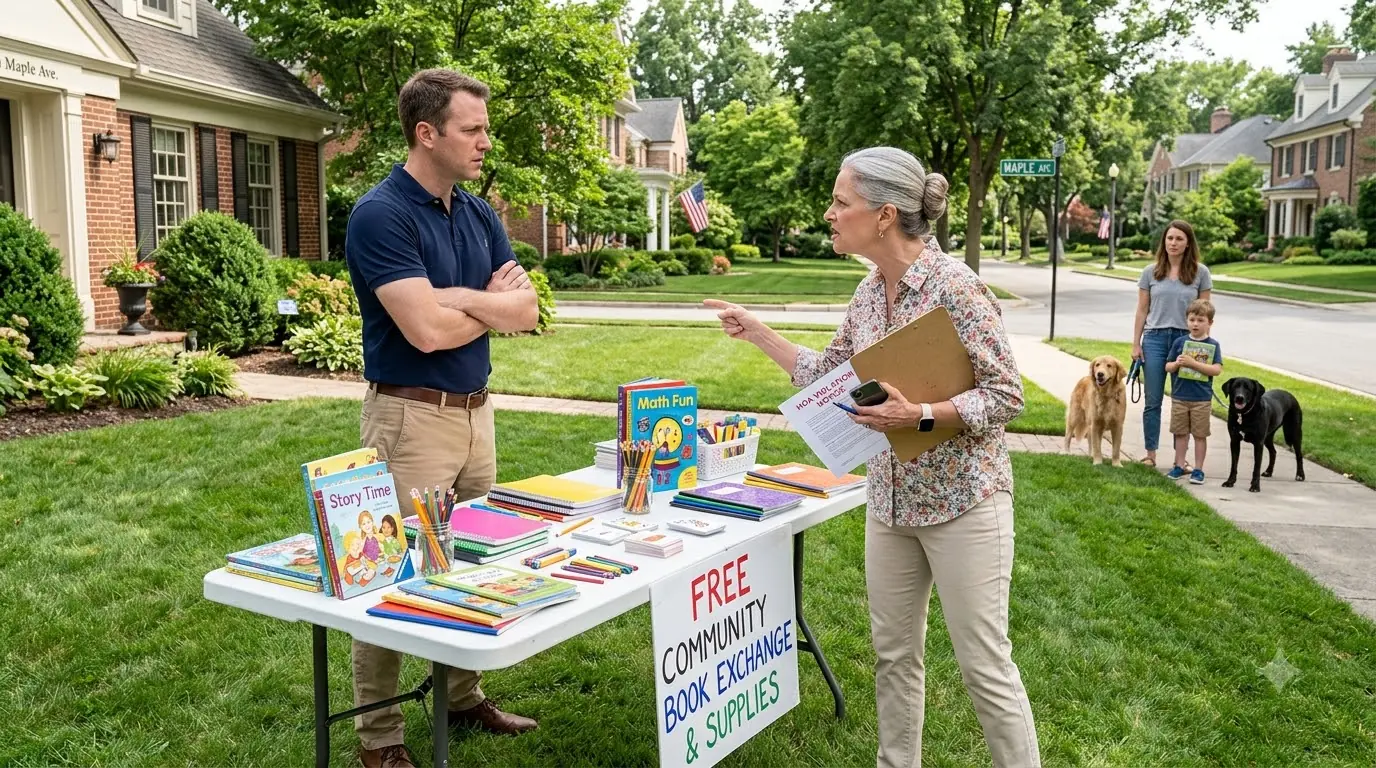
“Free?”
“Every one.”
The boy’s face changed immediately.
He stepped onto the grass, then hesitated.
His mother smiled.
“You can look.”
The child hurried toward the table.
The homeowner moved aside.
There were picture books.
Beginning readers.
Simple science books.
A few dictionaries.
Math workbooks.
Colored pencils.
Notebooks.
Flash cards.
Several donated backpacks sat beneath the table.
Most of it had come from a county literacy initiative trying to create small neighborhood distribution points before the beginning of the school year.
The rest had been donated by local families.
The homeowner had volunteered his front lawn because his house sat near the entrance to the subdivision, close enough to the sidewalk for children to reach easily without entering anybody’s home.
The program was simple.
Take what you need.
Leave what you can.
No money.
No registration.
No speeches.
No complicated rules.
The little boy picked up a book about dinosaurs.
He looked toward the homeowner.
“This one too?”
The homeowner smiled.
“Especially that one.”
The boy hugged it to his chest.
His mother selected a handwriting workbook and one packet of pencils.
“You sure?”
“Yes.”
The homeowner pointed toward a cardboard sign resting against the table.
“County program.”
“Everything was donated.”
The mother looked genuinely surprised.
“This is wonderful.”
The homeowner shrugged.
“Hopefully it helps.”
She thanked him twice before leaving.
The boy was still reading the dinosaur cover while walking away.
That should have been the beginning and end of the afternoon.
It was not.
The neighborhood had been arguing about the table for almost a week before it existed.
Not publicly.
Not yet.
The homeowner had first received an email from the county education office six weeks earlier.
The county wanted volunteers for a pilot program placing small free literacy stations in residential communities where families often had to drive several miles to reach the nearest public library.
The homeowner had volunteered because the idea seemed almost embarrassingly easy.
A table.
Books.
A shaded section of lawn.
A few weekend hours.
The county coordinator called him two days later.
They discussed visibility.
Weather protection.
Pedestrian access.
Safety.
They agreed that the table would be temporary at first, operating only during designated afternoon hours while the county evaluated interest.
Nothing permanent would be installed without additional review.
The homeowner asked one question immediately.
“What about the neighborhood association?”
The coordinator paused.
“Do you have one?”
“Unfortunately.”
The coordinator laughed.
Then became serious.
“We’ve dealt with associations before.”
The homeowner explained that his subdivision had strict architectural rules and a compliance committee with a reputation for interpreting those rules aggressively.
The coordinator asked for the management company’s contact information.
The homeowner provided it.
Three days later, the county sent formal program information to the association.
That should have solved everything.
Instead, it began the problem.
The first association email arrived the next morning.
The subject line read:
UNAUTHORIZED COMMUNITY ACTIVITY
The homeowner opened it while drinking coffee.
The message claimed that he had requested permission for a “commercial-style distribution station” in his front yard.
He had requested no such thing.
The county had simply notified the association that a temporary educational outreach table would operate on private property with the homeowner’s permission.
The email continued.
Outdoor tables could constitute prohibited displays.
Distribution activities could attract nonresidents.
Unapproved signs were restricted.
Potential liability had not been reviewed.
The homeowner reread the message.
Then called the management office.
A receptionist answered.
He explained.
She searched the property notes.
“I see the county letter.”
“Good.”
“So why did I get a violation warning?”
“It isn’t technically a violation yet.”
The homeowner stared at the phone.
“The subject says unauthorized activity.”
“Yes.”
“But I haven’t done anything.”