At 4:37 on a Thursday afternoon, Emily Carter had exactly twenty-eight miles of range left and no interest in arguing with anyone.
She had spent nine hours at Brookhaven Community Medical Center, picked up groceries for her father on the way home, and pulled into the Greenway Market parking lot because its four public EV chargers were the only fast chargers between the hospital and the small town where she lived.
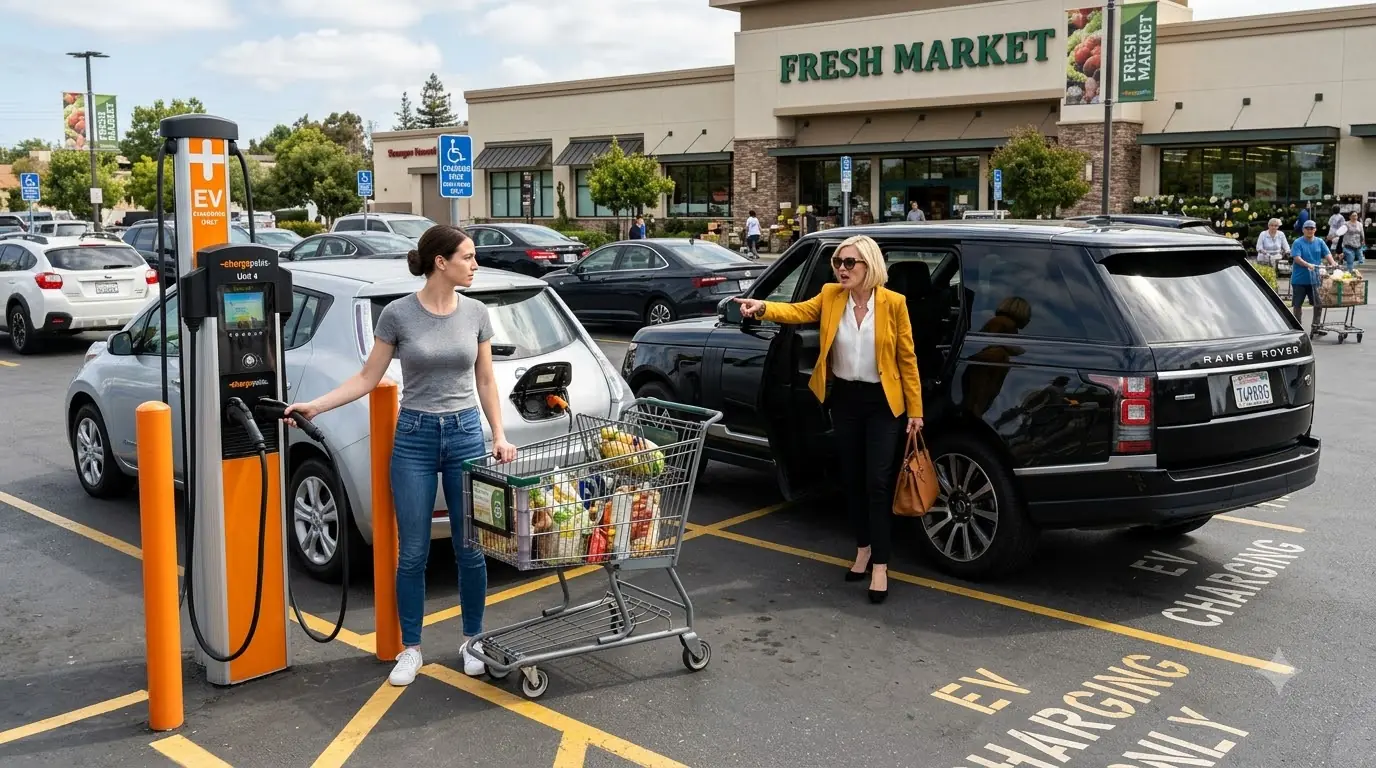
Three were occupied.
The fourth was open.
Emily parked her silver electric hatchback within the painted green lines, opened the charging door, and walked toward the orange-and-black station with the connector in her hand.
She was thirty-one, dressed in a plain gray T-shirt and jeans, her dark-brown hair tied into a low bun after a day long enough that she no longer cared what she looked like.
She plugged in.
The charging station beeped.
Session accepted.
Estimated time to eighty percent: twenty-three minutes.
Emily exhaled.
Perfect.
She locked the car, grabbed her reusable shopping bags from the back seat, and was reaching for a cart when she heard tires cut sharply across the painted lane.
A black luxury SUV swung around the corner.
Too fast.
It crossed the diagonal stripes beside the charging spaces, stopped halfway into Emily’s bay, backed up aggressively, then pulled forward again until the SUV’s front bumper sat less than three feet from Emily’s car.
The driver door opened.
A woman stepped out.
She was in her mid-fifties, blonde hair cut into a polished bob, oversized square designer sunglasses, gold earrings, a mustard-yellow fitted blazer over a white blouse, black trousers, and heels far more appropriate for a hotel lobby than a grocery parking lot.
She slammed the door.
Then pointed directly at Emily.
“Move.”
Emily looked behind herself.
There was nobody else nearby.
“Excuse me?”
“That charger.”
The woman pointed toward the cable connected to Emily’s vehicle.
“I need it.”
Emily glanced at the SUV.
It was parked crookedly across the edge of the charging zone.
She could not even see a charging port on the side facing her.
“My car is already charging.”
The woman pulled off her sunglasses.
“Then unplug it.”
Emily almost laughed.
She did not.
“I just started.”
“I was waiting for this space.”
Emily looked around the lot.
“You just drove in.”
“I was circling.”
“That isn’t waiting.”
The woman stepped closer.
Her name, Emily later learned, was Brenda Hollister.
At that moment she was simply an angry stranger who looked astonished that another person had answered her with a complete sentence.
Brenda folded her arms.
“I have an appointment.”
“So do I.”
“You’re grocery shopping.”
“So are you.”
Brenda looked at Emily’s inexpensive hatchback.
Then at her own SUV.
The comparison seemed to produce a conclusion in her mind.
“My vehicle needs the high-output charger.”
Emily looked at the charger display.
“This one is fifty kilowatts.”
“Yes.”
“So?”
“So my vehicle charges faster.”
Emily looked at the black SUV again.
“Then plug into another one when it opens.”
“I don’t have time.”
“I do?”
Brenda’s expression hardened.
“You’re being difficult.”
Emily reached for her shopping cart.
“No. I’m charging my car.”
Brenda moved in front of the cart.
Emily stopped.
“Ma’am.”
“Move your vehicle.”
“No.”
“I’m asking nicely.”
“You opened with ‘move.’”
Brenda stared at her.
For a second, Emily thought she might actually hear the absurdity.
Instead Brenda stepped toward the charging cable.
“I’ll unplug it myself.”
Emily immediately moved between Brenda and the connector.
“Don’t touch my car.”
“I’m not touching your car.”
“You’re reaching for the charger connected to it.”
“It belongs to the store.”
“The session is active.”
Brenda grabbed the cable several inches behind the handle.
Emily caught the connector body and pulled it safely toward herself before Brenda could interfere with the latch.
“Let go.”
Brenda’s eyes widened.
“You do not tell me what to do.”
Emily released the cable only after Brenda removed her hand.
Then she looked toward the supermarket entrance.
A few shoppers had stopped.
One man pushing a cart slowed deliberately.
A woman near the cart return had raised her phone.
Emily sighed.
She had seen enough parking-lot videos online to know exactly where this was going.
Brenda followed her gaze.
“Good.”
She raised her own phone.
“Let them record.”
Emily looked at her.
“Why?”
“Because when security gets here, they’re going to tow your little car.”
Emily blinked.
“My car?”
“You’re blocking a premium charging station.”
“It’s an EV charger.”
“Exactly.”
“My EV is charging.”
Brenda pointed at Emily’s hatchback.
“That thing barely qualifies.”
Emily stared.
Brenda continued.
“These chargers are intended for customers with actual electric vehicles.”
Emily looked down at the cable entering her charge port.
Then back at Brenda.
“I don’t know how to answer that without embarrassing you.”
The man with the cart laughed.
Brenda spun toward him.
“Mind your own business.”
He raised both hands.
“I’m trying.”
She turned back.
“I’ll have you towed.”
Emily nodded toward the supermarket.
“Go ahead.”
That was not the response Brenda expected.
“You think I won’t?”
“No.”
“You think security will take your side?”
Emily shrugged.
“I think they’ll look at the cars.”
Brenda stepped closer.
“You have no idea who you’re dealing with.”
Emily leaned slightly against her cart.
“No.”
Then she added:
“And I’m comfortable keeping it that way.”
That did it.
Brenda raised her phone and began calling.
Inside Greenway Market, parking supervisor Raymond Ellis was reviewing a produce-delivery complaint when his handheld scanner vibrated.
PARKING ASSISTANCE REQUEST — EV STATION 4.
Raymond looked at the time.
4:41.
He sighed.
The EV chargers were responsible for more arguments than the handicapped spaces, loading zones, and curbside-pickup lanes combined.
People unplugged strangers.
Gasoline cars blocked chargers.
Drivers treated public chargers like reserved private parking.
Ride-share drivers waited in the bays.
Sometimes people plugged in but never initiated a session simply to park close to the entrance.
Greenway had responded by installing plate cameras and a simple enforcement system.
First violation: warning.
Second: formal notice.
Third: removal eligibility if the vehicle remained after staff instruction.
It was not complicated.
It only became complicated when someone decided rules were personal insults.
Raymond grabbed his scanner and walked outside.
Another parking employee, twenty-four-year-old Luis Mendoza, followed with a booklet of violation notices.
From fifty yards away, Raymond could already hear Brenda.
“This woman physically threatened me!”
Emily’s eyebrows lifted.
“I did what?”
Brenda pointed.
“She grabbed the charger from my hand.”
Emily looked toward Raymond.
“Because she was trying to unplug my car.”
Brenda snapped:
“I was moving public equipment.”
Raymond held up one hand.
“Everyone stop.”
Brenda immediately started again.
“I called because she is monopolizing the charging station, and she nearly assaulted me when I tried to use it.”
Raymond looked at Emily’s vehicle.
The charger screen displayed ACTIVE SESSION.
Six minutes elapsed.
Then he looked at Brenda’s SUV.
No charging cable.
Parked partly inside the striped access zone.
Engine still running.
“Which vehicle is yours?”
Brenda pointed proudly.
“The black one.”
Raymond nodded.
“Are you charging?”
“I’m trying to.”
“Where is your charging port?”
Brenda hesitated.
“Passenger side.”
Raymond looked at the SUV.
“Then why did you park with the passenger side away from the charger?”
Brenda’s mouth tightened.
“That isn’t relevant.”
“It is if you’re saying you came here to charge.”
“I was going to reposition.”
Raymond looked at Luis.
Luis scanned the plate.
The device beeped.
Then beeped again.
Luis’s expression changed.
Raymond noticed.
“What?”
Luis turned the screen slightly.
“Plate already has warnings.”
Brenda heard him.
“For what?”
Raymond took the scanner.
Three entries.
March 11: EV bay occupancy without active charging.
April 28: EV bay occupancy without active charging.
July 3: blocked charging access lane, customer complaint confirmed.
Raymond looked at Brenda.
“Ma’am, this vehicle has already received three notices involving these charging spaces.”
Brenda stepped toward him.
“That is completely false.”
Raymond held up the scanner.
“It’s attached to your plate.”
“Your system is wrong.”
“It includes photographs.”
“Anybody can take photographs.”
“Store cameras took them.”
Brenda folded her arms.
“You cannot prove I was driving.”
Raymond nodded.
“That’s true.”
She looked triumphant for half a second.
Then Raymond continued:
“But the parking notice follows the vehicle, not the driver.”
Her expression fell.
Emily remained silent.
This was no longer her argument.
Raymond looked at Brenda’s SUV again.
“Right now you’re occupying part of an active charging bay without charging.”
“I’m waiting.”
“That doesn’t qualify.”
“There are no signs saying I can’t wait.”
Raymond pointed.
There was a sign directly beside the charger.
EV CHARGING ONLY
ACTIVE CHARGING REQUIRED
30-MINUTE LIMIT DURING PEAK HOURS
NON-CHARGING VEHICLES SUBJECT TO REMOVAL
Brenda stared at it.
Then:
“That sign is new.”
“It’s been there nine months.”
“I shop here every week.”
“Then you’ve had plenty of time to see it.”
Emily looked down, trying not to smile.
Brenda saw.
“You think this is funny?”
Emily shook her head.
“I think my car is charging.”
Raymond turned toward Luis.
“Document the current position.”
Luis photographed the SUV.
Brenda stepped in front of him.
“Do not photograph my property.”
Luis lowered the phone slightly.
“Ma’am, I’m documenting the violation.”
“You need my consent.”
“No.”
“You absolutely do.”
Raymond stepped between them.
“Brenda.”
She stared.
He had used her name.
“How do you know my name?”
Raymond pointed toward the parking record.
“Your previous appeal.”
Her expression changed.
“You remember me?”
“Yes.”
That was not good news.
She seemed to realize it.
Raymond remembered the July incident.
A black SUV had blocked two chargers for forty-three minutes while its owner sat inside drinking coffee.
When another driver asked her to move, she claimed the chargers were “public parking with optional electricity.”
The customer called the store.
Raymond arrived.
Brenda refused to move until a manager appeared.
The manager arrived.
Brenda demanded corporate.
Corporate confirmed the policy.
She moved.
Then filed a written complaint accusing Raymond of harassment.
The case had been reviewed.
Photos.
Camera footage.
Charging logs.
Complaint denied.
Raymond had hoped never to see her again.
Now she was back.
And this time she had tried touching someone else’s charging cable.
“Move the SUV,” Raymond said.
Brenda stared.
“I’m charging.”
“No.”
“I’m next.”
“There is no official queue.”
“I was waiting first.”
Emily spoke.
“She wasn’t here when I arrived.”
Brenda snapped:
“Nobody asked you.”
Raymond looked at her.
“Do not speak to customers like that.”
“She’s lying.”
“Then the entrance camera will show it.”
Silence.
That stopped Brenda.
Not because she believed the camera might be wrong.
Because she suspected it would be right.
Raymond pointed toward an ordinary parking space fifteen yards away.
“Move your vehicle there. When a charger opens, you may use it if you begin an active session.”
Brenda crossed her arms.
“No.”
Raymond nodded once.
“Luis.”
Luis pulled a bright orange violation notice from the booklet.
Brenda’s eyes widened.
“You are not putting that on my car.”
Raymond said:
“Move it.”
“You don’t control me.”
“No.”
He pointed toward the painted green pavement.
“I control parking enforcement on this property.”
“That is not the same thing.”
“No.”
“It absolutely is not.”
Raymond almost smiled.
“Correct. Which is why I’m not telling you where to go after you leave the charging zone.”
Luis placed the notice beneath the windshield wiper.